Showing posts with label patent. Show all posts

Saturday, November 28, 2015

US Patent for Distributed DPI Granted to Ericsson


A new US patent was granted to Francisco Cortes Gomez of Ericsson, for "DISTRIBUTED TRAFFIC INSPECTION IN A TELECOMMUNICATIONS NETWORK" (here)

DESCRIPTION

Distributed Traffic Inspection in a Telecommunications Network Technical Field

The present invention relates to methods for traffic inspection in a telecommunications network and to corresponding devices. Background

In telecommunications networks, inspection of a payload section of data packets may be used for enabling smarter network decisions, e.g., with respect to controlling data traffic. For example, the inspection may be used as a basis for providing differentiated treatment of traffic based on potentially complex characteristics of the data traffic itself. This differentiated treatment may involve acting on the data traffic itself, e.g., by discarding data packets, modifying data packets, throttling transmission rates, or the like. Further, the differentiated treatment may involve taking actions related to the data traffic, e.g., charging or replication of the data traffic for law enforcement purposes or monitoring. Such inspection of payload may be implemented as Deep Packet Inspection (DPI). DPI functionalities may for example be integrated in nodes conveying user plane traffic, e.g., in a gateway or transport node.

However, DPI may require significant amounts of processing resources. Accordingly, implementation of DPI in a node conveying user plane traffic may result in performance degradation of functionalities needed for conveying the user plane traffic. Such performance degradation may be up to several orders of magnitude.

In addition, the processing load caused by DPI may depend strongly not only on the complexity of implemented inspection algorithms, but also on the nature of inspected data traffic. For example, a high proportion of data traffic which is "easy to classify" may lead to relatively low processing load, while a high proportion of data traffic which is "hard to classify" may lead to a processing load which is significantly higher, e.g., up to several orders of magnitude, even if the absolute amount of conveyed data traffic remains unchanged. Although a statistical distribution of data traffic between „easy to classify" and „hard to classify" may be assumed as a general rule, this may alleviate high load variance within relatively short periods of time, but typically does not alleviate impacts from new traffic patterns or addition of complex services. For instance, the dissemination of a new virus/worm requiring complex detection rules, or the success of a new peer-to-peer product may significantly increase DPI load on a rather short time scale.

DPI may also be implemented in specialized nodes. Such nodes may be optimized for DPI and offer sufficiently high processing resources. However, as additional devices such specialized nodes typically require high-capacity network ports for transfer of the user plane data traffic. This applies to the specialized node itself, but also to other nodes connected to the specialized node. Such high-capacity network ports may contribute significantly to the overall cost of a node. Further, such specialized nodes are typically designed to offer processing resources which are sufficient to perform also very complex inspection and classification algorithms at high speed, which may result in significant costs for a given throughput of user plane data. In scenarios where the user plane data traffic has a high proportion of "easy to classify" data the expensive hardware of the specialized node would be utilized inefficiently. Moreover, such a specialized node may constitute an additional potential point of failure and add complexity to any high-availability transport network design.

Accordingly, there is a need for techniques which allow for efficiently inspecting traffic in a telecommunications network. Summary

According to an embodiment of the invention, a method of inspecting data traffic in a telecommunications network is provided. According to the method, a node of the telecommunications network receives data packets of a flow. The node also forwards the received data packets of the flow to a downstream node of the telecommunications network. Further, the node takes a decision whether to perform inspection of a payload section of at least one data packet of the flow at the node. The node indicates a result of this decision to the downstream node.

According to a further embodiment of the invention, a method of inspecting data traffic in a telecommunications network is provided. According to the method, a node of the telecommunications network receives data packets of a flow from an upstream node of the telecommunications network. Further, the node receives an indication of a result of a decision by the upstream node whether to perform inspection of a payload section of at least one data packet of the flow at the upstream node. On the basis of the indicated result of said decision by the upstream node, the node takes a decision whether to perform inspection of a payload section of at least one data packet of the flow at the node. According to a further embodiment of the invention, a node for a telecommunications network is provided. The node comprises at least one first interface for receiving data packets of a flow, at least one second interface for forwarding the received data packets to a downstream node of the telecommunications network, and a processor. The processor is configured to take a decision whether to perform inspection of a payload section of at least one data packet of the flow at the node and to indicate, e.g., via the second interface, a result of the decision to the downstream node.

According to a further embodiment of the invention, a node for a telecommunications network is provided. The node comprises at least one interface for receiving data packets of a flow from an upstream node of the telecommunications network and a processor configured to receive, e.g., via the interface, an indication of a result of a decision by the upstream node whether to perform inspection of a payload section of at least one data packet of the flow at the upstream node of the telecommunications network. Further, the processor is configured to take, on the basis of the indicated result of said decision by the upstream node, a decision whether to perform inspection of a payload section of at least one data packet of the flow at the node. According to a further embodiment of the invention, a system for inspecting data traffic in a telecommunications network is provided. The system comprises a first node and a second node.

The first node is configured to receive data packets of a flow, forward the data packets of the flow to the second node, take a first decision whether to perform inspection of a payload section of at least one data packet of the flow at the first node, and indicate a result of the first decision to the second node. The second node is configured to receive the data packets of the flow from the first node and, on the basis of the result of the first decision indicated by the first node, take a second decision whether to perform inspection of a payload section of at least one data packet of the flow at the second node. According to a further embodiment of the invention, a computer program product is provided, e.g., in the form of a computer readable storage medium, the computer program product comprises computer readable program code that, when executed by a processor of a node of a mobile telecommunications network, causes the node to operate in accordance with any of the above methods.

Friday, December 26, 2014

New ZTE Patent: Policy Control Method And System For Converged Network

 
A new patent, by Tong Rui, Xiaoyun Zhou, Xiaoyun Zhou from ZTE was published.

Abstract:

A policy control method for a converged network comprises: in a roaming scenario, after learning that a user equipment (UE) accesses a mobile network through a wireless local area network (WLAN) access, a visited policy and charging rules function (V-PCRF) establishing a subsession serving WLAN Offload when establishing an S9 session to a home policy and charging rules function (H-PCRF), and carrying a WLAN Offload instruction. With the present document, the WLAN offload data can be distinguished from data routed back to an EPC network in the roaming scenario, thereby delivering policy control for the WLAN offload data.

See "Patent application title: Policy Control Method And System For Converged Network" - here.

Tuesday, October 9, 2012

Neuralitic Systems Granted a New DPI Patent


Neuralitic Systems announced it has been "..granted a patent for a method and system for context aware deep packet inspection (DPI) in IP based mobile data networks .. The present invention relates to DPI probes that are optimized for IP based packet analysis in a mobile communication service provider’s (CSP’s) data network and performs context aware IP packet analytics".

The patent "METHOD AND SYSTEM FOR CONTEXT AWARE DEEP PACKET INSPECTION IN IP BASED MOBILE DATA NETWORKS" (here) by Olivier Mirandette (pictured), Mathieu Caron, Sébastien Nobert and Eric Melin.

"The present method and system perform context aware deep pack inspection in a mobile IP data network. For doing so, the method and system collect real time data from mobile IP data sessions, analyze the real time data and differentiate user data traffic from control traffic. Then, the method and system extract control information from the control traffic and create a subscriber context. The subscriber context comprises the at least one unique identifier and the corresponding IP address". 


See "Neuralitic Systems receives patent for a method and system for context aware deep packet inspection (DPI) in IP based mobile data networks" - here.

Tuesday, October 2, 2012

After 2 Years, Court Denied Amdoc's Suit Against Openet


It seems that Openet's CEO was right saying "We're not intimidated" (here) by the lawsuit filed by Amdocs more than two years ago (see "Amdocs Suing Openet for Patent Infringement" - here).
  
However, it did take a little longer than "between three and 12 months to sort out".
  
Openet announced that "a federal court in Alexandria, Virginia, has granted summary judgment for Openet in a lawsuit filed by Amdocs Limited. The court found that Openet software does not infringe Amdoc’s patents .. After extensive discovery of documents and deposition testimony of witnesses, Judge Leonie Brinkema [pictured] of the Eastern District of Virginia denied Amdocs’ claim. Her September 27, 2012 ruling found that none of Openet’s products infringed the four patents in question" 
 
See "Openet Wins Summary Judgment in Patent Infringement Suit" - here.

Saturday, May 5, 2012

NSN Patent: "Detecting Service Data of a Packet Data"

 
A recently published US patent application by Nokia Siemens Networks (inventors - Rasanen, Juha Antero and Sarja, Jorma Tapio) - ".. relates to an apparatus, a system, a method and a computer program product for transmitting to a policy and/or charging server information relating to a user, wherein the information includes an indication of a service data detecting entity for detecting service data of a packet data connection of the user, and initiating communication towards the service data detecting entity based on the received information".

See "Method, Apparatus and System for Detecting Service Data of a Packet Data Connection" - here.


Friday, May 4, 2012

A DPI Algorithm is Waiting for Commercialization


Earlier this year I posted a research on DPI technology - "Decompression-Free Inspection: DPI for Shared Dictionary Compression over HTTP" (here).

According to recent post by Tamir Huberman, VP Business Dev,, Yissum, the technology transfer company of the Hebrew University of Jerusalem, the technology is now available for commercialization.

Hay David (pictured) describes it as a "Novel pattern matching algorithm that inspects Shared Dictionary Compression over HTTP (SDCH)-compressed traffic without need for decompression .. Development stage is Proof of concept – algorithm complete but not yet implemented and a Patent application filed in the United States"

Yissum is "Seeking industrial cooperation to implement the system".

"Over the past 47 years, Yissum has granted more than 530 technology licenses and is responsible for commercializing an array of successful products that generate over $2 billion in worldwide sales every year"

See "Improved compressed data security scanning/Faster online DPI inspection" - here.

Wednesday, August 10, 2011

Cotendo CEO: "We have a fertile technological dialogue with Google"

 
Cotendo's (see "CDN Announcements: Cotendo's Cloudlet - Getting Closer to the Subscriber" - here) CEO, Ronni Zehavi (pictured), was interviewed to Batya Feldman, Globes, providing some insights into the company business.

Cotendo raised recently $17M from strategic (Citrix and Juniper) and existing investors (here).  Last year Akamai filed a patent infringement lawsuit against the company (here).

According to Globes, Cotendo ".. With tens of millions of dollars in annual sales, and after hiring scores of employees for its development center the company is forging ahead .. Cotendo currently has 350 paying customers .. it also has joint development agreement and fertile technological dialogue with Google".

Mr. Zehavi told Globes that "Akamai really arrived with a buzz 12 years ago and changed the market, but a few things have changed since then, and it didn’t change its business model .. Akamai has thousands of servers scattered around the world, and it's obvious that a company like us cannot set up such an infrastructure alone. That's why we decided to build a special pump that would render redundant the dispersion of servers and which would present better performance than the current architecture"
  
See "Site acceleration co Cotendo seeks to challenge Akamai" - here.

Wednesday, May 25, 2011

NI Deployments (72): StarHub (Singapore) Selected Neuralitic for Usage Profiling and Monetization

     
Neuralitic Systems announced a ".. a new deal with Singapore’s StarHub. The mobile operator will utilize Neuralitic’s SevenFlow™ software suite to understand the data usage profile of its customers and monetize data traffic".

See "Neuralitic Expands its Customer Base with StarHub" - here.

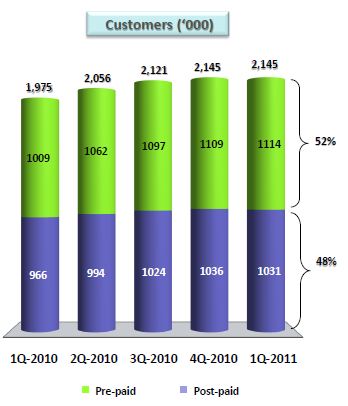
StarHub, Singapore’s 2nd largest mobile operator, had 2.145M subscribers at the end of Q1, 2011 (see chart).

Joanna Chan, VP of Personal Solutions, StarHub said: “The insights provided by SevenFlow help us in understanding customers' data usage pattern so that we can develop products and initiatives that better cater to the needs of specific customer segments.”

Neuralitic’s SevenFlow is a Mobile Data Intelligence solution that gives marketing professionals and other decision-makers the critical insights they need to improve marketing ROI based on actual subscriber usage characteristics. Its Data Bus component extracts 100% of all mobile network data from a copy of traffic across an industry-standard network interface. The Data Bus also includes customizable business rules to filter data on an as-needed basis, and channels the data to the Knowledge Portal.

Among other functions, the Knowledge Portal presents protocol usage information on a wide range of distinct protocols (http, BitTorrent, ftp, etc.); and helps users measure the impact of particular protocols on the mobile network. See also a patent application - "A METHOD AND SYSTEM FOR ANALYSING A MOBILE OPERATOR DATA NETWORK" - here.

Monday, October 18, 2010

Coopetition - Openwave Licensed Patents to Mobixell/724

  
Openwave announced that "it has licensed certain patents to Mobixell/724 Solutions Inc. On July 31, 2009, Openwave Systems Inc. filed a patent infringement lawsuit against 724 Solutions .. alleged that 724 Solutions had infringed several of Openwave’s networking and communications patents . The details of the agreement between the parties remain confidential."

See "Openwave Licenses Wireless Patents to Mobixell/724 Solutions" - here.

Ken Denman, CEO, Openwave said: “Going forward, Openwave will continue to invest in developing our industry leading technology, will look to collaborate with others to bring innovations to market, and will continue to protect our intellectual property.”

Tuesday, September 14, 2010

[Light Reading] Openet CEO: "We're not intimidated (by Amdocs) .. Doing R&D with Cisco and IBM"

 
Ray Le Maistre, Light Reading,  interviewed Niall Norton, CEO of Openet,  in view of the recent patent infringement lawsuit Amdocs filed against his company (see "Amdocs Suing Openet for Patent Infringement" - here). 

See "Openet 'Surprised' by Amdocs Legal Action" - here.

Some quotes -
  • About the Amdocs case - "We're not intimidated, but any case of this nature is going to be distracting. There's no good news in this for us .. Amdocs is a good company and a ferocious competitor.. this could take anything between three and 12 months to sort out".
     
  • About the business - "the growth in mobile data service usage around the world .. is fueling increasing demand for support systems that can deliver integrated policy control, charging, and balance management, which, is Openet's sweet spot .. Asia/Pacific has come alive in the past 12 months, Malaysia and Indonesia in particular .. I expect cloud services to change the market in the same way that the Internet .."
     
  • "Openet has been doing a lot of R&D work with Cisco and IBM .. We're good at being a 500- to 600-person company that can collaborate with others [see posts on Cisco/Openet relations - here and here], rather than being a do-it-all company .. RAN congestion [see "Cell Congestion Management Solutions from Openet and Sycamore "- here] will be the new buzz phrase in Barcelona next February "

Wednesday, August 25, 2010

Amdocs Suing Openet for Patent Infringement

  
Last week Amdocs filed to the United States district court, Eastern District of Virginia a complaint against Openet for patent infringement.

Amdocs claims that Openet is infringing US patents 6,836,797 ("System, method and computer program product for network record synthesis" - here) and 7,631,065 ("System, method and computer program product for merging data in a network-based filtering and aggregating platform" - here). Amdocs got these patents following the acquisition of XACCT, a mediation software vendor (here). 

Although the complaint relates to Openet's "FusionWorks mediation products", FusionWorks platform is also used for Openet's Policy Manager (here).