Showing posts with label Mobixell. Show all posts

Friday, June 13, 2014

[Calcalist]: Flash Networks Fires 25 Employees


Asaf Gilad reports to Calcalist [here, Hebrew] that "Following the acquisition of Mobixell [for $15M, see "No Longer a Rumor: Flash Networks Acquires Mobixell" - here], Flash Networks initiated a process of letting 25 of its Israeli employees go.. the employees are from both companies and all ranks .. in order to reduce redundancies. Flash Networks has 200 employees in Israel and another 100 internationally".   

Flash commented that "Flash Networks acquired its competitor, Mobixell, in the beginning of 2014, and doubled its size dramatically turning it to the biggest vendor of mobile networks' optimization and monetization with over 40% market share [see "Flash Networks (40%) and Citrix (30%) Lead the Mobile Optimization Market" - here]

We are sorry that some employees have to leave .. it is part of the merger process .. the company is going to expand in the coming years into new markets".

source:{Core Analysis} 2014 Market report


Tuesday, January 7, 2014

No Longer a Rumor: Flash Networks Acquires Mobixell


Liam Glin, CEO,
Flash Networks
I reported yesterday on the expected acquisition of Mobixell by Flash Networks (here) for $15M and today it is official.

"This synergistic union will enable Flash Networks to meet the growing demand for data optimization, acceleration, and monetization services following the explosive growth of new consumer devices, rich multimedia content, and high speed 3G, 4G, and LTE networks. By joining forces, the two companies’ complementary market presence and technological and commercial strengths will enable Flash Networks to offer operators best-of-breed mobile web and video optimization and monetization services, while continuing to maintain its commitment to existing customers .. The deal is expected to be formally closed by the end of January 2014."

See "Flash Networks Acquires Mobixell Networks to Become the Leading Mobile Data Optimization and Monetization Company" - here.

Monday, January 6, 2014

[Rumors]: Flash Networks to buy Mobixell


Further consolidation is expected this week in the video optimization market.

According to sources familiar with the space, Flash Networks is going to buy Mobixell for $15M in cash.

A recent report by {Core Analysis}, on the video optimization market found that "Mobixell Networks remains number 2 in deployments with 23%" (see "Video Optimization Market Reaffirms its Maturity; Citrix ByteMobile Leads" - here).

Two years ago, there were rumors about the acquisition of Flash Networks (for $100-200M - here) and Mobixell (here) by Allot Communications. However, eventually Allot acquired two other players in the video optimization - Ortiva Wireless and Oversi (see "Allot's Revenues from 2012 Acquisitions" - here).

Wednesday, October 9, 2013

{Core Analysis}: Video Optimization Market Reaffirms its Maturity; Citrix ByteMobile Leads


A new report of the video optimization market, by Patrick Lopez [pictured], Founder and CEO at {Core Analysis} finds that "The market trend for the segment reaffirms its maturity. Like last year, the summer has been quiet in term of activity while spring and the fall remain the high RFx quarters. We have recently seen two large groups select their vendor in the space (Telenor and Orange), more or less wrapping up the tier one group selection process for this cycle in mature markets. Growth in this segment now comes from Latin America and South East Asia, where many groups (Singtel, America Movil, ...) have yet to formulate / finalize a strategy in the space".
  • Citrix ByteMobile remains market leader, both in deployments and revenue. The deployment relative market share is decreasing slightly to 29%, while revenue market share is increasing.
    See also "Is the Optimization Market Declining?" with Citrix Bytemobile revenues, here.
     
  • Mobixell Networks remains number 2 in deployments with 23%, once again growing its market share over the period
     
  • Flash Networks remains a strong third with 17%, growing as well faster than the market
See "Video optimization mid-term update" - here.

Tuesday, March 26, 2013

Sandvine: 40 Joint Deployments with PeerApp, Mobixell and Netsweeper


It is no longer "traditional DPI" - detecting bandwidth hungry applications, and shaping traffic or managing congestion on mobile networks. It is about an "eco-system" of services operators wish to see implemented by a single vendor, device or solution.

Allot acquired several companies for video optimization and caching  (see "Allot's Revenues from 2012 Acquisitions" - here), Procera launched HTTP content technology (see "Procera: HTTP Needs Deeper DPI" - here and "Procera Adds High Performance Web Content Categorization & Filtering" - here) although it is focused more on the traditional solutions.

Sandvine builds an eco-system of partners, and it has "deployed over 40 plug-and-play video optimization, parental control and content caching solutions with leading vendors Mobixell, Netsweeper and PeerApp. Sandvine’s patented redirection technology enables: Content Caching, provided by the PeerApp UltraBand transparent caching platform .. Content/Parental Controls: provided by Netsweeper, enables operators to deliver web filtering as a value-added service across fixed and mobile networks and Video Optimization  provided by Mobixell Seamless Access platform, ".

Don Bowman (pictured), CTO, Sandvine said: “Our redirection technology provides clear efficiencies when partnered with third party experts. For example, the Sandvine -Mobixell and Sandvine-Netsweeper partnerships reduce the number of servers CSPs need to deliver video and filter content; and Sandvine solves the network inconsistency of triangle routing or asymmetry, which helps PeerApp deliver video and other content more efficiently”.

See "Sandvine Ecosystem Enables 40 Successful Deployments" - here.

Saturday, January 19, 2013

Mobixell Announces Embedded LTE/RAN Optimization and Caching Technology


I had several posts on vendors announcing RAN based optimization and caching solutions, such as Saguna/ADVA (here), RADCOM with HP (here) and Amdocs (here) and Sandvine  - here - all trying to solve radio and/or backhaul congestion problems. 
   
Mobixell Networks announced its own solution and similarly to Saguna it offers enabling technology to vendors of base stations/backhaul vendors, for LTE technology. 

The vendor says it has ".. deployed their Radio Access Network (RAN)-based optimization solution in the LTE access network of a leading European mobile operator as a proof-of-concept field test. This solution includes Mobixell Seamless Access video optimization, which enables operators to optimize video both in realtime and offline with built-in video caching of popular content. It was developed in cooperation with a major telecom infrastructure vendor, and integrated directly into their eNodeB, the network element that interfaces directly with end user devices"

Mobixell explains that "Mobile network traffic management is traditionally performed in the core network. There are, however, advantages to moving data optimization and caching out to the access network, closer to end user devices. Fewer backhaul resources are required for traffic management and detection of congestion at the cell site is more accurate. Accurate congestion detection is a critical component in ensuring that optimization resources are applied only to data that contributes to the degradation of network performance. By performing congestion analysis and optimization close to the end user’s devices, operators can more confidently deliver high-quality data services as a part of a satisfying customer experience. As LTE proliferates, and end user expectations for speed and performance increase, the importance of these advantages is multiplied"

See "Mobixell Announces World’s First Built-in Video Optimization Solution for LTE Access Hardware" - here

Tuesday, October 16, 2012

Optimization Deployments [189]: Safaricom [Kenya] Deployed Mobixell for QoE Management and Content Filtering

   
Mobixell Networks announced that Safaricom "..  has deployed Mobixell Seamless Access as its mobile data traffic management solution".

Thibaud Rerolle, Director Technology & IT, Safaricom said: “.. Our customers will now have faster access to data services faster and at the same time will be able to protect their families from unsuitable content [see "Mobixell and Commtouch Offer Parental Control W/Real Time Content Categorization" - here]”. 

Safaricom has 19M mobile subscribers; At the end of March 2012 it had 4.6M data customers - mobile and fixed. It uses OSS solutions from Huawei (here) and Alepo (here). 

See "Safaricom, Kenya’s Largest Mobile Operator, Accelerates Web Browsing with Mobixell Seamless Access" - here.

Wednesday, September 12, 2012

Mobixell Wins 2 Tier1 European MNOs: 28 Sites, 241M Subscribers


Mobixell Networks announced that "..it is in the process of deploying its Seamless Access multi-service platform for two leading Tier-1 mobile operators in Europe. Mobixell is implementing its video optimization and Web acceleration technology in the mobile core network at 28 different sites for the two international operators .. Both multi-million dollar deployments will serve a combined mobile subscriber base of 241 million"

"..In addition to the current deployments, these operators are also implementing Mobixell Smooth DBRA™ technology [see "Optimization Announcements: Mobixell Dynamically Optimize Mobile MP4" - hereand trialing Mobixell Customer Engagement Tools, a set of clientless browsing tools, so that they can offer personalized services and build better relationships with subscribers".

Mobixell updated me that "In one of the customers’ deployments, we integrated with another vendor’s DPI. Just for steering port 80 traffic only to the Internet gateway"

See "Mobixell Mobile Video Optimization and Web Acceleration Technologies Deployed by Two European Tier-1 Operators" - here.

Saturday, July 28, 2012

Optimization Announcements: Mobixell Dynamically Optimize Mobile MP4


Mobixell Networks announced that its "..‘Smooth DBRA’ technology is in pre-production tests at a leading Tier 1 European mobile operator ..  Integrated into the operator’s core network, Mobixell Smooth DBRA (Dynamic Bitrate Adaptation) technology senses changes on each connected mobile device and transrates (or adapts the output bitrate of) video files while they are playing to best suit changing network conditions: When bandwidth is available, DBRA maximizes a video file’s bitrate to deliver the highest available video quality. When less bandwidth is available, DBRA reduces bitrate so that a video can play without stalls and buffering. Then, when bandwidth becomes available again, DBRA restores maximal bitrate".

"Other DBRA solutions and video encoded with ABR (Adaptive Bitrate) can jump among only 3 or 4 pre-defined bitrates. However, Mobixell Smooth DBRA adapts video bitrate precisely to the level that is needed to match available network bandwidth. This ‘fine tuning’ creates a smooth viewing experience with the highest possible performance and quality and ensures that video is optimized only when needed .. In addition to MP4 support and fine-tuned transrating, Mobixell Smooth DBRA also reacts to changes in network conditions and adapts video bitrate up to twice as fast as existing solutions – within 1 to 2 seconds compared to 3 to 4 seconds".

Related posts: "Vantrix adds Optimization Features" - here "Openwave Adds Congestion/Location-Aware Optimization" - here.


See "Mobixell Unveils Unique Technology to Dynamically Optimize Mobile MP4 Video" - here.

Friday, July 20, 2012

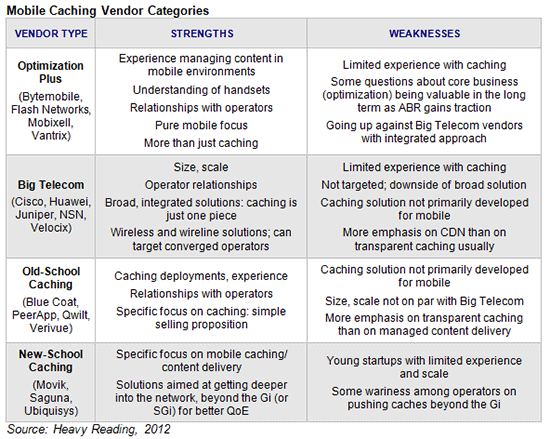
[Heavy Reading]: Mobile Caching - "part of larger traffic management solutions"


A new report by Aditya Kishore (pictured, see also "LTE will enable pushing cache into the base stations" - here), Senior Analyst, Heavy Reading looks at mobile data growth and caching solutions. 
  
"In a sense, the mobile caching space is not a separate market as much as it is an extension of other, adjacent markets. Caching is unlikely to be deployed on a mobile network in isolation; we anticipate most solutions will be integrated, partnered or part of larger traffic management solutions. Mobile optimization, network infrastructure, policy and RAN intelligence-type capabilities will all be leveraged alongside caching to better manage network traffic. This is evidenced by the types of vendors that are targeting this market".
"Broadly speaking, mobile caching vendors can be categorized into four groups, based on their history and the types of solutions they offer. Individual vendors within the same grouping have similar objectives, strategies and opinions. Unsurprisingly, they also demonstrate many similar strengths and weaknesses, though they do have individual attributes".

Posts related to companies mentioned in the table below, and their cache solutions: PeerApp, Qwilt, Saguna, Bytemobile, Mobixell, Vantrix, Velocix, BlueCoat, VerivueHuawei,   


See "Crossing the Gi: Will Edge Caching Be the Key to Managing Mobile Traffic?" - here.

Saturday, June 23, 2012

Mobixell: Video Optimization Myths


A webinar by Mobixell explains why and how MNOs should use video optimization.

Bottom line, according to Mobixell:
  • Video optimization helps you serve more high-performance sessions to more concurrent users
  • Targeted video optimization (device-, user-, content-, Network-, Congestion-Aware and Policy-driven) means better video performance
  • Too much video optimization can harm user experience and even revenue
  • Video optimization can defer CAPEX and does not have to be expensive
  • Video Optimization is critical for creating new data service revenues


Thursday, May 10, 2012

Sandvine: The Ups and Downs of Video Optimization

 
Few days after Sandvine's CTO warned that "buyers beware! Not all video optimization techniques are able to achieve the network savings that operators are seeking and the quality of experience that subscribers are demanding" (here), the company went further in pointing out the difference between its solution and the recently announced acquisition of Ortiva Wireless by its major competitor, Allot - although it does not have its own video optimization technology.

Sandvine announced that "..it has successfully deployed video optimization at nTelos Wireless with partner Mobixell. Sandvine’s patented divert technology has been successfully integrated with leading video optimization vendors and has been selected for six deployments worldwide in the last year alone. nTelos Wireless is one of the video optimization customers to date".
  
The Mobixell marketing team updated me that "nTelos is also a Mobixell customer in addition to the implementation with Sandvine .. the Mobixell Seamless Access Multiservice Platform at nTelos that delivers the optimization also serves a Web browsing gateway. It’s all part of a larger solution to provide services for a wide array of mobile subscriber needs".

The release does not mention optimization of Netflix traffic. According to Sandvine "Netflix and YouTube are the top two contributors of video traffic volume in mobile and fixed networks .. Netflix encrypts its video traffic using Digital Rights Management (DRM) techniques, so that data stream cannot be modified"


Source: Sandvine, Fall 2011 Global Internet Phenomena Report


So what is the differentiator, according to Sandvine? - " .. Accurately identifying traffic is a critical first step in optimizing video. Unlike certain competitive solutions, Sandvine’s granular identification and patented divert technologies create efficiencies in the optimization process and reduces traffic latency by diverting only relevant video traffic into third-party optimizers ..   Sandvine’s products extend beyond optimization and take into consideration video quality metrics [see "Sandvine Measures Youtube and Netflix QoE" - here]. Sandvine is the only Network Policy Control vendor that can provide quality metrics on streaming video such as duration, display characteristics and transport quality". 
 
See "Sandvine Optimizes Video at nTelos" - here.

Sunday, May 6, 2012

Sandvine's CTO: Video Optimization might not Work for you!

 
Up until recently, DPI/traffic shaping vendors and video optimization vendors worked on a partnership basis, mainly based on joint opportunities, the need to add one solution on top of an existing one, etc. DPI vendors usually emphasized the synergy of joint solutions (such as redirecting identified video traffic to the optimization device, saving resources), and were ready to work with any vendor. The "partners" web pages of DPI vendors shows usually a number of video optimization partners (Allot, Procera, Sandvine), and some announcements were made (Procera-Ortiva, Sandvine-Mobixell/Ortiva/Vantrix).
 
Recently these opportunistic relations took the next level and turned into a strategic direction. Bytemobile announced an integrated DPI/optimization solution (here) and Allot acquired Ortiva Wireless, a small player in the optimization space (see "Allot: Cost of Ortiva Acquisition - Less than $17M, in Cash" - here).
 
Analysts predict that Procera is also looking for an acquisition following it recent public offering, maybe also in the optimization space (see "Procera Builds M&A War Chest" - here).
 
On the other hand, Sandvine's CTO, Don Bowman (pictured), issued a "public warning" about the ability of current video optimization solutions to support the real-life video traffic.
 
In a recent blog post, Don says "buyers beware! Not all video optimization techniques are able to achieve the network savings that operators are seeking and the quality of experience that subscribers are demanding"
  
"From our Internet Phenomena report, we know that Netflix and YouTube are the top two contributors of video traffic volume in mobile and fixed networks. After these big two, there is still a fair amount of traffic from numerous other video content providers, but it is a very long tail so the net value of optimizing such traffic goes down substantially (i.e. lots of effort/processing with little gain). Netflix encrypts its video traffic using Digital Rights Management (DRM) techniques, so that data stream cannot be modified. On the other hand, YouTube today is transmitted using HTTP (in the clear); however, there is a movement towards encryption using HTTPS, and Google has announced it will begin implementing HTTPS as default for its searches"
 
Don suggests that ".. when selecting a video optimization provider, the investment needs to provide a secure foundation for continuing value-add services for the operator , such as: content caching .. the ability to splice in advertisements for incremental revenue .. content filtering capacity to perform optimization at the high scale needed in growing mobile networks".
 
See "The Need to Optimize Video Optimization" - here.

Monday, April 23, 2012

[Rumors]: Allot to Buy Ortiva Wireless


Orr Hirschauge reports to The Marker that Allot Communications is going to acquire Ortiva Wireless, a vendor of video optimization solutions for mobile operators. (here, Hebrew - I was interviewed to the story).

Ortiva's solutions provides 4 main functions: Application Aware Bandwidth Allocation, Client Buffer Management, Content Aware Bandwidth Reduction and Network Aware Adaption.  Like Allot, Ortiva uses ATCA as its hardware platform, and uses blades from Radisys (former Continuous Computing products). Ortiva is listed by Allot as a partner (here).Ortiva has also relations with Procera (here) and Sandvine (here).

Allot is looking for video optimization technology for long time now, and was previously in negotiations with other vendors in this space, including Mobixell and Flash Networks (here). Such offering may compete with the DPI/optimization integrated solutions from Bytemobile (here and here) and those that are planned by F5 (here) as well as other vendors. Allot already has a video caching solution integrated in its gateway (OEM from PeerApp).

Thursday, March 22, 2012

[Update 53: HP SNAP <-> Sandvine/Cisco/Procera] PCRF - DPI Compatibility Matrix

 
HP updated me that "..we work with Allot, Cisco, Sandvine .. We also have an installation with Procera on the Gy side .. Other vendors we integrate with for enforcement are Mobixell (see "Mobixell Explains its Joint Solution with HP" - here) and Flash".


The compatibility matrix was updated to reflect these updates.

Friday, March 2, 2012

Mobixell Reports Improved Buffer Management by YouTube

 
According to a report in Mobile Europe - "Staff at video optimisation company Mobixell noticed that some YouTube videos appear to be using a different streaming technology to usual. The change seems to be designed to reduce the amount of "unwatched video", and therefore unused data, delivered across fixed and mobile networks".

"Typically, if you start a YouTube video and then press pause the full video will continue to buffer while the player is paused. This is represented by a shadow progress bar loading from left to right, while the "play" progress bar is stalled. But Mobixell has noticed that in about 10% of videos it currently handles, when the pause button pressed the buffer stops as well .. Mobixell said that its files appear to show the new streaming protocol is called Toast and Buttered Sliced Bread, or TABSB".

Google's YouTube press office commented: "Optimising video streaming is important for the user experience and over the past year we've introduced a number of updates in the way some YouTube mobile clients perform buffering and caching. We continue experimenting and hope to introduce some exciting improvements in the upcoming months".

See "Is YouTube trialling mobile optimised streaming?" - here.

Sunday, February 26, 2012

Mobixell Explains its Joint Solution with HP


Mobixell Networks plans  ".. to demo Policy-driven Mobile Data Optimization solutions and Value-based Charging solutions ..designed around the Mobixell Seamless Access Mobile Internet Gateway (MIG) and the Policy and Charging Rules Function (PCRF) of the HP Subscriber, Network and Application Policy (SNAP - here) solutions .. Together with the PCRF of the HP SNAP solutions, techniques used to optimize data streams are applied or not applied by Mobixell Seamless Access according to pre-defined rules such as whether the subscriber is pre or post-paid, roaming or in the home network, etc. This approach can dramatically save on optimization resources which are often employed under circumstances when they are not actually needed".

I asked Noam Green (pictured), Mobixell's VP Marketing, why would operators use optimization based on subscribers' profile, instead of just using it whenever they can in order to relive congestion and reduce operation costs:

Noam: "Reducing operator’s operation costs (and specifically reducing overall data volume) was indeed the initial compelling reason for deploying optimization solutions. Over the past year and a half we have seen a shift in operator’s view of why and when to activate content optimization, from mere volume saving towards Quality of Experience and network congestion management. This is one of the reasons Mobixell has introduced a new way of approaching mobile data optimization. That’s Mobixell EVO™, an Evolved Optimization approach for mobile networks. This new approach focuses only on congestion rather than just arbitrarily reducing data volume. Network congestion, is one of the major effects on user’s Quality of Experience which is becoming a very important factor for using optimization. 

User profiling is another level operators are already deploying, which enables them to enable different levels of services (Class of Service (CoS)), or according to their billing cycle (e.g: closer to the end of their quota), or even location (roaming, vs. local). Some of our customers are deploying different levels of optimization according to pre and post-paid customers, or enabling DBRA (Dynamic bitrate adaptation) to their premium customers or only on premium content.

Web acceleration and Video Optimization are expanding from mere network savings towards quality experience enhancers. Combining these two with policy engines (such as standard PCRF) enables maximum flexibility and best Quality of Experience for operator’s customers".

See "New Mobile Solution to Let Operators Customize Data Optimization Strategy for Each Individual Subscriber" - here.

Wednesday, February 22, 2012

TM/Security Deployments [122]: StarHub [Singapore] Selected Mobixell

   
Mobixell Networks announced that "StarHub, Singapore’s fully-integrated info-communication company, has selected Mobixell Seamless Access as its mobile data traffic management solution. Seamless Access was chosen by StarHub to reduce costs and enable introduction of new and futuristic services, such as video optimization, personalized advertising and content filtering (see "Mobixell and Commtouch Offer Parental Control W/Real Time Content Categorization" - here), for the next generation mobile Internet".

Liong Hang Chew, Assistant Vice President of Mobile Network Engineering at StarHub said, “ .. At the same time, implementing Seamless Access will enable future services such as content security and other possible revenue-generating features"

At the end of 2011, StarHub had 2.2M mobile subscribers, of which 49% were post-paid, generating 81% of revenues. 

Related links:
  • StarHub (Singapore) Selected Neuralitic for Usage Profiling and Monetization - here
  • StarHub Uses Huawei to Reduce Network Signaling by 83% - here
See "StarHub Chooses Mobixell to Provide Next Generation Mobile Data Traffic Management Solution" - here.

Thursday, February 2, 2012

Survey: Subscribers Say that Operators are responsible for Bad Video QoE

 
We all know the frustrating experiences of watching Youtube's stalls every 10 seconds when watching a 5 minutes video clip. Who do we blame - the operator? Google? It seems that subscribers have love-hate relations with their operators. 

Mobixell Networks published the results of a survey they did (conducted OnDevice Research) among over 1,000 mobile phone users in the UK and France (of which close to 80% use streaming video), according to which:
 
 "..74% hold operators most responsible for their video stalling, buffering or taking too long to start when streaming over their mobile network .. consumers themselves predict a dramatic increase in their data usage as mobile networks move from 3G to 4G/LTE. The survey found that a total of 91% would browse and use more Internet services, watch more streamed videos, play more games, or download more files if their network performance was 10 times faster than it is today"

See also - "Bytemobile: Video Stalling is Still a Major Problem for MNOs" - here

On the other hand, a different survey conducted by OnDevice Research last November found that ".. the more people use the mobile internet, the more they love their mobile operator" - see "Frequent Mobile Internet Users Love Their Mobile Operator" - here.


See "Subscribers Hold Network Operators Responsible for Mobile Video Quality" - here.

Monday, December 12, 2011

[Guest post]: Mobile Operators will be just fine – If they choose to learn from history

By Yehuda Elmaliach*, CTO & Co-founder, Mobixell

Back in 2002, when 3G implementation started taking off, mobile operators enthusiastically made the jump from voice and messaging to data services, expecting exciting new content and services to become the new cash cow. Commodity voice and messaging revenues dropped steadily, as expected and data traffic, and revenues, increased. The years passed and the cow started getting fat. Mobile networks, powered by 3G technology, were supposed to swing the gates wide open to the flow of rich Internet content. But as animations turned into video clips and clips became 24/7 streaming movies and TV shows, those gates started to feel narrow. As we approach 3G’s 10th anniversary, history seems to be repeating itself.

4G/LTE is the new kid on the block promising to widen those old 3G gates with superfast mobile Internet access. The problem with more speed is more fun. And that means more congestion as new and more popular content becomes available and new mobile devices replace slower and less capable devices. Increasing mobile data traffic is inevitable, even welcome: more data equals more revenue. But that doesn’t mean that huge increases in traffic need to clog up mobile networks or that huge investment in network expansions will force operators to sacrifice profitability.

For now, mobile data optimization is successfully helping mobile operators to manage their investment in network infrastructure. But is data optimization an interim fix until the almighty 4G/LTE comes along? Or is it just another case of history repeating itself (as was the case just before the then-almighty 3G came along). Recent traffic patterns have shown that enlarging the pipe leads to more consumption and data-hungry applications, which in turn will lead to higher traffic demand. Nielson’s law states that “Network connection speeds for high-end users would increase 50% per year, or double every 21 months” – LTE is the right direction, but it’s definitely not a cure-all solution and data optimization will still be required to mitigate the growth vs. the expenses.

Click to Enlarge
However, over the next few years as mobile traffic expands (to what extent is still a point of contention), optimizing the enormous volume of data will become a heavy load in both hardware to support the processing but more importantly, in cost. And as traffic levels go up, so will the cost of optimization for the operator. But can this link be broken? It must be, and it can be.

As long as operators expand their optimization solutions to match their data volume, the cost of optimization will approach the unsustainable levels of the traffic itself. To break this link between soaring traffic volume and the cost of optimization, optimization technologies need to ignore most of the traffic and focus only on the traffic that causes congestion – the traffic that effects the subscriber’s mobile broadband experience. By predicting, through real-time traffic analysis, when and where congestion is about to happen and then applying optimization techniques only when absolutely needed, mobile data optimization takes on an evolved approach.

Evolved mobile data optimization needs to go beyond data volume reduction and even congestion detection. Even when an optimization solution performs offline statistical analysis of cells and aggregation links to predict congestion, the accuracy is limited by the method since congestion can present itself anywhere and at any time. With statistical congestion detection, optimization resources will still be wasted on streams that do not need to be optimized and subscribers will still experience congestion where and when offline statistics cannot predict transient spikes. By proactively performing real-time near-congestion prediction on a stream-by-stream basis, an evolved approach to optimization can dynamically apply the most appropriate optimization techniques when needed to avoid congestion before it affects the subscriber’s quality of experience.

Another element of evolved optimization is cloud-based caching and optimization. Since mobile network operators are already looking into cloud-based virtualization technology to support various services, using a similar model for optimization resources seems like an obvious step toward more cost effective and efficient mobile data optimization. Either through a private cloud-based model or sharing outsourced resources for even more efficiency, a mobile operator can significantly limit investment in optimization, even as the need for optimization grows with soaring data traffic levels.

These methods – real-time near-congestion prediction and cloud-based caching and optimization – are just a few ways that mobile operators will soon be able to continue to provide quality service while sustaining profitability long into the future. Once operators can better focus on the basics of providing high-quality services, they can then more easily adopt new and innovative ways of generating revenues that take advantage of their reliable, available network resources. If operators choose to learn from history, they will be able to change their future.

_________

Yehuda is the co-founder of Mobixell, and previously co-founded Optibase Ltd. (NASDAQ:OBAS),a leading specialist in the delivery of MPEG-based digital video over ATM and IP-based networks. During his years at Optibase, Yehuda held a number of different managerial positions including Vice President of Research and Development, and Chief Technology Officer. Prior to this, he worked at Intel's design center in Israel.

Yehuda holds a BSEE from the Technion (Israel's Institute of Technology).