Showing posts with label LTE. Show all posts

Wednesday, November 11, 2015

Vodafone: 75% Growth in Mobile Traffic During H1 2015


Vodafone published its H1 results (here), with some interesting stats its services:
  • 30m 4G customers (+10m in H1) in 19 markets
  • H1 mobile data traffic up 75%
  • record 400 petabytes of mobile data carried in Q2.


See "Vodafone Group Plc Half year results" - here.

Sunday, October 25, 2015

Oracle: LTE Diameter Signaling Traffic will Grow @68% CAGR


Oracle's new study “Oracle Communications LTE Diameter Signaling Index, Fourth Edition" finds "a massive increase in LTE Diameter signaling traffic ..  Oracle forecasts that LTE Diameter signaling traffic will grow at a compound annual growth rate (CAGR) of 68 percent in the next five years, from 30 million messages per second (MPS) in 2014 to 395 million MPS by 2019:

  • LTE Broadcast is the fastest-growing generator of Diameter signaling traffic, creating 49.5 million MPS by 2019 at a CAGR of 75 percent. The technology is just emerging, and continued growth is expected as CSPs trial LTE Broadcast for everything from digital signage to live video feeds at sporting events
       
  • Policy continues to drive the majority of Diameter signaling traffic, creating 277 million MPS. With more-sophisticated policy use cases, the number of Diameter transactions between policy enforcement points and charging has increased
     
  • Mobility will generate 25.3 million MPS by 2019. It is currently not a major factor in overall Diameter signaling traffic generation, because it creates a low number of transactions in the Diameter network
       
  • Voice over LTE (VoLTE) will generate 43.1 million MPS at a CAGR of 49 percent by 2019
See "Oracle Forecast: Global Diameter Signaling Growth Will Surpass Total Global IP Traffic Growth by 2019" - here.

Saturday, September 26, 2015

Here Comes the "Fast Lane" from Verizon (Over LTE & Fixed)


Here is how to offer "Fast Lanes" in the Net Neutrality era: call it a private network.

Matt Hamblen reports to Computerworld that "Verizon today introduced an LTE wireless traffic management service to give business and government customers the ability to prioritize critical network-based applications.

..Verizon said it is the first U.S.-based carrier to offer such a service, which it calls Private Network Traffic Management .. The service will work over both LTE wireless and wired communications and will segregate the priority communications from Verizon's public network 

Verizon will offer different service levels, including a "mission critical" class, that a customer could use for video or voice over IP traffic. In that scenario, a customer could decide to prioritize video communications above emails or even lower-priority communications in a machine-to-machine network.

.. Carlos Benavides, associate director of product management, Verizon predicted the biggest use of the private network will be to support Internet of Things buildouts .. there would be three levels of service: Enhanced, Premium and Public Safety" 


See "Some IoT functions would get higher priority than others in a crowded network" - here.

Sunday, August 16, 2015

[GSA]: 20% of LTE Operators Launched LTE-Advanced (88 vs. 20 in February)


GSA reports that "LTE-Advanced deployments have taken firm hold in all markets around the world with 131 i.e. over 30% of operators in 60 countries investing in LTE-Advanced system deployments, as reported in GSA's July Evolution to LTE report. Carrier aggregation is the first LTE-Advanced feature to be commercialised enabling operators to efficiently combine spectrum assets to deliver an improved customer experience of mobile broadband.

A total of 88 operators, i.e. over 20% of all LTE operators, have commercially launched LTE-Advanced service in 45 countries:
  • 15 LTE-Advanced networks support Category 4 devices (above 100 Mbps up to 150 Mbps peak downlink speed)
     
  • 73 networks (83%) support Category 6 devices (above 150 Mbps up to 300 Mbps) with most (37 networks) supporting the top theoretical peak downlink speed of 300 Mbps
      
  • In addition, another 22 are in deployment, trials or study phases
[Compare to the Feb'15 report - "[GSA]: 20 Operators Deployed 300 Mbps LTE-A" - here]


See "GSA says Investments in LTE-Advanced systems confirm global Cat 6 and Cat 9 growth trend" - here.

Tuesday, July 28, 2015

MNO Survey: 5G is Still an Unknown; LTE Materializing


A new survey by Stéphane Téral, research director for mobile infrastructure and carrier economics, IHS in which "operators were interviewed about their LTE network deployment plans, challenges and service offerings" finds that many do not know what 5G networks are:

"The 5G debate has started with great fanfare, hype and confusion, but little substance about what it is exactly and what it is not. For now, the mindset is still locked into mobile broadband as we know it with LTE, so it’s good that the ITU has just stepped in to define 5G in its brand new IMT-2020"

"Half of respondents participating in the study say they have already deployed LTE-Advanced (LTE-A) in their LTE networks [see "GSA: 497M LTE Subscriptions Worldwide" - here and "GSA: 360 LTE Networks Launched; 96 in 2014" - here.. We are slowly but surely moving to true 4G, and that’s good news. However, most users already believe they are on 4G, and that’s the bad news because the experience is far from consistent and is falling short of expectations. How many times does your smartphone display LTE or 4G and you still see the infamous spinning wheel?

"EricssonHuawei and Nokia (in alphabetical order) are perceived by survey respondents as the top LTE equipment manufacturers". 

Source: 5G Concept, by IMT-2020 (5G) Promotion Group - here.


Source: 5G Concept, by IMT-2020 (5G) Promotion Group - here.

See "5G Hype Aside, True 4G Is Finally Materializing, Says IHS" - here.

Saturday, June 6, 2015

Vodafone: Video Portion Jumped from 37 to 48%; Does 4G Increase ARPU?


Vittorio Colao, 
CEO, 
Vodafone Group
Vodafone published its annual report for 2015 (here). The "CEO Strategic Review" has some interesting facts on Vodafone's activity:
  • We have witnessed exceptional demand for data this year, whether 4G in Europe or 3G in emerging markets, with data growth totalling 80% for the full year, and accelerating every quarter in Europe. As video and music services proliferate, and data coverage widens and becomes more consistent, customers are increasingly using their smartphones and tablets for entertainment, work and social interaction.
     
  • Our 4G customer base has quadrupled to 20.2 million. While progress has been rapid, still only 13% of our European customer base is on 4G, providing us with a very substantial opportunity for future growth.
     
  • With quicker network response times, better in-building penetration and higher peak speeds, 4G is stimulating significant growth in data, with usage typically doubling when customers migrate from 3G to 4G .. Higher usage has helped drive higher revenues per customer in some markets, especially

  • Europe 4G customers

    Europe average smartphone data usage

  • As customers use more and more data it is important that we monetise this.  Higher usage has helped drive higher revenues per customer in some markets, especially in the UK where 4G data usage trends are particularly strong. In some markets, average revenue per user (‘ARPU’) has continued to fall as the benefit of increased data usage has not offset the fall in market prices


  • 4G is driving an increase in data usage, both in absolute and per-user terms. On average our 4G customers use twice as much data as our 3G customers and that has helped average smartphone usage increase from 473MB to 755MB during the year. This is supported by the large increase in video streaming, which now accounts for 48% of data traffic.

Friday, June 5, 2015

[ABI] Encryption Drives Mobile Optimization to a $40B Over 5 Year Market


While many think that the legacy DPI, optimization and traffic management functions lose their role in network management due to customers' demand for QoE, OTT services and growing video traffic, ABI research thinks differently - and the reason is the use of encrypted traffic.

A new report by Joe Hoffman [pictured], Practice Director, Mobile Networks, ABI Research sees the "worldwide market for mobile network monitoring and optimization exceeding US$40 billion over the next 5 years... LTE uptake in China leads worldwide traffic growth, including video, and pulls along the monitoring and optimization markets. 

Widespread adoption of SSL-encryption changes the game from compression, transcoding and transrating to throttling, pacing and manipulating the Adaptive Bitrate Stream from the content provider to achieve operator goals. State-of-the-art traffic management technology delivers a better customer experience and virtual capacity gains that operators will appreciate.

Mobile optimization is more important than ever and the advent of all IP services, including VoLTE, VoWi-Fi, LTE-U / LAA requires close attention from the operator to assure QoE. With an eye to monetization, DPI, Optimization and Policy remain the largest segments and come together as part of a total revenue enhancement solution. 


All leading network infrastructure vendors, including Ericsson, Nokia Networks and Alcatel-Lucent, offer their own or partnered solutions.Likewise, the independents, such as Citrix ByteMobile and Openwave Mobility, provide differentiated, targeted and ready-to-use solutions for every mobile broadband operator"

See "LTE Adoption to Drive Network Monitoring and Optimization Spend Past US$40 Billion" - here.

Monday, May 25, 2015

Vodafone Spain Tested LTE Broadcast at Valencia FC Game


Thomson Video Networks announced that its "ViBE® VS7000 multi-screen and HEVC encoder was chosen by Vodafone Spain and Valencia Football Club for Spain’s first live trial of an LTE Broadcast network on May 17. Vodafone Spain and Valencia CF used the ViBE VS7000 to distribute five simultaneous channels of live HD content to fans’ mobile devices in Mestalla Stadium during Valencia CF’s last Spanish League match against Celta de Vigo"
Related post - "Vodafone LTE Status: Traffic, Video, Carrier Aggregation, VoLTE, Video Broadcast" - here

"As an eMBMS-ready solution, the ViBE VS7000 provided the video encoding technology for converting the HD content to mobile formats during the trial. Offering a full IP video solution tailored for Web TV and OTT service delivery, the ViBE VS7000’s built-in support of MPEG-DASH, integration with eMBMS, and rich interfacing capabilities, made it the perfect choice for this eMBMS LTE Broadcast solution"


"Vodafone Spain’s successful LTE Broadcast trial delivered exclusive video content to Valencia CF fans in the arena via a new application on their mobile devices. Designed to enrich fans’ enjoyment of the football match, the content was tested using the 4G network infrastructure that Vodafone has deployed in the stadium and delivered in real time over five separate HD channels". 


See "Vodafone Spain and Valencia Football Club Complete Successful Trial of 4G LTE Broadcast Distribution Using Thomson Video Networks’ ViBE® VS7000" - here.

Saturday, May 9, 2015

Linkem: The Bigger Picture


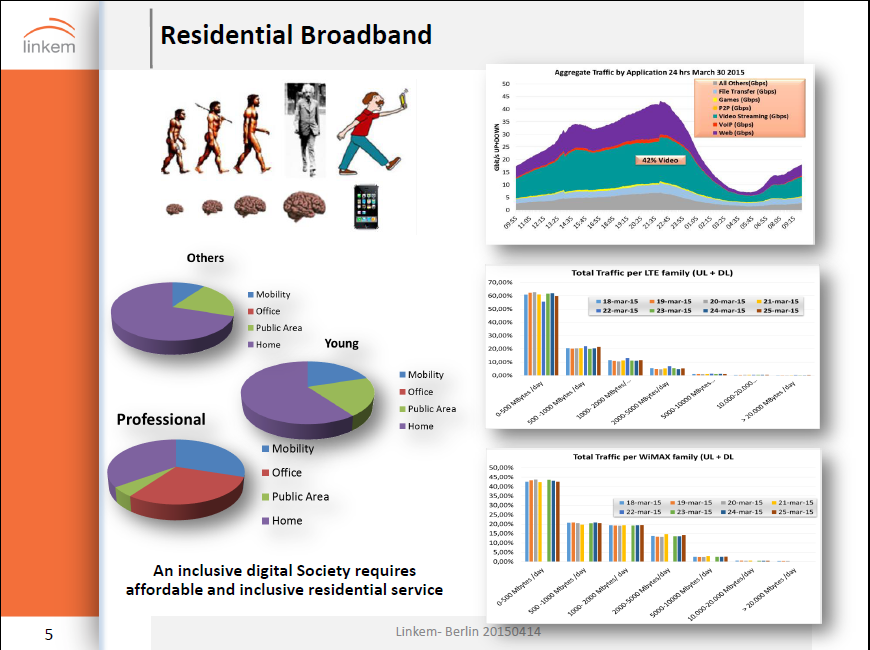
Following my yesterday's post on Amdocs' PCC deployment at Linkem (here), a friend sent me a presentation delivered by the Italian MNO' CTO, Rino Buccio [pictured], at the Policy Control 2015 event, that took place in Berlin last month.

Here are some of the slides, showing the challenges of providing "Residential Broadband Internet Wireless Access For Consumer and SOHO" in a "Copper Free Zone", and the overall solution for a dynamic, QoE controlled, LTE based, service.

The architecture includes Allot Communications' DPI device that analyzes flows and maps them into one of Linkem service classes (such as mail, FTP, streaming, Gaming and VoIP), controlled by Amdocs' PCRF.

Allot and Amdocs are long time PCRF-DPI partners, since the days of Bridgewater Systems, the origin of Amdocs' PCRF.


Friday, May 8, 2015

PCC Deployments [355]: Linkem [Italy] Selected Amdocs' Virtual Solution

  
Amdocs announced that "Linkem, an Italian provider of wireless broadband services, has selected an Amdocs virtualized network control solution to support the company's transition from WiMAX to LTE, and provide subscribers with a superior data experience based on differentiated service quality for high-bandwidth content.

The pre-integrated, virtualized solution combines Amdocs Policy Controller, an industry-leading policy control (PCRF) solution [see "Amdocs Announces Virtualized PCRF" - here], with Amdocs Home Subscriber Server for dynamic subscriber management. As a result, Linkem can deliver application-specific quality of service (QoS) to improve subscribers' end-to-end experience with streaming HD video, voice over IP, gaming and other data-intensive multimedia applications.

Source: Amdocs

Rino Buccio, CTO, Linkem said: "Amdocs' virtualized Policy Controller allows us to provide wireless data plans with tiered quality of service, enabling a consistent and optimal user experience in any network condition .. This implementation supports our strategy to launch advanced LTE data services today while laying the groundwork for a full network functions virtualization (NFV) architecture for even greater cost efficiencies and faster time to market for future technology enhancements"/

See "Italy’s Linkem Selects Amdocs Virtualized Solution for Premium LTE Services" - here.

Saturday, April 4, 2015

UK: LTE Performs Better than 3G!


Finally, a prove that the huge investment in LTE pays off!
   
A new research by the British regulator, Ofcom, finds that "Overall, 4G networks performed much better than 3G networks in five sample towns and cities tested - Edinburgh, Leeds, London, Newcastle and Poole/Bournemouth - where both 4G and 3G networks have been rolled out. In these areas, 4G networks delivered an average download speed of 14.7Mbit/s (compared with 5.9Mbit/s on 3G) and took 0.72 seconds to load a web page (compared with 1.04 seconds on 3G).

Source: Ofcom


Average download speeds, by provider, Q4 2014 Source: Ofcom

"For web browsing speed, the research measured the time it took to load a standard web page. Web browsing is one of the most popular activities on 4G. Across all 4G networks tested, average web browsing speed was 0.72 seconds"


Average web browsing speeds by provider, Q4 2014 (lower is better) Source: Ofcom

See "Ofcom today published research into 4G and 3G mobile broadband performance" - here.

Sunday, March 15, 2015

GSA: 497M LTE Subscriptions Worldwide


GSA announced that "Referring to newly-released data provided by Ovum Ltd, GSA calculated that LTE subscription net additions outpaced 3G/WCDMA-HSPA by 21% during the last 6 months of 2014, with LTE leading in both Q3 and Q4 .. There were 497 million LTE subscriptions worldwide by 31 December 2014. A total of 290 million LTE subscriptions were gained in the year, equivalent to 140% annual growth.

Alan Hadden [pictured], Vice President of Research, GSA said: "LTE subscriptions grew by 115 million in Q4, over 36% higher than 3G/WCDMA-HSPA connections. GSM subscriptions fell by 78.5 million in the same period. We are confident that LTE growth will continue to lead all other mobile systems."

GSA forecasts there will be at least 450 commercially launched LTE networks globally by end 2015, up from 364 that had entered service by the end of last year [here], with deployment of LTE-Advanced technologies as a major industry trend [here] regions. Further details will be provided in the next Evolution to LTE report to be published by GSA this month.


See "LTE reached 497 million subs by December 2014; growth outpaced 3G in 2H says GSA" - here.

Monday, March 2, 2015

Ericsson: 4 Video Channels O/LTE Use 10% Capacity; Deployed by Telstra


Ericsson announced that "Ericsson and Telstra continue to lead mobile operators in the adoption of LTE Broadcast .. Following a series of successful trials in 2014, Telstra will deploy Ericsson's LTE Broadcast end-to-end solution on their Australian 4GX network. 

[Related post - "GSA: 16 MNOs Deploying or Trialing LTE Broadcast" - here]

The LTE Broadcast trials 
(here and here) run by Telstra and Ericsson in Australia have shown that three or four channels of video can be efficiently streamed along with complementary data channels. This traffic used as little as 10% of the 20 MHz carrier to cover all users. 

The adoption of High-Efficiency Video Coding (HEVC) compression further improves network efficiency and potential picture quality (see "ITU New Approved Video Codec will Save 50% Bitrate" - here).


Source: Ericsson - LTE Broadcast a revenue enabler in the mobile media era (here)
In late February 2015, Ericsson and Telstra demonstrated LTE Broadcast transmission using HEVC encoders. HEVC encoding reduces the bandwidth required to deliver high quality video by around 30-40%, compared with existing MPEG-4 AVC coding, enabling operators to either deliver higher quality video or more channels in the same spectrum.


LTE Broadcast has a number of potential key use cases including new customer content experiences at sporting events, such as tennis, cricket, horse racing, car racing and other special events. Using the technology, event goers will be able to access multiple high quality video streams and event related data. 


Without LTE Broadcast technology, delivery of the video and data streams would have been via unicast, consuming significantly more spectrum and network resources. Delivery via LTE Broadcast will deliver an enhanced quality of experience to a higher number of subscribers than when served via unicast delivery"
.

See "Telstra deploys Ericsson LTE broadcast to enable video-centric applications" - here.

Wednesday, February 25, 2015

DSC Deployments [340]: Max [Bulgaria] Migrates WiMAX to LTE w/Diametriq


Diametriq announced that "Bulgarian mobile operator Max has selected Diametriq’s Diameter Solution Suite™for deployment in their LTE network .. Max pioneered WiMAX mobile networks in Europe in 2007 and is currently in the process of transitioning to LTE after launching the first commercial 4G Long Term Evolution (LTE) network in Bulgaria in May of 2014. Max has since extended the footprint of its advanced 4G LTE network to cover 50% of the urban population.

Anjan Ghosal [pictured], President and CEO, Diametriq explains: “Migrating to 4G can be problematic for WiMAX operators. Not having the benefit of a legacy 3G network makes a seamless transition challenging when it comes to providing out-of-network coverage. In many cases they have to rely on unique solutions that have not yet been addressed by the wider vendor community

"Max is tackling a number of these issues. First is the seamless integration of their WiMAX and LTE networks. The second is extending their data coverage to also provide voice services. Finally, they need to extend all of these capabilities outside of their network to outbound roamers as well as to allow visitors to roam onto their network .. Diametriq’s Diameter Interworking System plays a key role. It enables Max to integrate their legacy and 4G systems by enabling Data Interworking (dIWF), Voice Interworking (vIWF) and Charging Interworking (cIWF)".

See "Diametriq Provides Diameter Routing Solutions for Bulgarian Mobile Operator Max" - here.

Saturday, February 14, 2015

Thursday, February 5, 2015

[GSA]: 20 Operators Deployed 300 Mbps LTE-A


GSA confirmed that:
  • 20 operators have commercially launched 300 Mbps Category 6 LTE-Advanced service in 15 countries: Australia, Austria, Estonia, Finland, Germany, Hong Kong, Portugal, Romania, Russia, Singapore, Slovenia, South Korea, Spain, Switzerland and the UK .. 3GPP defines a Category 6 system within its Release 10 specifications as having a theoretical peak downlink speed capability of 300 Mbps, and 50 Mbps on the uplink.
  • A further 22 Category 6 LTE-Advanced systems are also being deployed or in a trial phase. It means that 42 operators in total are investing in 300 Mbps LTE-Advanced deployments in 24 countries
  • Nine Category 9 systems are in deployment, trial or test phase in Australia, Japan, Portugal, Qatar, Turkey, South Korea, Switzerland, UAE and the UK. 3GPP defines a Category 9 system as part of Release 11, and is capable of a theoretical peak downlink speed of 450 Mbps, and 50 Mbps for the uplink direction. Capabilities well beyond Cat 9 have already been demonstrated in a number of multiband multimode LTE-Advanced trials.


See "GSA confirms rise of 300 Mbps Cat 6 LTE-Advanced systems; 20 operators launched" - here.

Saturday, January 10, 2015

GSA: 360 LTE Networks Launched; 96 in 2014


A new report by GSA finds that:
  • 360 operators have commercially launched LTE networks and service in 124 countries (vs. 572 HSPA networks in 213 countries)
     
  • 96 LTE networks were launched in 2014
     
  • 611 operators are investing in LTE across 174 countries. This comprises 566 operator network deployment commitments in 166 countries (of which 360 networks have launched), and 45 pre-commitments trials in a further 8 countries
     
  • The LTE commercial service footprint extended to a further 27 countries in 2014
     
  • 80 operators in 42 countries i.e. over 22% of operators are investing in VoLTE deployments, studies or trials
     
  • 14 operators having launched HD voice service using VoLTE in 7 countries. Many more launches are expected in 2015
     
  • 107 operators in total, i.e. almost 30% of LTE operators have launched, are deploying or are trialling LTE-Advanced technologies
     
  • 49 operators have commercially launched LTE-Advanced carrier aggregation in 31 countries, and this figure could double in 2015
     
  • 373 million LTE subscriptions globally by Q3 2014 (according to Ovum) achieving 131% YoY growth. The balance of regional shares continued to shift to Asia, driven by impressive growth in China


See "GSA confirms 360 LTE networks commercially launched by end 2014, strong growth in LTE-Advanced and VoLTE deployments" - here.

Thursday, November 27, 2014

[Infonetics]: Reaffirms DPI Market CAGR: 22% ('13'-'18); Driven by LTE


Shira Levine, directing analyst for service enablement and subscriber intelligence, Infonetics Research, published additional excerpts from its latest DPI report (see April's release - "[Infonetics]: "net neutrality is now less of an issue in the U.S" for the DPI Market" - here):
  • The path that network functions virtualization (NFV) will take remains a bit uncertain as standards crystallize and operators develop their strategies, but we believe that NFV will ultimately have a significant impact on the deep packet inspection (DPI) market
     
  • The global deep packet inspection (DPI) market is forecast by Infonetics to grow at a 22% CAGR from 2013 to 2018, to reach $2B. See Infonetics chart below. The other chart shows the past revenues for the 3 public DPI companies. 2014 revenues are for the first 3 quarters.
     
  • Sandvine maintained its leading market share position in the overall DPI market, while Cisco narrowly took the lead in mobile DPI,
     
  • There is a growing interest in leveraging DPI to support more innovative service plans and content bundles, particularly in markets where net neutrality is an issue
     
  • LTE is driving spending on DPI in developed markets, where the additional bandwidth is igniting more video consumption


Source: The Broadband Traffic Management Blog

See "Network functions virtualization (NFV) will have big impact on deep packet inspection (DPI) market" - here.

Sunday, November 16, 2014

UK: 4G vs. 3G QoE Tested


Ofcom published its first research into "..consumers' experience of mobile broadband in the UK since the 4G auction in 2013. The research measured the performance of 4G and 3G services on smartphones from the four main mobile operators - EE, O2, Three and Vodafone - in Birmingham, Edinburgh, Glasgow, London and Manchester". 

Using smartphones, some 210,000 tests of 4G and 3G mobile broadband were carried out both indoors and outdoors across the five UK cities between March and June 2014 .. The research compared the performance of 4G and 3G services overall and highlighted variations between operators across four key measures: Download speed, Upload speed, Web browsing speed and Latency". 


See "4G and 3G mobile broadband speeds research" - here.

Tuesday, October 28, 2014

BroadForward Enables MVNO to Upgrade to LTE with Old Generation HLR


BroadForward announced that Voiceworks [MVNO, Netherlands] has "extended the use of the BFX Interface Gateway to support integration with KPN’s 4G network. Like for Voiceworks and hundreds of other operators and MVNO’s worldwide, it used to be impossible to connect to 4G/LTE networks with existing, older generation HLR’s (pre 3GPP release 8). This limitation is now removed with the latest release of BFX, facilitating connectivity with LTE networks for various generations of HLR’s.

Working in close cooperation with Voiceworks, BroadForward has developed a unique solution to address this limitation, provided as an on-board function of the BFX product. Now service providers with older generation HLR’s can establish LTE connectivity with a cost-effective and independent solution. This offers providers the opportunity to avoid the usual route of upgrading their HLR, often involving high cost, risky projects and vendor lock-in".

See "Voiceworks launches 4G service with unique interworking solution from BroadForward" - here.