Showing posts with label Bluecoat. Show all posts

Friday, June 12, 2015

[Technavio]: 33% CAGR for Transparent Caching Market 2015-2019


A new report by Yechnavio finds that the "global transparent caching market is expected to grow at a CAGR of more than 33% from 2015-2019.

.. over the last five years, global consumer Internet traffic has increased by more than five times. OTT content such as videos, file sharing, web surfing, and online gaming have grown significantly. Web surfing includes accessing web content, emails, and online data, apart from videos.

This is a small CAGR increase compared to the previous report predicting a 31.3% for 2013-2018 (here).

"The traffic is expected to increase from 34.29 Exabytes per month, in 2014, to over 98.16 Exabytes per month, by 2019. An increase in Internet traffic will increase the demand for transparent caching from network operators and MSOs. It will also help the operators provide the highest QoE to their subscribers and achieve cost efficiency.

Key Vendors: Akamai Technologies, Blue Coat Systems, Juniper Networks, PeerApp and Qwilt. 

Other Prominent Vendors: Alcatel-Lucent, Allot Communications, ARA Networks, Brocade, BTI Systems, Cisco Systems, Conversant, Fortinet, Google, Huawei, Level 3 Communications, MaraSystem, SuperLumin Networks, Swiftserve and VidScale".
    
See "Global Transparent Caching Market 2015-2019" - here and "Transparent Caching Market to Grow at 33% CAGR by 2019 Says a New Research Report at ReportsnReports.com" - here

Saturday, December 13, 2014

Cache Deployments [330]: CallPlus Brands [New Zealand] Uses Qwilt


Qwilt, announced it will ".. power the online video traffic delivered by leading New Zealand telcos Slingshot and Orcon. Qwilt’s Video Fabric Controller will be used by Slingshot and Orcon, both owned by New Zealand fixed line, voice, mobile and internet company, CallPlus, to cache and deliver online video traffic from a growing number of content providers, including Amazon, Apple, Hulu, Netflix and Twitch".

Back in July 2011, Bluecoat announced "CallPlus has selected Blue Coat®CacheFlow® 5000 appliances to help manage the large and growing demand of its customers for Internet content from outside New Zealand" (here) and in September 2010 Alcatel-Lucent announced that "it has been chosen by Orcon, the fastest growing service provider in New Zealand, to improve the delivery and experience of Internet-based video to its customers" (here).

"CallPlus selected Qwilt for the job because other vendors were unable to meet Slingshot and Orcon’s requirements for universal caching. Upon deploying Qwilt’s open caching technology, Slingshot and Orcon saw immediate savings in international transit costs and improved quality of experience (QoE) for its subscribers, when compared to competitive caching products".

See "Qwilt Selected by Slingshot, Orcon to Cache Increasingly Popular OTT Video Content" - here.

Sunday, August 24, 2014

[TechNavio]: Transparent Cache Market to Grow at 31% CAGR


A new report by TechNavio finds that ".. Transparent caching is a solution that enables the service provider to offload a significant amount of content traffic by storing a cached copy of the popular content close to the edge of the network, which is delivered to the user directly from the edge of the network rather than from the source. It is invisible to both the content originator and the end user, hence the name. 

TechNavio's analysts forecast the Global Transparent Caching market to grow at a CAGR of 31.3 percent over the period 2013-2018".

TechNavio identifies Blue Coat Systems (here), Juniper Networks, PeerApp (here) and Qwilt (here) as key vendors and Akamai, Alcatel-Lucent (here), Allot Communications (here), ARA Networks, Brocade, BTI Systems (here), Cisco Systems (see "Cisco Partners with PeerApp" - here), Fortinet, Google (here), Huawei (here), Level 3 (here), SuperLumin Networks, Swiftserve (here), VidScale as prominent vendors

See "Global Transparent Caching Market 2014-2018" - here.

Saturday, April 12, 2014

VAS/Security Deployments [302]: AT&T Uses Bluecoat for Network based Protection

  
AT&T announced ".. the launch of AT&T Cloud Web Security for businesses of any size. The new offering will provide real-time protection against viruses, malware, and compromised web sites --- all without the need for on-site equipment ..  built on Blue Coat SystemsSecurity Policy and Enforcement Center. It enables customers to enforce consistent global security policies across wired, roaming, and mobile environments".


See "AT&T Continues Drive to Strengthen Security for Businesses" - here.

Thursday, May 30, 2013

Blue Coat Buys Security Analytics Vendor Solera Networks


Blue Coat Systems announced that it has "..entered into an agreement to acquire Solera Networks, the industry’s leading provider of big data security intelligence and analytics for advanced threat protection. The Solera DeepSee platform will add industry-leading security analytics and forensic capabilities to the Blue Coat product portfolio, delivering an end-to-end security solution that includes protection, remediation and governance and gives enterprises complete visibility into the content and context of advanced targeted attacks. The acquisition is expected to close within the next 30 days".

See also "DPI/Security/Analytics Market: Intel Invests $20M in Solera Networks" - here.


Solera DeepSee Dashboard

"Solera’s customers include organizations around the world in many market segments, including the Departments of Energy, Homeland Security and Defense, Hitachi, Qualcomm, Overstock.com, Parsons Corporation and Zions Bank. For these customers, Solera’s DeepSee platform helps defend against advanced persistent threats and targeted malware attacks
".

See "Blue Coat to Acquire Solera Networks" - here.

Tuesday, October 16, 2012

Riverbed OEMs Vineyard's DPI Engine

  
Vineyard Networks announced that Riverbed Technology ".. has licensed Vineyard’s Network Application Visibility Library (NAVL) deep packet inspection (DPI) engine, designed to provide Riverbed® customers with comprehensive application classification technology to protect critical applications while containing recreational applications"

According to Vineyard, its DPI software is part of the recent enhancements to Riverbed's Steelhead (RiOS release 8.0) and the enhanced Layer 4-7 app classification capabilities in it. Riverbed now claims the ".. ability to scale automatic identification and prioritization to more than 600 applications" (see "Riverbed Introduces Software Enhancements and New High Performance Hardware Models to Steelhead Product Family" - here)

Vineyard partners' page (here) shows additional vendors as "powered by Vineyard" including BlueCoat.

"Integrating NAVL with market-leading Riverbed wide area network (WAN) optimization solutions increases the accuracy and efficiency of the real-time network traffic classification. The licensed technology helps identify all types of applications, even hard to detect applications and custom applications, to protect critical applications like web, voice, and video and contain recreational application traffic".

See "Vineyard Networks Announces Strategic Relationship with Riverbed to Provide Powerful Layer-7 Application Identification Technology" - here.

Friday, July 20, 2012

[Heavy Reading]: Mobile Caching - "part of larger traffic management solutions"


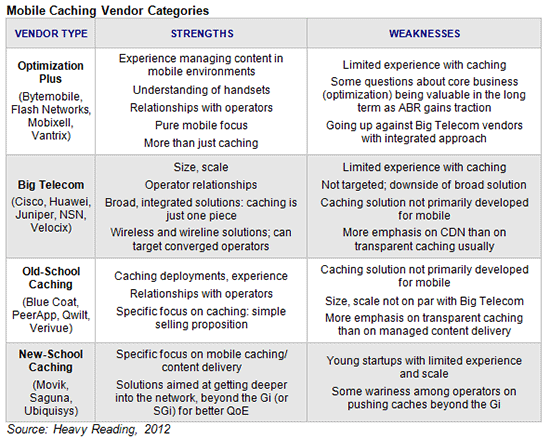
A new report by Aditya Kishore (pictured, see also "LTE will enable pushing cache into the base stations" - here), Senior Analyst, Heavy Reading looks at mobile data growth and caching solutions. 
  
"In a sense, the mobile caching space is not a separate market as much as it is an extension of other, adjacent markets. Caching is unlikely to be deployed on a mobile network in isolation; we anticipate most solutions will be integrated, partnered or part of larger traffic management solutions. Mobile optimization, network infrastructure, policy and RAN intelligence-type capabilities will all be leveraged alongside caching to better manage network traffic. This is evidenced by the types of vendors that are targeting this market".
"Broadly speaking, mobile caching vendors can be categorized into four groups, based on their history and the types of solutions they offer. Individual vendors within the same grouping have similar objectives, strategies and opinions. Unsurprisingly, they also demonstrate many similar strengths and weaknesses, though they do have individual attributes".

Posts related to companies mentioned in the table below, and their cache solutions: PeerApp, Qwilt, Saguna, Bytemobile, Mobixell, Vantrix, Velocix, BlueCoat, VerivueHuawei,   


See "Crossing the Gi: Will Edge Caching Be the Key to Managing Mobile Traffic?" - here.

Thursday, April 5, 2012

DPI Announcements: Bluecoat Adds IPv6 Support and Increases Performance

    
Bluecoat announced "PacketShaper version 9, a new software operating system release for Blue Coat®PacketShaper® appliances that introduces the industry’s first [see comment below] network-, application- and content-level visibility and control for IPv6 “shadow networks” which have, up until now, run undetected on existing corporate IPv4 networks. In addition, the new software enables scalable performance of up to 8 Gigabits per second (Gbps) to meet increased network demands with more video and other rich media, large software downloads and other network application traffic".
   
".. Content is now widely available over IPv6 from providers such as Netflix, YouTube and via emerging Peer-2-Peer (P2P) applications. At the same time, many desktop and mobile endpoints, including tablets and mobile phones, are fully IPv6 ready .. PacketShaper version 9 adds IPv6 application and content visibility to the most powerful real time classification engine available today, with granular understanding of 700+ applications and tens of millions of Web sites categorized into 84 content categories.". 
   
The PacketShpaer product line is the former Packeteer (the DPI pioneer), product line. During the years, Packeteer and later Bluecoat focused on DPI based WAN Optimization solutions for enterprises, universities (where it competes with Allot and Procera - see a recent announcement "Procera Launches the PacketLogic™ PL7810" - here) and small ISPs, due to the limited performance compared to the other DPI players. Note that Procera announced already support for IPv6 (here). 
  
See "New PacketShaper Drives Performance up to 8 Gbps and Introduces Visibility and Control of IPv6 “Shadow Networks” - here

Friday, February 10, 2012

Cache Deployments [121]: Citarella [Argentina] Reduced Bandwidth by 50% W/Blue Coat

   
Blue Coat Systems announced that "Citarella S.A. of Buenos Aires, Argentina, achieved two key milestones to improve its overall customer satisfaction: reduction of its bandwidth usage by 50 percent and immediately obtaining results of zero customer complaints after the installation of the Blue Coat® CacheFlow® 5000 appliance .. to support its “iplatense” Internet service, for a mix of residential and business subscribers who count on smooth video streaming and a fast, interactive Web 2.0 experience".

"YouTube traffic had grown to become 25 percent of all the ISP’s Internet traffic and Facebook had increased to 15 percent .. By efficiently and intelligently caching Web content to substantially reduce bandwidth consumption, the CacheFlow appliance can boost the quality of a subscriber’s Internet experience. CacheFlow also acts as a “shock absorber” for traffic spikes that occur when Web sites and content become popular over a very short period of time, such as during coverage of a major news, sporting or political event. In addition, CacheFlow appliances can provide protection from malware and unusual traffic as well as URL filtering to meet cultural and regulatory requirements."

See "Citarella S.A. Deploys Blue Coat CacheFlow Solution to Improve Subscriber Web Experience" - here.

Tuesday, February 7, 2012

PeerApp: “Caching is the future of Optimization”

   
Few days ago I met Shmulik Bachar, VP of products and marketing, PeerApp, in its R&D site.

PeerApp, according to Frost and Sullivan recent research, leads the transparent cache market (see “F&S: Transparent caching market to Reach $708M by 2015; PeerApp Leads” – here). In 2011, the market had estimated revenues of $140M.

Some of the Q&A we had:

Q: Who do you see now in the caching market?

A: As direct competitors we mainly see Blue Coat. Note that we are also selling through OEMs, which includes Allot Communications and BTI Systems.

Q: What about the cache offering from Juniper, Cisco and the video optimization vendors?

A: These companies do not compete with us directly. They use caching as internal mechanism in their solutions, but not as a solution for optimizing Over the Top (OTT) traffic, as we do.

Q: We saw recently some announcements of integrated Carrier CDN and transparent caching solutions. Are the two will finally become one?

A: In many cases, carriers like to see one solution. This is why we announced a joint solution with Edgecast (here), and Verivue, who came from CDN solution side is now adding transparent caching (here). Transparent caching and CDN provide the carrier with similar benefits, although the technical solution for transparent caching and CDN is different.

Q: What is the business case for transparent caching? It is still about bandwidth savings?

A: It is no longer just savings, except for specific regions. The main goal now is to improve the subscriber’s quality of Experience (QoE) and monetize OTT services.

Q: Monetize? How?

A: One example, implemented by some of our customers, is the ability to sell higher tiers of service (usually volume-based) knowing that caching will enable better QoE.

Q: How about PeerApp? Where is it going?

A: We continue to focus on caching. It is the future of optimization, both for fixed and mobile operators. I believe that the different Adaptive Bitrate technologies (from Apple, Microsoft and Adobe) will make the other real-time/network based video optimization technologies (see here) redundant. Caching has real value, for bandwidth savings, QoE improvement and monetization.

PeerApp is doing very well, we closed a $8M investment last year (here) and we are working on additional OEM opportunities to expand our reach to other elements of the core network.

Thursday, September 29, 2011

Optimization Deployments [93]: Afribone [Mali] Uses Blue Coat Cache to Reduce International Bandwidth

     
Blue Coat announced that "Afribone, the pioneer and leading provider of Internet access in Mali, has selected Blue Coat® CacheFlow® 5000 appliances to help manage its customers’ large and growing demand for international Internet content from outside Mali .. Last year Afribone noted a significant increase in its customers’ multimedia needs, as well as significant growth in traffic to Web 2.0 sites. The number of requests directed at video-sharing websites increased massively, and bandwidth demand started to outstrip the ISP’s capacities .. Afribone has obtained immediate and spectacular benefits since deploying CacheFlow appliances, including being able to more than double its client-side bandwidth without adding additional international bandwidth".

Recently, Blue Coat announced a significant performance boost to the CacheFlow 5000 as well several ISP wins (here), mainly in countries with limited or expensive international bandwidth costs.

See "Afribone Selects Blue Coat CacheFlow Appliances to Save on Expensive International Bandwidth and Provide High Quality Web Experience" - here.

Friday, September 16, 2011

Cache Announcements: Blue Coat CacheFlow 5000 – 3x Performance, IPv6, 10GE

  
Blue Coat announced "its next-generation Blue Coat® CacheFlow® 5000 appliance, which delivers a significant leap forward in performance and capacity -- more than three times greater throughput and cache storage compared to the previous version -- in the same compact, 4U footprint. The new CacheFlow appliance is available immediately and includes IPv6 support .. Deployed in nearly 50 service provider networks [see -  Umniah, Lebanon Online, CallPlus,True Internet] around the world today, the appliance has achieved on average 40-50% bandwidth savings on general Web traffic .. The new CacheFlow appliance also adds an option for 10GigE Fiber"

See "Blue Coat Enables Service Providers to Meet Staggering Demand for Web Video with New High Performance CacheFlow Appliance" - here.

Tuesday, September 6, 2011

Optimization Deployments: Umniah [Jordan] Improves Performance by 90% with Bluecoat Cache

 
Bluecoat announced recently that "new data collected from live deployments shows that Blue Coat® CacheFlow® 5000 appliances for carrier caching can dramatically improve user Web experience. This data demonstrates that CacheFlow appliances achieve, on average, ten times faster Web downloads for video and other Web 2.0 content, which can lead to dramatically improved customer satisfaction. Blue Coat has made testing tools available, so that customers evaluating the CacheFlow solution can test end-to-end response time in their own environment to quantify the user experience benefit."

"One mobile operator, Umniah in Jordan, with over two million subscribers, reported an overall browsing performance increase of 90 percent using CacheFlow appliances, resulting in a 95 percent decrease in customer complaints. A rural ISP, North-Eastern Pennsylvania Telephone Company, was able to add premium, high speed Internet access to its service offerings once it deployed the CacheFlow solution"

See "New Data Shows Service Providers Can Make Web Downloads Ten Times Faster Using CacheFlow Appliances" - here.

Tuesday, August 16, 2011

Cache Deployments (86): Lebanon Online Selected Bluecoat for Bandwidth Management and Future VAS

 
Bluecoat announced that ".. Lebanon Online [site coming soon!] has deployed the Blue Coat®CacheFlow® 5000 appliance. The newly installed platform enables Lebanon Online to substantially reduce operational expenses by cutting bandwidth spend, manage sizeable increases in network traffic and subscriber growth, enhance Web security and optimize and enhance the delivery of rich Web 2.0 content, large files and video. Lebanon Online expects the return on its investment in CacheFlow appliances to be less than six months, based upon bandwidth savings alone .. Lebanon Online is also formulating a value-added services strategy where it can provide additional, potentially chargeable services to its customers, including parental controls and a ‘clean Internet’ security service to further leverage the capabilities of Blue Coat solutions".

See "Lebanon Online Deploys Blue Coat CacheFlow Appliance to Reduce Bandwidth Costs and Enhance End-User Experience" - here.

Sunday, August 7, 2011

Cache Deployments (83): CallPlus[New Zealand] Selected Bluecoat for International Bandwidth Optimization

   
Bluecoat announced that ".. CallPlus has selected Blue Coat®CacheFlow® 5000 appliances to help manage the large and growing demand of its customers for Internet content from outside New Zealand .. CallPlus estimates that 90-95% of its traffic is for international content, and the demand is growing at a rate of about 50% per year, by volume .. Initial trials of the Blue Coat Web caching appliances conducted by CallPlus showed a reduction in its bandwidth consumption by over 40%. At the same time, the speed of content delivery and quality of video experience increased dramatically due to the use of caching". 

See "Blue Coat announced that CallPlus has selected Blue Coat CacheFlow 5000 appliances to help manage the growing demand for Internet content from outside New Zealand" - here.

Adrian Dick, CTO, CallPlus said: “Once we deployed the caching technology, we were serving Web traffic considerably faster than our main competitors”. Note that Telecom New Zealand is also using the same Blue Coat solution - here.

Wednesday, June 29, 2011

Vodafone UK: Web Traffic Filtered by Bluecoat, w/RT Content Analysis

  
The NO DPI site reports that Vodafone UK filters web traffic using a Bluecoat based filter. The article provides some packet traces as a prove and then brings VF's response.

The rather detailed response provides a good explanation on the technology associated with network based web filtering service - how illegal traffic is blocked (based on IWF lists - here) and how sites are categorized using a pre-populated database and real-time content analysis.

"The Bluecoat filter you refer to classifies every internet site into one or more of over 70 categories.  In order to apply the adult bar to protect our younger customers, Vodafone take these 70+ categories and rates them as either Adult of Universal.  As the internet is growing at an ever increasing rate, so there are a percentage of sites not yet classified by Bluecoat as they are too new. To be on the safe side,  when a user requests a site that is not classified, the Bluecoat system pulls the page requested and checks to see if there is any obvious content that would make it necessary to classify it.   If it does appear adult, then the warning page is displayed. If not, it is served to the customer in the normal way.   In order that we preserve customer service in terms of performance, but do not compromise safety, this is all done simultaneously. Vodafone do not retain any of this information.  The site will be dynamically rated on each visit.  If the site is a more popular one, it is added to the database and the checking process would stop occurring If a customer is over 18 then they can access any internet site they wish with the exception of sites dealing with child abuse images as classified by the IWF.  If a customer is under 18 then where content is regarded as unsuitable we serve a warning page.Bluecoat does not constitute ‘spyware’.  It is a network operation applied to every internet request and we are required to do this in order to meet our regulatory and industry obligations. This is not a question of intercepting customer communications but the safety of our younger customers in a dynamic environment.  Other network operators use the same or similar systems"

See "Vodastalk; Vodafone and Bluecoat Stalking Subscribers" - here.

See also:
  • UK Government Pushes ISPs (Again) to Provide Better Parental Control - here
  • UK: Public Pressure on ISPs to Enforce Parental Control (Killing a VAS?) - here
  • Vodafone Turkey Uses Optenet and Allot for Web Filtering - here
  • TalkTalk [UK] Launches Free, Opt-in, Parental Control/Malware Detection - here
 

Wednesday, March 9, 2011

Alcatel-Lucent: "Cache in Routers is more than Nice to Have"

   
Phil Harvey, Editor-in-chief for Light Reading, interviews Basil Alwan, President IP Division and Head of Portfolio Strategy Networks Group, Alcatel-Lucent, during OFC/NFOEC 2011.

See "OSA 2011: Caching's In at Alcatel-Lucent" - here and video below.

According to ALU, network caching should have an hierarchical structure, and in order to get deeper into the network, and closer to the users, it should be more than "nice to have" feature of the routing platforms.

Alcatel-Lucent acquired the caching technology vendor Velocix (chart below) and has a reselling agreement with Bluecoat for its ProxySG cache appliances (see "Alcatel-Lucent Adds Bluecoat's Over-the-Top Caching to its Velocix CDN Solution" - here).

It seems that we are about to see one of the two integrated into ALU products (the 7750 Service Router?).


Thursday, February 17, 2011

Cache Deployments (53): True Internet [Thailand] Uses Bluecoat to Reduce Costs and Improve QoE for Web and Video

         
True Internet, Thailand’s largest ISP with approximately 1.5M subscribers (of which nearly 800,000 in Bangkok Metropolitan Area) must be a paradise for equipment vendors, as it frequently agrees to deploy similar systems from multiple vendors, cooperates very well with the vendors and allows them to mention that in press releases.

3 months ago Oversi announced a cache deployment at True (see "Does True Internet [Thailand] Use Oversi Just to Improve Internet Video QoE?" - here) and now Bluecoat announces that "True Internet .. has deployed Blue Coat® CacheFlow® 5000 [here and chart below] appliances to reduce costly international bandwidth consumption, as well as to improve end-user Web experience especially for the delivery of rich Web 2.0 and video content"
  
See "True Internet Deploys CacheFlow Appliances to Reduce Bandwidth Costs and Improve User Experience for Rich Web 2.0 & Video Content" - here.

True is also using PeerApp - see "True -- Thailand's Largest Internet Service Provider Cuts Bandwidth Costs with New Peer-to-Peer Technology from PeerApp" - here.

This time it is clearly said that caching is used to reduce the usage of costly international bandwidth, and not only in order to improve subscribers’ QoE. Bluecoat explains that "Particularly in high-growth, developing regions such as Latin America, Middle East, Eastern Europe and Southeast Asia, international bandwidth costs can be prohibitive for service providers. In many instances, regional service providers may be paying hundreds or thousands of dollars per megabit per second (Mbps) per month for international IP transit bandwidth."

Dr. Viriya Upatising, CTO of True Internet said “..We face considerable demand for bandwidth, especially as each customer consumes a growing amount of rich media content from such sources as Facebook, MySpace, YouTube, DailyMotion, RapidShare and other sites With international bandwidth still being quite expensive, the CacheFlow appliances have provided a significant remedy for us by helping us manage the operational challenge of adding more users and addressing greater traffic volumes. From our extensive testing of the solution, we have seen how the CacheFlow product consistently delivers high bandwidth savings, while improving the quality of our Internet service to our customers”. Dr. Viriya was also quoted on Oversi's release.

Friday, October 15, 2010

Video Caching Market Finally Growing

    
It seems that 2010 will be the year of video caching - it will finally get the traction is deserves.

While caching itself is as old as the internet, video caching (either fro streaming or file-sharing traffic) is relatively new, and vendors in this space had some difficulties marketing the solution. Main reason is operators’ concerns of legal issues rising from caching copyrighted content. Therefore the vendors focused their sales efforts in markets (mainly parts of Asia, Latin America, Eastern Europe and Africa) where international bandwidth is expensive, and the ROI for the solution is very quick.

2010 seems to be different:
  • Video streaming grew and is now more significant traffic, probably releasing some concerns of caching P2P traffic. The potential monetization benefits (QoS based tiered services, partnering with content providers etc) may be lucrative also to larger operators searching new ways to increase ARPU. See "BT Selects Cisco's Video Content Delivery System" - here.
      
  • Introduction of solutions by tier1 vendors: Huawei (here), Cisco (here) and Juniper (here)
       
  • Integrated DPI/caching solutions - since an efficient caching solution needs DPI support, an integrated solution is a clear winner. PeerApp offers such solution with Allot and Sandvine
     
  • New solutions by smaller vendors - Bluecoat (here), BTI (here)
     
  • Integration with gateways - Acision (here)
     
  • Integration of CDN and caching - see Alcatel-Lucent (here)
And the results of all this?  

A joint press release from Sandvine and PeerApp shows us some market traction - stating that "within the past six months the Sandvine-PeerApp pre-integrated content caching solution has doubled its deployments and is now being used in 11 service provider networks serving over two million cable and DSL subscribers worldwide".

See "Content Caching Deployments Double Over Past Six Months" - here.

A transparent caching solution generally saves 20 to 30 percent of transit link and circuit costs for a typical operator,” said Frank Childs, PeerApp’s vice president of marketing. “By pre-integrating and pre-packaging this solution with Sandvine, our customers can quickly and easily attach it to the network, begin saving money immediately and improve their service quality to their subscribers.


Friday, September 24, 2010

Alcatel-Lucent Adds Bluecoat's Over-the-Top Caching to its Velocix CDN Solution

   
Bluecoat announced "a strategic reseller agreement .. Alcatel-Lucent will sell Blue Coat products, including Blue Coat® ProxySG® and CacheFlow® appliances, to Alcatel-Lucent customers worldwide – including tier-one telcos, managed service providers, regional ISPs and mobile operators"

See "Alcatel-Lucent and Blue Coat Form Global Reseller Agreement and Collaborate to Help Service Providers Deliver Better Video Experience for Customers" - here.

This is a necessary, so I believe, first step towards the integration of video distribution (CDN) and caching into one solution, targeting the service provider market (see more - "BT Selects Cisco's Video Content Delivery System" - here)

"Alcatel-Lucent will specifically leverage the CacheFlow appliance as a complement to Alcatel-Lucent’s Velocix Content Delivery Network solution. The Velocix Digital Media Delivery Platform manages the distribution of digital content and is based on open Internet based video standards. The CacheFlow appliance reduces the strain of bandwidth-consuming dynamic Web 2.0 and video content by transparently caching such “over-the-top” content, providing bandwidth savings for carriers and a better experience for users. The CacheFlow appliance also helps service providers manage traffic “spikes” due to unusually high demand for content on breaking news or special events."

Paul Larbey, vice president of Alcatel-Lucent’s Velocix Content Delivery Network solutions said: “The Blue Coat platform is proven in some of the largest service provider and enterprise environments in the world, and it complements our existing products and services, giving service providers another tool to improve and simplify video delivery.

Velocix, in its early days as CacheLogic, also did content caching (for P2P file sharing, mainly).

Related posts:
  • DPI Announcements - Blue Coat Introduces Carrier Caching Appliance - here
  • Yankee Group: CDNs Expand to Mobile Broadband [Independent Caching OK?] - here