Showing posts with label spectrum. Show all posts

Tuesday, December 3, 2013

[ABI]: VoLTE Triggers Re-assigning 2/3G Spectrum to LTE


Ying Kang Tan [pictured], research associate, ABI Research reports that "Spectrum repurposing is gaining momentum. The launch of Voice-over-LTE (VoLTE) services  [see "[ABI]:VoLTE will Help MNOs Fight OTT Voice and Messaging" - here] by major carriers first in South Korea and soon in the United States is part of the effort to move voice calls from the circuit switched 2G and 3G networks to the packet switched LTE networks. To achieve this, operators have built extensive LTE networks, which also serve as a marketing tool to stay in competition".

“For CDMA operators such as Verizon, aggressive LTE deployment is necessary because a VoLTE call cannot fall back to the circuit switched domain. Even for WCDMA operators like AT&T, it makes sense to do likewise because LTE is much more spectral efficient than WCDMA .. by the end of next year, when VoLTE has gained more momentum, ABI Research expects more than 93% of the North American population to have access to LTE".

Related post - "[Guest Post]: Circuit Switched Fallback: In Danger of crippling 3G and leaving LTE underused" - here.

The following Infographic by Alcatel-Lucent:


See "Telecom Regulators and Mobile Carriers Stepping Up Efforts to Repurpose 2G and 3G Spectrum for LTE" - here.

Sunday, April 28, 2013

Ofcom to Pilot ‘white space’ Technology


One more step towards a to solve the mobile data tsunami .. Ofcom announced "plans for a pilot of innovative ‘white space’ technology in the UK, among the first of its kind in Europe. The technology uses gaps in radio spectrum, called ‘white spaces’, which exist in between frequency bands. In this instance, these bands have been reserved for digital terrestrial TV broadcasting and wireless microphones.

Use of these white spaces will allow devices to transmit and receive wireless signals for applications such as broadband access for rural communities, Wi-Fi-like services or new ‘machine-to-machine’ networks.
Source: wireless pulse, Comsearch


Ofcom is inviting industry to take part in the pilot, which is intended to take place in the autumn
".

See "Ofcom invites industry to pilot ‘white space’ devices" - here.

Monday, March 18, 2013

[Infonetics]: MNOs can do without Additional Spectrum

 
A recent report by Stéphane Téral (pictured), principal analyst for mobile infrastructure and carrier economics, Infonetics Research, explains how operators can "optimize their cellular resources without adding more spectrum and provides an alternative view to the mainstream belief that there is not enough spectrum":
  • “HSPA+ and LTE are two of the primary reasons operators have been able to squeeze more and more bits out of limited spectrum HSPA/HSPA+ and LTE improve spectral efficiency so significantly that the need for spectrum has been greatly reduced, often by at least half. LTE technology is not only resistant to interference between cells but also spreads transmission efficiently over available spectrum.
     
  • WiFi offload may also be helping ease the spectrum crunch: Some mobile operators report to Infonetics that up to 75% of mobile device data traffic is on WiFi".
See "Is there a mobile spectrum shortage? New data from Infonetics may come as a surprise" - here.

Friday, February 1, 2013

FCC Adds Spectrum for Gigabit Wi-Fi


Julius Genachowski (pictured). Chairman, FCC, says in a LinkedIn post - ".. Wi-Fi congestion is becoming a critical problem for consumers and innovators .. That’s why last week I announced that the FCC, in coordination with other federal agencies, is kicking off an effort to free up unlicensed spectrum for ultra-high-speed, high-capacity Wi-Fi, known as “Gigabit Wi-Fi” This action would increase speeds and alleviate Wi-Fi congestion at major hubs such as airports, convention centers and large conference gatherings .. This effort would also increase the speed and capacity for Wi-Fi in the home, where multiple users and devices – including those streaming HD video – are often on the network at the same time".


See "Boosting Wi-Fi Speed and Reducing Wi-Fi Congestion Key for Innovation & Consumers" - here.

Sunday, July 8, 2012

Ofcom - Spectrum Management for the Olympic Games


Ofcom published is final plans regarding the organization of spectrum during the 2012 London Olympic Games.

"As part of the UK's bid to hold the 2012 Games, the UK Government guaranteed the allocation of the spectrum required for the organisation of the Games. Ofcom is responsible for managing spectrum for the Games, in accordance with the Government’s guarantees".


See "Countdown to the London 2012 Games" - here. See also "UK 2012 Olympic Delegation: All Available Frequencies (and Athletes)" - here.

Sunday, June 17, 2012

How will T-Mobile US Improve Spectral Efficiency?


Mike Dano reports to Fierce Wireless on T-Mobile's CTO Neville Ray (pictured) presentation at the NGMN conference held in San Francisco earlier this week.

Mr. Ray provided some statistics on T-mobile's "4G" network (or HSPA+, as the rest of the world calls it; LTE, by NSN and Ericsson, will be launched in 2013). The network reaches 230M people, has 37,000 cell sites and the current average monthly smartphone bandwidth consumption is 760MB, or 1.3GB for HSPA+ devices. This (760MB) is a 30x increase compared to 2009.

See "T-Mobile's HSPA+ 42 smartphone users guzzle 1.3 GB per month" - here.

In addition, one of Ray's slides (full presentation - here) shows how T-Mobile is planning to improve spectrum and capacity challenges, resulting from the above usage.

Related post: "Kineto Wireless Makes Wi-Fi Offload Easier; Used by Orange UK and T-Mobile US" - here.


Tuesday, January 24, 2012

UK 2012 Olympic Delegation: All Available Frequencies (and Athletes)

 
Back in October I had a post predicting hard time for mobile services during the London Olympic Games this summer:

"London mayor Boris Johnson, Three CEO David Dyson and others have warned that London will run out of mobile capacity within a year, and that the influx of visitors to the 2012 Olympics was likely to crash the existing networks" (see "A Year Before the Olympics - London is Running Out of Mobile Capacity" - here).

It turns out that the UK regulator, Ofcom, wasn't ignoring the challenge and "has been working on a plan since 2006 to ensure that viewers will not miss any of the sporting action".

In a new report, Ofcom says that ".. The event presents a unique logistical challenge never faced before by the UK, with a need to assign up to 20,000 wireless frequencies to be used for the Games in London, more than double the number usually assigned in a year" and lists how the demand for capacity will be met:

"To meet the extra demands of broadcasters, media and the London 2012 Organising Committee (LOCOG) during Games time, Ofcom has developed a plan to secure additional capacity. This will be achieved in four main ways:

  • By borrowing spectrum on a short-term basis from public sector bodies, such as the Ministry of Defence
  • Ensuring that civil spectrum is used efficiently by making unused frequencies available. An example of this is spectrum that will shortly be auctioned by Ofcom, but is currently not being used
  • Making use of spectrum freed up by the digital switchover
  • Using spectrum that is available without the need for a licence
See "Record spectrum demand at London 2012 Games" - here.

Monday, January 16, 2012

Ofcom: Why does the UK Need More 4G Sepctrum?

 
Ofcom, the UK regulator, "set out a number of new proposals for making 4G mobile spectrum available in the UK. This includes introducing new measures expected to extend coverage to at least 98% [indoor coverage by population] of the UK population and revised plans to promote competition".
 Why?

"Demand for mobile data in Western Europe is estimated to increase by more than 500% over the next five years. This demand is being fuelled by smartphones and mobile broadband data services such as video streaming, email, messenger services, online mapping and social networking"
  
" .. As the UK switches from analogue to more efficient digital TV, new spectrum capacity is becoming available to meet this demand. This ‘digital dividend’ uses airwaves in the 800MHz band, which will be auctioned along with higher frequency airwaves in the 2.6GHz band at the end of 2012. This will be equivalent to three quarters of the mobile spectrum in use today" 

See "Proposals to extend 4G mobile coverage" - here. See also "[Yankee Group]: MBB Penetration in Western Europe to Reach over 14% by 2015" - here.

Wednesday, January 4, 2012

[Survey]: Which Solutions will Gain the Most Traction for Managing Mobile Data?


Chetan Sharma Consulting published the findings of its "2012 Mobile Industry Predictions Survey" (here and ) - ".. Executives, developers, and insiders (n=150) from leading mobile companies and startups from across the value chain and around the world participated to help see what 2012 might bring to keep us on our toes. What makes this survey unique is that it draws upon the collective wisdom of folks who are at the center of the mobile evolution". 


Source: Chetan Sharma Consulting

Question 11 was "Which solutions will gain the most traction for managing mobile data broadband consumption?" (see chart above) and the analysis says - "Managing data growth and margins drives all strategies at mobile operators these days which in turns drives the value chain. 4G, tiered pricing, and mobile offload continue to be the top solutions if one has the spectrum that is".
 

Sunday, December 11, 2011

Ofcom Plans to "Monitoring approaches to traffic management" in 2012/13

 
Ofcom, the UK regulator, published its "Draft Annual Plan 2012/13" (here). The plan has strategic purposes, shown in the chart below. Each purpose has priority items, such as "Promote competition and investment in the delivery of superfast broadband", releasing analogue TV spectrum and "Promote effective choice for consumers by ensuring that clear information on service, price and quality is available".


In addition, the draft plan has "other work areas" for the strategic purposes. Under "Help communications markets work for consumers" Ofcom says it plans to "Monitoring approaches to traffic management to ensure innovation for consumers", 

The latter follows the recent Ofcom's publication on Net Neutrality (here), and the draft plan is:
  1. In the publication Ofcom’s Approach to Net Neutrality in November2011, we set out our position on net neutrality and traffic management. In particular, we provided our views on the level of consumer information which we want to see the market deliver, and also the potential circumstances which might warrant the development of a minimum quality of service. We are committed to undertaking further research on consumer information. We appreciate the importance of finding a balance between providing the right type of information and ensuring it is targeted and clear, and overloading consumers with too much information, resulting in consumer confusion. We will also undertake research on the provision of ‘best-efforts’8 internet access.
     
  2. We will monitor progress, and keep under review the possibility of intervening more formally in relation to the issues we have identified. We will do so as part of our ongoing work, within the context of our infrastructure reporting duty, to monitor traffic management practices. We expect to publish our next update on this work in summer 2012.
     
  3. We will also continue to engage with stakeholders to identify market developments that might hinder or support the co-existence of ‘best-efforts’ internet and managed services. Based on this research and engagement, we will assess whether any further regulatory action is necessary. We will continue to engage in the European debate and contribute to ongoing BEREC work on transparency, discrimination, quality of service and IP interconnection.
The draft plan is subject to a consultation process (here). 

Tuesday, April 26, 2011

AT&T: We Need T-Mobile for the "wireless broadband revolution"

    
AT&T announced that it "filed with the Federal Communications Commission its Public Interest Statement regarding its proposed acquisition of T-Mobile USA. The filing demonstrates the numerous benefits of the merger, including the deployment of 4G LTE network technology to more than 97 percent of the population".

One of the benefits AT&T sees in the merger is (the full document, with its 381 pages, is available here):

"AT&T is using up its spectrum at an accelerating rate, and the wireless broadband revolution is just beginning.  Over the next five years, data usage on AT&T’s network is projected to skyrocket as customers “mobilize” all of their communications activities, from streaming HD video and cloud computing to a range of M2M applications like energy management, fleet tracking, and remote health monitoring. In just the first five-to-seven weeks of 2015, AT&T expects to carry all of the mobile traffic volume it carried during 2010".

AT&T explains that it "... has worked tirelessly to address this data explosion through a wide variety of means. For example, it has purchased spectrum on the open market when available and has added thousands of cell sites and additional backhaul capacity to its network grid. AT&T has also deployed distributed antenna systems, 24,000 Wi-Fi hotspots across the country, and Wi-Fi Hotzones in heavy usage areas—such as Chicago’s Wrigleyville, New York’s Times Square (here) [See below an example for the merged network in New York], and others—to off-load traffic from its mobile network. All told, AT&T invested $21.1 billion in capital expenditures to upgrade its wireless network between 2008 and 2010 [here]".

The press release "AT&T Files Public Interest Statement With FCC on T-Mobile Acquisition" is here and a special site - here.

See also "AT&T CEO Expects "a very significant increase in data throughput in a very short time" - here.


Friday, April 1, 2011

AT&T CEO Expects "a very significant increase in data throughput in a very short time"

   
AT&T is spending $39B to meet demand for mobile data.

Randall Stephenson (picture), AT&T CEO, told Paul Taylor from the Financial Times on the recent proposed purchase of T-Mobile USA:

"This transaction is very instrumental in this, because in New York City [here] we will get a 30 per cent lift in capacity virtually the day the deal closes. That [will result] in a very significant increase in call quality and data throughput in a very short time .. data consumption had increased by 8,000 per cent over the past four years [previously - "5,000% in 3 Years" - here] and was projected to increase eight to10-fold over the next five years ..There is not enough spectrum and airwaves to accommodate this if there isn’t a restructuring of the spectrum in some fashion "
 
I guess this means that the T-Mobile network is significantly under-utilized!
 
Full story "AT&T chief defends T-Mobile tie-up" - here.
 

Friday, February 18, 2011

ITU Urges Governments to Release Extra Spectrum for Mobile Broadband - US Allots $18.2B

   
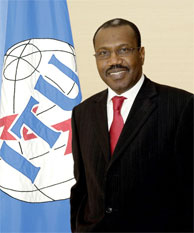
ITU's Secretary-General Dr. Hamadoun Touré says that "Governments need to take urgent action now to support mobile broadband growth .. Mobile operators have been investing billions to upgrade and improve the capacity and performance of their networks, but in some high-usage cities, such as San Francisco, New York and London, we are still seeing users frustrated by chronic problems of network unavailability .. Robust National Broadband Plans that promote extra spectrum and the faster roll-out of the fibre networks which are essential to mobile backhaul are vital to support the growing number of data-intensive application".

See "Network congestion set to worsen ITU calls for international broadband commitment" - here.

See also: "US and UK Regulators to add Mobile Spectrum for Data" - here, "Obama details $18.2 billion wireless broadband plan" - here and the video below (Obama's advisor, Melody Barnes says: "we are building on top of what the private sector is doing and filling in the gaps that are missing".


Saturday, January 8, 2011

US and UK Regulators to add Mobile Spectrum for Data

 
The FCC and Ofcom both announced recently their intentions to add more spectrum to mobile carries, for data services.

FCC Chairman Julius Genachowski said in a press event at the 2011 CES show - "We need to free up more spectrum .. If we don’t tackle the spectrum crunch now, network congestion will grow, and consumer frustration will grow with it .. That’s why unleashing spectrum to support mobile innovation is at the top of the FCC’s 2011 agenda". See "Chairman Genachowski's Remarks at the 2011 International Consumer Electronics Show" - here.

Ofcom published a statement saying that "From today the airwaves used by mobile phone operators for 2G services, such as making phone calls and sending texts, will be available to provide 3G services .. Today’s move means that this spectrum could in future be used to meet the growing demand from smartphone devices and the like for 3G services". See "Ofcom opens up more frequencies for 3G services" - here.

Not everybody was happy with the move - for example 3UK, an operator that does not have 2G frequencies (as the name indicates ..). See "3UK head criticizes spectrum allocation ruling" - here. 
 
"Kevin Russell, chief executive of 3 UK (picture), has indicated that his business could be sold after accusing ministers and regulators of distorting competition in the telecoms industry. He criticized a decision by regulators to let the operator’s larger rivals reallocate some of their radio spectrum from basic phone services to data activities such as internet browsing. .. The company wants Ofcom, the telecoms regulator to draw up auction rules that cap the amount of spectrum that any operator can hold. Without this, 3 doubts that O2 and Vodafone could end up holding the bulk of the spectrum available at a bandwidth below one gigahertz. Everything Everywhere, the largest network operator, has similar concerns to 3".