Showing posts with label P2P. Show all posts

Tuesday, November 18, 2014

EE: The Cost of Managing P2P


My friend Jonathon Gordon, Directing Analyst - Telecoms, Expert Market Insight shared his impressions from the Broadband Traffic Management event, held last week at Barcelona.

An interesting observation comes from the presentation of Shan Eisenberg [pictured], Head of Home Propositions and Pricing, EE [UK], While many think that P2P file sharing traffic is no longer a major traffic management issue (due to the portion of video streaming services), it seems that for ISPs this is still a current issue (concerning 4% of the customers, in the following case):

"EE spends around £5M a year on DPI for Peer-to-Peer control within their network [see EE's policies here]. He claimed the alternative is to charge P2P users an addition £15 a month to cover the cost of their network usage. Seems EE is one of the few operators that is not shy to admit they are using DPI (Deep Packet Inspection) to prioritize or limit traffic. EE assert that this results in 770,000 happy broadband customers and 35,000 “constrained customers”. Mr Eisenberg added that they also use DPI to prioritize VoIP and gaming traffic during network congestion, so not all evil after all".

See more - "Great second day at the Telco Big Data and Broadband Traffic Management conference today" - here

Saturday, October 18, 2014

[Israel]: ISP to Compensate Customers for P2P Traffic Shaping


Two years after a class action lawsuit was filed, judge Ester Shtemer, from the Lod District court, ruled against 012 Smile (subsidiary of Partner Israel), one of Israel largest ISPs for its traffic shaping policy (see the full decision below, Hebrew).

The plaintiff claimed that the 012 did not provide an appropriate speed to its subscribers, when P2P file sharing programs were used, and asked for a compensation of over NIS70M (~$20M).

012 Smile said that they are not committed to provide any specific speed, and they use traffic management policies to prevent P2P program to takeover all available bandwidth, as file sharing is different from interactive web browsing. 012 admitted that file sharing users were discriminated, that they over-subscribe their infrastructure. However, they did not participate in the Glasnost (see "Glasnost: These ISPs are Shaping Traffic!" - here) tests that were presented as evidence by the plaintiff.

[Related post: "Israel: Carriers Must Disclose Broadband CIR" - here and "[Israel] ISPs Respond to the CIR Regulation - What do they Promise?" - here]

012 Smile CEO, Uri Wertman (left the company earlier this year), testified that they have 500,020 subscribers; an estimated 25% were using P2P file sharing applications, and 45% of them were discriminated - a total of 56,252 customers were affected.

The result?
  • Smile 012 will provide 9 months of free speed upgrade to each customer asking for it (worth $2/month)
  • 012 smile will deploy a control system that will ensure that the network will provide 98% of the accumulated demand (95% at peak hours) of all customers. 


Friday, August 15, 2014

T-Mobile to Shape Misusage Over LTE

  
Years after P2P identification and shaping was almost the only business for DPI products in the fixed market (starting with music files going to video), it is back again - to LTE networks.

Cam Bunton reports to TmoNews that In an "..internal memo to staff, it’s been revealed that T-Mobile is going to clamp down on users taking advantage of their unlimited 4G/LTE plans for peer-to-peer file sharing and other misuse of their data allowance" (see the leaked document below) 

Misuse, a-la T-Mobile, includes P2P file-sharing, but also other popular uses, such as M2M (here) "using the Service in connection with server devices or host computer applications, including continuous Web camera posts or broadcasts, automatic data feeds, automated machine-to-machine connections or peer-to-peer (P2P) file-sharing applications that are broadcast to multiple servers or recipients, “bots” or similar routines that could disrupt net user groups or email use by others or other applications that denigrate network capacity or functionality"

Will the FCC send now a new set of questions to US MNOs, based violating the open Internet principles by discriminating content?  (see "FCC Expands Traffic Management Policies Questioning to all MNOs" - here) 


See "T-Mobile to throttle customers who use unlimited LTE data for torrents/p2p" - here.

Tuesday, July 22, 2014

UK: ISPs will Alert Subscribers on Copyright Infringement


The UK has a new plan for reducing copyright infringement, as probably the older plans did not work - UK Culture Minister Vaizey:'SPs have their role to play to help consumers find legitimate content'"- here and "[UK]: Major ISPs Asked to Build 'Downloaders Database'" - here:
 "Representatives from the UK's creative industries and major Internet Service Providers (ISPs) have come together with the support of government to launch Creative Content UK, a ground-breaking new partnership that will boost consumer awareness of the wide array of legitimate online content services and help reduce online copyright infringement.
Creative Content UK will comprise two key components. 
  • The first, which will launch before Spring 2015, will be a major multi-media education awareness campaign, led by content creators and part-funded by government, that aims to create wider appreciation of the value and benefits of entertainment content and copyright. 
  • The second component is a subscriber alerts programme that will be co-managed and co-funded by ISPs and content creators and due to begin at a later date. Participating ISPs will alert and advise subscribers when their accounts are believed to have been used to infringe copyright. Account holders will receive an alert from their ISP, advising them unlawful filesharing may have taken place on their connection and offering advice on where to find legitimate sources of entertainment content.
.. Creative Content UK founding partners include the Motion Picture Association (MPA), the BPI (British Recorded Music Industry), and the four main internet service providers: BT, Sky Broadband, TalkTalk and Virgin Media, with the prospect of other ISPs joining at a later stage .. The campaign will aim to inform and encourage consumers - ranging from the next generation of digital users to 'silver-surfers' – about the huge range of entertainment content that is available from legal and licensed sources; giving them greater confidence when buying and using content online and providing additional guidance about internet safety.

John Petter [pictured], CEO, BT Consumer, said: “BT is very pleased to be able to support this important announcement today. The UK has a world-leading creative sector which plays a vital role in promoting the nation’s economic prosperity. BT is committed to supporting the creative industries by helping to tackle the problem of online piracy while ensuring the best possible experience for its customers. That’s why we’ve worked very hard with rights-holders and other leading ISPs to develop a voluntary programme based on consumer education and awareness which promotes the use of legal online content.”

See "UK Creative Industries and ISPs Partner in Major New Initiative to Promote Legal Online Entertainment" - here.

Thursday, January 9, 2014

How will Pirate Bay Avoid Blocking?

 
As once said "All site blocking techniques can be circumvented" (here). Apparently we are going to see one more way to do that.

Ernesto reports to TorrentFreak that "The Pirate Bay’s PirateBrowser just hit 2.5 million downloads but the notorious torrent site has much bigger plans in store for the new year. The team behind the site is developing a new tool that doesn’t rely on domain names or server farms. Instead, users will serve as the P2P hosts of the sites, with the system running its own alternative DNS. Today, the Pirate Bay team shares some more details on the technology.

Over the past few years The Pirate Bay has had to deal with its fair share of censorship, mostly through court-ordered blockades
[see "UK ISPs Ordered to Block Pirate Bay" - here] . In response to these efforts the site launched the PirateBrowser last summer.

“The goal is to create a browser-like client to circumvent censorship, including domain blocking, domain confiscation, IP-blocking. This will be accomplished by sharing all of a site’s indexed data as P2P downloadable packages, that are then browsed/rendered locally,” a Pirate Bay insider explains .. The new software will be released as a standalone application as well as Firefox and Chrome plugins.


See more "How The Pirate Bay Plans to Beat Censorship For Good" - here,

Tuesday, November 12, 2013

[Sandvine] NA Fixed Traffic: Netflix+Youtube >50%, P2P < 10%


Sandvine's recent Internet traffic trends report, (based on data from a selection of Sandvine’s 250-plus service provider customers) finds that “For the first time ever, peer-to-peer filesharing has fallen below 10% of total traffic in North America, which is a stark difference from the 60% share it consumed 11 years ago ..Netflix (31.6%) holds its ground as the leading downstream application in North America and together with YouTube (18.6%) accounts for over 50% of downstream traffic on fixed networks.


See "Sandvine Report: Netflix And YouTube Account For 50% Of All North American Fixed Network Data" - here.

Saturday, October 5, 2013

LSE: No Need to Punish Copyright Infringers


A report by Bart Cammaerts, Robin Mansell [picutred] and Bingchun Meng from the Department of Media and Communications, The London School of Economics and Political Science finds that "The experiences of other countries that have implemented punitive measures against individual online copyright infringers indicate that the approach does not have the impacts claimed by some in the creative industries".

See also "LSE: 'The use of peer-to-peer technology should be encouraged'" - here.

".. A 2013 report by the European Commission’s Joint Research Centre on online music consumption in France, Germany, Italy, Spain and the UK looked at clicks and visits to legal and illegal services. It showed that digital music ‘piracy’ did not displace legal music purchases in digital format and that the majority of music consumed illegally would not have been consumed if it was not freely available. It observed that, in France, HADOPI may have affected consumer choices and also that France had the highest content streaming rates compared with other countries, indicating the fast pace of changes in technology and online digital content services".

The lesson for the UK? - "We recommend a review of the DEA [UK's Digital Economy Act - see "UK: "3 Strikes" Regulation Expected in 2014"- here] and related legislation that strikes a healthy balance among the interests of a range of stakeholders including those in the creative industries, Internet Service Providers and internet users. Fitting the digital sharing culture and new forms of cultural production into a copyright enforcement model that is out of touch with today’s online culture will only suppress innovation and dampen growth".

See "Copyright & Creation A Case for Promoting Inclusive Online Sharing" - here.

Tuesday, September 3, 2013

[UK]: Major ISPs Asked to Build "Downloaders Database"


I thought that fighting music sharing is no longer an issue, as reasonably priced legal services are very successful - but it turns out that the record industry is still thinking of a new ways to stop downloaders. The recent one is BPI that represents the UK’s recorded music industry.

Dave Neal report to The Inquirer that "Four UK internet service providers (ISPs) have been invited to help create a database of allegedly illegal downloaders for music record labels and film companies. Four firms - BT, Virgin Media, Bskyb and Talktalk - have been asked to provide information on a voluntary basis.

Virgin Media spokesperson Emma Hutchinson said that "what they're currently proposing is unworkable"; BT said that it was open to suggestions that would not harm its users' rights to privacy"
.

See "Media companies want a downloader database" - here.

Thursday, August 1, 2013

Qwilt has 40 Customers and 10 Trials; Raised $16M


Qwilt [here] announced it has ".. closed a $16 million Series C funding round led by Bessemer Venture Partners, with contributions from its current investors, Accel Partners, Redpoint Ventures and Marker LLC. The new funding brings the company’s total capital raised to $40 million [see previous funding here]. 

The new investment will be used to expand its international sales and engineering teams to meet global network operator demand for its flagship product, the Qwilt QB-Series Video Fabric Controller [see"Qwilt Unveils Transparent-video Delivery Solution" - here] ".
  
In an interview to Asaf Gilad, Calcalist [here, Hebrew] Qwilt's CEO, Alon Maor [pictured], said that the "..company serves 40 operators [see "Qwilt Adds 5 Transparent Caching Customers" - here], and conducts trials with 10 large operators in Europe, US, Japan and South Korea [see "Qwilt CEO Expects Full-Scale Deployments in Japan and Korea During 2013" - here]. Qwilt does not handle P2P file sharing traffic or illegal content"

"Qwilt created a new market from scratch, using a cloud based, out-of-the-box solution, available anywhere in the world", adds Alon. 

See "Qwilt Nets $16M in New Funding to Optimize Online Video Delivery" - here.

Tuesday, June 4, 2013

France: Liberté, égalité, fraternité and Internet


Eric Pfanner reports to the New York Times that the French government is about to end its 3-strikes (see chart below; FAI=ISP) anti-piracy law, and shutdown Hadopi (see "French Copyright Law - 165 Cases Reached Court; File Sharing Declines" - here and "The French Internet Police: 100,000 Warring Emails have been Sent" - here), the agency that was responsible for its execution.

"Fleur Pellerin [pictured], the French minister in charge of Internet policy, said during a recent visit to a high-technology complex in Sweden that suspending Internet connections was incompatible with the French government’s hopes of spurring growth in the digital economy .. 'Today, it’s not possible to cut off Internet access,' she said. 'It’s something like cutting off water'".


See "French Appear Ready to Soften Law on Media Piracy" - here.

Thursday, May 16, 2013

Sandvine: UBB Reduces FileSharing Consumption


Sandvine has just published its “Global Internet Phenomena Report 1H2013”.

Dave Caputo, CEO, Sandvine said: "We predict from this data that 2013 will be the year long-form video will make its move onto mobile networks, The “home roaming” phenomenon, the concept of subscribers voluntarily offloading mobile traffic onto Wi-Fi networks, has continued. This combined with increased consumption of real-time entertainment on mobile networks globally, and the doubling of Netflix traffic on mobile networks in North America, suggests that users are getting comfortable with watching longer form videos on their handheld devices”.

The report also follows the Usage Based Billing trend, and its impact on application usage (the "comparison did not look at the volume of traffic generated by the two types of
networks. A direct comparison proved difficult as each CSP offers various levels of speed tiers and usage caps which can greatly impact overall usage"), With a number of US-based fixed-access CSPs who participate in the Global Internet Phenomena report having implemented UBB over the past 18 months, we decided to compare how subscribers behave on networks that have implemented UBB versus behavior on unlimited usage networks" 

The figure below shows "a comparison of usage between the two types of networks during peak period .. What stands out most clearly is the fact that Real-Time Entertainment’s traffic share is almost identical on both  networks, demonstrating that high bandwidth streaming audio and video traffic is of such high value to all subscribers  that they are unwilling to stop or alter the way the consume it even though they have a cap placed on their monthly usage. What is also interesting is how much lower a share Filesharing traffic has on networks with UBB compared to those who do not have it"


See "Sandvine Report: Apple Takes Big Bite of Streaming Video" - here.

Sunday, February 10, 2013

Pirate Bay: The Movie


Enjoyed "The Social Network" ?

So here is The Pirate Bay movie: "The Pirate Bay Away From Keyboard  - documentary about the founders of the Pirate Bay".

See  also "There is always another Way to Download" - here.


Wednesday, February 6, 2013

Telstra to Test DPI for P2P Shaping

   
While large (usually incumbent) carriers/ISPs are moving away from using DPI for limiting the use of (somewhat historical) bandwidth hungry applications (BT, Bell Canada), Telstra seems to be going on the opposite direction.

John Chambers (pictured), director, Consumer Wireline, says in a a post to Telstra Exchange that "Telstra will shortly be undertaking a limited trial of a range of technical solutions for better managing network performance .. The trial will be limited to a small number of ADSL customers .. Network management practices of this kind are common internationally and are already in use by a number of Australian ISPs (particularly on wireless networks - see "Telstra CTO: "We do not currently implement traffic management"" - here)

 .. One of the variety of options being examined under this trial is the shaping of specific services (including some peer to peer (P2P) services) in certain circumstances, to determine what impact this has on total overall customer experience of time critical experiences for real time entertainment. 

.. As part of this project, Telstra is trialling network enhancements that allow the identification of specific types of traffic on our network. The technology being used looks at characteristics of the data packet to identify the type of the traffic present. Any inspection that takes place is used only to identify the signature of the traffic; it does not identify the content (eg whether this is a movie, the title or any other details).

See "Maximising the Customer Experience – Trialling New Ways of Managing Our Network" - here. See also "Telstra's Application assured Networking Uses ALU" - here.

Monday, December 17, 2012

Hola! Accelerates! Web! Browsing! by! 50!-100%(!!); Re-writes Wi-Fi


Start-up Hola! promises a faster web browsing experience - "Most pages load 50% -100% faster".

Amitai Ziv reports to TheMarker (here, Hebrew) that the company, founded in 2008, exposed recently its technology (still in Beta). To date, $18M were invested in the Israeli-based, 12 employees, start-up. Hola! is still looking for a revenue model.

How they do it (see demo below) ?

"The Internet is slowed down by server response times, Internet congestion, round trip times, and poorly written communication stacks in operating systems. Hola removes these bottlenecks by securely caching content on peers as they view it, and later serving it up to other nearby peers as they need it. Hola also compresses communication and employs a patented DNS acceleration to speed the net further. As more people install and use Hola, the faster and less congested it will be!".


In addition the software (available as a Chrome extension, for Windows and Android) offers to remove geographical restrictions in accessing media sources and better Wi-Fi - "We've re-written the software that connects to Wi-Fi from the ground up, utilizing patented methods for speeding up this process. With Hola it takes less than a second to connect to access points, making the searching for open Wi-Fi much less frustrating"

Sunday, November 18, 2012

[Ofcom] UK Traffic Management; P2P Might be Reduced by 99%


In its 2012 update, Ofcom, the UK regulator reports also on the status of traffic management in the UK. Ofcom says  [see also "UK: Broadband ISPs (except Sky) Still Limit P2P; Some Prioritize VoIP!" - here]:
  • We looked at the traffic management polices used by fixed and mobile operators and found that there is often significant variation in fixed ISPs’ and mobile operators’ traffic management practices. While most apply traffic management in some form, others do not and use the fact that they have no traffic management as a part of their promotional message (e.g. advertising their service as ‘truly unlimited’ in terms of both data use and throttling of certain services). 
     
  • Most commonly, ISPs tend to apply traffic management to P2P services such as BitTorrent. P2P traffic is most likely to have restrictions placed on it because of the way it works: the nature of P2P software is such that it increases data usage along a network to fill whatever capacity is available. That, and the fact that P2P downloads are not typically as time-dependent as other types of application mean that many ISPs and mobile operators find that controlling P2P traffic is an approach to keep down network infrastructure costs. 
  • The impact of traffic management on users of P2P services can be significant – in some cases speeds of P2P traffic can be reduced to a fraction of the speed of other traffic on the network. We asked operators to estimate the impact of traffic management restrictions. Although most told us that such calculations were too difficult to make, others told us that the impact could be significant, e.g. one fixed ISP said the estimated impact of its traffic management policies was to reduce P2P traffic to 1% of what it would otherwise be at peak times. 
  • P2P is not the only type of traffic which is subject to traffic management. For example, O2 restricts the speed of video traffic on its lowest priced broadband package to 0.8Mbit/s, and offers higher-priced broadband packages that do not use traffic management for video traffic.
     
  • In some cases, particular types of traffic are given greater priority and consumers who particularly value a type of service can choose packages that prioritise such traffic. For instance, Plusnet offers a premium broadband service for an additional £5 a month which gives priority to gaming traffic and traffic for virtual private networks (VPN).
See more - "Infrastructure Report - 2012 Update" - here. 

[TorrentFreak]: How will AT&T, Verizon and TWC Handle Piracy?


Ernesto, Founder and Editor-in-Chief, TorrentFreak reports how US ISPs will handle copyright infringements, following the voluntary MOU to stop piracy (see "US Anti-Piracy Delayed; ISPs will not Terminate Accounts" - here):
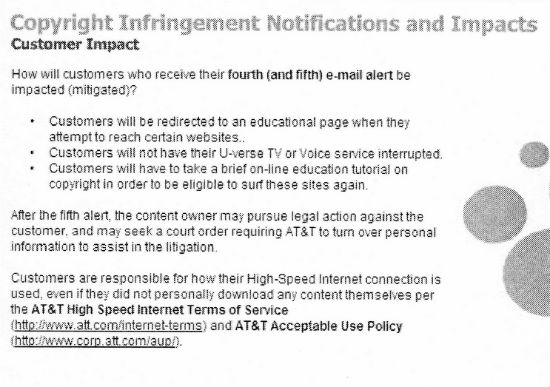
  • AT&T - "From leaked AT&T training documents we learned that the company will block users’ access to popular websites until they complete a copyright education course. However, none of the participating Internet providers have publicly commented on the measures they plan to take, until now" 
    Source - TorrentFreak- here


  • Verizon - Link Hoewing (pictured), VP Internet and Technology Issues, Verizon, said his company will employ a three stage process. The first two alerts will result in a simple notification email informing the users that their connection has been flagged for copyright infringements. After the second warning comes the acknowledgment phase in which a popup is delivered users. Once received subscribers are required to read and confirm, a process designed to ensure that they are aware of the unauthorized sharing that’s taking place via their account.If the infringements continue punishments become a reality on the fifth and the sixth alerts. Hoewing said that these repeated infringers will have their Internet connections throttled resulting in significantly slower download speeds. The throttling is temporary and will be lifted after two or three days.
     
  • TWC - Fernando Laguarda (pictured), VP External Affairs, Time Warner Cable said "his company will take a slightly different approach. The notification and acknowledgment phases are fairly similar, but instead of reducing connection speeds they will restrict users’ Internet browsing by directing them to a landing page".


See "Verizon Will Reduce Speeds of Repeated BitTorrent Pirates" - here.

Thursday, November 1, 2012

UK: Broadband ISPs (except Sky) Still Limit P2P; Some Prioritize VoIP!

 
Thomas Newton (pictured) reports to recombu on the "Fair Use Policies - FUP’s - of the UK’s main ISPs and seen how they stack up against each other" as "Knowing what the traffic management policy of an ISP entails is as important as doing your homework on things like the monthly usage cap, the cost of line rental, customer service and bundled services like digital TV or phone plans".

The article covers BT Broadband, Virgin Media, Sky Broadband, TalkTalk and Everything Everywhere Broadband (see also "UK: ISPs Publish New Voluntary Code on Broadband Traffic Management" - here). 
 
"Sky Broadband is perhaps unique among the UK’s major ISPs in that it doesn't apply any kind of traffic management at all" - but everybody else still limit P2P file sharing (here) - although P2P's share of total traffic is lower now as streaming traffic increases; Netflix alone has now 1M subscribers in the UK - (here). 
 
TalkTlak and EE Broadband prioritize some traffic - such as VoIP (both), gaming (EE) and even Web browsing (TalkTalk).
See "Traffic Management, FUP’s and Throttling: EE throttles P2P, speeds up gaming" - here.

Sunday, September 23, 2012

ARCEP Sees Decrease in Use of TM in Mobile; Plans to Monitor QoS on Fixed Networks

   
ARCEP, the French regulator, published an update on its work on Net Neutrality for France. Following are several  quotes from its press release on the new report:

"Through the Law of 22 March 2011, Parliament has asked ARCEP to provide an update on the status of net neutrality. ARCEP submitted today its report to Parliament and the Government on this issue.

In September 2010, ARCEP published 10 proposals
[here] that aimed at defining a sustainable, neutral and high-quality equilibrium for the functioning of the Internet, combined with tools to ensure this equilibrium is maintained and to guarantee it if needed ..  However, competition and transparency alone are not always enough Therefore ARCEP has engaged further efforts to ensure the ecosystem runs smoothly and stakeholders comply with the principles laid out in 2010.
  • .. to track the quality of Internet access services, ARCEP will adopt a decision before the end of this year that specifies the quality of service indicators for fixed networks, which will be measured and made public, in complement of those already measured for mobile networks   
  • ..  ARCEP has undertaken an inventory of traffic management practices implemented by operators - e.g. throttling, blocking or priority queues.-. Thanks in particular to competition, ARCEP has noticed a decrease in the use of these practices especially on mobile networks. Certain practices are nevertheless contrary to the framework set in 2010 which consists of five assessment criteria. ARCEP is therefore calling, among others, for the steady elimination of service blocking (VoIP, P2P) on mobile networks. If the market fails to make sufficient progress on its own, the current legislation gives the Authority the powers needed to intervene.
Source: ARCEP Report, September 2012
  • .. the interconnection business model, namely the relationships between Internet players, is evolving gradually and can give rise to conflicts: it needs to be better understood. In light of its analysis of the current state of the market, ARCEP considers that there is no need to strengthen the regulatory framework at this stage. The regular collection of information introduced by the Authority's decision of 29 March 2012 has produced its first results this summer 2012 and allows ARCEP to keep track of these trends, to analyse them and take action accordingly.
        
    [See related news about a recent decision given in the case of Orange-Cogent dispute over their peering agreement - "France Télécom may ask to be remunerated for opening additional capacity but it must clarify the commercial and billing relationship between its Internet access and Internet transit businesses" - here; Similar to the Comcast-Level3 case from two years ago (here). 
 ... It is now for Parliament and the Government to determine the follow-up to be given to this report.

See "Net Neutrality" - here.

Tuesday, September 18, 2012

DPI Deployments [176]: Vimpelcom [Russia] Deployed Procera to Manage P2P Traffic

   
While this is a 2011 project, one can still appropriate the willingness of the customer to be quoted by name after implementing a bandwidth management solution, used to "optimize" P2P file sharing traffic.

Procera Networks announced that VimpelCom "..  has deployed Procera’s PacketLogic platforms in nearly 43 cities throughout Russia. Last year, VimpelCom purchased Procera’s Intelligent Policy Enforcement (IPE) solutions to provide network visibility, analytics, optimization and bandwidth management. Most of the corresponding revenue was recognized by Procera last year"

Vimpelcom - Russia

"..[Vimpelcom] implemented a number of Procera’s IPE platforms and PacketLogic Intelligence Center (PIC) solutions including several PL10000 series platforms, PL 8000s, and PICs plus bypass switches for additional network resilience and availability".

"VimpelCom, in conjunction with technology system integrator Jet Infosystems, performed operational and laboratory testing using Procera’s PacketLogic Intelligence Center (PIC) solutions to gain “live” traffic analytics for their extensive network, and found that over 50% of broadband resources were being consumed by peer-to-peer file sharing. The two companies used the results of this research to design a solution that specifically meets VimpelCom’s unique requirements".
   
Related posts - "VimpelCom [Russia] Deployed Symantec's Web Filtering" - here and "Vimpelcom [Russia] Selected Vantrix for Video Services" - here. 

See "Procera Announces the Network-wide Deployment of PacketLogicTM Intelligent Policy Enforcement Solutions by VimpelCom in Russia and CIS Countries" - here.

Saturday, September 1, 2012

[TorrentFreak]: Site Suspected of Copyright Infringement Disappeared

 
TorrentFreak reports that ".. Filesonic, previously listed among the top 10 largest file-sharing sites in the world, was badly affected by the Megaupload shutdown and lost huge amounts of traffic in 2012. During the last 48 hours it simply ceased to function .. Despite the efforts of Filesonic to stay out of the copyright infringement spotlight (in December 2011 the company had partnered with anti-piracy company Vobile), in February 2012 the International Intellectual Property Alliance reported Filesonic to the USTR. IIPA, who count the MPAA and RIAA as members, described Filesonic as an 'infringing distribution hub'".


"But today, six months on, it appears something is seriously amiss with this former giant of the file-sharing world. For two days Filesonic has been completely unreachable via its .com domain after changes were made to its DNS settings"

See "Major Cyberlocker Filesonic Goes Offline After Traffic Plummets" - here.