Showing posts with label traffic shaping. Show all posts

Friday, August 7, 2015

DPI Deployments [361]: AccessKenya Selected Procera


Procera Networks and XON, the Pan-African ICT group announced that "AccessKenya, the leading and most reliable converged Communication and IT infrastructure service provider in East Africa, has selected Procera’s subscriber management solution (based on PacketLogic 8820) to replace an incumbent installation and deliver next generation subscriber experience management solutions to meet the region’s growing demand for high-touch IT services.

Due to an antiquated system becoming un-operational, AccessKenya needed to source a replacement for their subscriber management and provisioning system. The PL8820 was a natural fit meeting several key criteria which where critical to AccessKenya’s needs, including:

  • Multi-tenant support for enterprise clients, providing an enhanced interface to manage their own bandwidth and filtering specific services
  • Replacement of current subscriber statistical interface with an extended statistical interface and information
  • Provisioning mechanism to allow easy provisioning of new subscribers to subscriber manager and support their corporate customer management processes
AccessKenya National Connectivity

See "AccessKenya Chooses Procera Networks’ PacketLogic Platform for Next Generation IT Services" - here.

Tuesday, June 23, 2015

Ipanema Adds a Virtual, 1Gbps, Traffic Management Engine


Ipanema Technologies (part of InfoVista) announced the "..release of its new virtual engines portfolio, the vip|e. The solution embeds the whole set of features of Ipanema’s leading application performance physical devices offering (also known as ip|engines) – including application visibility and control (AVC), WAN optimization, dynamic WAN selection and network rightsizing – on a single, centrally-controllable virtual machine.

.. Ipanema’s virtual engine can be easily deployed in countries with custom-clearance issues, and in sites with limited space or constrained environments. vip|e also supports communications service providers’ (CSPs) Point of Presence-based deployments and provides them with a strong step towards network function virtualization (NFV) and SDN. Lastly, vip|e can be deployed in Cloud-Exchange Hub and Internet peering point to improve access to cloud-based applications.


Ipanema Application visibility 

The new virtual engine portfolio is available in four versions to match varying enterprise requirements from a maximum bandwidth of 20 Mbps up to 1 Gbps". 

See "Ipanema Launches Virtual Engine" - here.

Monday, June 22, 2015

Sprint's Congestion Management "relies on the radio scheduling software provided by Sprint’s hardware vendors"


Back in April '14, Sprint said that "To more fairly allocate network resources in times of congestion, customers falling within the top 5% of data users may be prioritized below other customers" (see "Sprint's Reasonable Network Management Practices - Fairness, Limit top 5%, Video Optimization" - here). 

It turns out that now, with the FCC' New Net Neutrality rules becoming effective, this is no longer necessary! (or fines like AT&T $100M [here] may cause more damage) - and now the Sprint congestion management "relies on Sprint’s hardware vendors".  

Lance Whitney reports to CNET that "Sprint has stopped its data-throttling policy now that new Net neutrality rules are in place, the Wall Street Journal reported Thursday.

.. Sprint acknowledged the halt to its data throttling in a statement sent to CNET:

'For less than a year, Sprint used a network management practice that applied only at the level of individual congested cell sites, and only for as long as congestion existed. At such sites, we temporarily allocated resources away from the top 5 percent of heaviest users and to the 95 percent of users with normal usage, to try to allocate the effects of congestion more fairly. Once congestion at the site passed, the limitation automatically ended. Upon review, and to ensure that our practices are consistent with the FCC's net neutrality rules, we determined that the network management technique was not needed to ensure a quality experience for the majority of customers'".

Sprint's updated "Open Internet Information" page (here) says: "Sprint employs a holistic approach to managing congestion on its data network. Sprint’s first goal is to avoid congestion altogether by directing traffic to the best available spectrum resources and cell sites. Sprint also attempts to avoid congestion by managing tonnage on its network. Finally, when congestion does occur, meaning that the demand on a particular sector temporarily exceeds the ability of that sector to meet the demand, Sprint relies on the radio scheduling software provided by Sprint’s hardware vendors to allocate resources to user

See "Sprint stops data throttling in wake of new Net neutrality rules" - here.

Monday, May 4, 2015

UK Experts: Need to Control Internet Demand, Due to Power & Fiber Shortage

    
Adam Withnall report to The Independent that "Britain could be forced to introduce internet rationing, after an expert warned it could consume the country’s entire power supply within 20 years. 

Experts said we were close to “filling up” the nation’s network of optical fibres for the first time ever, with the demands of popular video-streaming websites like YouTube and Netflix putting an unprecedented strain on communications infrastructure .. 

..devices such as PCs and TVs included, internet transmission already accounts for between 8 and 16 per cent of Britain’s power
 

Andrew Ellis [pictured], professor of optical communications at Aston University, said rationing internet use or charging more so that more cables can be installed may need to be considered. Unless action is taken, optical fibres could reach their limit within eight years". 

See "Britain may be forced to ration the internet, expert warns, as web use could consume 100% of nation's power supply by 2035" - here.

Thursday, April 9, 2015

Saisei Helps SPs Conform to Net Neutrality


DPI vendors are offering fairness-based traffic shaping solutions for more than 15 years now (such as Fair Use Management by Allot, Fair Use Policy by Sandvine and "Procera Networks and Openet Partnership Delivers Advanced Fair Usage to APAC" - here).

These solution support throughput of  hundreds of Gbps in an appliance or using a virtual s/w deployment (Sandvine, Procera, Allot), but one should never skip a good marketing opportunity - such as the anticipated (US-centric) new Net Neutrality rules.

And indeed - Saisei announced "Net-Neutrality-in-a-Virtual-Box, a simplified version of its powerful FlowCommand™ Network Performance Enforcement (NPE) software, that is specifically targeted at solving the network issues relating to the pending fair Internet usage mandate stemming from recent US FCC recommendations as well as growing enterprise network congestion.

Saisei’s Net-Neutrality-in-a-Virtual-Box comes preconfigured with Saisei’s unique “Host Equalization” enabled on start up. Using Host Equalization in-line, the Saisei solution automatically identifies, monitors and controls every single flow on a critical broadband link – up to millions of concurrent data, voice and video sessions – in real time without any impact on network performance.


Host Equalization gives every host – user – on a link exactly the same percentage of the available bandwidth that every other user has, regardless of what application(s) they may be running. Aggressive applications, including peer-to-peer apps like BitTorrent, high volumes of YouTube traffic or file transfers, that used to grab huge percentages of link bandwidth and crash other users, will now get the same percentage of a link’s bandwidth as every other user on the network.

Net-Neutrality-in-a-Virtual-Box can be deployed either as a VM under Hypervisor – VMware or KVM – control or, for customers preferring a traditional hardware solution, on Saisei-certified bare-metal x86 server cores as a bump-in-the-wire on routed IP links. Currently, links up to 10G are supported, with higher bandwidth solutions now under development"
.

See "Net-Neutrality-in-a-Virtual-BoxTM from Saisei Instantly Enforces Equal Access for all Broadband Network Users at the Click of a Button Regardless of Network Load" - here.

Tuesday, April 7, 2015

Juniper (W/Maxeler Technologies) Unveiled an Application & Packet Flow Accelerator


MaxelerLow Latency Platforms
Juniper Networks unveiled the "..QFX5100-AA, a new application acceleration switch, and the QFX-PFA, a new packet flow accelerator module, together providing a ground-breaking data center switch that consolidates compute resources and customizable logic into the network. 

Building on Juniper’s proven QFX product family, the QFX5100-AA and QFX-PFA in partnership with Maxeler Technologies’ customizable software logic will significantly accelerate business-critical applications in latency-sensitive computing environments.

Available in Q3 2015, the QFX5100-AA and QFX-PFA will enable financial services providers to streamline their network operations while empowering their customers to make split-second analysis based on significant amounts of data. Specific benefits will include:

  • A holistic data center network architecture that builds on the Juniper Networks®QFX5100 with a new 40G Ethernet switch that combines the Intel® Xeon™ processor E3-1125C v2 with Broadcom switching silicon, and the QFX-PFA module based on the Altera multi-100G field-programmable gate array (FPGA).
     
  • QFX5100-AA and QFX-PFA work with Maxeler Technologies’ dataflow programming environment for specific application programming that enables customers to develop and customize applications that best suit their requirements.
     
  • Performance acceleration at the application level provided by using customizable logic to offload processing of compute-intensive, real-time, deterministic, latency sensitive applications"
See "Juniper Networks Advances Application Performance and Acceleration with New Compact Compute-Integrated Network Switch" - here and "Require high performance and application acceleration? Meet the new QFX5100-AA Switch" - here.

Tuesday, March 3, 2015

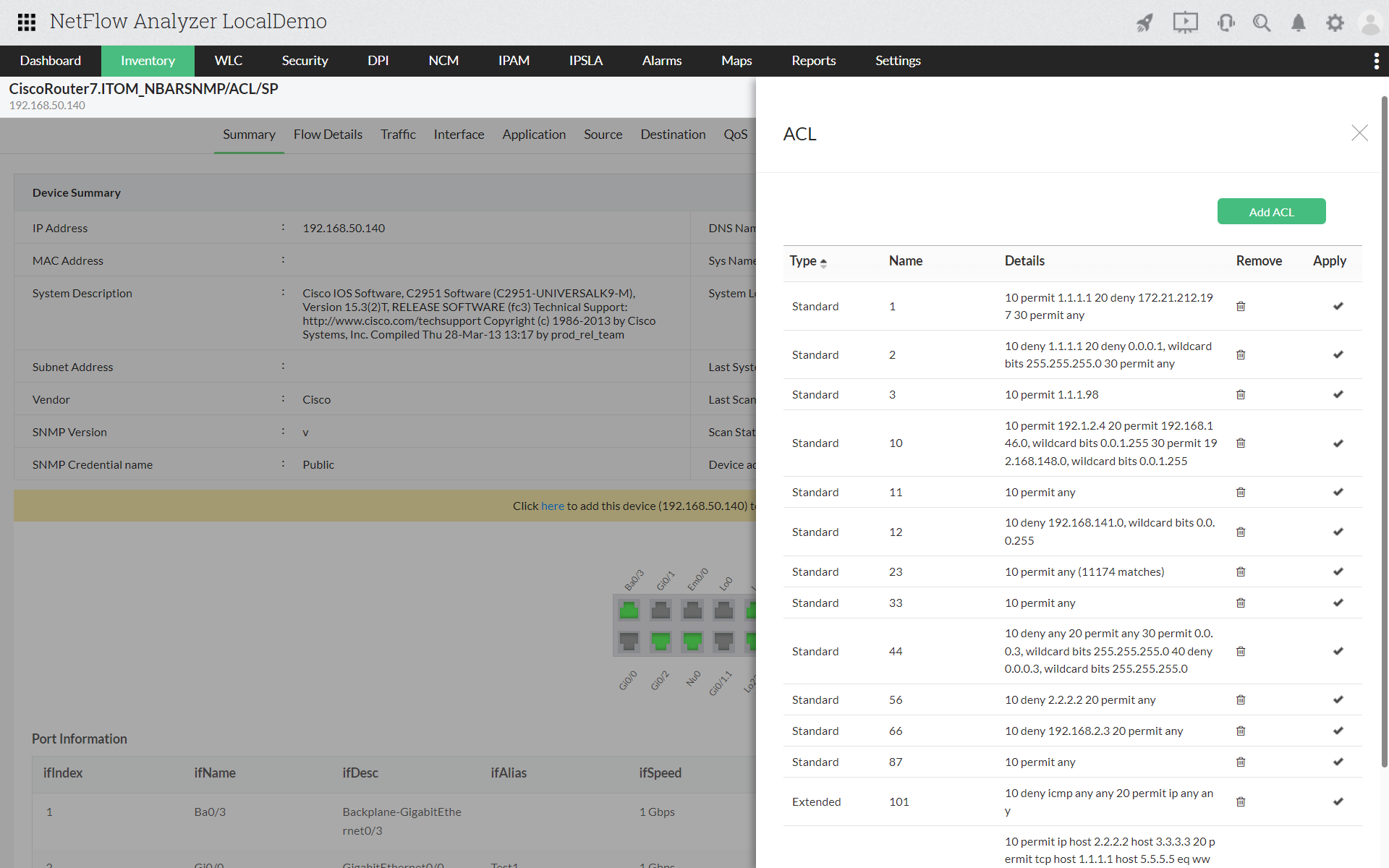
ManageEngine Enhances NetFlow Analyzer w/Traffic Shaping


ManageEngine announced the "latest versions of NetFlow Analyzer, its real-time bandwidth and security analysis software, and Network Configuration Manager, its network change and configuration management (NCCM) solution. Available immediately, NetFlow Analyzer pricing starts at $3,750 USD for 50 interfaces. Network Configuration Manager version 11 starts at $1,195 USD for 25 devices":
  • NetFlow Analyzer gains traffic shaping to ensure critical apps are served on priority, device discovery and one-click flow export to add devices from the web GUI itself, and email and SMS notifications for DoS attacks .. it shapes network traffic by reconfiguring the bandwidth allocated to various apps via CBQoS and access control list (ACL). Now, admins can not only monitor the traffic trends but also configure a guaranteed percentage of bandwidth to critical apps and serve them on a priority basis
  • DeviceExpert has been renamed as Network Configuration Manager and adds reports that help service providers who deal with customer card data comply with PCI DSS 3.0 requirements. It also includes a configuration review feature.
See "ManageEngine Adds Traffic Shaping, PCI DSS 3.0 Compliance to Network Management Solutions" - here.

Friday, January 16, 2015

Ruckus Adds App-Aware Traffic Management Technology to Improve Performance


Ruckus Wireless announced  that "..several Ruckus ZoneFlex™ access points (APs) ..  have all been qualified under the Microsoft Lync Server Wi-Fi qualification program.

.. Unlike competitive alternatives, Ruckus Smart Wi-Fi access points integrate patented SmartCast™ technology. SmartCast combines sophisticated scheduling and queuing mechanisms with advanced heuristic algorithms that automatically identify and characterize traffic based on its unique behavior to help ensure peak performance.


With a Ruckus Smart Wi-Fi system, all traffic is queued/de-queued by specialized schedulers, optimized for the corresponding traffic type, the delay/jitter tolerance and bandwidth requirements of the traffic, and the changing characteristics of each station on the wireless LAN. This automatic Type Of Service (TOS) tagging also eliminates complex Quality of Service (QoS) configurations, with automatic management of lower-speed 802.11 devices to assure bandwidth availability for prioritized video and voice over Wi-Fi applications. When combined with Ruckus BeamFlex™ adaptive antenna array technology that directs each packet over the fastest signal path that yields the highest data rates, multimedia Wi-Fi performance is effectively perfected".

See "Ruckus Makes Multimedia Streaming and Wi-Fi Calling Crystal Clear, Flicker Free, Picture Perfect" - here.

Sunday, January 11, 2015

AT&T: The FCC is to Decide if our Network Management Program is “unfair”


Last November I reported that the "FTC Sues AT&T for Shaping Unlimited Subscribers" (here).

Jon Brodkin reports to ARS Techica on AT&T's response: "The Federal Trade Commission cannot prevent AT&T from throttling unlimited data customers because of AT&T’s status as a common carrier, the company claimed in a motion to dismiss [see below] an FTC lawsuit this week"

In addition, AT&T says that the FCC is already checking the same issue:

"The FTC seeks to litigate the very same issues in an inappropriate parallel proceeding. It asserts in this lawsuit that AT&T’s imposition of MBR was unfair and that its disclosures were inadequate. But whether AT&T’s network management program is “unfair” and whether its disclosures were “inadequate” are issues for the FCC to decide, and in fact the FCC is in the process of so deciding, just as Congress intended".

See "AT&T defends unlimited data throttling, says the FTC can’t stop it" - here.


Tuesday, January 6, 2015

Secured Video Streaming is Bad for Your In-flight Internet


Gogo, the in-flight internet services provider, released a statement about its traffic shaping and blocking practice, made by Anand Chari [pictured], EVP and CTO:

Gogo takes our customer’s privacy very seriously and we are committed to bringing the best internet experience to the sky. Right now, Gogo is working on many ways to bring more bandwidth to an aircraft. Until then, we have stated that we don’t support various streaming video sites and utilize several techniques to limit/block video streaming. 

One of the recent off-the-shelf solutions that we use proxies secure video traffic to block it. Whatever technique we use to shape bandwidth, It impacts only some secure video streaming sites and does not affect general secure internet traffic. These techniques are used to assure that everyone who wants to access the Internet on a Gogo equipped plane will have a consistent browsing experience.

We can assure customers that no user information is being collected when any of these techniques are being used. They are simply ways of making sure all passengers who want to access the Internet in flight have a good experience.


This comes as a response to the following tweet:


See "STATEMENT FROM GOGO REGARDING OUR STREAMING VIDEO POLICY" - here.

Sunday, November 2, 2014

FTC Sues AT&T for Shaping Unlimited Subscribers


Do you remember this move by AT&T, back in 2011 -  "AT&T to Throttle Top 5% of Unlimited Subscribers" - here?

Here comes the consumer response.

The Federal Trade Commission (FTC) announced that  it has "..filed a federal court complaint against AT&T Mobility, LLC, charging that the company has misled millions of its smartphone customers by charging them for “unlimited” data plans while reducing their data speeds, in some cases by nearly 90 percent.

The FTC’s complaint alleges that the company failed to adequately disclose to its customers on unlimited data plans that, if they reach a certain amount of data use in a given billing cycle, AT&T reduces – or “throttles” – their data speeds to the point that many common mobile phone applications – like web browsing, GPS navigation and watching streaming video – become difficult or nearly impossible to use.


..The FTC alleges that AT&T, despite its unequivocal promises of unlimited data, began throttling data speeds in 2011 for its unlimited data plan customers after they used as little as 2 gigabytes of data in a billing period. According to the complaint, the throttling program has been severe, often resulting in speed reductions of 80 to 90 percent for affected users. Thus far, according to the FTC, AT&T has throttled at least 3.5 million unique customers a total of more than 25 million times".

Related post - "AT&T: 1M Subscribers Switched from Unlimited to UBB in Q1" - here.

See "FTC Says AT&T Has Misled Millions of Consumers with ‘Unlimited’ Data Promises" - here.

Saturday, October 18, 2014

[Israel]: ISP to Compensate Customers for P2P Traffic Shaping


Two years after a class action lawsuit was filed, judge Ester Shtemer, from the Lod District court, ruled against 012 Smile (subsidiary of Partner Israel), one of Israel largest ISPs for its traffic shaping policy (see the full decision below, Hebrew).

The plaintiff claimed that the 012 did not provide an appropriate speed to its subscribers, when P2P file sharing programs were used, and asked for a compensation of over NIS70M (~$20M).

012 Smile said that they are not committed to provide any specific speed, and they use traffic management policies to prevent P2P program to takeover all available bandwidth, as file sharing is different from interactive web browsing. 012 admitted that file sharing users were discriminated, that they over-subscribe their infrastructure. However, they did not participate in the Glasnost (see "Glasnost: These ISPs are Shaping Traffic!" - here) tests that were presented as evidence by the plaintiff.

[Related post: "Israel: Carriers Must Disclose Broadband CIR" - here and "[Israel] ISPs Respond to the CIR Regulation - What do they Promise?" - here]

012 Smile CEO, Uri Wertman (left the company earlier this year), testified that they have 500,020 subscribers; an estimated 25% were using P2P file sharing applications, and 45% of them were discriminated - a total of 56,252 customers were affected.

The result?
  • Smile 012 will provide 9 months of free speed upgrade to each customer asking for it (worth $2/month)
  • 012 smile will deploy a control system that will ensure that the network will provide 98% of the accumulated demand (95% at peak hours) of all customers. 


Friday, August 15, 2014

T-Mobile to Shape Misusage Over LTE

  
Years after P2P identification and shaping was almost the only business for DPI products in the fixed market (starting with music files going to video), it is back again - to LTE networks.

Cam Bunton reports to TmoNews that In an "..internal memo to staff, it’s been revealed that T-Mobile is going to clamp down on users taking advantage of their unlimited 4G/LTE plans for peer-to-peer file sharing and other misuse of their data allowance" (see the leaked document below) 

Misuse, a-la T-Mobile, includes P2P file-sharing, but also other popular uses, such as M2M (here) "using the Service in connection with server devices or host computer applications, including continuous Web camera posts or broadcastsautomatic data feedsautomated machine-to-machine connections or peer-to-peer (P2P) file-sharing applications that are broadcast to multiple servers or recipients, “bots” or similar routines that could disrupt net user groups or email use by others or other applications that denigrate network capacity or functionality"

Will the FCC send now a new set of questions to US MNOs, based violating the open Internet principles by discriminating content?  (see "FCC Expands Traffic Management Policies Questioning to all MNOs" - here


See "T-Mobile to throttle customers who use unlimited LTE data for torrents/p2p" - here.

Saturday, July 26, 2014

Verizon Expands "Optimization" to LTE Subs to Fight Cell Congestion


3 years after Verizon established its optimization policy to reduce cell congestion, [see "Verizon Explains its "Network Optimization" Policy" - here] it is now expanded to LTE.

Kellex reports to DroidLife that "On October 1, Verizon will expand its existing Network Optimization policy to include unlimited data customers who use 4G LTE devices and “have fulfilled their minimum contract term.” That “optimization” occurs when an unlimited data customer meets specific criteria and hops onto a cell site that is experiencing high demand. This is only a temporary reduction, not a billing cycle throttle. Once that customer leaves the cell site under stress, their connection should return to normal.

Update: The policy is changing somewhat on how long you could be throttled. From information we have received from sources (and now reflected on Verizon’s own policy), the throttling could last through a current billing cycle and on to the end of the next, should a user be on a cell site experiencing high demand. This is the exact wording for the potential throttling – “The customer may continue to be impacted for the rest of the current billing cycle and through the next billing cycle, but only while on a cell site that is experiencing high demand.


Verizon's Optimization Policy page (here) says that "95% of our data customers are not impacted. The top 5% with devices on unlimited data plans may experience managed data speeds when connected to a cell site experiencing high demand after reaching certain data-usage levels in a bill cycle. These high data users will feel the smallest possible impact and only experience reduced data speeds when necessary for us to optimize data network traffic in that area"

See "Starting October 1, Verizon Will Include Unlimited 4G LTE Customers in “Network Optimization”" - here.

Sunday, June 15, 2014

Zen Internet: Unlike Other UK ISPs - We do not Shape Traffic


A post to Zen Internet's (UK) blog states that "All ISPs manage the data running across the network – the traffic – to some extent, but some larger ISPs are more intrusive. In some cases they throttle speeds, deliberately slowing down connections when users exceed what the ISP terms acceptable use. In others, they use a technique called Deep Packet Inspection to monitor usage and throttle the connection when you’re using specific bandwidth-intensive applications, such as Peer to Peer file-sharing.

.. At Zen, we think this is wrong. We don’t use traffic shaping or deep packet inspection in any form. We feel that our customers deserve services that are open, honest and easy to understand. That’s why our products use a fully transparent system of allowances, where customers simply pay for blocks of additional usage when they go over their generous monthly allocation, and where unused blocks can be held back for another month".

However, we understand that broadband usage patterns are changing. More of us are doing more online through more devices. That’s why we doubled the usage allowances across our product range and why we invest heavily in the network to ensure we can provide reliable speeds and quality of service.

See "No throttling, no squeezing: The Zen approach to Traffic Management" - here.

Saturday, June 14, 2014

Cisco: The Internet Needs Prioritization


Grant Gross reports to Network World about Cisco's approach to Net Neutrality "All bits running over the Internet are not equal and should not be treated that way by broadband providers, despite net neutrality advocates' calls for traffic neutral regulations, Cisco Systems said". 


Cisco's Recent  Visual Networking Index Predictions

Jeff Campbell, VP government and community relations, Cisco says: "Some Web-based applications, including rapidly growing video services, home health monitoring and public safety apps, will demand priority access to the network, while others, like most Web browsing and email, may live with slight delays .. We really have a multiplicity of applications and services that are now running across the network, some of which require dramatically different treatment than others".

This is of course, the easier part of Net Neutrality - prioritize traffic according to its network needs - and may be part of "Reasonable traffic management" - rather than prioritizing traffic according to its content provider which may create unfair competition.

See "Cisco: Broadband providers should not treat all bits the same" - here.

Sunday, May 11, 2014

Sprint's Reasonable Network Management Practices - Fairness, Limit top 5%, Video Optimization


Tammy Parker reports to FierceWireless that "Sprint's pledge of unlimited data [see "Will New Competition Drive AT&T to Bring Back Unlimited Data?" - here and "Sprint CEO: 'we have no plans go to tiered data pricing'" - hereis looking increasingly less sustainable, as the carrier maneuvers to rein in network traffic generated by its heaviest data users and ensure quality of service for the majority of its customers. Postpaid as well as prepaid Sprint customers, including those on its Virgin Mobile USA and Boost Mobile sub-brands, have begun receiving notices alerting them to new data "prioritization management" the operator will employ as of next month to prevent network congestion .. Prioritization can include a reduction of throughput or speed for those targeted users connected to congested sites".

Sprint's "Open Internet Information" page (here) says that 
  • Sprint uses various tools and techniques to manage its network .. Sprint's network management activities may include identifying spam and preventing its delivery to customers, detecting malicious Internet traffic and preventing the distribution of viruses or other harmful code or content, allocating spectrum and network resources amongst customers, devices, and price plans, and using other tools and techniques to deliver the best possible broadband Internet experience of Sprint's customers
     
  • Network bandwidth isn't infinite. In times of network congestion, the network segment or sector impacted doesn't have enough bandwidth to fully serve all customers requesting it. The network is designed to dynamically allocate available bandwidth in a way that is fair to all users. The fairness algorithms below describe the approach. The resulting impact to the end-user experience is that the user may temporarily experience slower-than-normal data speeds until the congestion has passed.
     
    • On the Sprint 3G (CDMA) and 4G LTE networks, Sprint uses a proportional fairness scheduler algorithm that allocates network resources based on radio frequency signal quality and other metrics. During times of congestion, the proportional fairness scheduler algorithm ensures no one user is deprived of network resources.
       
    • On Sprint's 4G WIMAX network, Sprint may periodically measure a user's bandwidth usage on a specific network segment or sector, as compared to the overall bandwidth usage for all users on that segment or sector. At times when an individual user is consuming high amounts of bandwidth and at the same time the overall bandwidth is being used by all users on that network segment or sector at high levels, Sprint 4G customers may experience a temporary adjustment in available network resources until the conditions for network congestion have passed.

  • Sprint currently employs prioritization to improve data experience for the vast majority of users on Sprint’s CDMA and LTE networks. The heaviest data users consume a disproportionate share of network resources and cause a negative user experience for the rest. To more fairly allocate network resources in times of congestion, customers falling within the top 5% of data users may be prioritized below other customers attempting to access network resources, resulting in a reduction of throughput or speed as compared to performance on non-congested sites .. in addition to the heavy user treatment outlined above, Sprint also reserves the right to alter the priority of other customers on specific devices or plans on the Sprint network. Customers on devices or plans subject to prioritization management may experience a reduction in throughput or speed
     
  • Optimization is deployed for RTSP and HTTP video traffic and all HTTP web traffic [by Citrix/Bytemobile - here]. Video optimization uses four basic technologies [see "Sprint Migrates from a "Basket of Tools" to Consolidated Video Optimization Solutions" - here]:
      
    • Video Delivery Synchronization: Delivers video "just in time" to the mobile device. Intent is to eliminate network waste associated with transmitting video that isn't watched.
       
    • Quality Aware Transcoding: Matches video quality with network conditions in real time. Optimizes video for the bandwidth available to the user. Intent is to minimize or eliminate annoying video stalling. Similar in concept to the optimization techniques already employed by sites using adaptive streaming.
       
    • Video Transcoding: Transcodes video with intent to optimize the video experience for the user while efficiently using network bandwidth. Provides for the elimination of video waste using techniques like replacing less efficient video codecs with more efficient ones. Optimizes video for the mobile device the customer is using.
       
    • Intelligent Caching: Caches optimized video in the network with the intent of eliminating delay associated with internet video sites.
       
  • Web optimization uses three basic technologies:
    • Caching: Caches web pages to help avoid delays associated with retrieval of the same internet content multiple times.
       
    • Text/Binary Compression: Lossless compression of data and binary files using standard compression techniques supported by HTTP-compliant browsers.
       
    • Image Compression: JPEG and GIF compression designed to reduce the size of images while maintaining no user perceptible loss of quality.
See "Sprint slams on the brakes for top 5% of data users in congested areas" - here.

Wednesday, April 9, 2014

ConteXtream and Guavus Bring Analytics to SDN-based Carrier Networks


ConteXtream announced that it has "..partnered with Guavus to bring real-time analytics to Software Defined Networking (SDN) deployments on service provider networks. The partnership will combine ConteXtream’s ContexNet™ and Guavus’ Reflex™ operational intelligence platform. 

The joint solution gives network operators an end-to-end view across their network and enables Communication Service Providers (CSPs) to dynamically and more efficiently allocate network resources for video optimization, TCP optimization, and rate shaping".


See "ConteXtream and Guavus Partner to Make Service Provider Networks Programmable with Real-time Analytics" - here.

Wednesday, July 17, 2013

IETF Proposed Framework for Application Visibility


A new IETF Internet Draft "provides a framework for communicating information elements (a.k.a. metadata) in a consistent manner between applications and the network to provide better visibility of application flows, thereby enabling differentiated treatment of those flows. These information elements can be conveyed using various signaling protocols, including PCP, RSVP, and STUN".

Authors are: Toerless Eckert, Reinaldo Penno, Amine Choukir and Charles Eckel [pictured] - all from Cisco.


See "A Framework for Signaling Flow Characteristics between Applications and the Network" - here.

Monday, May 20, 2013

[Plusnet]: "We’re big fans of traffic management and truly unlimited broadband"

 
Kelly Dorset, Head of Products and Digital Care, Plusnet [UK] explains in a post to lovemoney that ".. traffic management is often seen in a negative light with many in the industry, technology media and broadband users viewing it as an unnecessary slow down on services to stop users downloading lots of bandwidth. Here at Plusnet [here], that couldn’t be further from the truth. We’re big fans of traffic management and truly unlimited broadband and we offer them both at the same time. Traffic management, otherwise known as traffic prioritisation, is applied to all Plusnet’s broadband products and ensures that real time applications like gaming and streaming don’t get interrupted when more than one person is downloading at the same time".

Plusnet traffic management policies are explained here and shown below ("the systems identify traffic and assign it to one of six priority queues; Titanium is the highest priority").

The ISP mentions that "Some applications not using the standard port may not be identified correctly by our system, as we use DPI to identify applications on the network. These applications may be classified as 'other' traffic in which case a lower priority may apply"
 
Plusnet Traffic management Policies

See also "[Ofcom] UK Traffic Management; P2P Might be Reduced by 99%" - here and "Plusnet: Troubles with Traffic Management System" - here.

"Plusnet prioritises certain types of traffic to ensure there is enough bandwidth, or data, available for each activity to be performed without interruption. Plusnet gives streaming games and video high priority to ensure they don't buffer or lag. For example, if you’re making a video call to relatives on the other side of the world, you don’t want the picture of your suntanned beloved to break up"

See "Why broadband traffic management is a good thing" - here.