Showing posts with label EANTC. Show all posts

Wednesday, October 15, 2014

Procera Validates 40 Gbps Performance for its NFV Product

   
The DPI vendors continue to promote their NFV products (see "Allot and Procera Push NFV-based DPI" - here), with Prcera Networks already validating its perfroamce level on standard hardware.

the company announced today that "PacketLogic/V, [see "Procera Goes Virtual" - here] Procera’s Network Functions Virtualization (NFV) software solution, has been benchmarked by the European Advanced Network Test Center (EANTC) at 40Gbps with fully active Internet Intelligence functionality, running on commercial off-the-shelf (COTS) equipment. 

The EANTC testing measured the performance of the PacketLogic/V solutions running on a dual socket Intel® Xeon® E5-2699v3 CPUs clocked at 2.30 Ghz and 18 cores with 64 Gigabytes of memory (RAM). The software environment for the test was Debian 7.6 and Qemu 1.6.2, as well as version 15.0.4.5 of PacketLogic software. 

The tests measured the performance and latency of PacketLogic/V running in a NFV configuration with full Internet Intelligence capabilities being exercised. In the tests where PacketLogic/V was achieving 40Gbps of performance, the CPU usage never exceeded 45%, demonstrating that the performance could go higher if the platform supported more interfaces".

The following charts show the tests results in which "we sent full-stack layer 7 traffic and measured again the throughput of the system. The throughput of the system during this test was less influenced by the packet per second performance but by actually running the deep packet inspection analysis on the flows the Ixia tester generated and creating statistics on these flows" for HTTP-only and mixed traffic flows.

HTTP-Only
Throughput Performance

HTTP, YoutTube, Bittorent,SIP and Skype mix
 Throughput Performance

See "Procera Networks NFV Performance Validated by EANTC at 40Gbp/s on COTS Equipment" - here.

Saturday, February 23, 2013

Cisco: PCRF Performance Improved


 Murali Nemani (pictured), Sr. Director, Service Provider Mobility Marketing, Cisco updates in a blog post about a recent performance test for its (ex. BroadHop) Quantum policy manager.

The test, performed by EANTC (see "How did EANTC Test Comverse PCRF?" - here), shows the system has a "linear scale-out to 250K transactions-per-second with 75M concurrent sessions" (see report below).

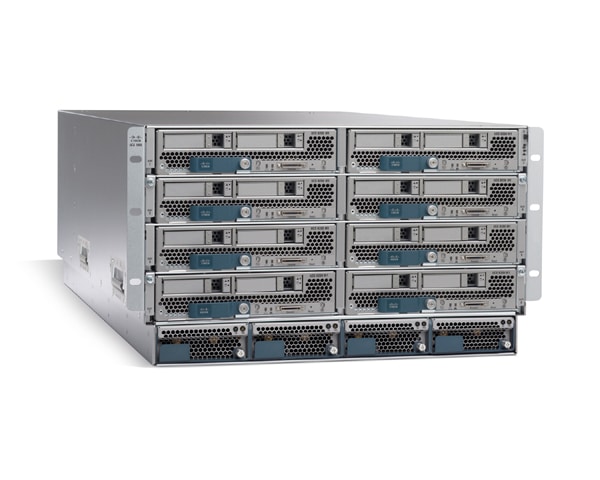
Cisco UCS 5108
A "system" in this case was up to 6 UCS 5108 chassis, each taking 6RU with 8 UCS B200 blades, with fabric interconnect. For the table below I took the numbers for a single chassis with 6 blades ("initial load") in order to try to compare with the other vendors. Previous test results by BroadHop (here) "Demonstrated support for 28,000 TPS with 16 blades in a single 10U chassis"

See below a short comparison of all tests published so far. Test scenarios, hardware configuration, size and cost are not the same in all tests. Probably even the definitions of TPS (or PDP contexts setups by some vendors) are not equal as well. Please refer to vendor's documentation for more specific information.

Vendor
Date
Published
Tester
System Performance (TPS/Chassis)
Subscribers/
System
Blade Performance
Blog Post
Cisco
Feb 22, 2013
EANTC
34,000
10.2M


Openet
Jan 9, 2013
Internal
200,000

25,000
Comverse
Jan 9, 2013
EANTC
200,000
31.5M
15,000
Tango Telecom
Feb 6, 2012
Internal
192,000

12,000
Amdocs (Bridgewater)
Sep  15, 2010
EANTC


See "A Quantum Leap Forward for Policy" - here.

Tuesday, January 15, 2013

How did EANTC Test Comverse PCRF?

 
My post "PCRF Performance: Openet vs. Comverse Vs. Others" (here) mentioned that Comverse's PCRF testing was performed by the European Advanced Networking Test Center (EANTC).

EANTC also tested previously the BroadHop (Cisco) and Bridgewater Systems (Amdocs) PCRF products.

Developing Solutions announced that it was "invited by the EANTC to participate in the testing of Comverse’s Data Management and Monetization Policy Manager (PCRF) in multiple configurations, including an LTE scenario. Developing Solutions’ dsTest® supported EANTC’s testing with flexible configurations based on the solution’s capabilities and EANTC’s test plan .. Four separate scenarios were tested: Gx, Gx/Rx, Gx/Sy, and Gx/Rx/Sy. These scenarios called for subscribers being active for 30 minutes performing coordinated updates with customized AVPs on the interfaces under test. dsTest simulated 36 Million active subscribers and maintained the more than 200,000 TPS requirement".

See also - "[Guest post]: PCRF Test Methodology", by By Don Wuerfel, Director of Engineering, Developing Solutions - here.


See "EANTC Chooses dsTest for Comverse PCRF Performance Testing" - here. 

Saturday, November 20, 2010

PCRF Vendors Publish Performance tests - now it is BroadHop

   
Following Bridgewater Systems (here), BroadHop also engaged the European Advanced Networking Test Center (EANTC) to measure its policy management server performance.

The company announced that " Quantum Network Suite, BroadHop’s 5th generation policy management and control solution, successfully completed an in-depth and independent set of policy tests designed to measure scalability, performance, and real world use required for today’s rapidly evolving networks".

See "BroadHop Sets New Performance and Scalability Benchmarks for 3G, 4G LTE Mobile Networks Policy Control" - here.

"Key findings from the BroadHop Quantum Network Suite Performance and Scaling Tests:
  • Demonstrated support for 20 million active mobile user sessions from a single, 10U server chassis with sixteen server blades
     
  • Demonstrated support for 28,000 TPS with 16 blades in a single 10U chassis
     
  • Demonstrated support for 13K TPS with 8 blades in a single 10U chassis while applying policy and charging rules to multimedia voice and data traffic (Gx/data and Rx/VoIP)"
I was not able to find comparable results from Bridgewater.

See also:
  • "Heavy Reading - "[performance boosted] policy management can play a vital role a telco’s overall product and service strategy" - here
     
  • "Bridgewater and Broadhop are Getting Closer to Cisco" - here.

Wednesday, September 8, 2010

Lightreading: Cisco's GGSN DPI Feature Under Test [Continued]

    
LightReading published the 2nd part of its Cisco mobile solution testing. See my post on the first part - here.

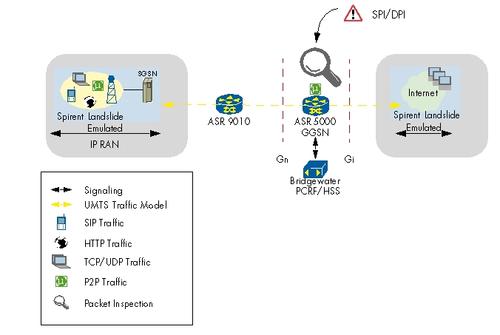
This time the Cisco GGSN, ASR 5000, (former Starent product) was tested, including its DPI capabilities.

See "Results: ASR 5000 GGSN Performance With DPI" - here.

LightReading summarizes: "In a GGSN role, the Cisco ASR 5000, configured with a Cisco-selected list of 900 HTTP, 99 TCP/UDP stateful filter rules plus one BitTorrent filter rule, achieved the exact same 20 Gbit/s throughput performance with 1 million active subscribers as in the previous GGSN test"

LightReading assumes that "The question in DPI tests is mainly how many rules are there, of what kind, and to what detail" - I must add to that that the rate of new connections (which means the rate of application identification processes) is also an important factor to the DPI performance.

The test itself had one rule for P2P traffic (detecting BitTorrent) and 900 rules for URL match (which Starent had for long time, for charging purposes). All the rest, including VoIP, was detected using layer 3-4 parameters (i.e. non-DPI detection).

If I am trying to correlate the test to common use-cases, my observations are:
  • Use case 1 Slowdown traffic - penalize subscribers that have exceeded their monthly usage limits, or reduce load on congested links - Usually means slowing-down all P2P file sharing traffic not just BitTorrent. Although all they had to do here was to define the relvant policies.
     
  • Use case 2 Block competitive VoIP services - Skype is the major detection challenge - but it was not tested.
     
  • Use case 3  charging - detecting access to a list of URL represents this well. It was tested here (although without the north-bound reporting).
Therefore, I believe that the test (which only tested the DPI process, without the QoS actions that are usually associated with DPI policies) does not really represent the common uses of DPI in mobile broadband environment.

I am also not sure that "Carriers favor integrated solutions, however, for ease of management and maintenance" - for the case of the GGSN, which is the most significant network element in the packet core where stability and performance are above all. It seems that the DPI solution from the pure players are much more advanced in their application identification capabilities.

LightReading comments on the above that "As a side note, the ASR 5000 product documentation (version 10.0) lists support for detection of over 64 peer-to-peer and streaming protocols, including the classics (BitTorrent, eDonkey, Gnutella), voice over IP protocols (Skype, Google Talk, Skinny), games (for example World of Warcraft, Xbox, SecondLife), video streaming (Slingbox etc.), and chat protocols (Fring, Yahoo, MSN...). The operator can not only block the traffic, but also police the bandwidth (limiting VoIP quality to be worse than operator voice service quality, for example – hard to pinpoint for subscribers). We tested only BitTorrent blocking in the available time."


Monday, August 30, 2010

Lightreading: Cisco QoS for Mobile Under Test

 
Lightreading published the results of a comprehensive test of Cisco Mobile/RAN solution. One of the scenarios tested was QoS performance - "demonstrated that the ASR 9010 and 7609 platforms could appropriately classify and prioritize five classes of traffic during link congestion"

See "Testing Cisco's Next-Gen Mobile Network QoS in the IP-RAN" - here.

I do not see anything about the ability to classify applications - they were probably using tagged or marked headers.

The tests were conducted by European Advanced Networking Test Center AG (EANTC).