Fixed-line broadband providers need to constantly invest in increased network capacity in order to keep pace with unrelenting growth in subscriber Internet usage, driven largely by bandwidth-intensive consumption of rich media content such as OTT video. Trouble is, while per-subscriber usage continues to increase, ARPU has remained flat, resulting in margins getting squeezed because there’s no incremental revenue growth to offset the capital expenditures in expanded capacity required to ensure satisfactory quality of experience for subscribers.
Network operators have two ways to overcome this challenge. They can adopt a usage-based pricing model that generates additional revenue, especially from the subscribers who consistently consume the most bandwidth. While this is certainly an important aspect of addressing the problem, it’s even more critical that operators have the ability to manage subscriber demand in order to alleviate congestion during periods of peak traffic load – typically the evening hours. Without this ability, the network has to be engineered for peak demand – a costly proposition that results in operators over-investing in network capacity.
The real key to solving the problem is harnessing subscriber usage and network utilization data. First, operators need to gain visibility into subscriber behavior and network performance so they can analyze demand for network capacity management and planning. They can invest capital more efficiently by knowing exactly where capacity needs to be expanded. Second, by leveraging new streaming data collection protocols and a high-performance data mediation and storage management system architecture, operators can use this same data for near real-time service and traffic management applications.
High-Performance Data Mediation
The network elements already deployed in the existing broadband network infrastructure are the source of a wealth of subscriber usage and network telemetry data that can be retrieved using highly efficient streaming data collection protocols such as IP Detail Record (IPDR), RADIUS and IPFIX/NetFlow. When enabled in a network element, these protocols operate by periodically taking a snapshot of a set of statistics and parameters and packaging the values into a single record that is sent to a centralized collector. If the collection interval is set short enough – 10 to 15 minutes – then it is possible to use the data collected for near real-time service and traffic management applications.
However, doing this effectively in a large network with hundreds of thousands or millions of subscribers requires a service management system capable of collecting, processing and storing a large number of stream data records within each specified collection interval. This involves decoding protocol records and performing a series of checks and cross-checks to ensure the integrity of the data. It also involves generating mediated subscriber usage records that are time normalized relative to a fixed reference for the service management system. These mediated records then need to be stored in an in-memory cache for rapid access by service and traffic management applications as well as written to disk for archival storage and historical trend analysis. The massive volume of usage data collected requires Big Data storage technology in order to meet the stringent performance and scalability requirements.
Applying Usage Data for Policy-Based Traffic Management
Mediated subscriber usage data can serve as the foundation for service and traffic management applications that measure and monitor subscriber usage as well as network utilization and apply policies to network elements to actively manage subscriber traffic in near real-time. Network operators can choose to implement policy-based proactive and reactive traffic management schemes to avoid network congestion and alleviate it when it occurs, improving overall utilization while ensuring subscriber quality of experience.

Proactive traffic management ensures that usage conforms to a subscriber's service tier by continuously monitoring a subscriber's usage over a sliding time window and triggering the application of policies to manage a subscriber's service when specific usage thresholds defined in the subscriber’s service profile are exceeded. This approach simplifies network capacity management by ensuring subscriber usage will conform to a set of service tiers that can be modeled with the network engineered accordingly.
However, even a well-engineered network with all subscriber traffic in conformance can experience congestion during peak busy hours, resulting in the need for reactive traffic management. This approach detects congestion by continuously monitoring network utilization and automatically taking action to manage subscriber traffic when a specified utilization threshold is exceeded. A reasonable and fair way to alleviate congestion is to identify the subscribers with the most usage during the recent time window and apply policies to manage their traffic. Managing the traffic of just the top subscribers will free up bandwidth for the rest of the subscribers.
The Business Value of Usage-Based Broadband Service Management
Broadband providers can realize significant business value by leveraging subscriber usage data for broadband service management. Usage data is critical for network capacity management, allowing operators to analyze network utilization for more efficient capital expenditures when expanding capacity. More importantly, it can serve as the foundation for policy-based service and traffic management applications that ensure more efficient network utilization while improving subscriber quality of experience, enabling network operators to better amortize investments in network capacity.
_______

*Stephen Collins is the vice president of product marketing and business development at
Active Broadband Networks. Prior to joining Active Broadband, Stephen served as vice president of product marketing at Acme Packet. Earlier in his career, Stephen held executive marketing and business development positions at Tatara Systems, ThinkEngine Networks, Sonus Networks, and Spring Tide Networks (acquired by Lucent Technologies), which he co-founded. He was a founding engineer at Wellfleet Communications and began his career as a member of technical staff at AT&T Bell Labs.
 ManageEngine announced the "latest versions of NetFlow Analyzer, its real-time bandwidth and security analysis software, and Network Configuration Manager, its network change and configuration management (NCCM) solution. Available immediately, NetFlow Analyzer pricing starts at $3,750 USD for 50 interfaces. Network Configuration Manager version 11 starts at $1,195 USD for 25 devices":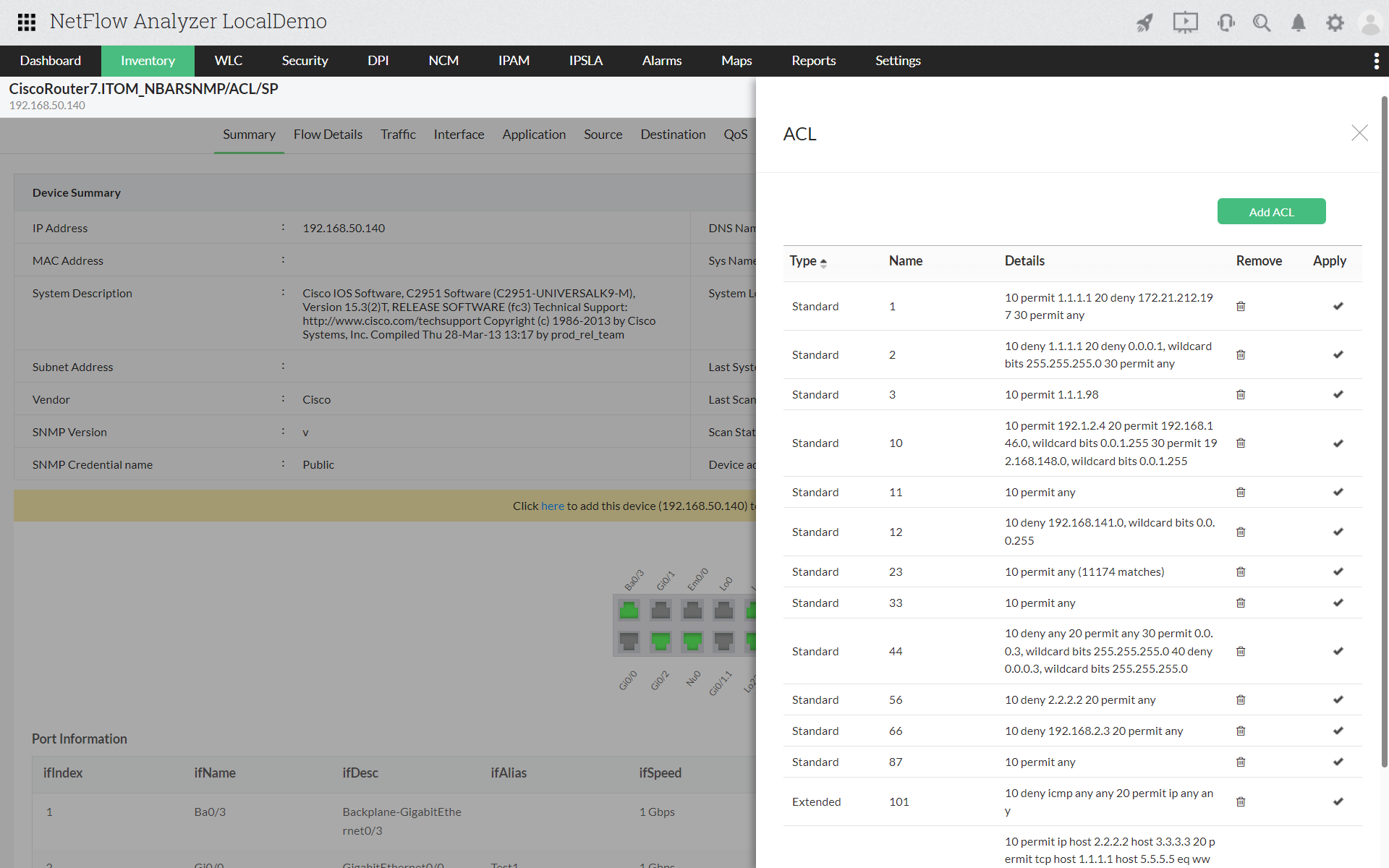


 Posts
Posts

