Showing posts with label Plusnet. Show all posts

Tuesday, January 20, 2015

[UK]:"Unlike some countries", All ISPs Voluntary Signed for the Net Neutrality Code


The Broadband Stakeholder Group (BSG) announced that "all of the UK’s leading Internet Service Providers (ISPs) have now signed up to a voluntary Code of  Practice in support of the Open Internet.

The Open Internet Code [herewas launched in 2012, building on previous work on the transparency of traffic management. EE, Virgin Media and Vodafone have recently signed up to the Open Internet Code, meaning that all major ISPs, operating across both fixed and mobile networks, are now signatories.

Matthew Evans [pictured], CEO of the BSG which facilitated the code, said: “Unlike some countries where net neutrality has become a controversial topic for discussion, the UK benefits from a fiercely competitive market and high levels of transparency – which together offer the best assurance of an Open Internet. The Code now provides an even stronger and more effective foundation, whilst also allowing for an environment where new business models for internetbased services which benefit consumer choice can thrive.”

The signatories of the code are: BT, BSkyB, EE, KCOM, giffgaff, O2, Plusnet, TalkTalkTesco Mobile, Three, Virgin Media and Vodafone. 

By agreeing to the code, they confirm that they will:
  1. Ensure that full and open internet access products, with no blocked services, will be the norm within their portfolio of products.
     
  2. Provide greater transparency in instances where certain classes of legal content,applications and/or services are unavailable on a product. These products will not be marketed as “internet access” and signatories will be obliged to ensure that any restrictions are clearly communicated to consumers.
     
  3. Not target and degrade the content or applications of specific providers.Content providers are able to raise potential cases of targeted and negative discrimination with ISPs. If they are not satisfactorily resolved, these issues will be lodged with the BSG  who will share them with Ofcom and government. This initiative, which the BSG was asked to undertake on behalf of the Government, builds on the transparency code of practice published in 2011 which ensures that clear, understandable and comparable information on traffic management practices is available to consumers.
See "Remaining ISPs commit to the UK’s Open Internet Code" - here.

Monday, November 18, 2013

Plusnet: Traffic Management/DPI is for your Own Viewing Pleasure!


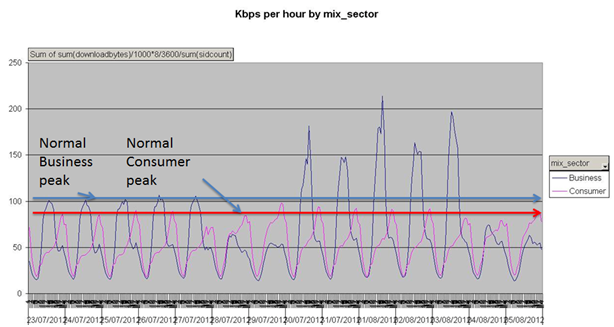
Martyn Hudson explains in Plusnet's blog how the UK ISP deals with major events generating spikes in bandwidth demand for several hours "Red Bull Stratos" (8M people watching live) or two weeks during the London 2012 Olympics games [see "Sandvine and Procera Analyze the Olympics Games" - here].

The games "saw Internet usage skyrocket – no more so than from business users. As we can see from the graph below, business use, depicted by the darker line, more than doubled across several days – no doubt as workers sneakily tuned into Olympics coverage whilst at their desks throughout the working week. Traffic from business use returned to a low level from the 3rd, which was incidentally the first weekend".


"So how does Plusnet cope with all this demand? - We know that people using our broadband, whether at work or at home, want to be able to watch big events particularly if it is once in a lifetime, such as the London Olympics was. In the case of events like the Olympics we have to consider not only the normal every day demand and the extra traffic from people watching the event but also increased usage from people working from home who didn’t want to travel. In order to ensure that everyday browsing, streaming and gaming continues to work as normal and everyone gets a good experience on the event traffic and their work VPNs Plusnet uses traffic prioritisation. 

This traffic prioritisation ensures that interactive and real time traffic will take priority over less time critical traffic, like file downloads, so that where one person in a household is watching the football game they don’t see any buffering because someone else is downloading the latest software updates for their phone at the same time". 

Nevertheless, Plusnet deploys a traffic management policy is done "at busy times" - probably not only just during global event, such as the Olympics or the Royal wedding. Their support web page (here) explains it:


See "Internet usage around big events" - here.

Thursday, September 5, 2013

[UK]: Ofcom Consumer Guide for Traffic Management


I am following the UK traffic management regulation since the early days of this blog (see "DPI Deployments - Part4: UK - Everybody is Doing it !" - here), as the UK ISPs are more transparent in their disclosure (voluntarily or by regulation - see "[UK]: Self Regulation doesn't Satisfy Ofcom; Publishes Minimum Disclosure Level" - here) compared to ISPs in other countries.

On top of all that, Ofcom published a new consumer guide, explaining consumers what is traffic management and exposing ISPs policies. They used the common comparing Broadband Traffic Management to motorways, serving variety of cars and

"With 46 million people in the UK having access to broadband and many using it for data heavy activities such as streaming and downloading, the internet is becoming increasingly busy.To ensure that networks operate efficiently, ISPs can restrict or ration traffic on their networks, or give priority to some types of traffic over others. This is known as ‘traffic management’.

"Each ISP has its own traffic management policy and so when choosing a provider you should check their policy meets your needs. Below you will find links to policies of the largest providers. If your ISP is not on this list, visit your provider’s website or speak to their customer services department: BTKarooPlusnetSkyTalkTalk, Virgin Media (National and Cable), O2 (Home broadband and mobile broadband), EE (Handsets, broadband and mobile,broadband), ThreeVodafone."


See "New consumer guide on internet ‘traffic management’" - here.

Monday, May 20, 2013

[Plusnet]: "We’re big fans of traffic management and truly unlimited broadband"

 
Kelly Dorset, Head of Products and Digital Care, Plusnet [UK] explains in a post to lovemoney that ".. traffic management is often seen in a negative light with many in the industry, technology media and broadband users viewing it as an unnecessary slow down on services to stop users downloading lots of bandwidth. Here at Plusnet [here], that couldn’t be further from the truth. We’re big fans of traffic management and truly unlimited broadband and we offer them both at the same time. Traffic management, otherwise known as traffic prioritisation, is applied to all Plusnet’s broadband products and ensures that real time applications like gaming and streaming don’t get interrupted when more than one person is downloading at the same time".

Plusnet traffic management policies are explained here and shown below ("the systems identify traffic and assign it to one of six priority queues; Titanium is the highest priority").

The ISP mentions that "Some applications not using the standard port may not be identified correctly by our system, as we use DPI to identify applications on the network. These applications may be classified as 'other' traffic in which case a lower priority may apply"
 
Plusnet Traffic management Policies

See also "[Ofcom] UK Traffic Management; P2P Might be Reduced by 99%" - here and "Plusnet: Troubles with Traffic Management System" - here.

"Plusnet prioritises certain types of traffic to ensure there is enough bandwidth, or data, available for each activity to be performed without interruption. Plusnet gives streaming games and video high priority to ensure they don't buffer or lag. For example, if you’re making a video call to relatives on the other side of the world, you don’t want the picture of your suntanned beloved to break up"

See "Why broadband traffic management is a good thing" - here.

Sunday, November 18, 2012

[Ofcom] UK Traffic Management; P2P Might be Reduced by 99%


In its 2012 update, Ofcom, the UK regulator reports also on the status of traffic management in the UK. Ofcom says  [see also "UK: Broadband ISPs (except Sky) Still Limit P2P; Some Prioritize VoIP!" - here]:
  • We looked at the traffic management polices used by fixed and mobile operators and found that there is often significant variation in fixed ISPs’ and mobile operators’ traffic management practices. While most apply traffic management in some form, others do not and use the fact that they have no traffic management as a part of their promotional message (e.g. advertising their service as ‘truly unlimited’ in terms of both data use and throttling of certain services). 
     
  • Most commonly, ISPs tend to apply traffic management to P2P services such as BitTorrent. P2P traffic is most likely to have restrictions placed on it because of the way it works: the nature of P2P software is such that it increases data usage along a network to fill whatever capacity is available. That, and the fact that P2P downloads are not typically as time-dependent as other types of application mean that many ISPs and mobile operators find that controlling P2P traffic is an approach to keep down network infrastructure costs
  • The impact of traffic management on users of P2P services can be significant – in some cases speeds of P2P traffic can be reduced to a fraction of the speed of other traffic on the network. We asked operators to estimate the impact of traffic management restrictions. Although most told us that such calculations were too difficult to make, others told us that the impact could be significant, e.g. one fixed ISP said the estimated impact of its traffic management policies was to reduce P2P traffic to 1% of what it would otherwise be at peak times
  • P2P is not the only type of traffic which is subject to traffic management. For example, O2 restricts the speed of video traffic on its lowest priced broadband package to 0.8Mbit/s, and offers higher-priced broadband packages that do not use traffic management for video traffic.
     
  • In some cases, particular types of traffic are given greater priority and consumers who particularly value a type of service can choose packages that prioritise such traffic. For instance, Plusnet offers a premium broadband service for an additional £5 a month which gives priority to gaming traffic and traffic for virtual private networks (VPN).
See more - "Infrastructure Report - 2012 Update" - here

Tuesday, December 21, 2010

Plusnet: Troubles with Traffic Management System

 
2 days ago I mentioned Plusnet's (UK) traffic management policies, providing advanced application-based tiering (here) - and today I saw that the operator has experienced some issues with the DPI system used to implement it (from Ellacoya-Arbor Networks - see "U.K. Provider PlusNet Addresses Network Management With Tiered Services and Transparency" - here)

Bob Pullen, from Plusnet's Customer Support, writes to his customers about "..the problems we've been experiencing with our traffic management platform. Because of these problems, your Internet connection may not have been performing as well as you would normally expect."

See here. Needless to say (and may be irrelevant to Plusnet’s unfortunate problem), that like all critical network components, DPI and their management systems (policy servers, for example) need to have a well-thought redundancy design. One example (rather basic with partial redundancy) is shown in the following chart:


"Our network engineers have managed to partially restore service, and the traffic management platform is now processing requests again. Customers should be aware that there are certain cases where we will have to manually fix accounts. This particularly applies to customers who changed account type today or have recently entered/exited failed billing. We will be looking to fix these accounts tomorrow where necessary. We still need to swap out some hardware and restore resiliency to the platform so we're not completely out of the water yet."

Sunday, December 19, 2010

Yankee: "Operators need to develop the right price/package mix"

  
A new research by Gordon Mack, Research Associate, Yankee Group focus on the recent tiered services trend: "Operators around the globe are embracing tiered pricing plans for data device and smartphone users. The plans show a wide range of price points and market strategies, but are not without pitfalls. Poorly constructed plans can easily cost operators revenue."

See "Global Adoption of Tiered Data Highlights Pros and Cons" - here.

" ..tiered pricing presents operators with a dilemma. While tiered plans can both help operators gain subscribers and increase revenue, they also have several pitfalls that if not avoided can thwart both objectives. For example, if plans aren’t designed and marketed properly, bill shock and overage fees may end up leading to churn and hurting operator bottom lines. Operators adopting tiered pricing need to develop the right price/package mix to fit both their network and strategic goals. Those that avoid competing solely on price and get creative in building their tiers will see the most success".

Note that in most cases, the tiers in tiered services are volume-based only (here). However, a more advanced approach would be to add additional value to the tiers, such as guaranteed QoS - mainly for video or VoIP services. See the suggestion of Allot and Openet (here), TeliaSonera's Value-based Pricing (here), ideas from Everything Everywhere (here) or even the complex plan offered by Plusnet, a UK-based Broadband provider (here - see chart below - how the different service plans are mapped to traffic priorities)


Wednesday, March 10, 2010

DPI Deployments - Part4: UK - Everybody is Doing it !

     
On June 2008, the UK regulator Ofcom published its Voluntary Code of Practice: Broadband Speeds "a voluntary and self-regulatory measure" (here). The code suggests that ISPs will disclose to their subscribers (and the public) the real service levels they provide.

In particular interest to our discussion is section 39: "Where ISPs apply traffic management and shaping policies, they should publish on their website, in a clear and easily accessible form, information on the restrictions applied. This should include the types of applications, services and protocols that are affected and specific information on peak traffic periods"

Ofcom maintains a list of ISPs that endorsed the code (here). The list has over 50 names, including all leading UK ISPs.

These ISPs should according to section 33 - "use their best endeavours to set out clearly, and in a prominent place on their websites (e.g. within help or FAQs sections), information relating to their respective policies on fair usage; traffic management and traffic shaping to cover, at a minimum, the matters set out below."


In my earlier post - "Net-Neutrality Crosses the Pond" (here) I brought the relevant policies of the UK leading ISPs - Plusnet, TalkTalk, Virgin Media and Sky - having in total over 15M subscribers. Plusnet even issued a press release "PlusNet welcome Ofcom's Broadband Speed Code of Practice" (here) saying that "Although the code of practice is certainly a step in the right direction, we would question whether these voluntary guidelines go far enough"

As we can see, the majority of the internet traffic in the UK is subject to traffic control. Some of the ISPs' stated policies could not be achieved without DPI (needed, for example, to detect "downloads") - and there even some public announcements on that:
  • Plusnet (BT retail service) is using Ellacoya (now Arbor Networks) - see PlusNet Picks Ellacoya (here). This was one the first DPI deployments by a larger ISP, world-wide.
     
  • Carphone (TalkTalk) is using Sandvine - "Carphone Warehouse Selects Sandvine to Enhance Subscriber Internet Experience" (here) - one of the earlier adapters of Sandvine's 10Gbps DPI product. Carphone consumer retail service is TalkTalk (listed above).
While using DPI for traffic management, fair-use or congestion management seems to be well accepted in the UK, the imitative of several ISPs to use DPI for targeted advertizing (using a solution from the UK based Phorm) failed with severe consequences:

UK ISP BT Could Face CPS Prosecution over Secret Phorm Trials  - "The Crown Prosecution Service (CPS) has confirmed that it is still assessing the prospect of opening a criminal case against BT following the operator’s secret trials of Phorm in 2006/2007. Phorm controversially worked with UK broadband ISPs ( BT , TalkTalk and Virgin Media ) to develop a system that would monitor what websites you viewed for use in targeted advertising campaigns, though many likened its service to Spyware." (here)

Showing us the good and bad in DPI - and maybe it is better to disclose your service details rather being "secret".

Thursday, March 4, 2010

Net-Neutrality Crosses the Pond

"The deployment of traffic management techniques and policies is now happening in scale here [UK] as well. And last year's adoption of the EU Framework moves us firmly into new territory." said Ofcom's Chief Executive Ed Richards.

"Clearly, we need to be vigilant about genuinely anti-competitive discrimination. But we also need to be wary of rushing to judgement on the likely behaviour of firms at this stage" he added. "Ofcom, collaborating closely with our colleagues in BEREC, is now committed to developing some answers to these questions as a priority and we hope to publish our initial proposals later in the spring". here.

As Mr. Richards says, traffic management policies are already in place by UK ISPs. Nevertheless, the ISPs fully disclose their policies (which is one of the US Net-Neutrality guidelines). See the following examples for the UK Top4 ISPs:
  • Plusnet - (5M Subscribers) "Our broadband service is provided over a shared network. This means we have to manage traffic to make sure our customers receive a quality and sustainable broadband service" - here and here
     
  • TalkTalk (4.2M Subscribers) - "Traffic management involves monitoring and restricting the service speed at peak times for a small minority of users who exceed reasonable use of the service" - here
     
  • Virign Media (4.1 M Subscribers) - "So, to make sure our service is fair for everybody, we monitor our network's performance. And, if someone is downloading a large amount of data and impacting others, we may moderate their speed during peak times"  - here
     
  • Sky (2.4M Subscribers) = "To ensure we provide a sustainable quality broadband service to our customers, we continuously monitor and efficiently manage the Sky Network as a whole. To do this, during peak times (from 5pm to 12am each day), we may slow down the speed that all Sky Broadband Connect customers can get on certain applications which we consider use up a lot of bandwidth (for example peer-to-peer and newsgroups) and which have a negative affect on other customers" - here