Showing posts with label Juniper. Show all posts

Friday, January 11, 2013

Sandvine Q4: Channel Success; Juniper - $7M Deal in NA


Sandvine published its Q4 (Nov '12) results, showing a nice revenue ($27.5M) - Q/Q growth of 26% and Y/Y growth of 32% after several quarters of repeated disappointments. See "Sandvine Reports Q4 2012 Results" - here.

Sandvine's filing (here) shows that resellers generated 78% of Q4 revenues (see charts below), of which 3 - Alcatel-Lucent, Huawei and Juniper Networks were 63.3% of total revenues from sales to 15 customers.

Juniper contributed $7M (58% of the region's revenues) for a deal with a "converged service provider customer in North America. The orders represent a large initial rollout, with forecasted plans for expansion. Sandvine will be fulfilling the sale through a major network equipment vendor, with which it recently signed a reseller agreement" - here). The average deal size for Huawei and ALU was $740K.


Monday, August 13, 2012

[ABI Research]: 4G Drive Mobile Core Spending (+19% for 2012)


A new report by Aditya Kaul (pictured), practice director of mobile networks, ABI Research concludes that "Despite cut-backs in network equipment spending by mobile network operators this year due to the economic climate, purchases of mobile core gateway equipment for packet core networks are set to increase 19% from 2011 to more than US$1.2 billion in 2012 .. Mobile gateway spend for 4G networks will account for approximately 60% of the total in 2012".

"The vendors benefiting from the increase in EPC spend include the five major wireless network equipment vendors (Alcatel-Lucent, Ericsson, Huawei, Nokia Siemens Networks, and ZTE), as well as router vendors such as Cisco Systems and Juniper Networks. The Big Five will continue to dominate, although Cisco is gaining some market share".

See "Mobile Core Gateway Spend is a Bright Spot in a Gloomy Mobile Infrastructure Market" - here.

Thursday, July 26, 2012

Juniper Integrates Riverbed Technology for Mobile Acceleration


Juniper Networks announced a new technology partnership with Riverbed ".. in wide area network (WAN) optimization, application delivery and mobility to deliver market-leading technologies for enterprises looking to increase the efficiency of their IT infrastructures and securely deliver better performance of applications across devices, networks and clouds".
  
Among other things "Riverbed and Juniper will begin a joint effort to integrate Riverbed's Steelhead® Mobile technology into the Juniper Networks® Junos® Pulse client to provide a mobile acceleration solution for mobile phones and tablets". 
"With Steelhead® Mobile client software, companies of any size can give mobile workers LAN-like access to corporate files and applications no matter where they are in the world. Steelhead Mobile overcomes the challenges that plague mobile workers, including variable locations, inconsistent links, and high-latency environments, and it does so seamlessly and transparently. The result? Higher productivity and more efficient operations, access, and performance anywhere"


See "Juniper Networks and Riverbed announce technology partnership to enable more secure, efficient delivery of applications across devices, networks and clouds" - here.

Sunday, July 15, 2012

VAS/Security Deployments [162] Telefonica Deploys Juniper for Mobile Security


Juniper Networks announced that " Telefónica Digital has selected Juniper Networks® Junos® Pulse Mobile Security Suite to create a branded mobile security service for its consumer customer base across Europe .. Telefónica's new mobile security service will provide a comprehensive range of features including anti-virus, anti-spyware, data back-up, remote lock-and-wipe, device locate and parental controls
  
".. The solution is supported by Juniper Networks' Mobile Threat Center, which is dedicated to 24x7 global monitoring and mitigation of emerging and evolving malware threats to mobile operating systems and applications"

Jose Perdomo, managing director, Security and eHealth Area, Telefónica Digital said " .. It enables Telefónica to provide a homogenous, cost-effective service that supports numerous devices for the mass market helping us better protect our customers and our network"


See "Telefonica to launch European mobile security service based on Juniper networks junos Pulse solution" - here.

Tuesday, April 10, 2012

[Heavy Reading] - More on the PCRF/DPI Market

    
Ray Le Maistre (pictured) published some more details from  the recent Heavy Reading report on the PCRF/DPI market (see "[Heavy Ready]: 2011 Policy Management & DPI Market Reached $1B; TEMs Gain Higher Share" - here).

"In the policy server market, we believe that the major telecom equipment vendors saw faster growth, as a whole, than specialist vendors. ... Much of the momentum for these major vendors has come from their position as suppliers of core network equipment such as GGSNs, which has pulled through a lot of new policy business," notes the report's author, Heavy Reading Chief Analyst Graham Finnie"
 
"Those same large vendors, plus the likes of Cisco [here], Hewlett-Packard [here] , Juniper Networks, Tellabs [here] and ZTE now account for more than half of the policy server and deep packet inspection (DPI) sector covered by the report, a market that was worth more than $1 billion in 2011 and which is due to grow to about $2.7 billion by 2016 .. most specialists are also seeing robust growth"

See "Policy Specialists Squeezed by Vendor Giants" - here.

Tuesday, February 7, 2012

PeerApp: “Caching is the future of Optimization”

   
Few days ago I met Shmulik Bachar, VP of products and marketing, PeerApp, in its R&D site.

PeerApp, according to Frost and Sullivan recent research, leads the transparent cache market (see “F&S: Transparent caching market to Reach $708M by 2015; PeerApp Leads” – here). In 2011, the market had estimated revenues of $140M.

Some of the Q&A we had:

Q: Who do you see now in the caching market?

A: As direct competitors we mainly see Blue Coat. Note that we are also selling through OEMs, which includes Allot Communications and BTI Systems.

Q: What about the cache offering from Juniper, Cisco and the video optimization vendors?

A: These companies do not compete with us directly. They use caching as internal mechanism in their solutions, but not as a solution for optimizing Over the Top (OTT) traffic, as we do.

Q: We saw recently some announcements of integrated Carrier CDN and transparent caching solutions. Are the two will finally become one?

A: In many cases, carriers like to see one solution. This is why we announced a joint solution with Edgecast (here), and Verivue, who came from CDN solution side is now adding transparent caching (here). Transparent caching and CDN provide the carrier with similar benefits, although the technical solution for transparent caching and CDN is different.

Q: What is the business case for transparent caching? It is still about bandwidth savings?

A: It is no longer just savings, except for specific regions. The main goal now is to improve the subscriber’s quality of Experience (QoE) and monetize OTT services.

Q: Monetize? How?

A: One example, implemented by some of our customers, is the ability to sell higher tiers of service (usually volume-based) knowing that caching will enable better QoE.

Q: How about PeerApp? Where is it going?

A: We continue to focus on caching. It is the future of optimization, both for fixed and mobile operators. I believe that the different Adaptive Bitrate technologies (from Apple, Microsoft and Adobe) will make the other real-time/network based video optimization technologies (see here) redundant. Caching has real value, for bandwidth savings, QoE improvement and monetization.

PeerApp is doing very well, we closed a $8M investment last year (here) and we are working on additional OEM opportunities to expand our reach to other elements of the core network.

Tuesday, December 13, 2011

LIME [Caribbean] Loves Video Caching

   
Recently I had some posts on the need and availability of integrated CDN and transparent caching (for OTT traffic) solutions (see here and here).

Recent announcements by PeerApp and Juniper Networks, for systems installed by LIME (part of the Cable & Wireless Communications Group) in the Caribbean, provide an example of a carrier using both technologies, however by separate systems.

Few weeks ago it was PeerApp announcing it "... was selected by LIME ..to provide its UltraBand transparent caching platform throughout LIME’s Caribbean operations. UltraBand will help LIME deliver Internet content, including video and multimedia, with improved quality, while reducing associated network congestion and costs" (here).

Now, Juniper Networks is announcing that LIME - ".. is deploying Juniper Networks® Media Flow Controller [post - here] to underpin its next-generation TV and video services. .. The new entertainment service will use adaptive bitrate streaming to deliver up to 130 television channels over subscribers’ broadband Internet connections, and LIME is using Media Flow to cache, distribute and deliver content for maximum efficiency and viewing experience".


See "LIME Selects Juniper Networks Media Flow For Advanced" - here.

Sunday, November 27, 2011

Rumors: Akamai to Buy Cotendo for $300M

     
Ronni Zehavi, CEO
Asaf Gilad reports to Calcalist that 4 years old CDN startup Cotendo is about to be sold to Akamai, for $300M.No comment was received from Cotendo, and Akamai provided the expected response from a public company - "our policy is not to respond to rumors".

Cotendo (see "Cotendo's Cloudlet - Getting Closer to the Subscriber" - here), based in Israel, has 90 employees, and lists Google (see "Cotendo CEO: "We have a fertile technological dialogue with Google" - here), Facebook,  Microsoft and AOL among its customers.

In addition to a number of VC funds (here), Cotendo has Citrix and Juniper as shareholders and strategic partners (see "Cotendo Raises $17M; Announces Mobile Acceleration Suite and Partners with Citrix and Juniper"- here).

The company’s revenues for 2011 are expected to reach $20-30M. A year ago, MIT and Akamai filed a patent infringement lawsuit against Cotendo (here), shortly after AT&T announced it will use Cotendo's technology (here).

Story - here (Hebrew).

Friday, October 28, 2011

Juniper Integrates Radware's Traffic Management Software

 
Radware announced that it "worked with Juniper to create a scalable ADC software application, based on Radware's Alteon® ADC technology and using the Junos® SDK to fully integrate the ADC with Juniper Networks Junos operating system. The ADC application is implemented on high-performance service cards for the MX Series, enabling Juniper customers to improve their service delivery capabilities while concurrently avoiding the cost and complexity of deploying and maintaining ADC-specific appliances. The ADC and MX Series also share the same configuration and management tools, and the ADC leverages Junos integration with Operational Support Systems (OSS), which further reduces customer costs and risk"

"Juniper's router-integrated ADC employs sophisticated load balancing algorithms that ensure optimal performance and service quality by intelligently distributing and directing traffic based on real time changes in server load and availability. The advanced solution complements the Juniper Networks MX Series comprehensive set of carrier-grade services, and addresses the resiliency and performance requirements of many types of services and applications, including DNS, WAP gateways, Content Delivery Networks (CDN), SIP-based VoIP, as well as many others".


See "Radware Provides Application Delivery Control for Juniper Networks MX Series 3D Universal Edge Router" - here.


Thursday, August 18, 2011

[Juniper] Anomaly Detection and DPI Defend Against Application-Layer DDoS

  
Raju Manthena, from Juniper's Security Services and Research team published a new article to Juniper's "Networking & Security Now" blog about "Application-layer Denial of Service" (here).

"Sony PlayStation Network experienced Distributed Denial of Service (DDoS) attacks that compromised millions of user accounts and resulted in 3 weeks of outage [see "PlayStation Network Outage the Worst Service Outage Ever?" - here - and chart below] .. Application-layer DoS exploits vulnerabilities in application software such as buffer overflows or null pointer dereferences in database or web server software. These attacks can appear to be legitimate application-layer traffic and are not easily detectable. Although a single or slow application request rate may trigger DoS, DDoS involves engaging large botnets (with millions of nodes) to send minimal per-client traffic that is large enough to overwhelm and exhaust application resources".


According to Arbor Networks' "Network Infrastructure Security Report" (here, registration required) - "Application-Layer DDoS Attacks Are Increasing in Sophistication and Operational Impact .. IDC and mobile/fixed wireless operators in particular are reporting significant outages, increased OPEX, customer churn and revenue loss due to application-layer DDoS attacks. These attacks are targeting both their customers and their own ancillary supporting services, such as DNS, Web portals, etc" (see chart).

Back to Juniper's article - "The ability to defend against application-layer DoS attacks and implementing an optimal mitigation solution relies on understanding the nature of the attack and the objectives of the attacker. Using information collected by Network/Application Anomaly Detection, Deep Packet Inspection (DPI/IPS), and Network Access Control systems, it may be possible to identify attack traffic.  Depending on the nature of attack, several mitigation strategies need to be considered"


Friday, August 12, 2011

VAS Deployments (85): AT&T Uses Juniper for Security Services

    
Last May we learned that "AT&T Plans to Launch Wireless Consumer Security Service" (here), and before that "AT&T Develops Mobile Security" (here). Now we hear that the new service will be based on a Juniper solution. 

AT&T announced that it "..has executed an agreement with Juniper Networks to deliver this security capability and additional services based on the platform in the future. This new agreement is part of AT&T’s mobile security strategy to manage and protect smartphones and customer information .. The first phase of the platform – the AT&T Mobile Security application – is expected to be available later this year and is based on the Juniper Networks® Junos® Pulse solution".  

See "AT&T Invests in Mobile Device Security Platform" - here.

Junos Pulse is flexible, supporting personal mobile device access to corporate networks and resources through a zero touch deployment model. A cloud based, Software-as-a-Service (SaaS) offering—which speeds and simplifies deployment and user rollout—Junos Pulse Mobile Security Suite includes the Juniper Networks Junos Pulse Mobile Security Gateway, a hosted, web-based administrative management console from which Junos Pulse Mobile Security Suite services are enabled and managed by enterprises and service providers (here).

Wednesday, June 15, 2011

Cotendo Raises $17M; Announces Mobile Acceleration Suite and Partners with Citrix and Juniper

     
Cotendo (see "Cotendo's Cloudlet - Getting Closer to the Subscriber" - here) announced "the launch of its purpose-built Mobile Acceleration Suite (MAS). This new suite extends Cotendo’s powerful existing Web acceleration services to dramatically speed up delivery of mobile websites and mobile applications. With MAS, Cotendo now delivers reliable and high-performance acceleration for content to any device on any network in any location in the world"

See "Cotendo Sets a New Standard for Mobile Content Delivery With Breakthrough Mobile Acceleration Suite" - here.  

In addition, the company has completed a funding round of $17M adding new strategic investors - Juniper Networks and Citrix:

"Strategic investors and new business partners Citrix Systems and Juniper Networks .. along with existing venture backers Sequoia, Benchmark and Tenaya Capital. Citrix and Juniper, market leaders in their respective industries, join the growing ranks of Cotendo strategic partners, including AT&T, Google and Sumitomo .. The synergy between the services and technologies of Citrix Systems and Cotendo blend on-premise physical and virtual appliances, content acceleration and cloud services that will accelerate and optimize delivery from the end user all the way to the enterprise over distributed networks, thereby improving end user experience from any location to any device .. The relationship between Juniper Networks and Cotendo will address the demand of service providers for technologies that will enable them to offer value added services and over-the-top services to content providers". 

See "Cotendo Announces $17 Million Funding Round that Includes Strategic Investors and Business Partners Citrix Systems and Juniper Networks" - here.

Tuesday, May 17, 2011

AT&T Plans to Launch Wireless Consumer Security Service


Source: Malicious Mobile Threats report 2010/2011
Juniper Networks
 Up until recently, security was a non-issue for wireless devices (i.e. smartphone, tablets) - mainly due to the small number of connected devices (compared to traditional windows based PCs), their limited capabilities, and the diversity of operating systems. Now, a number of reports indicate that these devices are on the radar (see "At Risk: Global Mobile Threat Study Finds Security Vulnerabilities at all Time Highs for Mobile Devices" - here - and chart).

While security specialist Arbor Networks said recently that "Mobile Operators Lack Visibility and Control over Security threats" (here), we learned that "AT&T Develops Mobile Security"- here.

Sinead Carew reports to Reuters that AT&T ".. plans to launch a wireless security service for consumers next year to help combat a big rise in cyber attacks on mobile devices". 

John Stankey (picture), the head of AT&T's enterprise business, said he had ".. seen a big spike in security attacks on cellphones .. Hackers always go to where there's a base of people to attack ..AT&T would probably launch such services in 2012 .. When you start asking them what's your willingness to pay for a solution, if they're not a little frightened, their willingness to pay is nothing .. It'll take a little time for this in the mass market".

See "AT&T plans consumer security service for 2012" - here.

Tuesday, April 5, 2011

Juniper Adds Openet to its Policy Management Portfolio

  
2 months ago Bridgewater Systems announced a partnership with Juniper in which "Juniper Networks will resell Bridgewater's complete control plane portfolio globally, as an integral component of Juniper's MobileNext, the industry's first open mobile core for 2G/3G and LTE networks" (see "Juniper Announces MobileNext" - here).

Today, Openet announced that "Juniper Networks has selected the Company as a strategic partner, and will resell Openet’s policy management and charging platforms as part of Juniper’s MobileNext solution announced in February".

Difficult choice for Juniper customers, as both lead the market (see here and here).

See "Openet and Juniper Networks Partner To Deliver Increased Control and Flexibility to Mobile Operators Through Policy and Charging Platform Solution" - here.


Thursday, March 3, 2011

Bridgewater - Will the Juniper Agreement Replace Alcatel-Lucent Revenues?

    
Bridgewater Systems published its Q4 and 2010 results yesterday (see "Bridgewater Systems Reports Q4 & Full-Year 2010 Financial Results" - here).

One of the recent highlights is the reselling agreement with Juniper , announced during MWC (see "Juniper Announces MobileNext - "Open mobile core for 2G/3G and LTE networks"; Partners with Bridgewater, Openwave" - here).

Nevertheless, a source-code licensing agreement the company had with Alcatel-Lucent expired on October 2010. During the results conference call, BWS' CFO, Kim Butler (picture), said that the agreement generated revenues of CAD $8M during 2010 - no doubt with very high margin.

As for the expectations from the Juniper agreement - CEO Ed Ogonek, said that Bridgewater will be selling its portfolio through Juniper; the agreement is in place and they are in process of getting it fully integrating into the operational sales processes of Juniper. They are working together on a pipeline and Ed expects to see the benefits in back half of the year as they have very strong customer
    
Bridgewater Systems published its Q4 and 2010 results yesterday (see "Bridgewater Systems Reports Q4 & Full-Year 2010 Financial Results" - here).

One of the recent highlights is the reselling agreement with Juniper , announced during MWC (see "Juniper Announces MobileNext - "Open mobile core for 2G/3G and LTE networks"; Partners with Bridgewater, Openwave" - here).

Nevertheless, a source-code licensing agreement the company had with Alcatel-Lucent expired on October 2010. During the results conference call, BWS' CFO, Kim Butler (picture), said that the agreement generated revenues of CAD $8M during 2010 - no doubt with very high margin.

As for the expectations from the Juniper agreement - CEO Ed Ogonek, said that Bridgewater will be selling its portfolio through Juniper; the agreement is in place and they are in process of getting it fully integrating into the operational sales processes of Juniper. They are working together on a pipeline and Ed expects to see the benefits in back half of the year as they have very strong customer opportunities driven by Juniper sales.

Maybe this partially explains the modest expected revenue growth (if any). The company guidance for 2011 is for revenues in the range of $88.0 to $100.0 million - compared to revenue of $93.4 million for 2010, which was increase of 40%.

Sunday, February 13, 2011

Juniper Announces MobileNext - "Open mobile core for 2G/3G and LTE networks"; Partners with Bridgewater, Openwave

  
Juniper Networks announced "MobileNext, the industry's first open mobile core for 2G/3G and LTE networks .. MobileNext is a suite of software that runs on Juniper Networks industry leading MX 3D Universal Edge Router and Junos® software platform. MobileNext delivers on the "Project Falcon" initiative with breakthrough products, solutions and business models that address the needs of mobile operators today"

See "Juniper Networks Delivers MobileNext — Industry's First Open Mobile Core for Service Innovation" - here. See also a white paper from ABI Research - "Juniper MobileNext: Bending the Mobile Cost Curve" - here (see chart below for the summary of findings).
"MobileNext, with industry leading scalability of mobile sessions, set up rates and forwarding capacity, enables high-definition voice and video delivery with seamless handoff between 3G and LTE for non-interrupted user experience while integrating a rich portfolio of in-line IP services. These in-line services, including Deep Packet Inspection, Traffic Direct for Internet offload, Carrier Grade NAT, Firewall, Video Optimization, MPLS, and Application Load Balancing, provide deployment flexibility and dramatically reduce TCO to mobile operators".

The following vendors announced a partnership with Juniper:
  • Bridgewater Systems announced that "Juniper Networks will resell Bridgewater's complete control plane portfolio globally, as an integral component of Juniper's MobileNext, the industry's first open mobile core for 2G/3G and LTE networks".  See "Juniper Networks and Bridgewater to Partner on End-to-End Mobile Packet Core Solution" - here
     
  • Openwave Systems announced that "Juniper Networks has selected the Company as a strategic partner to integrate its Media Optimizer into Juniper’s Media Flow solution for mobile video optimization. The combined solution is expected to dramatically improve the economics of delivering video over mobile networks while revolutionizing the user viewing experience". See "Juniper Networks Partners with Openwave to Redefine Mobile Video Delivery and Revoltionize User Viewing Experience" - here.

Sunday, October 24, 2010

Openet Expects Revenues of €75M in 2010 ; Getting Ready for IPO

 
John Collins from the IRISHTIME.com reports that "OPENET TELECOM posted its first profit last year as turnover grew almost 50% to €46.1M and the company says it is still planning for a Nasdaq flotation ..  posted a pre-tax profit of €1.2M compared to a loss of €2.3M in 2008, in accounts seen by The Irish Times"

See "First profit for Openet as lawsuit delays flotation" - here.

Openet's CEO Niall Norton said "Openet had planned to be “IPO ready in 2011” but this would be delayed due to a lawsuit filed by Amdocs [here], a much larger Israeli competitor, in the US courts .. the company expected to increase revenues in 2010 to around €75M .. If a flotation is delayed the company would consider going to its shareholders for bridging finance .. Openet has developed a very successful relationship with Cisco [here and here] but it has similar relationships with IBM and Juniper Networks. IBM yesterday highlighted Openet as one of its key partners in its strategy regarding cloud computing for service providers."  

ATT is spending the equivalent of Irish GNP in three months on its 4G network, and Openet’s systems are at the core”  (here)

Friday, October 15, 2010

Video Caching Market Finally Growing

    
It seems that 2010 will be the year of video caching - it will finally get the traction is deserves.

While caching itself is as old as the internet, video caching (either fro streaming or file-sharing traffic) is relatively new, and vendors in this space had some difficulties marketing the solution. Main reason is operators’ concerns of legal issues rising from caching copyrighted content. Therefore the vendors focused their sales efforts in markets (mainly parts of Asia, Latin America, Eastern Europe and Africa) where international bandwidth is expensive, and the ROI for the solution is very quick.

2010 seems to be different:
  • Video streaming grew and is now more significant traffic, probably releasing some concerns of caching P2P traffic. The potential monetization benefits (QoS based tiered services, partnering with content providers etc) may be lucrative also to larger operators searching new ways to increase ARPU. See "BT Selects Cisco's Video Content Delivery System" - here.
      
  • Introduction of solutions by tier1 vendors: Huawei (here), Cisco (here) and Juniper (here)
       
  • Integrated DPI/caching solutions - since an efficient caching solution needs DPI support, an integrated solution is a clear winner. PeerApp offers such solution with Allot and Sandvine
     
  • New solutions by smaller vendors - Bluecoat (here), BTI (here)
     
  • Integration with gateways - Acision (here)
     
  • Integration of CDN and caching - see Alcatel-Lucent (here)
And the results of all this?  

A joint press release from Sandvine and PeerApp shows us some market traction - stating that "within the past six months the Sandvine-PeerApp pre-integrated content caching solution has doubled its deployments and is now being used in 11 service provider networks serving over two million cable and DSL subscribers worldwide".

See "Content Caching Deployments Double Over Past Six Months" - here.

A transparent caching solution generally saves 20 to 30 percent of transit link and circuit costs for a typical operator,” said Frank Childs, PeerApp’s vice president of marketing. “By pre-integrating and pre-packaging this solution with Sandvine, our customers can quickly and easily attach it to the network, begin saving money immediately and improve their service quality to their subscribers.


Wednesday, August 25, 2010

DPI/QoS Announcements: Juniper VXA Media Flow Engine

    
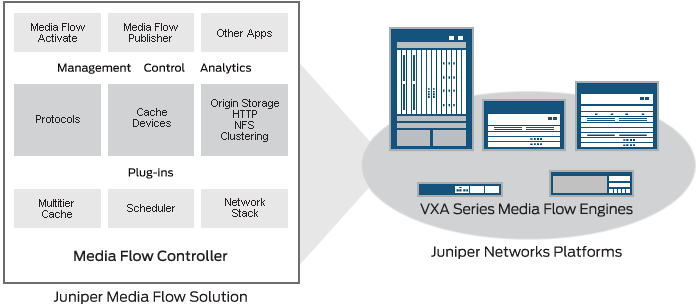
Juniper announced the "availability of Juniper Networks VXA Series Media Flow Engines, a converged content delivery and caching solution that enables service providers, content publishers and content delivery networks (CDN) to deliver rich media content"

See "Juniper Networks Delivers New VXA Media Flow Engines to Improve the Economics and Experience of Rich Content Delivery" - here.

"Juniper's Media Flow Solution enables customers to Reduce transit traffic and lower CapEx and OpEx .. significantly improves the user experience enabling a TV-like viewing experience even as network conditions fluctuate [and] .. allows service providers to introduce many compelling new content-based services.  The foundation of the Media Flow Solution is Juniper Networks Media Flow Controller, a hierarchical caching software appliance that provides an awareness of content requirements, network conditions and storage infrastructure for optimal caching efficiency and performance ..  Media Flow Controller can be deployed on the VXA Series Media Flow Engines or on general purpose x86 servers"

Offering of caching solutions for service providers (as oppose to CDN providers) is expanding quickly, each with its approach to the problem, but all offering the same benefits to the service provider.

See posting about Bluecoat (here), Huawei (here), PeerApp (here), and about a recent Yankee Group report "CDNs Expand to Mobile Broadband" - here. Other players are Allot and Oversi.

Source: Juniper

Tuesday, February 16, 2010

Juniper Traffic Direct Announcement

As indicated last week, Juniper announced a new traffic control s/w module, named Traffic Direct. The formal announcement published just before MWC 2010 opening day (here).

A Juniper sponsored IDC research paper (“Mobile Networks at the Tipping Point : The Data Explosion and Next Generation Network Challenge”) does not add much to the press release:

.. As IDC conversations with MNOs have confirmed, the majority of content responsible for the explosion in data traffic is web based and therefore does not actually require transit through the service complex. Offloading this traffic would substantially decrease the amount of capex and opex as much of the expansion would be obviated. Offloading also means that the data traffic would not be subjected to the latency that is introduced in the service complex. Thus, it also creates the added benefit of an improved quality of experience

Does Juniper's Traffic Direct include DPI? Traffic shaping? it not, this seems a bit trivial solution!