Showing posts with label Optimization. Show all posts

Monday, December 28, 2015

Astellia Optimizes Bouygues Telecom's Radio Network


Astellia announced recently that it "..affirmed today its position as preferred vendor for network optimization by performing successful, in-depth radio optimization campaigns for Bouygues Telecom, France. Astellia’s monitoring solution is already deployed on Bouygues Telecom’s 2G, 3G and 4G networks and analyzes network performance from RAN to Core. 

Astellia now further strengthens its partnership with Bouygues Telecom by performing well targeted radio optimization campaigns. Astellia’s highly skilled radio experts analyzed the activity of more than 2 million subscribers to optimize RF coverage & quality of Bouygues Telecom’s 2G and 3G networks in Paris. 

Astellia’s radio optimization activities focused on the detection of cell overshooting, crossed sectors, PSC/BSIC clashes. Reducing the need for costly drive tests, Astellia pinpointed coverage holes, traffic hotspots and detected bad RF conditions.

See "Astellia and Bouygues Telecom strengthen partnership with collaboration on radio optimization" - here

Tuesday, December 22, 2015

[Study]: Most Mobile Travel Sites are too Slow!


A new study by Radware finds that "76% of the industry’s top 100 sites are slow to load, paralyzed by third-party scripts and trackers, and image-heavy. In fact, the average page took 6.7 seconds to load on the iPhone 6, slower than the 4 second ideal time tolerated by shoppers.


..  By the end of 2015, mobile-booked travel is expected to reach $52.08 billion. with this level of exponential growth, travel websites have a lot to gain by preparing for the volume of mobile traffic they’ll be seeing in 2016.

Source: Radware's 2015 State of the Union: Mobile Performance of the Top Travel Industry Sites:
Do Your Customers Want To Take A Vacation From Your Slow Site?

The Radware report finds that there are a number of factors contributing to poor performance that can be fairly easily remedied: Overloaded with Requests .. Image Heavyweights .. Responsive Web Designs (RWD) Typically Optimize Viewing but Not Performance.. " 

See "Radware Study Reveals 76% Of Travel Industry Websites Aren’t Fully Optimized For Mobile Customers" - here.

Monday, December 14, 2015

BT to Offer Riverbed as Service to Accelerate Cloud Applications


BT announced that "..as part of its Cloud of Clouds vision it will deploy virtual Riverbed SteelHead application acceleration technology in the core of its global network, providing superior application performance for customers accessing BT’s own cloud services as well as other leading Software-as-a-Service (SaaS) offerings. 

It is the first time Riverbed technology has been deployed into the core of a global telecoms network"
  

Related link "Gartner's WAN Optimization Report", positioning Riverbed as a leader in WAN Optimization - here.

"BT and Riverbed are embedding their services at global business hubs in Europe, North America and Asia in locations where BT has direct links to leading cloud providers and high-capacity internet breakout. 


The service will be available globally from early 2016 and accessible through BT’s IP Connect VPN from 198 countries and territories. A series of pilots of the new capability showed substantial network performance improvements for SaaS applications such as the Microsoft Office 365 productivity suite.

In addition to application acceleration and network bandwidth optimization, customers using the new service also gain increased control over their applications, better end-to-end visibility into performance, and significantly improved reliability and security compared to delivering applications over the internet". 


See "Customers to benefit from improved performance when connecting to applications in the cloud" - here.

Monday, December 7, 2015

Nokia: EE Demonstrated MEC w/Edge Video Orchestration


A post to Nokia's Blog by Dirk Lindemeier [pictured], head of Liquid Applications, describes the latest development in the Mobile Edge Computing (MEC - see "Mobile Edge Computing Group Formed" - here):

"At the recent Connected Stadium Summit, held at Wembley Stadium, UK operator EE demonstrated the power of Mobile Edge Computing. 

An application called Edge Video Orchestration (EVO) shared live video of both a football match and a simulated security scenario to multiple screens with less than 1 second latency. The demonstration was the first of its kind in the UK and was shown to IT and technology directors of some of the world’s largest venues, including the All England Club which hosts Wimbledon.

EE demonstrated the capability of a high-performance and scalable solution suitable for deployment at the edge of the mobile network, with data processed and stored in a distributed manner". 

Related link - an interview with Mansoor Hanif, Director of Radio Access Networks, EE - "Iconic Wembley stadium is the “Mothership” of EE’s network" - here.
 
See "EE and Mobile Edge Computing ready to rock Wembley stadium" - here.

Sunday, December 6, 2015

Microsoft iOS App Detects Mobile Bottlenecks


A paper by Nimantha BaranasuriyaVishnu Navda [pictured], Venkata N. Padmanabhan, Microsoft, and Seth GilbertDepartment of Computer Science National University of Singapore presents a tool (iOS app) helping to locate the bottleneck in a cellular service - which is not always in the wireless segment.

Abstract

Mobile communication is often frustratingly slow. When a user encounters poor performance, and perhaps even “confirms” the same by running a speed test, the tendency is to ascribe blame to the user’s last-mile provider. However, as we argue in this paper, a more nuanced approach is needed to identify the location of the bottleneck responsible for the poor performance. Specifically, we focus on the question of whether the bottleneck lies in the cellular last hop (3G or LTE link) or elsewhere in the WAN path.


We present QProbe, a tool that takes advantage of the proportional fair (PF) scheduler employed in cellular networks to determine whether queuing is happening at the cellular link. After validating QProbe through simulations and controlled experiments, we present our findings from a measurement study conducted over a 2 month period involving over 600 real-world users across 51 operator networks in 33 countries. We find that, for example, the cellular last-hop link is the bottleneck in 68.9% and 25.7% of the total bottleneck cases for 3G and LTE clients, respectively, suggesting that there is a significant fraction of cases where the poor performance experienced by the user is due to the WAN and could potentially be routed around. Moreover, we show that QProbe detects the bottleneck link location with greater than 85% accuracy for both 3G and LTE clients in our measurement study.

Following are the results of QProbe test, on an iPhone 6, taken at my home in Tel-Aviv (Saturday morning, in a quiet neighborhood, is probably not the best time to diagnose bad connections):


See "QProbe: Locating the Bottleneck in Cellular Communication" - here.

Thursday, November 19, 2015

Akamai Expands HTTP/2 Deployment


Akamai Technologies announced that it is now "..actively working with more than 150 customers to deliver HTTP/2-enabled websites and is expanding its HTTP/2 program to all customers using qualifying products to deliver TLS encrypted web content.

HTTP/2 represents the first major update to the HTTP network protocol in nearly 20 years. Although websites have dramatically evolved during this time, HTTP, the underlying protocol of the Web, has not. Through features and capabilities such as multiplexing and concurrency, header compression, server push, support for the latest cipher suites, and an overall reduction in development complexity, HTTP/2 is intended to significantly improve the performance and security/privacy of today’s Web.

More than 70 percent of requests on Akamai’s CDN currently come from HTTP/2 compliant browsers; however, some older browser versions will continue to be used for the foreseeable future. Therefore, Akamai’s implementation of HTTP/2 has been designed to use real-time network and end-user intelligence to dynamically apply the appropriate performance optimizations to ensure the best performance for each user. In addition, we believe Akamai is well positioned to offer the tools and intelligence required to take full advantage of the move to HTTP/2. For example, easy‑to‑use, self-service and highly granular configurability allows customers to control the deployment of HTTP/2, while built-in monitoring and reporting helps measure the impact
"


HTTP/2 attempts to solve many of the shortcomings and inflexibilities of HTTP/1.1. Its many benefits include:
  • Multiplexing and concurrency: Several requests can be sent in rapid succession on the same TCP connection, and responses can be received out of order - eliminating the need for multiple connections between the client and the server
     
  • Stream dependencies: the client can indicate to the server which of the resources are more important than the others
     
  • Header compression: HTTP header size is drastically reduced
     
  • Server push: The server can send resources the client has not yet requested

See "Akamai Helps Drive Adoption Of Faster And More Secure Web Protocol" - here.

Saturday, November 14, 2015

Amdocs on Network Optimization Competition


During Amdocs' Q4 2015 earning call, a question was asked about the network optimization market, to which the company has entered using several acquisitions - Celcite (2014, $129M, here) and Actix (2013, $120M, here)

[related post - "Amdocs CEO: 'Network Optimization Business is Slow'" - here]

[Q]  Tom Roderick [pictured], Stifel Nicolaus, Analyst

.. Eli. Curious for your additional thoughts on the competitive landscape and the network optimization business. You mentioned, I think, obviously you guys have been the disruptor in that market. I know Cisco has made some moves competitively. Some of the other NEPs have, as well. What are they doing, what are the traditional network equipment providers doing to protect their position, whether it's through pricing or bundling or things of that nature and how, what are they doing as a response to your disruption in the market?


[A] Eli Gelman [pictured], President & CEO. Amdocs:
    
To be honest, the first thing they do is they try to use a lot of fear against us, because we are the new guys in this area. They will try to slow this thing as much as they can. They will not announce it necessarily, but we see from everywhere. It's not like a specific company I can tell you all the guys that are producing a lot of boxes are trying actively to slow down this trend. I don't think they can do it. Even if they slow it down, it would not take, let's say, five years to come to full fruition. Maybe it will take seven years. You can not slow this down.

And I'll tell you more than that. Carriers cannot afford not to do it, because otherwise, the big guys will do it themselves. Level 3 will do it. Amazon would do it. They will build their own networks. And if the carriers are not careful, both, by the way, MSOs, the Comcasts and the Charter of the world, and the AT&T and Verizon of the world, if they would not do it, other people will do it for them or to them. So they have to do it.

The providers will try to slow it as much as possible. They say that they are investing in it and all of that. I don't think so. And every time that they see that they are a buying company, we've seen in several cases like this, they kill the company. In other words, they buy companies that have some momentum in this area and especially to kill them and not to build them. And we have a very different opinion. We have a different opinion that we have infrastructure and new components and new theory and new approach to this entire thing. And we'll see. We'll have the best man win.


See "Edited Transcript of DOX earnings conference call or presentation 10-Nov-15 10:00pm GMT" - here.

Friday, November 13, 2015

Telecom Italia Deployed Qwilt to Improve OTT Streaming Video QoE


Qwilt announced that "Telecom Italia has deployed Qwilt's award-winning open caching solution to boost network capacity and improve quality of over-the-top (OTT) streaming video for its more than 30 million customers. Telecom Italia implemented Qwilt's solution to provide enhanced quality of experience (QoE) for its subscribers using online video and live streaming services from OTT content providers in Italy.

 .. The operator deployed the Qwilt open cache solution over a year ago to create a scalable architecture for its network and has experienced improved performance that meets the needs of its customers.

Qwilt's solution is delivered as a fully managed service to speed deployment and streamline ongoing operation. The broader operator organization -- including network planning, engineering and operations teams -- benefits from comprehensive media analytics, which offer insights into growth trends, content sources and consumer preferences.


By relying on open caching for online video delivery at the network edge, operators can substantially reduce network capital and operational costs -- a typical open cache deployment yields a return on investment (ROI) in less than 12 months.

The open caching deployment at Telecom Italia was supported by local systems integrator Proxy.


See "Telecom Italia Deploys Qwilt to Optimize Over-the-Top Video Content for Improved Customer Quality of Experience" - here.

Tuesday, November 10, 2015

EdgeConneX Shows 12-20% Improvement in Quality of Experience


EdgeConneX announced a "Conviva white paper that validates the EdgeConneX business model. The white paper quantifies significant improvements in Quality of Experience metrics for end-users of Internet content and the content creators themselves. 
 
Conviva, the leader in Over the Top (OTT) video experience optimization for the world’s top media companies, measured the video data streams of multiple publishers that distributed EdgeConneX-enabled streams for a leading Internet Service Provider (ISP) in San Diego, CA. These measurements were compared against a peer network that did not utilize an edge localization strategy with EdgeConneX.

Conviva found that EdgeConneX-enabled streams produced a 12 to 20% improvement in re-buffering rates, which is a measurement of the percentage of the time a video is loading versus playing on an end-user’s device. Re-buffering rates are a clear indicator of the quality of a video. These rates are directly related to lengthier customer engagement times, greater customer satisfaction, and as a result, lower customer turnover and abandonment.


See "White Paper Confirms EdgeConneX Delivers Superior Video Experience" - here.

Tuesday, October 20, 2015

Openwave Demoed Optimization (40% lower bitrate) for Live Gaming Broadcasts


Openwave Mobility announced that it ".. successfully showcased optimization of live-gaming broadcast traffic via sites including YouTube Gaming and Twitch for a Tier 1 European operator. Openwave Mobility is the first to use quality-aware traffic management for live-gaming broadcasts. The company lowered bitrates by over 40% for YouTube Gaming and Twitch while maintaining an excellent QoE for subscribers.

Indranil Chatterjee [pictured], VP of Product Management, Marketing & Strategy, Openwave Mobility explaineds: “Live-gaming streams are far more data demanding than VoD. And they can consume considerable bandwidth. That’s bad news for operators and a bad experience for the gaming fans. Operators are struggling to deal with the phenomenal growth in video – and now most of that is encrypted too. That’s another headache. For cost conscious subscribers, higher bandwidth means higher data bills. That’s where our innovative technology comes in”.

See "Openwave Mobility First to Use Quality-Aware Optimization for Live Gaming Broadcasts" - here.

Monday, October 19, 2015

LG to Integrate Giraffic Video Optimization to Smart TV


Meir Orbach reported to Calcalist (here, Hebrew) that "LG will integrates Giraffic video optimization technology in its smart TV product line to enable 4K streaming". 

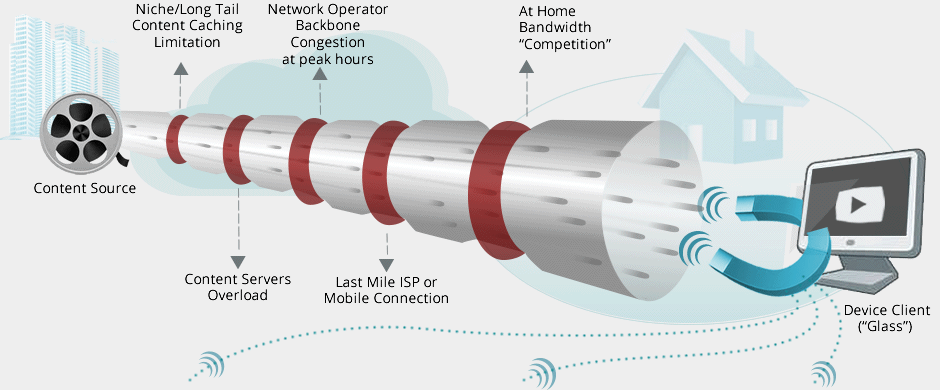
Giraffic’s multi-patented client-side AVA™ technology overcomes Internet bottlenecks from source to glass, enabling devices to actively control Internet streaming quality.Smart TVs, IP STBs, Tablets and smartphones with Giraffic AVA™ software provide a faster and smoother streaming experience from any internet content source on the end-user’s existing internet connection. Giraffic’s patents on multi-source streaming, congestion control, dynamic maximization of HTTP communication throughout, predictive buffering and network shaping overcomes internet bandwidth limits

Yoel Zanger [pictured], Giraffic CEO told Calcalist: "We understood that great technology (see "New Start-up Promises X2 Faster Video Streaming with 'Crowd CDN'", here) does not always trun into a revenue generating business model. We need to go after those who can and willing to pay. Therefore, 3 years ago, we made a change in our direction. The content and smart devices domain goes to 4K resolution, but the internet infrastructure cant provide the required quality to the home user".


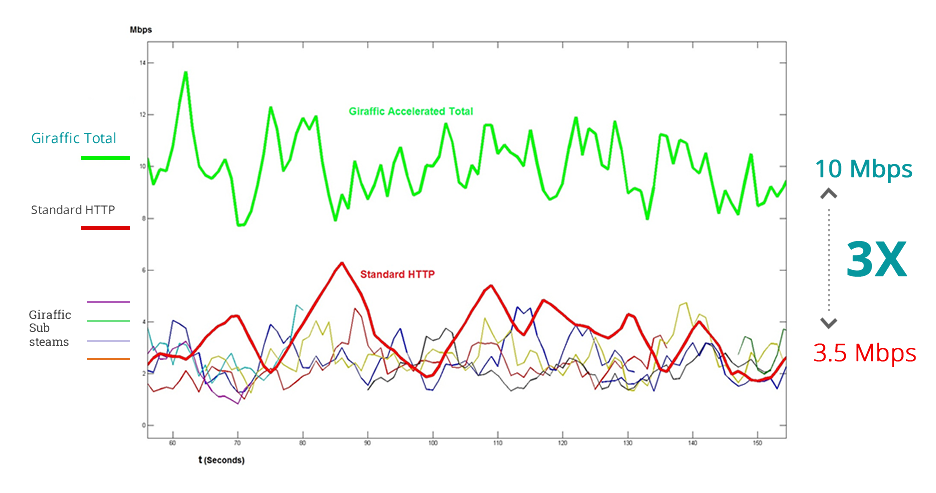
A real network monitor view of a typical Giraffic accelerated stream: averaging 3X higher throughput, and smoother QoS

Sunday, October 11, 2015

Google & Partners Introduce "Accelerated Mobile Pages"


Yet another component in Google's effort to make the internet faster.

Google's Official Blog announced that "after discussions with publishers and technology companies around the world, we’re announcing a new open source initiative called Accelerated Mobile Pages, which aims to dramatically improve the performance of the mobile web". 

Some of the other Google optimization projects:
  • Google's Introduces New Compression Algorithm  - here
  • Google (regretfully) Shuts Down PageSpeed and Recommends 10+ Alternatives  - here
  • Google Chrome New Compression Proxy Reduces Data by 50%  - here
  • Google Optimizes Web sites and Brings CDN Serivce to the Masses - here
  • Google [Still] Claims there is a Faster TCP - here
"We want webpages with rich content like video, animations and graphics to work alongside smart ads, and to load instantaneously. We also want the same code to work across multiple platforms and devices so that content can appear everywhere in an instant—no matter what type of phone, tablet or mobile device you’re using.
 

The project relies on AMP HTML, a new open framework built entirely out of existing web technologies, which allows websites to build light-weight webpages. To give you a sense of what a faster mobile web might look like, we’ve developed this demo on Google Search:

Over time we anticipate that other Google products such as Google News will also integrate AMP HTML pages. And today we’re announcing that nearly 30 publishers from around the world are taking part too.

This is the start of an exciting collaboration with publishers and technology companies, who have all come together to make the mobile web work better for everyone. TwitterPinterestWordPress.comChartbeatParse.lyAdobe Analytics and LinkedIn are among the first group of technology partners planning to integrate AMP HTML pages".

How do Accelerated Mobile Pages work?

Accelerated Mobile Pages are just like any other HTML page, but with a limited set of allowed technical functionality that is defined and governed by the open source AMP spec. Just like all web pages, Accelerated Mobile Pages will load in any modern browser or app webview. AMP files take advantage of various technical and architectural approaches that prioritize speed to provide a faster experience for users. The goal is not to homogenize how content looks and feels, but instead to build a more common technical core between pages that speeds up load times.

In addition, AMP files can be cached in the cloud in order to reduce the time content takes to get a user’s mobile device. Under this type of framework, publishers continue to control their content, but platforms can easily cache or mirror the content for optimal delivery speed users. Google has stated that it will provide a cache that can be used by anyone at no cost, though the cache (Google's or otherwise) is not required. Other companies may build their own cache as well.

In summary, the goal is that that the combination of limited technical functionality with a distribution system built around caching will lead to better performing pages, and increased audience development for publishers.


See "Introducing the Accelerated Mobile Pages Project, for a faster, open mobile web" - here.

Thursday, October 8, 2015

Astellia to Optimize Telefonica Group's RAN


Telefonica Group global presence 
Astellia announced that it has ".. entered a global framework agreement for RAN optimization with Telefónica .. the two-year framework agreement establishes Astellia as a qualified global supplier and enables any of Telefónica’s Operating Companies (OpCos) to benefit from Astellia’s solution and expertise in network optimization.

With this agreement, Telefónica reinforces its focus on making network quality a core component of its customer experience policy. Astellia’s radio optimization expertise in multi-techno, multi-vendor environments will help Telefónica prevent any quality degradation of their network and hence improve the customer experience". 


Astellia's  Nova RAN Optimizer is a multi-technology & multi-vendor radio optimization tool which uses network equipment Call Trace files to measure RF coverage & quality of the network. It facilitates daily radio optimization tasks by automating recurrent analysis and reduces drastically the number of drive tests.

Geo-located Radio Coverage

See "Astellia signs global framework agreement with Telefónica Group" - here.

Friday, October 2, 2015

Teridion Promises 20x End User Internet Performance Improvement; Raised $20M


Teridion announced:
  • general availability of its advanced Global Cloud Network to provide up to 20x performance improvement for enduser generated bi-directional Internet content. The company’s solution is currently being used by more than 15 companies spanning some of the most bandwidth-demanding applications and services, such as hosting and file sharing, rich media and advertising.
     
  • Total of $20 million in funding, having closed a $15 million Series B round of financing led by Singtel Innov8. Existing investors JVP and Magma also participated in the round. 
Elad Rave [pictured], founder and CEO, Teridion said. “We are breaking down these boundaries and providing users with a seamless Internet experience – no matter their location, device or application. It’s our goal for our SaaS customers to be able to generate additional customer loyalty, and the funding and general availability of our product are major steps in this direction.” 

Designed for bi-directional, user-generated Internet content, Teridion features: 
  • The Teridion Global Cloud Network – Bringing intelligent routing to the cloud. Proprietary algorithms and the Teridion Management System, in conjunction with Teridion Measurement Agents, provide a real-time congestion map of the Internet to find the best possible path, taking into account bandwidth, latency and geography

  • High performance, low latency – Up to 20x Internet performance improvements, enabling users to rethink what’s possible online
       
  • Unparalleled flexibility – Teridion Cloud Routers are created on demand, providing scalability and enabling users to only pay for the resources consumed. The solution works with the largest cloud providers in the world to ensure the speed and reliability of traffic, without requiring customers to leave their cloud provider
      
  • Bolstered security – Teridion does not cache users’ data, and end-to-end SSL encryption with no termination secures data across the network
      
  • Simple onboarding – With no hardware or software to install, and quick and easy provisioning, a typical cloud customer can be connected to the network in under an hour"


See "Teridion Announces $20M in Total Funding to Speed Up Internet Performance by Up to 20 Times" - here.

Monday, September 28, 2015

Openwave: How Could MNOs Optimize Traffic in the Encryption Era?


According to Openwave Mobility "encrypted traffic travelling on many mobile networks has risen fivefold in just one year and has now reached 60% of all data. 

Based on current trends, encrypted traffic levels will exceed 80% within 12 months in several regions. This is now one of the biggest areas of concern for mobile network operators as sites such as Google, Facebook and Wikipedia use HTTPS encrypted protocols. 

The findings are based on observing and analyzing traffic trends at a number of mobile operator customers around the globe". 

Related post: "[ABI] Encryption Drives Mobile Optimization to a $40B Over 5 Year Market" - here.
 
"As networks go “dark”, carriers are unable to gain insight into the encrypted data travelling on their networks. Operators can struggle to optimize the traffic and this can seriously impact users’ Quality of Experience (QoE). Moreover, some operators are unable to apply filters to block content such as adult material or to identify video streams that could even be used for extreme purposes such as to radicalize vulnerable individuals"

John Giere [pictured], CEO, Openwave Mobility advice to MNOs: “Operators need to consider solutions that optimize the TCP/IP layer of their networks and apply smart heuristics to achieve optimization in the application layer too. There are solutions that can identify bandwidth-hungry objects, even when encrypted, and achieve 50% data savings on HD video, audio and apps. Best of all, they do not compromise subscriber privacy.” (see "Openwave Mobility: Federated SDM; Encrypted Traffic Optimization" - here)

See "Over 80% of Traffic on Mobile Networks will be Encrypted in 12 months" - here.

Friday, September 25, 2015

Google's Introduces New Compression Algorithm

 
Zoltan Szabadka [pictured], Software Engineer, Compression Team, Google announced in a post to Google's Open Source Blog a new compression algorithm ".. Brotli [code here] is a whole new data format. This new format allows us to get 20–26% higher compression ratios over Zopfli. 

In our study ‘Comparison of Brotli, Deflate, Zopfli, LZMA, LZHAM and Bzip2 Compression Algorithms’ we show that Brotli is roughly as fast as zlib’s Deflate implementation. At the same time, it compresses slightly more densely than LZMA and bzip2 on the Canterbury corpus

The higher data density is achieved by a 2nd order context modeling, re-use of entropy codes, larger memory window of past data and joint distribution codes. Just like Zopfli, the new algorithm is named after Swiss bakery products. Brötli means ‘small bread’ in Swiss German.

​The decompression speed vs. compression ratio.
Source: Comparison of Brotli, Deflate, Zopfli, LZMA, LZHAMand Bzip2 Compression Algorithms

The smaller compressed size allows for better space utilization and faster page loads. We hope that this format will be supported by major browsers in the near future, as the smaller compressed size would give additional benefits to mobile users, such as lower data transfer fees and reduced battery use"

Can Google Beat this ? See more: Pied Piper Waiting for the next Season! 

See "Introducing Brotli: a new compression algorithm for the internet" - here.

Saturday, September 12, 2015

Opera Offers "Ultra Data Savings" on Samsung Galaxy J2


Opera announced that "Opera Max together with Samsung R&D Institute of India powers Ultra Data Saving feature on Samsung Galaxy J2 in India. Consumers can get the most out of their mobile data plans.

Samsung Galaxy J2’s Ultra Data Saving let users to allow and block individual apps from using mobile data and save data by enabling data optimization at the same time. Each action takes just one click in Ultra Data Saving Mode. Users will also get an overview so they can track how much mobile data is consumed and saved, so they can enjoy the mobile internet with better peace of mind.

.. Opera Max offers unique data-optimization technology. It reduces data consumption on images, webpages, videos and audio streams, especially with image-heavy or video apps, such as Instagram, YouTube, Vine, IMDB and Flipboard. Ultra Data Saving mode provides up to 50% savings in data and also frees up to 11% RAM, thereby refining customer’s experience on a smartphone".


See "Opera Max supports Ultra Data Saving Mode for Samsung Galaxy J2" - here.

Friday, September 11, 2015

Flash Networks xtraAir Reduces Signaling Events by 5-15%


Flash Networks announced the release of "xtraAir Data Signaling Optimization that enables operators to manage the exponential increase in connected devices as a result of the Internet of Things (IoT) by reducing signaling events by 5-15%. xtraAir automatically improves radio network performance by managing traffic flows at the network core using field proven, proprietary, and patent pending technology.

Using a variety of techniques to streamline signaling traffic xtraAir reduces the volume of signaling events. xtraAir streamlines data signaling traffic for 3G and 4G networks, HTTP 1.1/2.0, HTTPS and other TCP based networks.


See "Flash Networks Launches xtraAir Data Signaling Optimization to Enable Operators to Manage Surge in IoT Traffic" - here.

Tuesday, August 4, 2015

DiViNetworks Launched Managed Access Service


DiViNetworks introduced its ".. DiViPipe Internet Traffic Delivery and Management Solution. .. With DiViPipe, ISPs, telecoms and infrastructure network providers, enable premium customers to classify, prioritize and distinguish cloud applications while guaranteeing bandwidth and meeting SLAs. With the new offering, DiViNetworks arms its customers with the competitive advantage for generating new revenue streams.


DiViPipe extends the operator's customers control over the network. Being Cloud-based network infrastructure, the platform provides access to PoPs at major Internet Exchanges in 5 continents.
[see map below] 

With a corporate dashboard for visibility into data traffic composition, the solution adds flexible policy definitions – set by the customer – that allows them to handle all elements of traffic management and dedicate bandwidth for cloud services. DiViPipe is enabled over the DiViCloud DDN (Data Delivery Network) platform which requires no CapEx investment and is effortlessly operated via a simple corporate desktop application.


See "DiViNetworks Introducing DiViPipe Solution To Enhance ISP Revenue Generation" - here.

Thursday, July 30, 2015

Amdocs CEO: "Network Optimization Business is Slow"


In the past two years, Amdocs entered a new space of managing networks' traffic  by acquiring two companies - Celcite (2014, $129M, here) and Actix (2013, $120M, here). See also "Amdocs Integrates RAN Management and Optimization Solutions" - here.

Was this a successful move? 

Amdocs Q3 (June 30) earning call (revenues of $908M, here) provides some insights into Amdocs' network business: 

Question by Amit Singh - Jefferies: " .. you have previously highlighted network optimization as one of the avenue of growth. And I believe a few quarters ago you had even said that it could be about $100 million plus revenue this year. So just wanted to get a sense of how that business or the growth in that business is playing out and what is your expectation going forward from here?"

Answer by Eli Gelman [pictured], President and CEO, Amdocs: "So network software in general, including network optimization, is moving along well. Its lumpy, because the deals there are not so smooth I would say in terms of the deals, the deal flow, not the execution.

So we see progress. We actually expanding the offering, so it’s not only specific in the network optimization, it's not only around that product that we acquired we are now talking about more services, a broader view of the problem, not only the red optimization other network optimization as well. And as we are talk about that we are also trying to make our first moves into the network visualization which is the even the bigger potential in this network software space.

But it’s slow, its – we are executing on some development, we have some dialogue with some customers. But these are completely new topics. So the ones that we have already are progressing well. The new ones are a big unknown. And what we are learning is that it is lumpy as many other projects" 


See "Amdocs' (DOX) CEO Eli Gelman on Q3 2015 Results - Earnings Call Transcript", by SeekingAlpha, here.