Showing posts with label HEVC. Show all posts

Saturday, December 12, 2015

Netflix: The Challenges of Preparing Video for Best QoE


Anne Aaron [pictured], Manager, Video Algorithms, and David Ronca, Director, Encoding Technology, explain in a post to Netflix Techblog how Netflix prepares its video content and "encode them to the best video streams possible for a given member’s viewing device and bandwidth capabilities" which turns out to be a bigger challenge than what most people think.

Related posts
  • How does Netflix Optimize Video? - here
  • Sandvine: Streaming Video is 70% (Netflix 37%) of NA Fixed Traffic" - here.
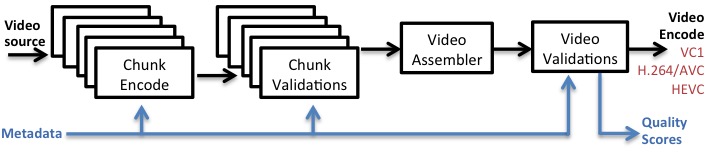
"The video encoding pipeline runs EC2 Linux cloud instances. The elasticity of the cloud enables us to seamlessly scale up when more titles need to be processed, and scale down to free up resources .. Long processing jobs are divided into smaller tasks and parallelized to reduce end-to-end delay and local storage requirements .. A modern 4K source file can be quite large. Larger, in fact, than a typical drive on an EC2 instance. In order to efficiently support these large source files, we must run the inspection on the file in smaller chunks .. Before we implemented parallel chunked encoding, a 1080p movie could take days to encode, and a failure occurring late in the process would delay the encode even further"

"..At Netflix we stream to a heterogeneous set of viewing devices. This requires a number of codec profiles: VC1, H.264/AVC Baseline, H.264/AVC Main and HEVC. We also support varying bandwidth scenarios for our members, all the way from sub-0.5 Mbps cellular to 100+ Mbps high-speed Internet. To deliver the best experience, we generate multiple quality representations at different bitrates (ranging from 100 kbps to 16 Mbps) and the Netflix client adaptively selects the optimal stream given the instantaneous bandwidth" 


See "High Quality Video Encoding at Scale" - here.

Monday, May 25, 2015

Vodafone Spain Tested LTE Broadcast at Valencia FC Game


Thomson Video Networks announced that its "ViBE® VS7000 multi-screen and HEVC encoder was chosen by Vodafone Spain and Valencia Football Club for Spain’s first live trial of an LTE Broadcast network on May 17. Vodafone Spain and Valencia CF used the ViBE VS7000 to distribute five simultaneous channels of live HD content to fans’ mobile devices in Mestalla Stadium during Valencia CF’s last Spanish League match against Celta de Vigo"
Related post - "Vodafone LTE Status: Traffic, Video, Carrier Aggregation, VoLTE, Video Broadcast" - here

"As an eMBMS-ready solution, the ViBE VS7000 provided the video encoding technology for converting the HD content to mobile formats during the trial. Offering a full IP video solution tailored for Web TV and OTT service delivery, the ViBE VS7000’s built-in support of MPEG-DASH, integration with eMBMS, and rich interfacing capabilities, made it the perfect choice for this eMBMS LTE Broadcast solution"


"Vodafone Spain’s successful LTE Broadcast trial delivered exclusive video content to Valencia CF fans in the arena via a new application on their mobile devices. Designed to enrich fans’ enjoyment of the football match, the content was tested using the 4G network infrastructure that Vodafone has deployed in the stadium and delivered in real time over five separate HD channels". 


See "Vodafone Spain and Valencia Football Club Complete Successful Trial of 4G LTE Broadcast Distribution Using Thomson Video Networks’ ViBE® VS7000" - here.

Monday, March 2, 2015

Ericsson: 4 Video Channels O/LTE Use 10% Capacity; Deployed by Telstra


Ericsson announced that "Ericsson and Telstra continue to lead mobile operators in the adoption of LTE Broadcast .. Following a series of successful trials in 2014, Telstra will deploy Ericsson's LTE Broadcast end-to-end solution on their Australian 4GX network. 

[Related post - "GSA: 16 MNOs Deploying or Trialing LTE Broadcast" - here]

The LTE Broadcast trials 
(here and here) run by Telstra and Ericsson in Australia have shown that three or four channels of video can be efficiently streamed along with complementary data channels. This traffic used as little as 10% of the 20 MHz carrier to cover all users. 

The adoption of High-Efficiency Video Coding (HEVC) compression further improves network efficiency and potential picture quality (see "ITU New Approved Video Codec will Save 50% Bitrate" - here).


Source: Ericsson - LTE Broadcast a revenue enabler in the mobile media era (here)
In late February 2015, Ericsson and Telstra demonstrated LTE Broadcast transmission using HEVC encoders. HEVC encoding reduces the bandwidth required to deliver high quality video by around 30-40%, compared with existing MPEG-4 AVC coding, enabling operators to either deliver higher quality video or more channels in the same spectrum.


LTE Broadcast has a number of potential key use cases including new customer content experiences at sporting events, such as tennis, cricket, horse racing, car racing and other special events. Using the technology, event goers will be able to access multiple high quality video streams and event related data. 


Without LTE Broadcast technology, delivery of the video and data streams would have been via unicast, consuming significantly more spectrum and network resources. Delivery via LTE Broadcast will deliver an enhanced quality of experience to a higher number of subscribers than when served via unicast delivery"
.

See "Telstra deploys Ericsson LTE broadcast to enable video-centric applications" - here.

Tuesday, January 13, 2015

M-GO Uses Beamr to Reduce 4K Video Bit Rate by up to 50%


Beamr announced that "M-GO is using Beamr Video [see "Beamr Launches Beamr Video 2.0 For Improved User Experience and Efficiency in Video Optimization" - hereto provide a best-in-class user experience for the company’s premium streaming service. Based on a patent-pending perceptual quality measure, Beamr Video automatically reduces the bitrate of any H.264 or HEVC HD and 4K video stream by up to 50 percent while retaining the full perceptual quality and format of the original file. 


"The table below summarizes the typical bitrate reduction ratios achieved by Beamr Video optimization for various types of content:

Content SourceBitrate reduction
BluRay Discs50 - 75%
Consumer video cameras (AVCHD, DSC, mobile)50 - 70%
Download services (iTunes, Amazon)40 - 50%
Streaming services (Hulu, NetFlix, YouTube)20 - 40%

See "M-GO Partners with Beamr Video to Provide Best-in-Class Streaming Quality" - here.

Tuesday, October 14, 2014

Openwave Supports HEVC for 4K Ultra-HD Video Optimization


Openwave Mobility announced it is the ".. first company to provide comprehensive optimization for 4K Ultra-HD video on mobile networks. It offers carriers up to five times more data savings compared to previous technologies. Openwave Mobility’s DynaMO, is now capable of optimizing High Efficiency Video Coding (HEVC) [see "ITU New Approved Video Codec will Save 50% Bitrate" - here] to achieve optimum HD video playback on mobile devices .. DynaMO’s HEVC optimization is available for trials and demos immediately"

[Related post - "Openwave Mobility Deploys Cloud-based Mobile Video Optimization" - here]

source: 4K Shooters - here

"DynaMO is the industry’s first NFV-ready audio, HD and media optimization solution to help carriers manage the bandwidth constraints on their networks. DynaMO uses a combination of contextually-selective and congestion-aware optimization techniques to provide the highest quality video experience for users. Taking into account each subscriber’s device, it intelligently adapts video optimization to fit the original video. The solution monitors individual users’ data sessions, optimizing videos only when networks are congested and to the extent where smooth playback can be achieved".

See "Openwave Mobility Develops An Industry First: 4K Ultra-HD Video Optimization for Mobile Devices" - here.

Thursday, September 25, 2014

Artesyn Announced High-density Video Acceleration PCI Cards

 
SharpStreamer™ PCIE-7207
Artesyn Embedded Technologies announced the "SharpStreamer™ add-on acceleration card that enables content owners, broadcasters and service provider networks to speed the deployment of high density video transcoding and multiscreen delivery.

..Artesyn is targeting the highest H.264/AVC and H.265/HEVC transcoding density in the smallest footprint. An Artesyn SharpStreamer card is capable of up to 48 streams of 1080p H.264 transcodes, or 4 streams of 1080p H.265/HEVC transcodes. It uses four Intel® Core™ i7-4650U Processors at 1.7 GHz with Intel® HD graphics 5000 Graphics supported by 8 GB memory per processor subsystem in a three-quarter length PCI Express card footprint.

..As with other add-on acceleration cards in the Artesyn portfolio, SharpStreamer is designed for compatibility with servers from Dell and HP.

The SharpStreamer is equipped with a software development kit comprised of the Intel® Media SDK with Intel® HD Graphics' hardware acceleration, monitoring and processor subsystem operating system and management tools for easy integration with server host processing environments"


See "New Artesyn Embedded Technologies Add-on Acceleration Card Enables High Density Video Processing in Standard Servers and Cloud Networks" - here.

Tuesday, January 29, 2013

ITU New Approved Video Codec will Save 50% Bitrate


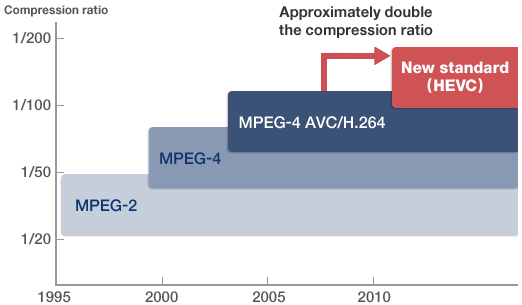
The ITU has approved "A new video coding standard building on the PrimeTime Emmy award winning ITU-T H.264 / MPEG-4 AVC .. The new standard, known informally as ‘High Efficiency Video Coding’ (HEVC) will need only half the bit rate of its predecessor,ITU-T H.264 / MPEG-4 Part 10 ‘Advanced Video Coding’ (AVC), which currently accounts for over 80 per cent of all web video".

"HEVC will unleash a new phase of innovation in video production spanning the whole ICT spectrum, from mobile devices through to Ultra-High Definition TV .. ITU-T H.265 / ISO/IEC 23008-2 HEVC will provide a flexible, reliable and robust solution, future-proofed to support the next decade of video. The new standard is designed to take account of advancing screen resolutions and is expected to be phased in as high-end products and services outgrow the limits of current network and display technology".

"Companies including ATEME, Broadcom, Cyberlink, Ericsson [see "Ericsson to Launch New Video Encoder for Live TV over Mobile" - here], Fraunhofer HHI, Mitsubishi, NHK, NTT DOCOMO and Qualcomm have already showcased implementations of HEVC. The new standard includes a ‘Main’ profile that supports 8-bit 4:2:0 video, a ‘Main 10’ profile with 10-bit support, and a ‘Main Still Picture’ profile for still image coding that employs the same coding tools as a video ‘intra’ picture".


See "New video codec to ease pressure on global networks" - here.