Showing posts with label MLab. Show all posts

Tuesday, December 2, 2014

M-LAB Blames Transit Carriers for ISPs Service Performance Degradation


A new report by M-Lab concludes that "we observed sustained performance degradation experienced by customers of Access ISPs AT&T, Comcast, Centurylink, Time Warner Cable, and Verizon when their traffic passed over interconnections with Transit ISPs Cogent Communications, Level 3 Communications, and XO Communications.

In a large number of cases we observed similar patterns of performance degradation whenever and wherever specific pairs of Access/Transit ISPs interconnected. From this we conclude that ISP interconnection has a substantial impact on consumer internet performance -- sometimes a severely negative impact -- and that business relationships between ISPs, and not major technical problems, are at the root of the problems we observed.


Observed performance degradation was nearly always diurnal, such that performance for access ISP customers was significantly worse during peak use hours, defined by the Federal Communications Commission (FCC) as the hours between 7pm and 11pm local time. This allows us to conclude that congestion and under-provisioning were causal factors in the observed degradation symptoms. 

It is important to note that while we can infer that performance degradation is interconnection-related, we do not have the contractual details and histories of individual interconnection agreements. As such, we cannot conclude whether parties apart from the two we identify are also involved (e.g. in the case that an Access ISP shares an interconnection point with another, etc.). We leave this non-technical question open for further study by others and focus here on the impact of what we can observe on consumer performance through measurement
".


See "ISP Interconnection and its Impact on Consumer Internet Performance" - here.

Saturday, January 25, 2014

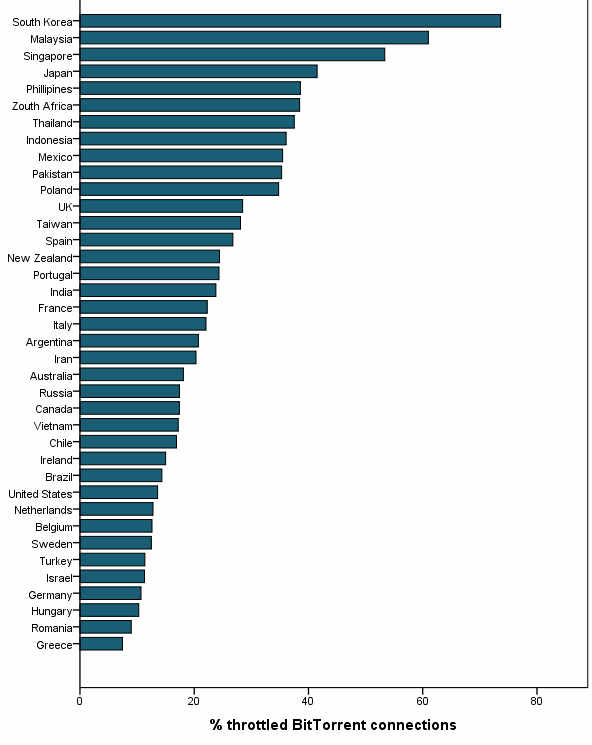
P2P Traffic Shaping is Still There; South Korea Leads

 
A recent report in TorrentFreak shows that DPI and traffic shaping is still a popular practice, globally. The report also finds that South Korea and Japan, known for their high speed broadband connections, are in the top 5 countries where ISPs are limiting the use of file sharing.

".. fresh data from the Google-backed Measurement Lab, which provides new insight into the BitTorrent throttling practices of ISPs all over the world. The data show that many ISPs still interfere with file-sharing traffic, but to varying degrees. Hundreds of ISPs all over the world limit and restrict BitTorrent traffic on their networks. Unfortunately, this is something that most of these companies are quite secretive about".


See "Is Your ISP Messing With BitTorrent Traffic? Find Out" - here.

Saturday, May 5, 2012

Bell Canada and Rogers are still on the World's Top Throttlers List

  
MLabs, a project "funded by the U.S. National Science Foundation" (see "Syracuse University Research on Deep Packet Inspection" - here), published updated information on ISPs found to be throttling data, through DPI, for BitTorrent files sharing traffic.
".. we show the 10 or 11 ISPs who had the highest percentage of tests that yielded a positive result; that is, a result indicating that DPI was used to throttle or block BitTorrent. If an ISP’s result on the chart is 93%, for example, it means that 93 percent of the tests their users conducted using Glasnost produced a result that shows that the BitTorrent application was singled out and manipulated by the ISP using deep packet inspection technology. The chart shows the two-letter country code and the name of the network operator".
Among the the top 10 throttlers for the first quarter of 2012 are two Canadian operators, who said recently they will stop throttling P2P traffic on March 2012 - will we see them the next time?
  • Bell Canada - see "Bell Canada will Stop Shape "diminishing" P2P Traffic on March 2012" - here 
  • Rogers - see "Rogers Stops DPI/Traffic Management" - here.
See " The world’s top bittorrent manipulators" - here.

Sunday, October 23, 2011

Syracuse University Research on Deep Packet Inspection

   
Syracuse University has now a website ("The Network is aware" - here) that ".. features the ongoing activities and results of research investigating whether deep packet inspection is changing the way the Internet is governed .. We analyze DPI deployments that generated political, legal and regulatory conflicts. We explore how its capabilities led to strategic interactions among network operators pursuing their business interests, government agencies seeking control, activists fighting for privacy or net neutrality, politicians and regulators responding to publicity, legislators and courts resolving disputes"
 
Analytical model of co-production
 of technology and governance
used in the case studies.
From Bendrath & Mueller (2011)

The research is led by Milton Mueller (pictured) , Principal Investigator, with a team of 5 researches (here) and "funded [here] by the U.S. National Science Foundation, SBER Division, Program on Science, Technology and Society".

See also "Milton Mueller vs. Dan Kaminsky on ISP Traffic Management Detection" - here.

Among other things, the site features [rather old] data from MLab (here, supported by Google), that uses "crowdsourced network monitoring data" to detect possible use of DPI by ISPs for BitTorrent throttling.