Showing posts with label offload. Show all posts

Thursday, December 17, 2015

Bhutan Telecom to Use Alepo's Wi-Fi Offload and Hotspot Monetization Solution


Alepo announced a "..new partnership with Bhutan Telecom, the largest mobile operator in Bhutan, to launch an expansive Wi-Fi Offload and Hotspot Monetization Solution for the Bhutanese market.

With Alepo’s Wi-Fi monetization solution Bhutan Telecom will be able to fully monetize its Wi-Fi hotspot networks by offering attractive Wi-Fi plans and promotions to its subscribers. Bhutan Telecom’s customers will be able to use a single mobile voucher to purchase mobile and Wi-Fi hotspot services, making it a simple and convenient experience. 
  • As part of its Wi-Fi monetization platform, Alepo provides an end-to-end solution for the entire purchase, activation, real-time charging, and customer care of Wi-Fi hotspot services, as well as integration with the charging system in the mobile core. 
  • With Alepo’s Carrier Wi-Fi offload solution, Bhutan Telecom will be able to leverage its planned network of Wi-Fi hotspots across Bhutan in order to increase its capacity for mobile data services as well as to enhance the customer experience of those data services.
Bhutan Telecom subscribers will enjoy a seamless 3G/4G LTE to Wi-Fi offload experience, thanks to Alepo’s full integration with the HLR and HSS in the mobile core network. 

The agreement with Bhutan Telecom signifies major milestone for Alepo. The “all things data experts” technology provider has announced several Wi-Fi monetization and offload contracts with many tier one mobile operators like Sri Lanka Telecom, Afghan Wireless, ETB Colombia [here] and others"

See "Bhutan’s Largest Telecom Operator, Bhutan Telecom, Taps Alepo for Wi-Fi Monetization and Offload" - here.

Thursday, September 3, 2015

Offload Deployments [363]: ETB [Colombia] Expands LTE Coverage w/Alepo

     
Alepo announced that "La Empresa de Telecomunicaciones de Bogota (ETB), has successfully launched Alepo’s Wi-Fi Offload solution in Bogota, Colombia .. With Alepo’s Wi-Fi Offload solution, ETB is able to broaden its next-generation data footprint with a combination of high-speed LTE and Wi-Fi Hotspot services. In doing so, ETB can deliver complete data coverage for its subscribers. Whether connected to ETB’s recently launched LTE network or – in absence of LTE coverage – offloaded to the operator’s expansive Wi-Fi hotspot network, ETB subscribers enjoy a consistent and convenient data experience".

Related post - "ETB [Colombia] Uses Alepo's PCRF-Lite" - here.

"In order to enable LTE to Wi-Fi offload at ETB, Alepo integrated its carrier-class Wi-Fi Offload platform with ETB’s LTE Home Subscriber Server (HSS). Armed with subscriber profile information, the Alepo solution is able to authenticate ETB subscribers to the Wi-Fi hotspot without requiring them to manually log on to the Wi-Fi hotspot network at each use. The scalable solution employs open, standards-based interfaces, making ready to deploy in best-of-breeds network environments of any size". 

See "Alepo Makes Wi-Fi Offload a Reality for ETB in Colombia" - here.

Monday, August 10, 2015

Vodafone India Launches a Seamless Wi-Fi Offload App


ETTelecom.com reports that "Vodafone India, the country's second largest telecom operator, has rolled out its wi-fi offload application, which will shift data traffic away from the cellular network and help decongest it. The move comes amid rising subscriber complaints about inconsistent data speeds over the cellular network, with 3G dropping to 2G speed frequently as mobile internet usage surges in India.

Vodafone Wi-Fi Connect is available on Android and iOS platforms and requires a one-time sign-in. It will come into effect anytime the user enters Vodafone's wi-fi zones in Delhi and Mumbai. It has about 100 such zones in total.

The seamless authentication of customers with the mobile network profile was a key integration challenge, experts said. Vodafone India didn't respond to ET's queries.

Rivals such as Bharti Airtel, Idea Cellular and Aircel are also looking at wi-fi as an alternative that can be deployed in parallel with the existing macro base-station network, making more spectrum available for data usage.

The company added 1,100 3G sites and 1,000 2G sites in the quarter as part of its Project Spring initiative. 3G coverage in targeted urban areas increased marginally to 91% from the previous quarter's 90%". 

  
See "Vodafone India aims to decongest 3G data networks via Wi-Fi offloading app" - here.

Tuesday, June 2, 2015

[ABI]: Wi-Fi Offload Traffic Volume will Exceed All Cellular Traffic


Just after Opera Software added features to handle Wi-Fi congestion (here) ABI Research finds that Wi-Fi offloading is growing at a "double-digit rate".

A new report by Nick Marshall [pictured], Research Director, ABI  Research forecasts that "..rapidly increasing offload of cellular traffic to Wi-Fi will reach over 17 exabytes per month by 2018 – greater than all of 2G, 3G, and 4G cellular traffic combined.

..In-building wireless data traffic will grow at a double-digit rate to reach more than 50 exabytes per month worldwide in 2020 .. Video remains the dominant traffic type with traffic volume outstripping all other traffic types, while in the enterprise and commercial segment sports venues, transportation and healthcare continue to be the verticals which transport the most traffic with shopping malls and hospitality coming in a close second place.

..DAS (distributed antenna systems) and Mobile Equipment vendors are poised to benefit from this explosion in traffic. Leading companies include Alcatel-Lucent, Axell Wireless, Cisco, CommScope, Corning, Dali Wireless, Ericsson, Goodman Networks, JMA Wireless, Nokia Networks, TE Connectivity, Wireless Telecom Group and Zinwave. These companies and others will benefit from increased DAS spending as Mobile Broadband Operators densify networks to meet this explosion in mobile traffic".

See "Global In-Building Off-load to Exceed 17 EB per Month—Critical Leverage for Mobile Broadband Operators" - here.

Thursday, May 28, 2015

[Infonetics Survey]: CSPs Expect to "significantly increase" Wi-Fi Access Point Deployment


A recent survey by Richard Webb [pictured], research director for mobile backhaul and small cells, Infonetics Research, finds that "service providers across the globe that operate carrier WiFi networks or will do so soon .. expect to significantly increase their access point deployments by the end of 2016 .. a quarter of the respondents expect that by 2016, 26 percent of their access points will be Hotspot 2.0-compliant to enable seamless roaming among WiFi networks and between WiFi and cellular networks"

Related post - "Ruckus/Global Reach Enables Hotspot 2.0 Service in San-Francisco Area"  - here

Revenue generation has become a key driver of carrier WiFi deployments. Not only does Hotspot 2.0 support integration of WiFi with mobile and fixed networks, but it supports the creation of new revenue models for WiFi services”. Says Richard. 


  • Survey respondents’ top drivers for deploying carrier WiFi are preventing churn, bundling service with mobile broadband, improving coverage and generating new WiFi access revenue
     
  • Carriers surveyed are adopting a growing variety of monetization models, with tiered hotspots and WiFi roaming growing the fastest through 2016
     
  • For the third straight year, Ruckus Wireless and Cisco lead respondent perception of top carrier WiFi vendors
See "Hotspot 2.0 and Virtualization Key to New Revenue for WiFi Carriers" - here.

Saturday, May 16, 2015

KDDI: Wi-Fi Offload to Reach 65%; LTE Capex Dropped by 50%


Joseph Waring reports to Mobile World Live that "Japanese operator KDDI’s push over the past year to boost WiFi offload has resulted in a sharp increase in the amount of data moved off macro sites as well as huge savings in wireless capex".

KDDI started with its offloading project more than 4 years ago, announcing its plan to deploy Ruckus' 120,000 Wi-Fi access points (here). They now have 3,000,000 access points. At the end of March 2015, KDDI had 43,478,000 mobile subscriptions. 

Fumio Watanabe [pictured], chairman of KDDI’s R&D Laboratories, spoke at BROADBAND ASIA, SINGAPORE and said that "WiFi offload was stuck at about 30 per cent three to four years ago when users faced frequent connection issues with WiFi and because flat-rate plans didn’t give them much incentive to use WiFi. 

It was only after the company distributed three million free WiFi access points that the percentage jumped from 30 per cent to 57 per cent .. We hit the 57 per cent target last fiscal year, which ended 31 March, and aim to expand the offload to 65 per cent this fiscal year, which will further reduce our LTE capex”.

Source: KDDI 2014 annual report 

Watanabe told Mobile World Live that "with more than half of its macro traffic offloaded to WiFi, its LTE capex has dropped by a similar percentage".

Source: KDDI 2014 annual report 

See "KDDI aims to offload 65% of mobile data to WiFi this year" - here.

Friday, January 9, 2015

Openet's Wi-Fi Offload Solution Deployed for 1.9M Subscribers

 
Openet announced that its "Network Selection Intelligence solution has been deployed by a leading Southern European wireless, wireline, broadband and cable TV operator. The operator selected Openet’s end-to-end solution, based on the ANDSF standard [see "Openet Acquires Routing Policy Technology" - here], to provide intelligent Wi-Fi management and offload capabilities to optimize the mobile data experience for its customers while dramatically reducing network costs".


Related post - "Ovum: Operators Look for a Device-based Policy Solution for Wi-Fi Offload" - here.

"This operator has turned to Wi-Fi management techniques as a way of cost effectively improving the mobile data experience for its 1.9 million customers. Openet’s Network Selection Intelligence solution can seamlessly integrate with existing network elements and applications to significantly reduce costs from interconnection fees, and use of a less expensive access technology. The solution will also ensure all customers benefit from the best available network capacity and enjoy an optimal mobile data user experience".

See "European Cable Operator Deploys Openet’s Network Selection Intelligence Solution" - here

Sunday, January 4, 2015

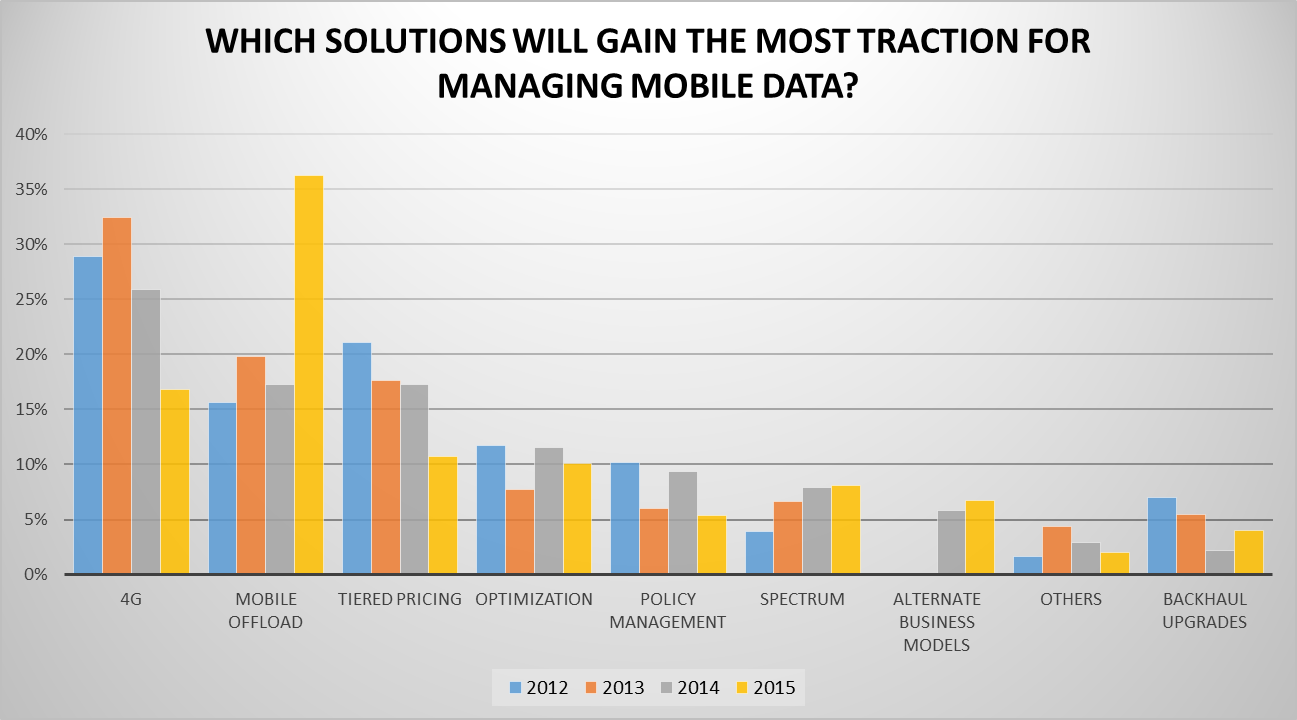
[Survey]: Offload to Gain Most Traction in Mobile Traffic Management for 2015


Chetan Sharma [pictured] published his annual survey for 2015 - "a way to engage our knowledgeable community on the trends we are likely to see the next year. We put some of the pressing questions to our colleagues and industry leaders from all corners of the world .. Executives, developers, and insiders (n=175) from leading mobile companies and startups from across the value chain and from around the globe participated to help see what 2015 might bring to surprise us. The survey draws upon the unique collective wisdom of the folks who are the center of the mobile evolution. Thanks for being part of our annual ritual".

Q10 is relevant for this blog: "Which solutions will gain the most traction for managing mobile data broadband consumption?

Wi-Fi accounts for bulk of the mobile data traffic in almost all major markets hence the rise of mobile offload as the preferred solution for managing data growth. But, LTE deployment, spectrum acquisition, and tiered pricing remained the top solutions for the operators.


See "Mobile Predictions 2015" - here.

Friday, December 12, 2014

Devicescape: Integrated Wi-Fi/Cellular Service Increases Consumption


Devicescape shared ",, new data demonstrating that consumer consumption of cellular data grows significantly for the majority of users following the introduction of an integrated Wi-Fi and cellular service. Figures from commercial deployments of Devicescape’s ABC (Always Best Connected) solution revealed a 17% increase in billable monthly cellular data use from 64% of end users.

Devicescape’s policy-based ABC solution intelligently manages the movement of users between cellular networks, the Devicescape Curated Virtual Network of 20 million amenity Wi-Fi locations worldwide, and private hotspots in the home and office.


Given automated access to the best available networks, end users ‘supersized’ their overall data consumption. Within three months, the average user’s combined cellular and Wi-Fi data consumption grew by 48%.

While a 17% increase in cellular data represents an excellent operator revenue opportunity, end users themselves were able to exploit Wi-Fi for a dramatic increase in overall data consumed against a small incremental investment in cellular". 


See "Commercial deployments show increased Wi-Fi consumption drives appetite for cellular data" - here.

Wednesday, August 6, 2014

Israel: Wi-Fi Offload Allowed!


A year ago the Israeli Ministry of Communications decided that MNOs will not be allowed to offer Wi-Fi offloading in public areas (see "Israel: MNOs won’t Offload to Wi-Fi" - here).

This has changed today, and the Ministry announced (here, Hebrew) that any organization may offer such services, in any location (private or public). Some municipalities, such as Tel Aviv, are offering free Wi-Fi services for sometime now.

MNOs will not be able to charge extra from their customers for the Wi-Fi access, and will not be able to count the usage towards their monthly quota.


Monday, May 12, 2014

[ABI]: 10.5M Wi-Fi Hotspots by 2018 to Maximize Coverage


A new report by Marina Lu [pictured], Research Analyst, ABI Research finds that "Worldwide Wi-Fi deployments reached a total of 4.2 million hotspots in 2013, and will continue to grow at a CAGR of 15.0% between 2013 and 2018, to exceed 10.5 million .. The number includes Wi-Fi hotspots deployed by mobile and fixed-line carriers as well as third party operators .. Wi-Fi helps to offload 3G/4G mobile Internet users to Wi-Fi networks, which is a more cost-effective method for both mobile carriers and mobile users.”

In Asia-Pacific, China alone has deployed 620,000 Wi-Fi hotspots, of which 420,000 have been built by China Mobile, followed by China Telecom with 128,000 hotspots, and China Unicom with 72,000. 

In Latin America, Brazil’s carrier Oi [see "Oi [Brazil] Uses Aptilo to Create a Public Wi-Fi over Home/SMB Routers" - here] has completed its target of 500,000 Wi-Fi hotspots by the end of 2013, ahead of the 2014 FIFA World Cup.

.. Wi-Fi also represents a good opportunity for fixed-line operators to join in the mobile broadband field. The UK fixed-line operator BT with 200,000 of Wi-Fi hotspots (excl. homespots) is also providing Wi-Fi roaming services to mobile operators and other Wi-Fi providers"

See "Global Wi-Fi Hotspots Will Grow to 7.1 Million in 2015 as a Method to Offload Traffic" - here.

Sunday, March 30, 2014

[Singapore]: Auto Login to Free Wi-Fi (also for Visitors!)


The Infocomm Development Authority of Singapore (IDA), announced that "Consumers will soon enjoy easier access to all Wireless@SG hotspots, when a new automatic login feature kicks in from April 1. 

Dubbed EAP-SIM (RFC), this new SIM card-based login feature offers users an "always on" experience by allowing them to automatically connect to any Wireless@SG hotspot using a supported device with a local SIM card. This means new and existing users of Wireless@SG no longer need to sign up for the service or enter any credentials to access the Internet at any Wireless@SG hotspot.

Wireless@SG users can easily configure their supported mobile devices to make use of this new login feature by following the connection guide available from the IDA website at www.ida.gov.sg/Individuals-and-Community/Infocomm-You/Wireless-SG.

Source: Cisco (here)
Visitors in Singapore will benefit from the improvements, too. From June 2014, visitors can register for a free account at any Wireless@SG hotspot and receive their login details through SMS messages sent to their foreign mobile numbers. Alternatively, visitors can buy a local prepaid SIM card from M1 (here) and StarHub (here) to log on to Wireless@SG via the new SIM-based login feature .. By 2015, the IDA will double the total number of hotspots to 10,000. This will be further doubled to 20,000 by 2016".

See "Wireless@SG to Offer Seamless Wi-Fi Connectivity, More Hotspots" - here.

Sunday, September 22, 2013

Offload Deployments [265]: Cricket [US] Uses DeviceScape w/16M Hotspots


Devicescape announced that "Cricket Communications, Inc., a nationwide no-contract wireless provider, has deployed Devicescape’s Curator Service to provide offload services and capacity-reach. Cricket customers now have access to the fast growing Devicescape Curated Virtual Network (CVN) of over 16 million high-quality Wi-Fi hotspots and intelligent connection software to provide seamless and automatic connectivity to Wi-Fi. 


The Devicescape Curator Service will allow Cricket customers to gain simple and immediate access to Devicescape’s CVN of public Wi-Fi hotspots, which are continuously tested in real-time to ensure they meet Cricket’s requirements for a quality experience. Devicescape’s Curator Client, working together with the cloud-based Curator Service Platform, identifies the best available connection and proactively connects, including auto-navigation of click through portals".

See "Cricket Communications, Inc. Selects Devicescape for Wi-Fi Offload" - here.

Friday, September 20, 2013

Openet and Smith Micro Show Intelligent Wi-Fi Offload Interoperability


Openet, working with Smith Micro Software (see "Smith Micro Helps MNOs with Smarter Offloading" - here), announced "completion of successful interoperability tests leveraging standards-based methods to deliver intelligent Wi-Fi offload and traffic optimization for heterogeneous networks .. The interoperability test utilized Smith Micro’s NetWise™ I/O Toolkit and centered on Openet’s Access Network Discovery and Selection Function (ANDSF) server [see "Openet Acquires Routing Policy Technology" - here], a 3GPP and OMA standards-compliant component of Openet’s Interaction Gateway. The server interacts with on-device agents to dynamically coordinate network selection based on device, network, and subscriber contextual information. Network selection decisions can incorporate any information source; examples include the quality of Wi-Fi and radio network signal, or specifics from the subscriber’s service plan agreement.

Openet’s Interaction Gateway [see "Openet Extends Policy Enforcement to the Device; Reduces Signaling Congestion" - here] provides integration with operator policy and charging control systems as well as intercommunication through the S14 interface with handsets that support ANDSF to coordinate device policies. Openet’s capabilities extend ANDSF with additional policy and charging options, in the context of device usage, for discovery and intelligent network selection. The solution also provides analytics for network and device performance, assisting operators to better the quality of users’ experience".


See "Openet, Smith Micro Validate ANDSF Interoperability for Intelligent Wi-Fi Offloading and HetNet Optimization" - here

Wednesday, September 11, 2013

[Survey] Policy Management Shifts From Congestion to Service Plan Management


A recent survey by Graham Finnie, Chief Analyst Heavy Reading (sponsored Volubill, based on responses from 81 individuals at 56 network operators across all regions and types of providers) finds that "network operators’ primary priority has shifted from managing network congestion to offering subscribers more control and higher quality of service (QoS) through enhanced mobile policy offerings, like LTE and self-care dashboards".

Key findings:  
  • 75% of respondents consider introducing new services, price plans and options the primary purpose for policy management technologies in the next two years 
  • 25% of respondents citing the management of network congestion as the priority

    The following percentage numbers refers to the network operators:
  • Approximately 70%  currently enable or plan to enable users to monitor data volume usage via a policy-linked self-care app or dashboard
  • 54% plan to allow customers to change plan options directly via their device. 
  • Nearly 87% are deploying, or plan to deploy, LTE
  • 43% are upgrading or adding capacity to existing policy platforms to accommodate LTE
  • 52% expect to manage WiFi Offload using a policy solution
  • 54% currently, or plan to, use policy control to give certain content or applications priority, and charge subscribers accordingly
See "Heavy Reading Research Reveals Quality of Service a Primary Goal for 75 Percent of Network Operators" - here

Saturday, August 31, 2013

[Strategy Analytics]: SDN can save MNOs more than $4B CapEx by 2017

   
A new study by Sue Rudd [pictured], Director, Service Provider Analysis, Strategy Analytics (sponsored by Tellabs) finds that "SDN can save mobile operators more than $4 billion in capital expenses by 2017. Savings stem from 5 key SDN applications for mobile backhaul networks [see below]".

The highest % of savings relates to Wi-Fi Offload and video redirect (over $1B). 

"The Tellabs Congestion Control Application, which it demonstrated earlier in 2013 [here], is one example of SDN in action. The application applies SDN to head off bottlenecks and reroute traffic in the backhaul network before users are aware of any problems with their service. For this demonstration, Tellabs’ approach was to add the SDN controller to its existing Tellabs® 8000 Intelligent Network Manager. This means that customers can deploy SDN seamlessly without the need to rebuild the network to achieve the advantages that SDN brings"


See "New Study Reveals: SDN Could Save Operators $4 Billion in Capital Expense by 2017" - here.

Tuesday, August 13, 2013

[Light Reading] NSN Wins 2 Wi-Fi Offload Deals in India

 
Danish Khan report to Light Reading that Sandeep Girotra [pictured], India Head, Nokia Solutions and Networks said in a press conference that NSN "signed up with two top India telcos to provide them with WiFi network integration and access point and core setup for seamless WiFi offload .. The key trigger for telcos to opt for Wi-Fi offload is spectrum. In WCDMA for example, each operator has 5 MHz, which is a narrow chunk of spectrum. So, when the capacity hits in hotspots, operators need to offload from the WCDMA to the lower layer of Wi-Fi .. We are in process of rolling out Wi-Fi offloading solutions"

"Girotra says that NSN works with 9 telecom players--Bharti Airtel, Vodafone India, Idea Cellular, TTSL, Aircel, Uninor, BSNL, Videocon and Railways in the country".

See "WiFi Offload Does It For NSN" - here.

Saturday, July 27, 2013

[YG]: Policy on Device - "an essential element in their overall policy architecture"

   
A new report by Jennifer Pigg [pictured] , VP, Yankee Group, concludes that "Service providers should approach policy on the device (PoD) as an essential element in their overall policy architecture. Wi-Fi offload should be the MNOs’ trial balloon for PoD, but MNOs should look to enhanced PoD use cases to provide differentiated services. Hotspot 2.0 will simplify Wi-Fi roaming, but at the same time will exacerbate the challenge of controlling the user experience when the subscriber roams off the network. MNOs will need PoD to maintain control of their subscriber base.

"A new class of policy on the device (PoD) vendors has emerged. These vendors use a variety of product, pricing and go-to-market strategies. Their PoD solutions will enable new revenues streams across a wide variety of usage models".

Related posts:
  • Openet Acquires Routing Policy Technologyhere and Openet Extends Policy Enforcement to the Device; Reduces Signaling Congestion - here
  • GOS Networks: DPI & Policy Control won't Help - Control Needed at the Device - here
  • Ovum: Operators Look for a Device-based Policy Solution for Wi-Fi Offload - here
See "Extending Network Policy to the Device" - here.

Friday, June 28, 2013

BroadForward Helps Convergence w/RADIUS to Diameter Interworking


BroadForward (see "BroadForward CEO: 'We have a very ambitious 5 year growth plan'" - here) announced that the "..latest release of the BFX Interface Gateway introduces further service logic enhancements for advanced RADIUS to Diameter Interworking scenarios. Users of BFX get sample configuration templates to quickly connect RADIUS based Fixed network elements such as Edge Gateways and Wi-Fi Packet Gateways with Diameter based Mobile network elements such as PCRF, OCS, optionally through a DRA. 

The ability to connect RADIUS and Diameter network elements allows service providers to enable service continuity scenarios with converged policy control and integrated data bundles. Examples of such converged services are: common charging and subscriber policies across access networks, automatic access to Wi-Fi offload, seamless roaming scenarios between access providers including authentication and accounting of the subscriber, portable security and service assurance amongst others".

See "BroadForward enables advanced RADIUS -Diameter interworking for Fixed-Mobile Convergence" - here.

Wednesday, June 26, 2013

HP Launches Intelligent Wi-Fi Solution - Integrates Offload, Analytics and Policy Management

 
HP announced a ".. new solution designed to help mobile network operators (MNOs) improve overall service quality and customer experience by leveraging WiFi technologies .. HP is providing a wide set of modules that can be used independently or together to enable WiFi services such as WiFi Offload .. HP’s Intelligent WiFi solutions are available worldwide with pricing based on solution size and architecture".  

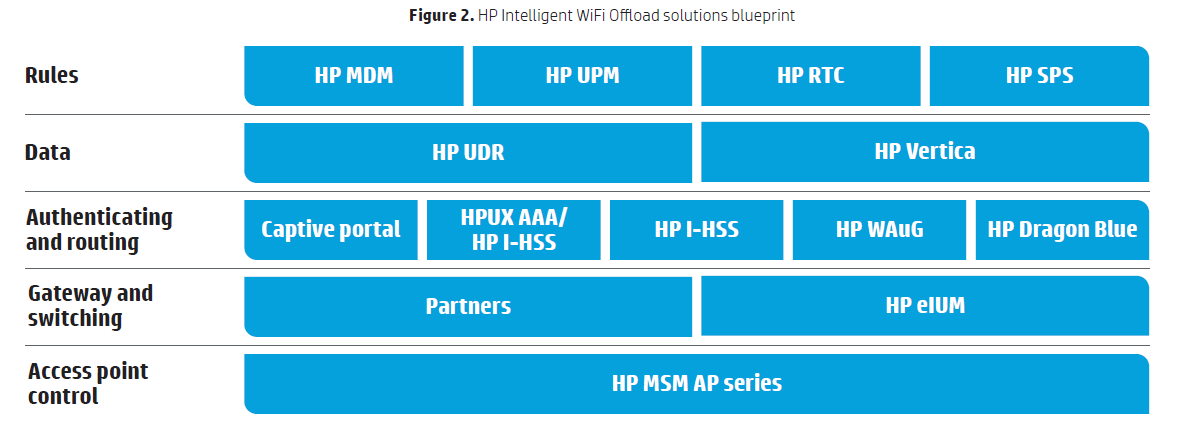
HP Intelligent WiFi Offload solutions rely on many HP sub-domains and define a wide framework
divided into five layers:
 

  • Access point control provides a complete range of networking products for offloading, including a large portfolio of hotspots scaling
     
  • Gateway and switching link WiFi traffic with the data network, tunneling data to ensure security, and providing protection against attacks and identity theft
     
  • Authentication and routing methods identify the user who wants to connect on WiFi and includes HSS core network elements and the deep packet inspection (DPI) function to collect user information for further business analysis
     
  • Data logical layer stores subscriber data and applies analytics and business intelligence [here]
     
  • Policies and rules dictate hotspot network selection, policy control rule function (PCRF - here), real time charging (RTC) rules, and where business analytics reside.


See "HP Helps Mobile Operators Enhance Services through Intelligent WiFi Technologies" - here.