Showing posts with label lawful intercept. Show all posts

Tuesday, December 27, 2011

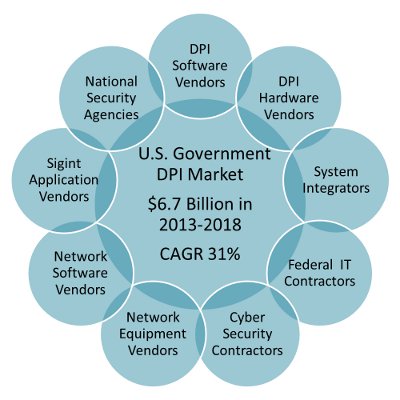
US Government will Spend $6.7B on DPI Based Security for 2013-2018

    
A new research by Market Research Media finds that "The U.S. Government Deep Packet Inspection market is projected to grow at a CAGR of 31% from 2013 to around US$ 1.8 Billion by 2018. The market will see a few good years of explosive growth in all segments before going flat"

"While technological advantages of the DPI technology leave no doubt about its significant role in cyber security, lawful interception and data leakage protection, the perception of DPI as “postal employees opening envelopes and reading letters inside” and privacy concerns hurdle its deployment."

While the report shows a nice annual growth, the numbers are smaller comapred to the previous report, which projected $7.2B spending from 2010 to 2015 (here).

See "Deep Packet Inspection (DPI): U.S. Government Market Forecast 2013-2018" - here.

Thursday, November 25, 2010

HP Adds Qosmos DPI to its Data Retention Solution

   
HP announced that "it has integrated application probe capabilities from Qosmos into HP DRAGON [see chart below], the company's data retention solution that helps telecom companies and law enforcement agencies fight terrorism and organized crime .. The integration of Qosmos Network Intelligence probes broadens the already strong data collection capabilities in HP DRAGON"

See "HP enhances DRAGON Data Collection with Qosmos to streamline telecoms' fight against terror and crime" - here.

"Qosmos' technology queries the CSP's IP network in real-time as if it were a database, filtering only relevant data and creating call data records (CDRs) that are optimized for storage and analysis," said Thibaut Bechetoille, president and CEO of Qosmos. "As a result, HP DRAGON can help service providers respond quickly and cost-effectively to legal and investigative requests for electronic evidence."

"In contrast to storing raw network data, the HP and Qosmos technologies use aggregation and correlation to store data intelligently. This approach yields benefits for CSPs:
  • Improves the quality of the information stored in the repository
  • Improves performance by reducing record counts
  • Reduces storage requirements by storing a single intelligent record, not many individual records"
Related posts:
  • DPI Announcements: CommProve and Qosmos Offer Layer 7 Visibility into Mobile Traffic - here
  • DPI Announcements: Data Retention System from Bivio - here
  • DPI Deployments (37): Momentum Telecom Use VoIP CDRs to Troubleshoot and Generate Business - here
 

Sunday, August 8, 2010

New Paper on "Deep Packet Inspection and Internet Governance"

 
It seems that the DPI's recent public attention attracts legal, social and political research on the subject. The latest comes from Ralf Bendrath (right picture) and Milton Mueller.

See "The End of the Net as We Know it? Deep Packet Inspection and Internet Governance" - here

Abstract:

Advances in network equipment now allow internet service providers to monitor the content of data packets in real-time and make decisions about how to handle them. If deployed widely this technology, known as deep packet inspection (DPI), has the potential to alter basic assumptions that have underpinned Internet governance to date. The paper explores the way Internet governance is responding to deep packet inspection and the political struggles around it. Avoiding the extremes of technological determinism and social constructivism, it integrates theoretical approaches from the sociology of technology and actor-centered institutionalism into a new framework for technology-aware policy analysis.

The paper covers the common DPI use cases (network security, bandwidth management, Governmental surveillance, Content regulation, Copyright enforcement and Ad injection), discusses whether DPI is a "a disruptive technology" and concludes (regarding two of the presented cases):

"If ISPs have an interest in DPI usage for bandwidth management, they can and often will go ahead and just do it. When DPI is desired by third parties like copyright holders, on the other hand, those actors must invest heavily to make ISPs cooperate. In this respect, technology determines politics "

Related post "The Legality of DPI - Paper by Angela Daly" - here.

Sunday, June 27, 2010

DPI Announcements - Cisco/Starent PGW - DPI, QoS, LI


Cisco updated on Friday its information on "Cisco PGW Packet Data Network Gateway" (PGW), a function that is supported on Cisco's ASR 5000 multimedia core platforms (the former Starent ST40 GGSN product).

See the introduction - here.

According to Cisco, the PGW function supports also the following functions, all in the ASR-5000 platform - and seems to be available now.
  • Acts as the Policy and Charging Enforcement Function (PCEF)
  • Manages quality of service (QoS)
  • Provides deep-packet inspection and lawful intercept