Showing posts with label TCP/IP. Show all posts

Thursday, November 19, 2015

Akamai Expands HTTP/2 Deployment


Akamai Technologies announced that it is now "..actively working with more than 150 customers to deliver HTTP/2-enabled websites and is expanding its HTTP/2 program to all customers using qualifying products to deliver TLS encrypted web content.

HTTP/2 represents the first major update to the HTTP network protocol in nearly 20 years. Although websites have dramatically evolved during this time, HTTP, the underlying protocol of the Web, has not. Through features and capabilities such as multiplexing and concurrency, header compression, server push, support for the latest cipher suites, and an overall reduction in development complexity, HTTP/2 is intended to significantly improve the performance and security/privacy of today’s Web.

More than 70 percent of requests on Akamai’s CDN currently come from HTTP/2 compliant browsers; however, some older browser versions will continue to be used for the foreseeable future. Therefore, Akamai’s implementation of HTTP/2 has been designed to use real-time network and end-user intelligence to dynamically apply the appropriate performance optimizations to ensure the best performance for each user. In addition, we believe Akamai is well positioned to offer the tools and intelligence required to take full advantage of the move to HTTP/2. For example, easy‑to‑use, self-service and highly granular configurability allows customers to control the deployment of HTTP/2, while built-in monitoring and reporting helps measure the impact
"


HTTP/2 attempts to solve many of the shortcomings and inflexibilities of HTTP/1.1. Its many benefits include:
  • Multiplexing and concurrency: Several requests can be sent in rapid succession on the same TCP connection, and responses can be received out of order - eliminating the need for multiple connections between the client and the server
     
  • Stream dependencies: the client can indicate to the server which of the resources are more important than the others
     
  • Header compression: HTTP header size is drastically reduced
     
  • Server push: The server can send resources the client has not yet requested

See "Akamai Helps Drive Adoption Of Faster And More Secure Web Protocol" - here.

Sunday, June 7, 2015

Teclo Helps 3 MVNOs Reduce Hosting Costs by Halving Images Traffic


Teclo Networks announced that its "SSeries solution has recently been deployed by three European Mobile Virtual Network Operators (MVNOs) to compress images and website resources as they are downloaded to a mobile handset. 

Since its installation, each MVNO has seen the traffic volume devoted to image transfers halved, with a corresponding decline in payments to host networks. As the S-Series is quick and easy to install within mobile network infrastructure, MVNOs can instantly secure major OPEX savings whilst still delivering a superfast web browsing experience to their subscribers".

See "Three European MVNOs deploy Teclo Networks’ S-Series solution to lower operating costs by compressing images" - here.

Tuesday, November 4, 2014

[ABI]: New Video Delivery Technologies


A new report by Sam Rosen [pictured], Practice Director, ABI Research finds that video delivery technology has to be adapted to be able to meet demand and quality.

"A few trailblazers are working on disruptive innovations. Areas such as the inability of TCP delivery to keep up with high throughput demands, the lack of perceptual tools in modern codecs, as well as the inefficiency of storage within CDNs all pose significant additional challenges within the ecosystem. A number of innovative companies, from startups to more mature businesses, are addressing these issues: bitmovin [transcoding and players], beamr [Optimization], Akamai, Aspera [High-speed transfer] (part of IBM), Vantrix [here], and Conviva [Analytics]".

“Of the areas we examined, carrier equipment for video delivery, transit replacements for TCP, and real user monitoring (RUM)/application performance monitoring (APM) applied to video have the largest market potential and are expected to be the most pervasive in tomorrow’s video services .. Meanwhile, OTT monitoring is expected to remain a niche market. These disruptive innovations will lead to about US$1.5 billion in 2020 revenues across a variety of industries”.

See "Video Delivery Requires New Codecs, Improved Network Protocols and Analytics" - here.

Tuesday, September 23, 2014

Teclo Migrates its Mobile Acceleration Technology to Enterprise Networks


Teclo Networks announced the "launch of the B-Series, a simple to deploy solution that speeds up business networks. Based on its mobile data acceleration technology and expertise [see "Free [France] Uses Teclo's TCP/IP Optimization" - here] - delivering lightning-fast Internet for wireless operators- Teclo Networks now brings outstanding network performance and reliability to the enterprise.

Proven to speed up business networks by as much as 400%, the B-Series will improve a number of network functions including: cloud computing, file transfers, web browsing and video conferencing. The B-Series runs off just one single hardware unit, making it both cost effective to buy and install. Regardless of the amount of devices or operating system connected, the B-Series is able to improve the performance and user experience on smartphones, tablets, PCs, laptops and Mac devices"
.


See "New Enterprise Class Technology from Teclo Networks to Power Workplace IT Networks" - here.

Saturday, September 6, 2014

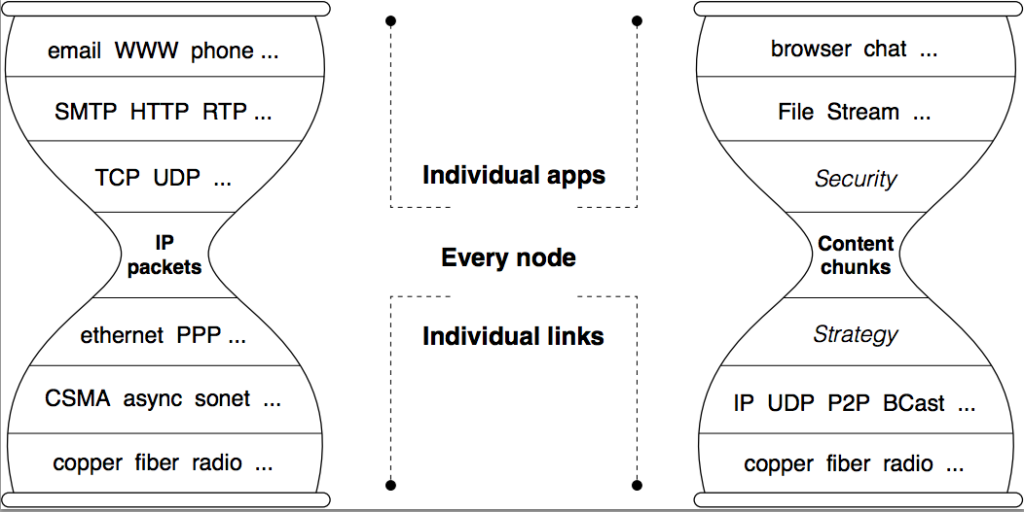
New Consortium Wishes to Replace TCP/IP


A new consortium, led by the Lixia Zhang, Jonathan B. Postel Chair in Computer Science, and Van Jacobson, a UCLA adjunct professor and member of the Internet Hall of Fame from UCLA Henry Samueli School of Engineering and Applied Science, was launched "to promote the development and adoption of Named Data Networking. NDN [technical report - hereis an emerging Internet architecture that promises to increase network security, accommodate growing bandwidth requirements and simplify the creation of increasingly sophisticated applications .. Among the industry partners planning to participate are Verisign, Cisco Systems and Panasonic". 

The consortium first meeting was held this week, in UCLA.

"The NDN team’s goal is to build a replacement for Transmission Control Protocol/Internet Protocol, or TCP/IP, the current underlying approach to all communication over the Internet. The consortium aims to generate a vibrant ecosystem of research and experimentation around NDN; preserve and promote the openness of the core NDN architecture; and organize community meetings, workshops and other activities"

Internet and NDN Hourglass Architectures
Source: Named Data Networking: Executive Summary

See "UCLA-led consortium to focus on developing a new architecture for the Internet" - here.

Tuesday, July 29, 2014

Danish and US Researchers Use Math to Expedite the Internet (5-10X)


A new study by  Frank Fitzek [pictured], Professor in the Department of Electronic Systems from Aalborg University finds that "Mathematical equations can make Internet communication via computer, mobile phone or satellite many times faster and more secure than today. Results with software developed by researchers from Aalborg University in collaboration with the US universities the Massachusetts Institute of Technology (MIT) and California Institute of Technology (Caltech) are attracting attention in the international technology media.

A new study uses a four minute long mobile video as an example. The method used by the Danish and US researchers in the study resulted in the video being downloaded five times faster than state of the art technology. The video also streamed without interruptions. In comparison, the original video got stuck 13 times along the way.

The Danish and US researchers solution is a ".. special kind of network coding that utilizes clever mathematics to store and send the signal in a different way. The advantage is that errors along the way do not require that a packet be sent again. Instead, the upstream and downstream data are used to reconstruct what is missing using a mathematical equation".

See "Math Can Make the Internet 5-10 Times Faster" - here.

Wednesday, July 9, 2014

Optimization Deployments [316]: Free [France] Uses Teclo's TCP/IP Optimization


Teclo Networks announced that "Free Mobile, has deployed Sambal from Teclo Networks to deliver lightning fast mobile internet to subscribers across the network .. Sambal manages and optimizes data transferred through TCP/IP without caching. Put simply, Sambal brings the consistency of fixed line Internet to mobile networks. Sambal also has optional compression features. It can work in two modes: transparent, with no content change and non-transparent, with slight image degradation to make mobile web pages download faster".


Related post - "MTS India Deploys Allot with Video and TCP Optimization" - here.

See "Free mobile maximizes data speeds with Teclo Networks’ optimization" - here.

Friday, June 20, 2014

MTS India Deploys Allot with Video and TCP Optimization


In a post to Allot Communications' blog, Matan Trogan, Regional Product Manager for APAC, covers the vendor's recent APAC customer event in Phuket, Thailand.

Among the case studies presented at the event, Matan mentions that a "customer explained that video traffic from their 10M subscribers comprises 40% of downlink traffic and that video stalling and buffering have a negative impact on their customer satisfaction scores. To improve video quality of experience (QoE) and prevent churn they are implementing “just-in-time” video optimization and acceleration powered by Allot VideoClass – one of the value-added services that is fully integrated with and hosted in the Allot Service Gateway".

I understand that this customer is MTS India. In addition to Video optimization, they are also using Teclo Networks' TCP optimization, as an integrated add-on to Allot (related post - "MTS [Armenia] Deployed Teclo TCP Acceleration" - here). MTS are also using a video caching solution from PeerApp, a former partner of Allot before the acquisition of Oversi (see "MTS [India] Selected PeerApp" - here),

See "Use Cases Steal the Show in Phuket" - here.

Saturday, May 31, 2014

Flash Networks Optimizes LTE Upload Messaging Services


Flash Networks announced that it is the"..  first mobile optimization vendor to accelerate upload speeds for messaging apps such as WhatsApp and Snapchat. Flash Networks uses patented technology to optimize LTE bandwidth utilization, resulting in up to 30% faster upload speeds for an improved user experience.

Flash Networks’ TCP-4TE 
[see chart below for download optimization] uses inline high-speed congestion-detection algorithms to dynamically adjust transmission rates based on real-time network conditions to enable faster uploads of content to messaging services. TCP-4TE minimizes the inherent inefficiencies of standard TCP stack, making its data transmission methods more compatible with high-speed LTE networks".


See "Flash Networks accelerates mobile uploads for whatsapp, snapchat, and other messaging applications" - here.

Tuesday, April 22, 2014

IETF: Requirements for Congestion Control


An informational RFC by Randell Jesup [pictured], Mozilla "attempts to describe a set of requirements that can be used to evaluate other congestion control mechanisms in order to figure out their fitness for this purpose, and in particular to provide a set of possible requirements for proposals coming out of the RMCAT  [RTP Media Congestion Avoidance Techniques] Working Group".

Some of the requirements:
  • The congestion control algorithm must attempt to provide as-low-as-possible-delay transit for real-time traffic while still providing a useful amount of bandwidth.
     
  • The algorithm must be fair to other flows, both realtime flows (such as other instances of itself), and TCP flows, both long-lived and bursts such as the traffic generated by a typical web browsing session
     
  • The algorithm should quickly adapt to initial network conditions at the start of a flow. This should occur both if the initial bandwidth is above or below the bottleneck bandwidth
     
  • The algorithm should not require any special support from network elements 
See "Congestion Control Requirements For RMCAT" - here

Wednesday, April 9, 2014

ConteXtream and Guavus Bring Analytics to SDN-based Carrier Networks


ConteXtream announced that it has "..partnered with Guavus to bring real-time analytics to Software Defined Networking (SDN) deployments on service provider networks. The partnership will combine ConteXtream’s ContexNet™ and Guavus’ Reflex™ operational intelligence platform. 

The joint solution gives network operators an end-to-end view across their network and enables Communication Service Providers (CSPs) to dynamically and more efficiently allocate network resources for video optimization, TCP optimization, and rate shaping".


See "ConteXtream and Guavus Partner to Make Service Provider Networks Programmable with Real-time Analytics" - here.

Monday, March 3, 2014

Optimization Deployments [293]: MTS [Armenia] Deployed Teclo TCP Acceleration

  
Teclo Networks announced that "VivaCell-MTS Armenia has deployed Sambal to enhance the speed of the mobile internet for its subscribers. Thanks to Sambal, the Armenian operator has already boosted network speeds remarkably and reduced retransmissions by over 10 percent, resulting in faster internet for customers across the network".

VivaCell- MTS is Armenia’s leading mobile operator, with 2.1M subscribers (1.7M are pre-paid)

About Teclo's optimization technology (see also "Teclo Networks Unveils Most Comprehensive TCP Data Optimization Product" - here):

"TCP/IP does not interact efficiently with radio networks. A few packets of data lost at the wrong time in a mobile broadband network leads to extended pauses in downloads and web page loading. This leads to frustration and dissatisfaction for the customer and more often than not a swift departure to another provider.Sambal has been measured to achieve 30% speedups in typical mobile broadband networks. This is achieved solely by optimising TCP/IP behaviour to make it operate much more effectively towards a lossy and high latency radio network"


See "VivaCell-MTS Armenia Appoints Teclo Networks for High-Speed Mobile Internet" - here.

Wednesday, June 19, 2013

Time Warner Cable: Slow Internet is Normal - We don’t Throttle Traffic

 
Jeff Simmermon (pictured), Director Digital Communications, Time Warner Cable explains in a blog post why the Internet is sometimes slow. There are many reasons - but not the speculation "A small subset of our customers" that "seem to think we are intentionally degrading their service"

We don’t throttle traffic

".. We’ve invested billions of dollars to ensure that our networks deliver the best possible experience regardless of the source or nature of the traffic. However, the traffic only moves as fast as the weakest link. And when traffic travels across multiple networks, each with its own relationships, slowdowns and other problems can and do occur".

See "Explained: Why Internet Traffic Slows At Times" - here.

Saturday, April 27, 2013

Akamai: Number of DDoS Attacks Grew by 207% in 2012

 
Akamai's "The State of the Internet 4th Quarter, 2012" [here] report finds that the ".. number of Distributed Denial of Service (DDoS) attacks that Akamai saw in 2012 grew significantly from 2011. While 250 attacks were reported in 2011, 2012 saw 768 attacks reported by our customers, a year-over-year increase of more than 200%.

.. over a third (269 or 35%) of the attacks targeted companies in the Commerce sector. An additional 164 attacks (22%) targeted Media and Entertainment companies, followed closely by companies classified as Enterprise, which were targeted by 155 attacks, accounting for 20% of the total. High Tech companies were targeted by 110 attacks (14%), while Public Sector agencies were the target of 70 attacks (9%) last year. The 768 attacks were reported by 413 unique organizations, meaning that many organizations were targeted more than once — some significantly more.


".. attack traffic among the top 10 targeted ports [see chart] increased slightly during the fourth quarter of 2012, with these ports targeted by 60% of observed attacks, up from 59% in the third quarter, but down from the second and first quarters. The percentage of attacks targeting port 445 dropped very slightly quarter-over-quarter, though not as significantly as the declines seen earlier in the year".


Wednesday, March 27, 2013

Multi-Path TCP can Boost Performance


Richard Chirgwin reports to The Register on a recent "demonstration that's routed 50 Gbps of traffic across multiple different paths", by researchers from ICTEAM.

"The experimental setup was straightforward enough: two HP DL 380p G7 machines configured with three dual-port 10 Gbps Intel NICs. The test machines were running Linux and hosting a Multipath TCP implementation created by ICTEAM. Netperf opened a single TCP connection between the two servers, and in the video below, the researchers demonstrate the scaling-up of performance, starting with a single NIC and enabling the multipath stack on the additional interfaces".

The researchers (Alan Ford, Cisco; Costin Raiciu, University Politehnica of Bucharest; Mark Handley, University College London; Olivier Bonaventure (pictured), Universite catholique de Louvain) published earlier this year thier findings in an IETF RFC ("TCP Extensions for Multipath Operation with Multiple Addresses" -here and below):

"TCP/IP communication is currently restricted to a single path per connection, yet multiple paths often exist between peers. The simultaneous use of these multiple paths for a TCP/IP session would improve resource usage within the network and, thus, improve user experience through higher throughput and improved resilience to network failure. Multipath TCP provides the ability to simultaneously use multiple paths between peers. This document presents a set of extensions to traditional TCP to support multipath operation. The protocol offers the same type of service to applications as TCP (i.e., reliable bytestream), and it provides the components necessary to establish and use multiple TCP flows across potentially disjoint paths". 


See "Belgian boffins boast after boosting TCP to 50 Gbps" - here.

Wednesday, January 30, 2013

Akamai: Recent DNS Attacks of 23 Gbps; Lists Attacked TCP Ports


Akamai published its State of the Internet report for Q3, 2012. The security section provides some interesting information on the volume of DDoS attacks Akamai saw recently, during "Operation Ababil" and about the distribution of DDoS attacks per TCP ports:

  • 'Denial-of-service attacks associated with “Operation Ababil” are targeting banks and financial institutions. Among those attacks targeting Akamai customers, Akamai observed up to 65 Gbps of total attack traffic, with nearly 23 Gbps of attack traffic targeting DNS servers". 


  • As for other attacks - "As shown in [top] Figure 2 [the second chart shows the Q1 '12/Q4 '11  results] attack traffic concentration among the top 10 ports once again declined during the third quarter of 2012, with these ports responsible for 59% of observed attacks, down from 62% in the second quarter, and 77% in the first quarter. The percentage of attacks targeting Port 445 once again dropped quarter-over-quarter, though not quite as significantly as seen between the first and second quarters. Port 445 remained the most targeted port in eight of the top 10 countries". 


Saturday, November 24, 2012

How to Build DPI Products? (Part XX - Progressive Download Video Rate Traffic Shaping)


Research by Ran Dubin (pictured), Ofer Hadar from Communication Systems Engineering, Ben-Gurion University of the Negev, Beer-Sheva, Israel; Rony Ohayon School of Engineering, Bar-Ilan University, Ramat-Gan, Israel; Noam Amram LiveU.

Abstract

Progressive download (PD) is a video streaming method over HTTP. Although PD is the most common streaming method over the internet it is highly inefficient from the internet service provider (ISP) point of view. ISPs need to compete with increasing competition, declining profitability and increasing client demand for network bandwidth (BW). ISPs, therefore, depend on the ability to optimize their network traffic, where video streaming has become the number one task.


As ISPs depend on deep packet inspection (DPI) systems in order to optimized and control their network, client/server shaping solution cannot be leaned on. Furthermore, such solutions are traditionally created by different buffer-based systems such as Leaky Bucket., but it is problematic to implement them on buffer -limited systems. Therefore, a highly efficient video traffic solution is needed.

This paper presents a buffer -free video streaming traffic shaping solution, based on TCP window size and  scale modification which depends on the CBR video encoding rate and network conditions. Our solution  can save up to 60% percent of bandwidth per connection under certain viewing habits conditions .Our simulation, which consisted of 3600 users over the time span of one hour, managed to achieve better network utilization by up to 25%.

See "Progressive Download Video Rate Traffic Shaping Using TCP Window and Deep Packet Inspection" - here.

Wednesday, October 24, 2012

Packet Transport Technology Improves Wireless Bandwidth by 10x


David Talbot reports to MIT's Technology Review that "Academic researchers have improved wireless bandwidth by an order of magnitude .. by using algebra to banish the network-clogging task of resending dropped packets".

Prof. Muriel Medard (pictured), MIT's Research Laboratory of Electronics and a leader in the effort, says:  "Several companies have licensed the underlying technology in recent months, but the details are subject to nondisclosure agreements.. Elements of the technology were developed by researchers at MIT, the University of Porto in Portugal, Harvard University, Caltech, and Technical University of Munich. The licensing is being done through an MIT/Caltech startup called Code-On Technologies"

"The technology transforms the way packets of data are sent. Instead of sending packets, it sends algebraic equations that describe series of packets. So if a packet goes missing, instead of asking the network to resend it, the receiving device can solve for the missing one itself. Since the equations involved are simple and linear, the processing load on a phone, router, or base station is negligible"

"Testing the system on Wi-Fi networks at MIT, where 2 percent of packets are typically lost, Medard's group found that a normal bandwidth of one megabit per second was boosted to 16 megabits per second".

See also - "Google [Still] Claims there is a Faster TCP" - here and "Huawei Improves TCP Performance by up-to 50%" - here.

See "A Bandwidth Breakthrough" - here.

Wednesday, June 13, 2012

DPI Announcements: Qosmos Adds IPv6 Support


While the portion of IPv6 traffic in public networks is still small, DPI products must support it - for example if you find YouTube  important - see "DPI Reports: IPv6 Gaining Share - YouTube Leads" - (here).

Qosmos announced that ".. its line of next-generation Deep Packet Inspection (DPI) products natively supports the IPv6 protocol. Qosmos is the first DPI engine to natively support IPv6 and all the transition mechanisms between IPv4 and IPv6. The capability has been in place since the inception of Qosmos technology more than ten years ago and its strategic importance is highlighted by the current worldwide migration to IPv6".

This includes:
  • Qosmos provides full support of protocol classification over TCP and UDP, enabling the translation and analysis of the different levels of encapsulation these protocols will require in an “IPv6 world.” With IPv6, all mobile networks will need to support this encapsulation in order to promote the efficient delivery of network traffic, and Qosmos supports this requirement.
     
  • Native support of IPv6-specific signaling protocols in the data and control planes including SIP, FTP and GTP means that solutions that rely on the advanced DPI capabilities in Qosmos’ products can be assured the traffic will be properly correlated and analyzed at any point, ensuring complete and efficient analysis of user and application information in real-time.
     
  • Qosmos supports communication protocols specifically designed for use in IPv6 networks, including ICMP V6, DHCP V6, IPv6 CP, Teredo, and Mobile IPv6.
See "Qosmos Announces Support for IPv6 in its Network Intelligence Technology Suite" - here.

Tuesday, June 5, 2012

QoS Announcements: Huawei Improves TCP Performance by up-to 50%

 
Huawei unveiled its ".. Backhaul Adaptive Solution, a mobile broadband (MBB) solution that provides operators with an IP Backhaul Performance Monitor (IPPM) and IP Backhaul Quality Management (IP SQM) services for improved IP backhaul efficiency ..
  • The Backhaul Adaptive Solution's IPPM service constantly monitors QoS between the eNodeB and the EPC Serving Gateway according to speed, delay, jitter and packet loss. The solution adjusts for bandwidth bottlenecking according to changes in network quality and realizes adaptive adjustments for bandwidth transmission.
     
  • The IP SQM service focuses on the downlink from the EPC Serving Gateway to the eNodeB to realize smooth levels of data traffic and buffering. The IP SQM also supports both static and dynamic bandwidth adjustments based on data provided by the IPPM and increases backhaul usage and improves user experience by decreasing packet loss and retransmission". 

"..The Backhaul Adaptive Solution has been successfully tested by top global operators. Test results show that when S1 link congestion occurs, TCP transmission efficiency is improved by up to 50% when the solution is employed".

See also "Google [Still] Claims there is a Faster TCP" - here and "QoS Announcements: Cisco's Traffic Packet Optimization" - here.

See "Huawei Unveils Mobile Broadband Backhaul Adaptive Solution for Enhanced Transmission Efficiency" - here.