Showing posts with label QoSMos. Show all posts

Saturday, October 10, 2015

Openwave Mobility Integrates Qosmos' DPI


Qosmos announced that "Openwave Mobility has embedded Qosmos ixEngine® into its Integra Layer 7 SDN/NFV platform, used by operators to orchestrate value added services for mobile data.
[related post - "Openwave Mobility: Federated SDM; Encrypted Traffic Optimization" - here]

Integra architecture 
.. Based on real-time traffic intelligence from Qosmos ixEngine, Integra manages mobile traffic (included encrypted) in different ways:
  • Directing traffic to specific services like firewall, caching, or video optimization
     
  • Blocking traffic in the case of suspected fraud or security threats
     
  • Shaping and enforcing quality of service according to the application identified
     
  • Understanding and managing quota and promotion based on application intelligence
See "Openwave Mobility Strengthens Integra Platform with Qosmos ixEngine" - here.

Thursday, October 1, 2015

Qosmos and NetSTAR Integrate DPI and URL Categorization Enabling Technologies


NetSTAR and Qosmos announced a ".. strategic partnership that will simplify the integration of NetSTAR’s inCompass® URL categorization and web security technology with the Qosmos ixEngine® 

..hardware vendors, software vendors, solution providers, operators, and service providers will be able to quickly and easily exploit the full power of Qosmos DPI technology .. combined with NetSTAR’s ability to categorize over 98% of all URL (http/https) traffic in one of over 180 different categories as well as over 12 different securities categories including malware, botnets, infected sites, spyware, phishing and spam". 


NetSTAR Self-operated URL research center

See "Qosmos and NetSTAR, an ALSI Group Company, Announce Plans to Combine Qosmos’ ixEngine Deep Packet Inspection Technology with NetSTAR’s inCompass URL Categorization and Security Technology" - here.

Saturday, June 13, 2015

Qosmos Goes for Open-Source NFV w/OPNFV's Arno


Qosmos announced that it "..fully endorses OPNFV Arno as the first industry-standard, open source platform facilitating adoption of NFV. 

Qosmos’ vision is that future networks will be built on components and leverage open source frameworks. For components from different suppliers to work, they will need to be interlinked with standardized interfaces defined by organizations such as ETSI, ONF, and IETF. In addition, the new component-based architecture will be structured around open source software initiatives such as OPNFV".


"Arno is the first release to build upon the promise of OPNFV (see "
OPNFV Delivers Open Source Software to Enable Deployment of Network Functions Virtualization Solutions" - here—a carrier grade, integrated, open source platform to accelerate the introduction of new NFV products and services. This release provides an initial build of the NFV Infrastructure (NFVI) and Virtual Infrastructure Manager (VIM) components of ETSI NFV architecture".

See "Qosmos Endorses OPNFV Arno as the First Release of an Industry-standard, Open Source NFV Platform" - here.

Thursday, March 26, 2015

Qosmos CEO: "We own 70% of the market and Deployed in 6 out of 10 Tier1s"


Steve Saunders, LightReading, CEO and Founder, interviews Thibaut Bechetoille [pictured], CEO, Qosmos on DPI (which Qosmos calls now "Network Intelligence", a better name, as Steve comments).

Some quotes:
  • Thibaut sees 3 use-cases for DPI - security, traffic management and analytics with its monetization potential. 
  • Service chaining (here) is an important shift in the industry, where telcos will be able to do per-user, per application, service enablement,
  • We have 6 out of 10 tier1 customers (through TEM OEM) .. we work closer to the telcos .. we have a team of 15 people (out of 100 employees) dedicated to direct touch with the telcos.
The competitors are Procera (based on the Vineyard Networks acquisition), ipoque .. We own 70% of the market.  we adjust our pricing proposal to the different  cases of our partners.

[According to Procera's 2014 annual reports [here], "NAVL revenue contributed $3.6 million in product revenue and $0.8 million in support revenue for the year ended December 31, 2014 compared to $1.7 million in product revenue and $0.9 million in support revenue for the year ended December 31, 2013"] 

Thibaut indicates 2 areas of new development:
  • SDN/NFV/ Service chaining such as the Classifier (see "Qosmos Launches a Standards-based Service Classifier (2300+ Protocols and Metadata) - here)
     
  • Going to adjacent markets to DPI, URL filtering  


See "Qosmos CEO: The Changing Face of DPI" - here.

Friday, February 27, 2015

Qosmos: OEM w/Anritsu; Demos Intelligent Service Chaining w/Cavium; Joins WindRiver Ecosystem


Intense activity at Qosmos! The embedded DPI s/w vendor announced following:
  • ".. it has joined the Wind River Titanium Cloud ecosystem, a program dedicated to accelerating the deployment of solutions for Network Functions Virtualization (NFV). The Qosmos Classifier [see "Qosmos Launches a Standards-based Service Classifier (2300+ Protocols and Metadata)" - here] has been pre-integrated and validated to fully benefit from the Wind River Titanium Server. This includes a straight alignment between the Intel® poll mode drivers (aka Intel DPDK®) along with the consistent networking (overlays support, etc.) support between the Wind River virtual switch and the Qosmos Classifier".

    See "Qosmos Joins Wind River Titanium Cloud Ecosystem to Accelerate Deployment of NFV Solutions" - here.
  • "Anritsu has embedded Qosmos ixEngine® into its MasterClaw™ Multidimensional Assurance solution.Qosmos ixEngine provides real-time, detailed visibility of key mobile applications and services for telecom operators using Anritsu MasterClaw. They benefit from 24×7 visibility across their network for all subscribers and get unrivalled service assurance capabilities strengthened by Anritsu’s eoLive real-time experience dashboard and eoSight next generational analytics"

    Neil Tomlinson [pictured], COO, Anritsu said: “Thanks to Qosmos ixEngine, we can give our CSP customers a true picture of customer experience, as perceived by a subscriber, and also make a clear link between application usage and network performance”.

    See "Anritsu Enhances MasterClaw Service Assurance Solution with Qosmos ixEngine" - here
    • It is "partnering with Cavium to showcase a demonstration of intelligent service chaining running on Cavium’s LiquidIO adapter. The demo shows a breakthrough combination of intelligence and optimized network processing power:
    Qosmos Classifier
      • Real-time intelligence is provided by a Qosmos-based service classifier, running on a Cavium LiquidIO adapter
         
      • High performance is enabled by the Cavium LiquidIO adapter, which accelerates network throughput by offloading vSwitch processing from the x86 host


    This new approach brings significant advantages for datacenter operators interested in dynamic, intelligent service chaining and optimized network infrastructure. They can programmatically create any type of service combination quickly and easily in a modern virtualized environment, while benefiting from extreme network performance.

    Key technical features:

    • Flow processing directly on the Cavium LiquidIO adapter for Layer 7 classification
    • Open interfaces and integration with OpenStack and SDN controllers
    • Provisioning of network rules consistent with the deployment of services
    • Provisioning using RESTful interface using NETCONF/Yang models
    See "Qosmos Showcases Intelligent Service Chaining in a Virtualized Environment Running on Cavium’s LiquidIO® Adapter" - here.

    Tuesday, February 17, 2015

    Qosmos Launches a Standards-based Service Classifier (2300+ Protocols and Metadata)


    Qosmos announced the "Qosmos Classifier, the market’s first standards-based, dedicated service classifier. It is based on award-winning Qosmos technology which identifies and extracts traffic information in real time, identifying protocols, types of application, and extracting additional information in the form of metadata. 

    The Qosmos Classifier is especially well-suited to enable intelligent, dynamic service chaining for mobile Gi-LAN environments.


    Key technical capabilities
    • ETSI-compliant Virtual Network Function (VNF) or software appliance
    • IETF NSH/SCH tagging (upcoming standard), in addition to existing ToS/DSCP marking and vLAN tagging
    • Application and subscriber awareness
    • Application metadata to enrich traffic information in real time
    • OpenStack-compatible northbound interface for provisioning
    • Open interfaces with SDN & NFV environments (OpenFlow, SDN standards, IETF, SFC)
    • Carrier-grade high performance and availability
    • Support for legacy applications to ensure a smooth migration between existing and future architectures


    See "Qosmos Announces the Qosmos Classifier™, Market’s First Standards-Based, Dedicated Service Classifier" - here.

    Monday, November 3, 2014

    [Guest Post] Standardizing Service Chaining Models for Next-generation Service Provider Architectures

    By Nicolas Bouthors*, Distinguished Technologist, Qosmos

    With intense competition in the communications industry, service providers are looking for ways to offer new services faster and more cost-effectively. Dynamic service chaining allows you to do just that. With application-aware service chaining, you can quickly and efficiently create and deliver new, composite services by routing network flows through multiple, linked service functions (SFs). Three industry organizations have proposed complementary standards for service chaining that include Deep Packet Inspection (DPI) integration because it is considered critical in making the models application-aware.

    The Internet Engineering Task Force (IETF) is developing a service function chaining (SFC) architecture that uses network flow classification to route traffic between service functions. Incoming network packets are sent to a service classifier, which attaches a metadata header to each packet and then forwards it to the appropriate set of service functions for processing. DPI technologies are used to enhance the capabilities of the service classifier, allowing it to identify the application in use and collect and format detailed metadata in a standard way.
       
    The European Telecommunications Standards Institute (ETSI) model is based on a generalized service architecture that uses network forwarding graphs to route traffic between virtual network functions (VNFs). Pre-defined virtual links connect service functions into chains. Network traffic is routed along service chains based on forwarding paths and policies. DPI provides the information needed to make service functions application-aware, and ETSI has defined the DPI module as a reusable virtual network function component (VNFC) within their architecture.
       
    Finally, the Open Networking Foundation (ONF) has proposed a software-defined networking (SDN) service chaining framework that uses an OpenFlow-based programmable switch and network forwarding graph to direct traffic to the appropriate service functions. DPI provides the application information needed to route traffic according to SDN rules and policies.

    The three organizations are actively working together and with the larger open source community to merge their projects into a complete, common service chaining model, as shown in Figure 1. ETSI and ONF are collaborating on network functions virtualization (NFV) and SDN integration projects to create proofs of concept (PoCs) and reference implementations. The ONF model leverages the OpenStack Networking (Neutron) Group-based Policy declarative approach to create communication contracts between groups of servers providing network services. And, more solidified specifications and reference implementations are planned for release in 2015 as each organization works toward key milestones. 

    Figure 1: The combined IETF, ETSI, and ONF service chaining model.

    In the above diagram, the DPI is supplied in the form a service aware module (in this case provided by Qosmos) which acts as a service classifier by providing real-time application awareness to virtual switches. As one of the leading experts in DPI technologies, Qosmos is active in all the IETF, ETSI and ONF initiatives for a common service chaining model, providing essential insight into DPI in order to speed development of the future standards and architectures and deployment of the next generation networks. The company also continues to work with standards organizations toward the vision of end-to-end application awareness throughout the next-generation service provider architecture, from orchestrator to data plane.

    ____________
    *Nicolas has spent many years in the telecommunications and information systems field. He was instrumental in creating Hewlett-Packard’s OpenCall business. As the R&D manager of Inovatel, the advanced research organization of SFR, Nicolas led several innovative projects highlighting the impact of internet technologies on Mobile Operators. Nicolas holds several patents relating to Mobile Data Charging.

    Nicolas joined Qosmos to focus on emerging SDN and NFV architectures. He contributes to IETF SFC, ONF and ETSI NFV initiatives to add Layer 4 to Layer 7 capabilities within global SDN/NFV architectures. 

    Nicolas holds an engineering degree from the French schools Ecole Polytechnique and Les Mines de Paris.

    Thursday, October 16, 2014

    Ceragon Partners with Qosmos and Telefonica to Improve QoE


    Ceragon Networks announced that " in collaboration with Telefonica .. is demonstrating applications that provide operators with the ability to enhance user experience and enable more capacity and coverage at a lower total cost of ownership. 
    • One application allows service providers to enhance Quality of Experience (QoE) by rerouting traffic based on intelligence of current network conditions and using DPI capabilities with wireless link information. This application shows how SDN and the IP-20 platform go far beyond the capabilities of today’s L2 and L3 networks.
       
    • A second application demonstrates the IP-20 platform’s ability to dynamically allocate spectrum where needed via central, dynamic spectrum and interference management which considers intelligence of service capacity demand with spectrum resources availability.
    ..For this demo, Ceragon has partnered with Qosmos, the market leader in embedded Deep Packet Inspection (DPI) and network intelligence technology for use in physical, SDN and NFV architectures" 

    Luis Miguel Contreras Murillo [pictured], technological specialist, Telefonica I+D / Global CTO unit said: “Telefonica shares in Ceragon’s long term SDN vision, and is confident in Ceragon’s abilities to deliver in this realm,” said. “We value our ongoing partnership and collaboration both in the ONF Showcase, and beyond

    See "Ceragon Demonstrates Advanced SDN Applications for Wireless Backhaul Networks at SDN & OpenFlow World Congress" - here.

    Friday, August 22, 2014

    [TechNavio]: The DPI Market will Grow at 36% CAGR


    A new report by TechNavio forecasts that ".. the Global DPI market will grow at a CAGR of 36.45 percent over the period 2013-2018 .. Although at present the EMEA region is a major contributor to the market, the APAC region is expected to emerge as a strong contributor to this market. ISPs and government organizations are the biggest adopters of DPI technology in the market .. with the increase in the use of bandwidth-intense applications such as P2P traffic and real-time multimedia content over the last few years, ISPs are increasingly adopting DPI solutions to manage and monitor the network".

    The report identifies Allot Communications, Cisco, Procera Networks and Sandvine as "key vendors" and Arbor Networks, Bivio Networks, Endace, Huawei Technologies, ipoque, Quosmos and Tableau Software as "Other Prominent Vendors" (although some are no longer players in the DPI/traffic management market).

    A year ago TechNavio had a similar forecast (see "[TechNavio] DPI Market to Grow at 35% 2012-16" - here).

    See "Global DPI Market 2014-2018" - here.

    Thursday, April 24, 2014

    [Infonetics]: "net neutrality is now less of an issue in the U.S" for the DPI Market


    According to information released by Infonetics Research from its Service Provider Deep Packet Inspection Products report "Operator spending on deep packet inspection (DPI) solutions grew 23% to $728 million in 2013, and is forecast by Infonetics to top $2 billion in 2018 .. Sandvine leads 2013 DPI market share, buoyed by a surge of new customers and a number of follow-on orders; AllotCisco, and Procera round out the top 4".


    Source: Broadband Traffic Management Blog

    Previously (Nov '13) Infonetics predicted a $2B market for 2017 (see "Infonetics: Embedded DPI Gets Traction" - here). See also "DPI Market Grew by 10% in 2013 ($278M Revenues for Allot, Procera and Sandvine)" - here.

    More from Infonetics: 
    • Due to recent legal developments, net neutrality is now less of an issue in the U.S., but it remains a barrier to DPI investment in other markets, especially the European Union, which prohibits preferential treatment and bars traffic blocking and throttling
       
    • Virtualization holds the potential to significantly change DPI deployment strategies over time, enabling DPI technology to be deployed more cost-effectively throughout the network
    Shira Levine, directing analyst for service enablement and subscriber intelligence at Infonetics Research says that "We’re seeing continued interest in embedding DPI functionality in applications such as security, video optimization, and revenue and service assurance, which is driving demand for embedded solutions that provide advanced packet classification, such as QosmosixEngine [see "Qosmos Added 21 OEM Customers in 2013; Claims for 70% Market Share" - here] and Procera’s NAVL”.

    See "Operators look to embed deep packet inspection (DPI) in apps; Market growing to $2B by 2018" - here.

    Saturday, March 8, 2014

    Qosmos Lays Down SDN/NFV Plans for DPI


    Qosmos announced a three-phase strategy for its SDN & NFV product portfolio:

    Phase 1: Service Aware Module (SAM) for virtual switch - (see "Qosmos Announces DPI for Virtual Switches (Intel first)" - here)

    Phase 2: DPI as a Virtual Network Function Component (VNFC)

    Qosmos DPI as a VNFC complies with an official use case standardized by ETSI. This new Qosmos product runs in a virtual machine and uses an optimized interface to feed application information and metadata to other integrated components, together forming virtual networking equipment (VNFs) such as Service Routers, GGSN, PCEF, BRAS, ADC/Load Balancers, Network Analytics, NG Firewalls, WAN optimization, etc.


    Phase 3: Service Chaining Module

    The Qosmos Service Chaining Module will leverage packet-tagging mechanisms and protocol extensions to convey application identification and metadata in real-time to applications and network functions. Thanks to this Qosmos middleware based on developing standards, software vendors will be able to provide solutions which dynamically optimize the number and the sequence of chained services, per type of network traffic. Service providers using solutions embedding the Qosmos Service Chaining Module will benefit from better resource utilization, dramatically improved ability to customize services and new possibilities for innovation.


    See "Qosmos Announces Strategic Roadmap for SDN & NFV" - here.

    Tuesday, February 18, 2014

    Qosmos Announces DPI for Virtual Switches (Intel first)


    Qosmos continues with its NFV/SDN strategy (see "Qosmos Updates DPI Engine with SDN/NFV Readiness, Performance and New Protocols" - here) and announced the ".. new Qosmos Service Aware Module (SAM), which adds intelligence and service awareness to virtual switches. Virtual switch developers benefit from rapid time-to-market for solutions requiring built-in application intelligence, while telcos and enterprises profit from optimized network services and reduced infrastructure costs .. As a first implementation.


    As a first implementation, Qosmos SAM™ is integrated with the Intel® DPDK vSwitch
    [see "Qosmos Integrates DPI with the Intel® Data Plane Development Kit" - here] [and] is available for pilot projects from Q1 2014 and will be commercially available from H2 2014".

    "Qosmos SAM is integrated with a vSwitch to provide detailed, real-time traffic intelligence and enable service-awareness at the infrastructure level. It is based on Qosmos’ flagship product ixEngine, which is already established as the de facto industry-standard DPI engine for developers of telecoms and enterprise solutions. The new module classifies flows at the hypervisor level and the resulting protocol information and metadata are either used directly by the virtual switch or passed on to guest applications .. Qosmos SAM™ conveys real-time layer 4-7 intelligence via an open API designed to enable short development cycles. Qosmos is working with leading switch vendors and the open source community to drive innovation while ensuring API compatibility and improving performance".

    See "Qosmos Announces SAM, Market’s First DPI Module for vSwitch, as the Foundation for Service-Aware Networks Based on SDN" - here.

    Saturday, January 18, 2014

    Qosmos Added 21 OEM Customers in 2013; Claims for 70% Market Share


    Qosmos announced that it had been "selected by 21 technology companies during 2013 for inclusion in their products for the telecommunications and security industries. This record year confirms Qosmos’ position as the dominant supplier of embedded DPI software .. The recent series of wins consolidates Qosmos’ market share at 70% of the worldwide embedded DPI market .. Qosmos’ flagship product ixEngine is the most widely used DPI and metadata engine in telecoms, cloud and SDN architectures"

    See "Qosmos Confirmed its Leadership on the Market for Embedded DPI and Network Intelligence During 2013" - here.

    Monday, January 13, 2014

    [Survey]: 2/3 of Vendors Now Believe DPI is a Must-have Technology


    A new survey by Graham Finnie [pictured], Chief Analyst, Heavy Reading (sponsored by Qosmos) finds that:
    • Two thirds of vendors now believe DPI is a must-have technology.
       
    • The largest use case (by number of vendors citing it) is service assurance for QoS/QoE; the second largest is policy control (PCEF), which we believe is the largest use case by volume

    • The proportion of vendors choosing to source DPI from a third party is gradually rising, and a majority of those doing so prefer to use a pure-play supplier of DPI components
       
    • Half of respondents said that encryption of protocols is reducing the effectiveness of DPI. Packet metric analysis (heuristics) was identified as the main remedy
       
    • More than 90 percent said ETSI NFV would affect next-generation product design, and more than half said availability of standardized virtualized network function (VNFC) components would likely lead them to source more third-party components, including the proposed ETSI DPI VNFC
         
    • Most vendors expect to use several hardware platform types, including in some cases proprietary or ATCA platforms, as they shift to virtualization 
    • More than two thirds said the virtual switch would be important in future product designs, and most also said it should be application-aware
    The survey was conducted in October/November 2013 and asked executives from telecom suppliers a range of questions about DPI/traffic analysis, virtualization and the relationship between the two.

    See "DPI & Traffic Analysis in Networks" - here.

    Based on NFV and SDN

    Saturday, December 21, 2013

    [Heavy Reading]: DPI Vendors Shift Focus to SDN/NFV


    A new report by Simon Stanley [pictured], research analyst, Heavy Reading finds that "Providers of DPI (deep packet inspection) technologies are shifting their focus to emerging software-defined network (SDN) and network functions virtualization (NFV) in an effort to boost network performance".

    See related posts on Procera Networks (here), Allot Communications (here), Sandvine (here, here), Radware (here) and Qosmos (here)

    Other findings:
    • "SDN/NFV are driving a shift to virtualized platforms running on standard servers or dedicated hardware
       
    • Strong ecosystem for DPI, policy management and analytics, including systems, software and processors
       
    • Long Term Evolution (LTE) remains a leading driver for growth in policy management and analytics
        
    • Consolidation in the market with Cisco, Intel [see "Intel Acquires DPI vendor Sensory Networks ($20M)" - hereand Procera [see " Procera Acquires Vineyard Networks for $28M" - here] acquiring key software suppliers
       
    • Multicore processors from Broadcom, Cavium, Freescale, LSI and Tilera have been widely used in DPI systems. Network processors from EZchip and Netronome are used for pre-processing, load balancing and coarse DPI. Following the development of the Intel DPDK, x86 multicore processors and, in particular, the Intel Xeon E5-2600 family processors have been increasingly used for DPI and policy enforcement [see "New Intel Platform Provides 140 Gbps of DPI" - here]. The drive for virtualization will increase the use of x86-based platforms for DPI and policy management. The latest ARMv8-based multicore processors may also take some of this market. Multicore processors and network processors will be used to offload DPI and network interface functions, accelerating virtual platform performance".  
    See "Virtualization Drive for DPI & Policy Management" - here and here.

    Friday, October 11, 2013

    Napatech and Qosmos Show Deeper DPI @10 Gbps


    Napatech and Qosmos announced ".. a new 10 Gbps DPI platform .. The 10 Gbps metadata demo combines Qosmos DPI capabilities with Napatech intelligent network adapters to provide rich, real-time input for big data analysis of network and application usage:

    • Qosmos’ ixEngine software extracts protocol and application metadata, enabling insight into network transactions and patterns of user behavior. Developers use Qosmos ixEngine to enable service classification and metadata extraction in their applications. IxEngine can extract more than 6,000 different types of metadata, such as file and application usage, application performance, traffic volume and content.
       
    Napatech 40 GbE Adapter
    • Napatech provides intelligent network adapters that guarantee real-time delivery of data at speeds from 1 to 40 Gbps. Napatech adapters provide layer 1-4 flow recognition, including tunneling protocols commonly used in mobile networks, such as GTP. Intelligent distribution can direct these flows to up to 32 server CPU cores. When combined with a standard server and DPI software, Napatech enables rapid development of high-performance appliances".
    See "Napatech and Qosmos to Demonstrate 10 Gbps Metadata Deep Packet Inspection at Futurecom Brazil" - here.

    Friday, September 13, 2013

    Qosmos Integrates DPI with the Intel® Data Plane Development Kit


    Qosmos continues to show progress in SDN/NFV based DPI (See "Qosmos Updates DPI Engine with SDN/NFV Readiness, Performance and New Protocols" - here).

    The DPI vendor announced that it will "show a live demo of the world’s first virtual switch with embedded DPI at the Intel Developer Forum (IDF) .. The demo features Qosmos ixEngine® integrated with the Intel® Data Plane Development Kit (Intel® DPDK) vSwitch, where Intel® DPDK ensures high packet processing performance and Qosmos provides application intelligence on Intel Architecture"

    See "Qosmos Announces Demo of World’s First Virtual Switch with Embedded DPI" - here.

    Thursday, September 5, 2013

    Qosmos Updates DPI Engine with SDN/NFV Readiness, Performance and New Protocols

      
    Few days ago I posted some quotes from an article showing the way to virtualized DPI (see "[Lee Doyle]: "In the future, we will see virtualized DPI functions" - here) and we can already see a vendor announcement for SDN/NFV ready DPI engine.

    Qosmos unveiled ".. significant advancements in Deep Packet Inspection (DPI) and network intelligence technology with the latest version of ixEngine®, the most widely used DPI and metadata engine on the market .. The latest version of ixEngine includes a number of ground-breaking enhancements: 
    • First DPI and metadata engine ready for SDN and NFV
    • Significantly enhanced processing speed
    • Extended support of protocols and metadata (Support for 2000+ protocols .. Extraction of thousands of application metadata across multiple categories .. Recognition rate of fully encrypted protocols enhanced from less than 10% to more than 95%, based on new statistical algorithms with self-learning capabilities
    • Faster and safer signature updates" 
    See "Qosmos extends technical leadership in embedded DPI for physical, SDN and NFV architectures" - here.

    Friday, May 10, 2013

    Tilera and Qosmos Offer Integrated DPI Solution

       
    TILEncore-Gx
    Tilera Corporation and Qosmos announced the ".. availability of high-performance integrated solutions for Software-Defined Networks (SDN) and Network Functions Virtualization (NFV), combining TILE-Gx processors with the Qosmos ixEngine software development kit.

    The solution leverages Tilera’s TILE-Gx processor family [herewith devices ranging from 9 cores up to 72 cores as well as hardware platforms such as the TILEncore-Gx™ PCI Express card and TILEmpower-Gx™ 1RU appliance. Scalable options for performance levels are available from 1Gbps for economical gateways to 40Gbps for high end appliances, all utilizing Tilera’s Multicore Development Environment™ (MDE) software tool suite with a standards-based Linux and C/C++ programming environment.

    Qosmos ixEngine, the most widely deployed DPI engine globally, identifies and extracts information traveling over networks in real time, providing a true picture of the traffic by identifying protocols, types of application, and extracting additional information in the form of metadata".
     
    See "Tilera and Qosmos Launch 40 Gbps DPI Solution for SDN and NFV Architectures" - here.

    Friday, April 12, 2013

    Emerson Introduced ATCA Platform for DPI, Powered by Qosmos

      
    Emerson Network Power announced new "application-ready platforms for
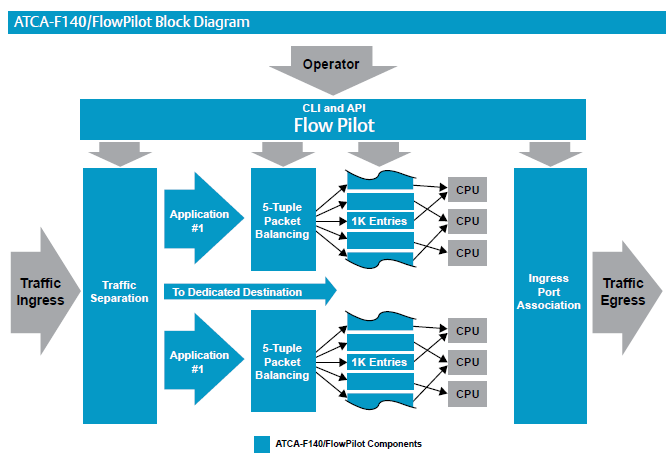
    deep packet inspection (DPI) applications. Emerson has integrated its new FlowPilot™ load balancing software with its Centellis™ series 40G ATCA® systems to create platforms that enable network equipment providers to accelerate the development and delivery of applications that use DPI. These include ‘bump in the wire’ applications such as policy enforcement, security gateways, and firewalls as well as network monitoring and optimization, and lawful intercept"

    "..  the new FlowPilot software provides the foundation for network intelligence applications, allowing users to deploy context-aware network applications faster, more cost effectively and with less risk. The initial release of FlowPilot software acts as the platform’s central packet dispatcher to achieve low latency, full wire speed, and context-aware packet distribution to and from all processing blades in the system. Emerson has collaborated with network intelligence software specialist Qosmos to enable customers to manage those data flows down to individual processors, cores or virtual machines". 


    See "Emerson Network Power ATCA Systems Ready for Deep Packet Inspection" - here.