A presentation by Biju M R, Sr Manager Presales & Solutions at Wipro (here)
Showing posts with label 3GPP. Show all posts
Showing posts with label 3GPP. Show all posts
Monday, March 9, 2015


Thursday, February 5, 2015
[GSA]: 20 Operators Deployed 300 Mbps LTE-A
- 20 operators have commercially launched 300 Mbps Category 6 LTE-Advanced service in 15 countries: Australia, Austria, Estonia, Finland, Germany, Hong Kong, Portugal, Romania, Russia, Singapore, Slovenia, South Korea, Spain, Switzerland and the UK .. 3GPP defines a Category 6 system within its Release 10 specifications as having a theoretical peak downlink speed capability of 300 Mbps, and 50 Mbps on the uplink.

- A further 22 Category 6 LTE-Advanced systems are also being deployed or in a trial phase. It means that 42 operators in total are investing in 300 Mbps LTE-Advanced deployments in 24 countries

- Nine Category 9 systems are in deployment, trial or test phase in Australia, Japan, Portugal, Qatar, Turkey, South Korea, Switzerland, UAE and the UK. 3GPP defines a Category 9 system as part of Release 11, and is capable of a theoretical peak downlink speed of 450 Mbps, and 50 Mbps for the uplink direction. Capabilities well beyond Cat 9 have already been demonstrated in a number of multiband multimode LTE-Advanced trials.

Monday, June 24, 2013
Allot Enhances DPI Gateway with Standard TDF; Deployed by LTE Operators
Allot Communications announced the ".. availability of its pure-play, 3GPP-compliant Traffic Detection Function (TDF) for LTE networks. Allot is a leader in LTE TDF [learn more about TDF - here] solutions, and several top tier LTE operators are already utilizing the TDF-enabled Allot Service Gateway to analyze subscriber behavior and monetize their broadband networks .. The TDF-enabled Allot Service Gateway is a pure-play solution that enables CSPs to analyze and monetize OTT traffic by leveraging application awareness and transaction information in order to deploy innovative pricing plans, drive new service revenues and increase customer loyalty. Allot led the standardization efforts of TDF for LTE and continues to lead standardization activity for connecting TDF to other 3GPP components for policy control and charging purposes".

See "Allot Communications' 3GPP-Compliant TDF Offers CSPs Innovative Ways to Analyze and Capitalize on LTE Traffic" - here.
Tuesday, June 18, 2013
Openet Acquires Routing Policy Technology
 Openet announced the acquisition of ".. Dublin, Ireland based Forkstream (founded in 2012 by John Fitzpatrick, pictured, and Hamid Nafaa] .. Forkstream’s technology enables operators to define policies for routing mobile data streams within and between different access networks while ensuring a seamless user experience. Forkstream’s client side technology interacts with the network core via Openet Interaction Gateway, enabling operators to manage network access policies using their Policy Controls Rules Function (PCRF). The technology is fully compliant with 3GPP Access Network Discovery and Selection Function (ANDSF) standards that enable consumer devices to discover and communicate with non-3GPP networks such as WiFi or WiMAX .. Forkstream technologies extend the functionality defined within the 3GPP standards to include dynamic network selection as well as analytics and monitoring".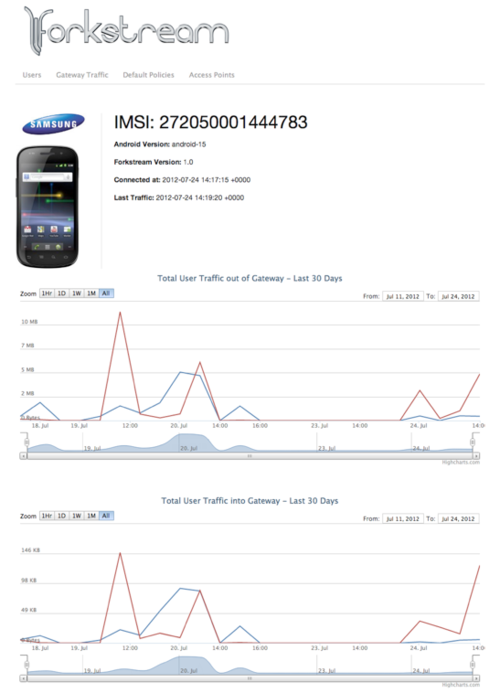
Monday, June 10, 2013
Openet Integrates Legacy IN into 3GPP Charging
Openet announced the availability of its "Intelligent Network (IN) replacement solution. The new offering will allow operators to profit from the rise of high speed data by evolving legacy platforms to provide flexibility and real-time capabilities required by operators".
Openet’s solution is based on Evolved Charging, a 3GPP compliant online charging system, which integrates with a service control point in the core network to enable dynamic charging for all voice and data services to all subscribers. Evolved Charging provides operators the ability to configure dynamic “offers” to their subscribers for voice or data or a mixture of services. Usage is rated and balances held in realtime for all subscribers, allowing them to choose payment methods for any service.

See "Openet Announces Intelligent Network (IN) Replacement Solution to Deliver Dynamic Services in a Data Centric World" - here.
Monday, May 6, 2013
Sandvine Wins $4M Fixed Network Project, w/PCRF Control
 3GPP goes to fixed networks. Or at least in converged networks.
Sandvine announced that a it has ".. received over $4 million in initial orders from a nationwide South East Asian operator. The operator has fixed and mobile properties, with the initial orders relating to the fixed line network. After a thorough evaluation, the new customer has chosen Sandvine’s solutions to integrate with the operator’s existing PCRF (Policy Charging and Rules Function) and 3GPP policy framework to support the enforcement of new subscriber service tiers, and to manage network traffic for an optimal subscriber experience. Both of these initiatives and future business decisions will be informed by the real-time network information and forecasting capabilities of Sandvine’s Network Analytics business intelligence solution.
All solutions will leverage Sandvine’s PTS 24000 hardware platform. The PTS is powered by the Sandvine Policy Engine and a high-performance packet processing operating system executing on purpose-built, carrier-grade hardware".
All solutions will leverage Sandvine’s PTS 24000 hardware platform. The PTS is powered by the Sandvine Policy Engine and a high-performance packet processing operating system executing on purpose-built, carrier-grade hardware".
See "Sandvine Receives Over $4 Million In Initial Orders From National South East Asian Operator" - here.
Wednesday, February 6, 2013
Allot-Tekelec and Procera-Comptel Interoperability
MWC announcements start on the lighter issues - today it is about interoperability. My PCRF-DPI table (here) already shows the two announced today - but it seems the relations have been upgraded/expanded:
- Allot Communications and Tekelec have "completed Interoperability Testing (IOT) for the 3GPP Sd interface (see "Resource: 3GPP Traffic Detection Function (TDF)/Service Awareness Overview" - here) that offers service providers more powerful application policy control and enforcement with a more efficient network architecture.
The IOT was performed to support a global Tier-1 mobile operator that plans to implement application-specific policies .. the companies are the first to announce IOT over the new Sd Diameter Interface, which communicates between the Tekelec Policy Server (PCRF) and Allot's Service Gateway Sigma E Traffic Detection Function (TDF) in order to enable detection and enforcement control over applications"
See "Allot and Tekelec Complete Interoperability Testing to Expand Policy Control to Over-The-Top Applications" - here.
- Comptel announced that it has "completed interoperability testing with Procera Networks .. The companies' joint, real-time policy control and charging solution, which consists of Comptel Policy Control and Procera's PacketLogic Subscriber Manager and PacketLogic Real-Time Enforcement (PRE), enables communications service providers (CSP) to offer, manage and monetise advanced data services, while optimising network usage, improving the overall customer experience .. The interoperability test demonstrated how policy and charging rules managed by Comptel Policy Control could be enforced in Procera's PRE product based on the real-time inspection of network traffic".
See "Comptel and Procera Collaborate on Real-Time Policy Control and Charging to Optimise the Customer Experience" - here.

 |
| Source: Comptel |
Wednesday, October 17, 2012
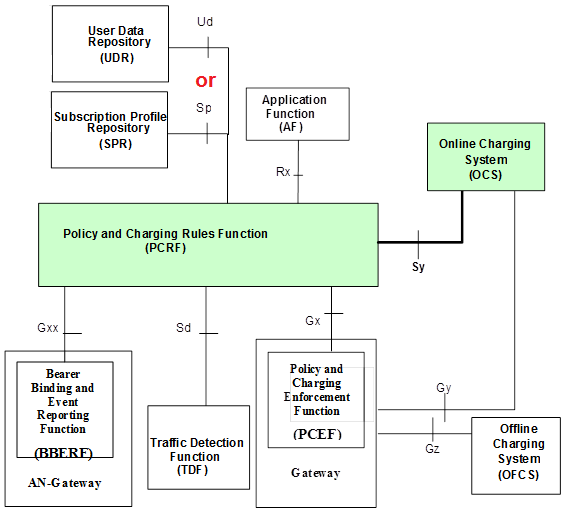
Resource: Overview of the Sy Interface
Bart Barton added another post to his very useful blog - "LTE and Beyond" - this time documenting the Sy Interface.
"The Sy reference point is defined between the PCRF and the OCS. Big picture of the relationships between functional entities are shown in Fig 1. below".
See "The Sy interface - between PCRF and OCS" - here.
 |
| Source: LTE and Beyond, by Bart Barton |
Sunday, September 2, 2012
[GIA]: 1.5B LTE Subscribers by 2018
 Predictions on the number of LTE subscribers keep coming, each presenting even a higher number.
This month we have already seen "[iSuppli] 1.2B(!) LTE Subscribers by 2016" - here and "[Pyramid]: 802M LTE Subscribers by 2017; US, Japan and South Korea Lead" - here.
A new report on 3GPP by Global Industry Analysts finds that "The global market for 3GPP LTE devices is projected to cross 624 million units, and the subscriber base is projected to reach 1.46 billion by 2018. Significant cost savings by mobile operators in terms of delivering megabytes of capacity through the deployment of LTE, which is capable of efficiently using available spectrum, is expected to emerge as a key contributing factor for the increasing operator adoption in the near future".
"By enabling more efficient bandwidth usage, LTE is capable of easing to a great extent, mobile operators’ troubles of insufficient capacity .. From 64, the current number of installed commercial LTE networks globally, is thus forecast to increase and reach 128 by the end of 2012, translating into a very high growth rate for a very small time period .. the market is presently largely concentrated in the US, owing to the ambitious rollout of network coverage by Verizon. However, the US, Europe, and Asia-Pacific regions are projected to be evenly paced by the year 2015, with the Asia-Pacific region racing away by the year 2018".
See "Efficient Spectrum Usage and Better Bandwidth Drives the Global 3GPP LTE Market, According to New Report by Global Industry Analysts, Inc" - here.
Monday, July 16, 2012
Standards News: BBF Released Policy Control Framework
 Broadband Forum (BBF) standard for policy control : TR134 - Broadband Policy Control Framework (here) was just released, edited by Ezer Goshen from BandWD and Bill Welch from Juniper Networks..
Abstract
TR-134 defines an architectural Framework to provide policy control of Broadband Multi-Service Networks. This Technical Report specifies business requirements, use cases, and a minimum set of Information Flows that facilitate the management and execution of policies.

The document defines ".. seven high level use cases. The uses cases are used to describe the needs
of Service providers and how they can be addressed using both provisioned and Policy based
solutions. Most of the seven use cases contain a number of more specific sub uses cases. These
sub use cases represent the originally contributed use cases, and they have been consolidated on
the basis of the underlying network functions that are used to address them:
- Layer 1 – 4 and QoS based Policy
- Layer 4 – 7 Traffic Policy
- Call Admission Control
- Authentication, Metering and Accounting Policy Use case
- Home Gateway use case
- Application Layer Policy [see chart below for one of the sub use cases]
- Emergency Services Use Case"

.
Saturday, July 14, 2012
IETF: Draft for "Mobile Communication Congestion Exposure"
 A new IETF draft for "Mobile Communication Congestion Exposure Scenario" was published (here), led by NEC, Ericsson and UC3M.
"The CONEX congestion exposure mechanism is intended as a general technology that could be applied as a key element of congestion management solutions in a variety of use cases. The IETF CONEX WG will however work on a specific use case, where the end hosts and the network that contains the destination end host are CONEX-enabled but other networks need not be".
CONEX Use Cases in the Mobile Communication Scenario:
CONEX Use Cases in the Mobile Communication Scenario:
- CONEX as a Basis for Traffic Management,
- CONEX to Incentivize Scavenger Transports,
- Accounting for Congestion Volume
- CONEX as a Form of Differential QoS
Wednesday, June 27, 2012
Testing S/W Announcements: GL Diameter Protocol Emulator
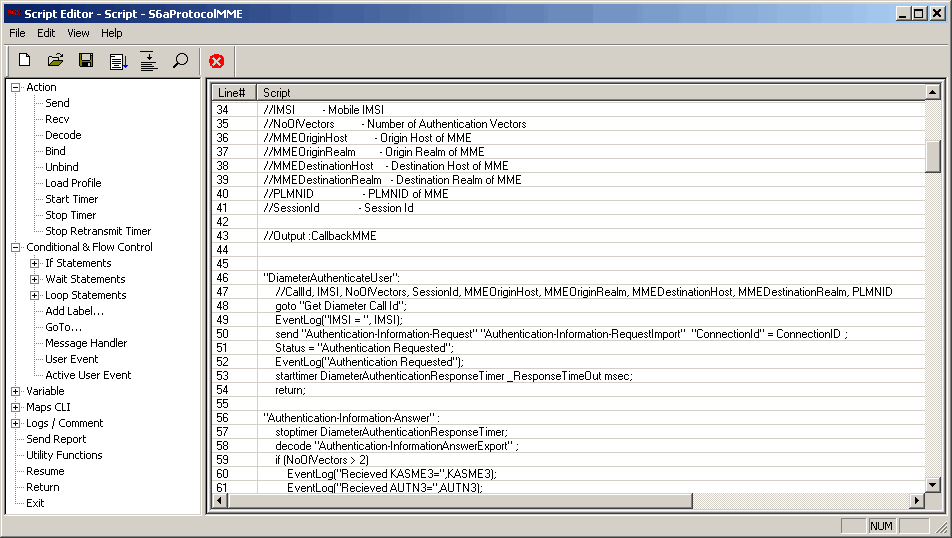
.png) GL Communications announced the release of its "latest product MAPS™ Diameter Protocol Emulator software – Scripted LTE Diameter S6a, S6d, Cx, Dx, Gx, and Rx Interfaces Emulation".
GL Communications announced the release of its "latest product MAPS™ Diameter Protocol Emulator software – Scripted LTE Diameter S6a, S6d, Cx, Dx, Gx, and Rx Interfaces Emulation".Other products in this market - Developing Solutions (here) and Mobile Metrics (here).
(1).png) Mr. Karthik Ramalingam, Manager of Product Development, said, “The Diameter protocol is intended to provide a framework for Authentication, Authorization and Accounting (AAA) .. GL’s general-purpose platform for emulation of protocols is Message Automation & Protocol Simulation (MAPS™). Recently Diameter protocol for has been added to its wide range of emulation support. The MAPS™ Diameter gives the users the unlimited ability to edit S6a, S6d, Cx, Dx, Gx, and Rx interface messages to support various procedures such as Location Management, Subscriber Data Handling, Authentication, Fault Recovery, and Notification procedures over S6a interface and AA-Request/Answer, Re-Auth-Request/Answer, Abort-Session-Request/Answer, and Session-Termination-Request/Answer procedure over Rx interface”.
Mr. Karthik Ramalingam, Manager of Product Development, said, “The Diameter protocol is intended to provide a framework for Authentication, Authorization and Accounting (AAA) .. GL’s general-purpose platform for emulation of protocols is Message Automation & Protocol Simulation (MAPS™). Recently Diameter protocol for has been added to its wide range of emulation support. The MAPS™ Diameter gives the users the unlimited ability to edit S6a, S6d, Cx, Dx, Gx, and Rx interface messages to support various procedures such as Location Management, Subscriber Data Handling, Authentication, Fault Recovery, and Notification procedures over S6a interface and AA-Request/Answer, Re-Auth-Request/Answer, Abort-Session-Request/Answer, and Session-Termination-Request/Answer procedure over Rx interface”.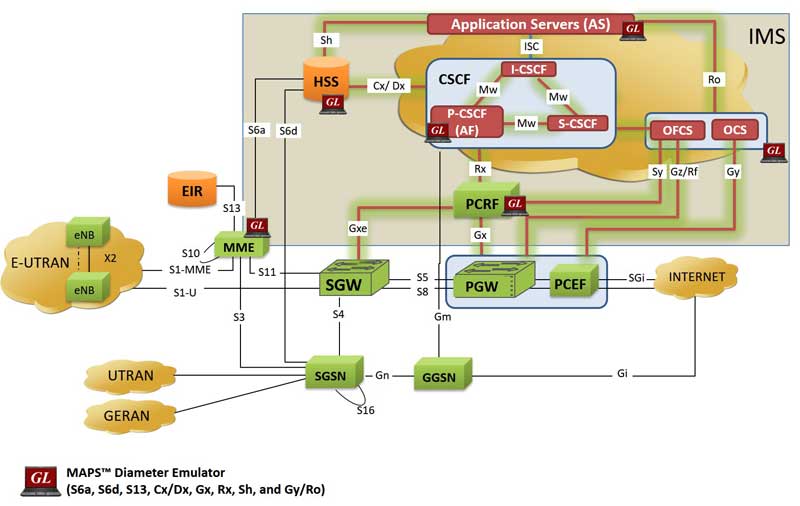
Wednesday, June 20, 2012
NSN - 5X Uplink Capacity Increase with CPC
Nokia Siemens Networks announced it is the ".. first to implement a bundle of standards-based features that deliver Continuous Packet Connectivity (CPC). By reducing network interference, the feature set provides five times more uplink capacity and allows operators to support more smartphone users on HSPA+ networks. In addition, smart device batteries last 15% longer while people benefit from a 60% increase in data rates".
CPC is (see "Understanding HSPA+ Cellular Technology", by Jodi Zellmer - here) ".. a collection of enhancements that allow more users to be continuously connected to the network and, at the same time, increase UE battery life and improve the link quality, especially for low-data-rate services like Voice over Internet Protocol (VoIP)".

Tuesday, June 5, 2012
QoS Announcements: Huawei Improves TCP Performance by up-to 50%
 Huawei unveiled its ".. Backhaul Adaptive Solution, a mobile broadband (MBB) solution that provides operators with an IP Backhaul Performance Monitor (IPPM) and IP Backhaul Quality Management (IP SQM) services for improved IP backhaul efficiency ..
 - The Backhaul Adaptive Solution's IPPM service constantly monitors QoS between the eNodeB and the EPC Serving Gateway according to speed, delay, jitter and packet loss. The solution adjusts for bandwidth bottlenecking according to changes in network quality and realizes adaptive adjustments for bandwidth transmission.
- The IP SQM service focuses on the downlink from the EPC Serving Gateway to the eNodeB to realize smooth levels of data traffic and buffering. The IP SQM also supports both static and dynamic bandwidth adjustments based on data provided by the IPPM and increases backhaul usage and improves user experience by decreasing packet loss and retransmission".

"..The Backhaul Adaptive Solution has been successfully tested by top global operators. Test results show that when S1 link congestion occurs, TCP transmission efficiency is improved by up to 50% when the solution is employed".
See also "Google [Still] Claims there is a Faster TCP" - here and "QoS Announcements: Cisco's Traffic Packet Optimization" - here.
See "Huawei Unveils Mobile Broadband Backhaul Adaptive Solution for Enhanced Transmission Efficiency" - here.
Sunday, April 22, 2012
Resource: Diameter Dictionary
 Developing Solutions has " .. released their complete Diameter Dictionary .. The dsTest dictionary capability allows users to define a set of message templates against which all messages are to be validated. A dictionary may be defined as a base level which can be applied to all applications with dictionary validation enabled, or at the application level which would only be applied to a specific application. Application level dictionaries are translucent, in that if a message or AVP from a message is not found, the base dictionary is also searched".
See "Developing Solutions® Announces Complete Diameter Dictionary" - here. The dictionary is accessible here.

Saturday, March 31, 2012
Optimization Deployments [138]:PCCW [HK] Reduces Signaling by 25% with Huawei
Nokia-Siemens Networks and Huawei continue to educate the market, push and sell solutions which address a significant pain for mobile operators - application level signaling traffic that floods the radio and backhaul links, creating congestion and reducing quality of experience for actual data.
Huawei announced that "PCCW mobile has adopted Huawei's pioneering smartphone signaling optimization solution to further enhance its network performance and improve the mobile broadband experience for its customers. The 3GPP-Release-8 (3GPP-R8)-based smartphone signaling optimization solution can significantly reduce 3GPP-R8 smartphone signaling traffic by over 25%".
 Mr. Ying Weimin (pictured), President of GSM,UMTS and LTE wireless networks, Huawei, said: "It took several months for Huawei and PCCW mobile to finish the testing of our signaling solution on existing networks. The high performance of this solution shows that Huawei is capable of innovation to help customers succeed".
See "PCCW mobile Pioneers Huawei's 3GPP R8 Smartphone Optimization Solution to Reduce Signaling Traffic by over 25%" - here.
Thursday, March 8, 2012
Wi-Fi Offload Deployments [129]: eircom [Ireland] Uses Aptilo for Service Management
 Aptilo announced that "eircom Group, the largest telecommunications operator in Ireland, has bundled Wi-Fi services with all of their data plans using the Aptilo solutions for carrier-class Wi-Fi service management and mobile data offloading .. eircom broadband, eMobile and Meteor customers are now leveraging the network as an important customer acquisition and retention tool by providing seamless, secure offload of data from their 3G networks to Wi-Fi".
John Bermingham, Senior Product Manager - Data Products, eircom Group said: “From being just one of the many services that we provide, our Wi-Fi offering has rapidly become a strategic tool for optimising the use of our network assets. The ability to offer customers a first-class user experience gives us a competitive edge .. The key to a successful mobile data offloading strategy is making that move from the 3G network to the Wi-Fi network truly invisible to the user. We are already exploring more options in Aptilo’s innovative mobile data offloading solution to make this move seamless for all our customers”.
 Among other features, Aptilo's offloading solution includes a Diameter Conversion functionality, with which "operators can transparently control and charge for services via standard Diameter (Gx, Gy and Gz) interfaces in the Wi-Fi network with the same mechanisms that they are using in the 3G network. These can still be differentiated for Wi-Fi usage" (here).
In its latest report, for 2010, the eircom group had 1M mobile subscribers.

See "Ireland’s eircom Group Deploys Aptilo’s Mobile Data Offloading Solution" - here.
Monday, February 27, 2012
BroadForward Offers "Policy Gateway" - Connectivity to Broadband, Policy, Charging or IT interface
 BroadForward announced the "BFX Broadband Policy Gateway enables connections to and from virtually any Broadband, Policy, Charging or IT interface, straight out-of-the-box. BFX features a rich set of translation, mediation and service logic functions for a wide range of protocols, such as Diameter, XML/HTTP, SOAP and Radius. The availability and flexibility of on-board protocols and functions prevents high customisation costs or upgrades associated with EPC, IMS or BSS systems that are required to fit within targeted Policy Control architectures. Either standalone or as embedded software, BFX can simultaneously handle multiple connections and roles on different interfaces in the operator’s network, at a small footprint".
See "BroadForward announces BFX, the world’s first Broadband Policy Gateway" - here.
Friday, February 17, 2012
Tekelec and Tecnotree Integrate their "Independent Policy and Charging Systems"
Two of my recent guest posts - "Policy and Charging: The Value of Independence" (here) by Tekelec and "Why Not a Single Vendor for Policy and Charging Controls?" (here) by Openet, probably represent a new marketing battle between the major policy vendors.
It started more than a year ago by Openet (see "S.O.S Call from Openet" - here) and shifted gear when Amdocs acquired Bridgewater Systems and differentiated itself with the value of integrated policy and charging (see "Amdocs Integrates BWS - Introduces a Charging and Policy Management Solution" - here). Infonetics Research helped Amdocs with this positioning as well (see "Infonetics Believes in an "integrated policy/charging solution" - here).
 Loyal to its position, Tekelec announced an integrated solution with Tecnotree Corporation - ".. successful interoperability testing between Tekelec's Policy Server (PCRF) and Tecnotree's Real-Time Convergent Charging system. This is the first announced integration between independent policy and charging vendors over the proposed Sy interface. This gives mobile service providers the scalability and Diameter signaling efficiency required to grow their mobile data networks and deliver personalized data plans"
  |
| Source: Openet |
See "Tekelec and Tecnotree integrate independent policy and charging systems" - here.
Monday, January 30, 2012
[Guest post]: Policy and Charging: The Value of Independence
By Doug Suriano*, Chief Technology Officer, Tekelec
Traditional charging and billing vendors propose solutions that pre-integrate policy and charging as an approach to monetizing mobile data. This single-vendor, pre-integrated approach has several drawbacks:
An Alternate Approach
Dozens of tier one operators have elected to deploy a best-in-class policy server sold independently from charging equipment. The first requirement for this to succeed, of course, is interoperability with multiple vendors’ online, offline and legacy charging systems, in addition to a broad array of policy enforcement points.
High performance and scalability are pre-requisites as well, to meet the growing data and signaling traffic resulting from new service models and from the increased usage of data-enabled devices and applications. A policy server should have standardized Diameter interfaces and incorporate advanced carrier-grade functionality such as high processing power, capacity, overload controls, monitoring, and protection mechanisms.
An independent policy server also needs advanced quota management capabilities. These allow service providers to do advanced usage tracking in the policy server for a wide variety of use cases. Examples include offloading complex charging systems and performing quota management of pre-rated data services (any prepaid or postpaid data service where the usage limits are pre-defined), postpaid customers, and fair usage in the policy server without an OCS. A policy server can accomplish this with pre-configured use cases and a user-friendly rules engine that allows policies to be deployed quickly and at a lower cost than through charging system customization.
In addition, an independent policy server must offer revenue-generating use cases for mobile data services. These offers include day passes, anniversary bonuses, happy hours and bandwidth boosts. Creating these programs requires policy and subscriber data management to meter multiple usage limits per customer and to zero-rate services based on application, time, and volume for different customer segments. Many of these services can bypass the charging system by using the rating engine and policy creation tools in the policy server. In this scenario, the monetary rating associated with a unit of data or time is pre-assigned, without the need for an OCS.
Shared data plans are also becoming an important use case as the number of devices per customer grows and families, businesses, and machine-to-machine customers ask for simplified, pooled data plans. These plans require subscriber and device data management to assign multiple device identities to each customer profile. They also require policy analytics to track and analyze customer and group usage.
Conclusion
Global service providers are adopting an approach that leverages a best-of-breed policy server with integrated subscriber data management and analytics for easy policy rule creation, quota and traffic management, and letting existing charging systems do what they do best – charge for services. They are also looking to the new Sy standard interface between policy and charging systems to ensure broad multi-vendor interoperability, eliminate costly integration and avoid lock-in. Finally, they are deploying a next generation Diameter signaling architecture to independently scale policy and charging systems to meet the demands of mobile data growth on their networks.
________
 *Doug Suriano, CTO and Vice President of Engineering at Tekelec, has more than 20 years of telecommunications and technology experience. He is responsible for product innovation, leadership in standards bodies and industry forums, and advocacy for innovative mobile data solutions.
Doug earned his Master of Science in Information Technology at the U.S. Naval Postgraduate School and a Bachelor of Science at the U.S. Naval Academy.
The integration of the policy server (the 3GPP-defined policy and charging rules function, or PCRF) with charging and billing systems is emerging as one of the key considerations in the 3GPP Policy and Charging Control (PCC) architecture. This architecture specifies several interfaces – Gx, Gy or Gz –to online (OCS) and offline charging systems (OFCS) through the policy and charging enforcement function (PCEF). However, the 3GPP doesn’t define how to implement this integration. As a consequence, vendors and service providers have pursued a variety of approaches.
More recently, the 3GPP introduced a new interface, Sy, to create a direct link between the PCRF and charging systems. The Sy interface eliminates the need to do usage tracking over both the Gx and Gy interfaces simultaneously, improving messaging efficiency and eliminating the possibility of accounting synchronization problems between the policy server and OCS. More importantly, it will eliminate the need for complex and costly pre-integration between the policy server and the OCS.
Integration between policy and charging systems is required to charge for services based on subscriber entitlements. Both multi- and single-vendor implementations can support this integration. However, a single-vendor platform that pre-integrates policy and charging functions can ultimately limit a service provider’s choices, flexibility, scalability, signaling efficiency and time-to-market for new services.
The Service Provider Point of View
In a June 2011 Heavy Reading survey, almost 75 percent of service providers said that the single biggest barrier in deploying a policy architecture is integrating policy and charging. When Heavy Reading probed deeper into the issue with Tier 1 operators in a November 2011 survey, they concluded that:
 |
| Source: Heavy Reading survey of Tier 1 network operator attitudes to policy and charging, November 2011 |
- Operators have run into major challenges implementing OCSs due to complexity and high costs associated with customization, professional services, and integration with gateways and policy servers (graph below). An operator provided insight into the size of the problem when he described a plan to move to a billing system capable of handling real-time, online transactions, and run pre-paid and post-paid on the same system. “This is a very complicated project,” he said, “and my guess is that it could take five years to fully implement.”
- Almost 70 percent of Tier 1 service providers will use the policy server rather than the charging system to perform some charging and rating functions such as quota management (data allowance), rating, and balance management as a way of avoiding certain integration problems and offloading the charging system to reduce cost and complexity.
- 3GPP standard interfaces are the most popular option for integration of policy and charging.
- In the medium term, operators believe a significant proportion of policy rules will need to refer to charging systems for charging data such as spending limits. Said one service provider: “The important thing for us is that they [vendors] can demonstrate that they can meet policy use cases we have defined that need to refer to charging systems, and that they have done this before with other operators. We would need that re-assurance.”
- Operators are planning deeper integration of policy with existing online and offline charging systems but they are not sure how to do it.
- Less than 10 percent of operators intend to deploy pre-integrated policy and charging solutions in the medium term to resolve integration issues (graph below). One operator said, “We don’t think we need a vendor with both policy and charging expertise. We already have charging systems, so the policy vendor will be chosen independently. But we do need a vendor that has experience of integrating its policy product with third party charging systems—that’s the key thing. It’s important to us to know that the vendor can grow the system and achieve the integration we need in the longer run.”
Traditional charging and billing vendors propose solutions that pre-integrate policy and charging as an approach to monetizing mobile data. This single-vendor, pre-integrated approach has several drawbacks:
- Costly and complex professional services and systems integration. Integrated policy and charging offerings often require higher professional services and systems integration costs to create policy rules and scale with network growth. In contrast, a network-based approach combined with an intuitive rules engine and carrier-grade software and middleware can provide a lower cost of ownership. Current Analysis recommends that “Operators should consider dismissing equipment makers that require operators to invest heavily in professional services in order to introduce new services or to modify existing service plans and service offerings.”
- Proprietary interfaces. Integrated policy and charging systems can require extensive customization and professional services to interoperate with other control plane elements. Each new interface or use case often requires a separate statement of work and lengthy professional services engagements, resulting in a higher total cost of ownership and slower time-to-market for new services.
- Poor scalability and reliability. As the network expands with multiple policy servers and charging systems, they need Diameter routing to direct messages to the appropriate system. A pre-integrated approach based on proprietary interfaces is not standards-compliant, making it difficult for the policy and charging infrastructure to scale. Furthermore, policy servers from charging vendors often lack key carrier-grade functionality required to ensure scalability and reliability when the network is congested.
- Increased complexity and cost. Online charging systems are already taxed by a large number of complex integration with gateways, servers, and nodes as shown in the figure below. And as demonstrated in the Heavy Reading survey above, these projects are expensive, time-consuming, and complex.
 |
| Source: 3GPP |
An Alternate Approach
Dozens of tier one operators have elected to deploy a best-in-class policy server sold independently from charging equipment. The first requirement for this to succeed, of course, is interoperability with multiple vendors’ online, offline and legacy charging systems, in addition to a broad array of policy enforcement points.
High performance and scalability are pre-requisites as well, to meet the growing data and signaling traffic resulting from new service models and from the increased usage of data-enabled devices and applications. A policy server should have standardized Diameter interfaces and incorporate advanced carrier-grade functionality such as high processing power, capacity, overload controls, monitoring, and protection mechanisms.
An independent policy server also needs advanced quota management capabilities. These allow service providers to do advanced usage tracking in the policy server for a wide variety of use cases. Examples include offloading complex charging systems and performing quota management of pre-rated data services (any prepaid or postpaid data service where the usage limits are pre-defined), postpaid customers, and fair usage in the policy server without an OCS. A policy server can accomplish this with pre-configured use cases and a user-friendly rules engine that allows policies to be deployed quickly and at a lower cost than through charging system customization.
In addition, an independent policy server must offer revenue-generating use cases for mobile data services. These offers include day passes, anniversary bonuses, happy hours and bandwidth boosts. Creating these programs requires policy and subscriber data management to meter multiple usage limits per customer and to zero-rate services based on application, time, and volume for different customer segments. Many of these services can bypass the charging system by using the rating engine and policy creation tools in the policy server. In this scenario, the monetary rating associated with a unit of data or time is pre-assigned, without the need for an OCS.
Shared data plans are also becoming an important use case as the number of devices per customer grows and families, businesses, and machine-to-machine customers ask for simplified, pooled data plans. These plans require subscriber and device data management to assign multiple device identities to each customer profile. They also require policy analytics to track and analyze customer and group usage.
Conclusion
Global service providers are adopting an approach that leverages a best-of-breed policy server with integrated subscriber data management and analytics for easy policy rule creation, quota and traffic management, and letting existing charging systems do what they do best – charge for services. They are also looking to the new Sy standard interface between policy and charging systems to ensure broad multi-vendor interoperability, eliminate costly integration and avoid lock-in. Finally, they are deploying a next generation Diameter signaling architecture to independently scale policy and charging systems to meet the demands of mobile data growth on their networks.
________
 *Doug Suriano, CTO and Vice President of Engineering at Tekelec, has more than 20 years of telecommunications and technology experience. He is responsible for product innovation, leadership in standards bodies and industry forums, and advocacy for innovative mobile data solutions.
Doug earned his Master of Science in Information Technology at the U.S. Naval Postgraduate School and a Bachelor of Science at the U.S. Naval Academy.
Subscribe to:
Posts (Atom)


 Posts
Posts

