Showing posts with label GGSN. Show all posts

Tuesday, January 1, 2013

PCC/DPI Deployments [216]: Maxis [Malaysia] Uses Cisco, Huawei and BroadHop


In a recent webinar, BroadHop presented several Policy and Charging Control deployments. The one presented here, at Maxis Malaysia, shows an integrated PCRF-PCEF solution with Cisco SCE (and Huawei's GGSN). Few days after the webinar, Cisco announced it is going to acquire BroadHop.

At the end of Q3, 2012, Maxis had 12.8M revenue generating subscribers (see chart below). Mobile and broadband data contributed 25.9% of total mobile revenues.


Monday, July 30, 2012

Telefonica: "We are also studying policy service implementation"


Huawei published in its Communicate Magazine (July '12 edition - here) an interview with Cayetano Carbajo (pictured), Telefónica Global Technology Director, about ".. the operator’s service platform and operation center innovations, as well as its All-IP transition process, and how they better suit customers’ changing consumption habits".

Mr. Carbajo said that "Quality of service (QoS) is also very important and the policy enforcement point is key ..To ensure QoS, you have to define the policy enforcement points. Today we have a QoS mechanism at nodes such as the gateway GPRS support node (GGSN) and broadband remote access server (BRAS). We are also studying policy service implementation. For quality of experience (QoE), it is more difficult as we are quite blind to end-to-end QoE, so we are implementing a solution to first monitor and measure QoE. With that information, we can make decisions and policies for enhanced QoE".

See also "Update: Sandvine/ALU Agreement Signed; $2.5M Orders Received" - here.
 
"There are lots of things to be modified in the network for managing video traffic. The QoS requirements for video services are different compared with legacy services, and the network needs to be restructured for carrying video traffic. There are many things on which we have to work. The first thing is the distribution of video content in the right way. For video-on-demand (VOD), video over-the top (OTT), and IPTV services, a content delivery network (CDN) is the right approach. For P2P or video communication services, you have to enable the core or control part for an IP multimedia database, so IMS will play a key role there".

See "Telefonica - Innovating All-IP and operations" - here.

Tuesday, April 10, 2012

[Heavy Reading] - More on the PCRF/DPI Market

    
Ray Le Maistre (pictured) published some more details from  the recent Heavy Reading report on the PCRF/DPI market (see "[Heavy Ready]: 2011 Policy Management & DPI Market Reached $1B; TEMs Gain Higher Share" - here).

"In the policy server market, we believe that the major telecom equipment vendors saw faster growth, as a whole, than specialist vendors. ... Much of the momentum for these major vendors has come from their position as suppliers of core network equipment such as GGSNs, which has pulled through a lot of new policy business," notes the report's author, Heavy Reading Chief Analyst Graham Finnie"
 
"Those same large vendors, plus the likes of Cisco [here], Hewlett-Packard [here] , Juniper Networks, Tellabs [here] and ZTE now account for more than half of the policy server and deep packet inspection (DPI) sector covered by the report, a market that was worth more than $1 billion in 2011 and which is due to grow to about $2.7 billion by 2016 .. most specialists are also seeing robust growth"

See "Policy Specialists Squeezed by Vendor Giants" - here.

Monday, October 3, 2011

ALU Positions the 7750-SR as a DPI based Mobile Application Assurance Gateway

    
Alcatel-Lucent published a new, very detailed, application note (here), presenting its 7750 Service Router (known by many as an access router for fixed networks) as a mobile gateway, with DPI capabilities and PCRF control.

This is direct competition to Cisco's ASR-5000 "inline services" (here) and Ericsson's SSR (here).

The note focuses on the merits of using DPI ("L4-L7 DPI") in a mobile service and presenting the 7750 as a PCEF working in conjunction with ALU's 5780 PCRF (covered here) and a mobile gateway supporting "Mobile Application Assurance (AA)".

"Mobile AA leverages MG-ISM hardware capability to identify different network applications by comparing traffic patterns extracted from real-time, stateful traffic inspection of traffic payload against a library of digital signatures, which is kept locally on the Alcatel-Lucent 7750 SR Mobile Gateway. Once a particular network application is identified, the MG-ISM can promptly perform additional actions in accordance with policies that are locally configured on the Alcatel-Lucent 7750 SR Mobile Gateway".


Friday, March 4, 2011

QoS Deployments (53): MegaFon [Russia] Deployed Cisco ASR-5000 for Service Personalization

   
Cisco announced that "MegaFon, one of Russia's leading telecommunications service providers, has installed the Cisco® ASR 5000 mobile multimedia core platform in its Central Region mobile network. With the high performance and advanced intelligence of the Cisco ASR 5000, MegaFon will be able to serve more customers, more reliably, while delivering enhanced mobile services such as data and mobile video".

See "MegaFon Upgrades Its Mobile Network With the Cisco ASR 5000" - here.

MegaFon is one of three major mobile networks in Russia, and the only one that operates its own network and provides a range of services throughout the country. It has more than 56 million active subscriber accounts.

Note that NSN showcased thier inteligent GGSN, Felxi NG (here), with MegaFon 6 months ago (see "NSN: Policy based Traffic Management with Flexi NG + DPI" - here)

Tuesday, February 15, 2011

[Update] BroadHop and CommProve Offer Integrated RAN Congestion Management Solution

 
[Update]: Regarding my comment below "Still not clear which element enforces the policies":

BroadHop clarifies that "it is GGSN or DPI that enforces the policy. Comprove has probes in network that identify congestion and which customers are experiencing that congestion. Quantum Network Suite then collects that info from ComProve and instructs GGSN or DPI to respond accordingly to better manage congestion for customers".    
     
Cell congestion management becomes an urgent need for mobile operators, and a number of DPI, traffic management and policy server vendors are addressing the need. See previous posts on this issue - here.  
  
BroadHop and CommProve join the party and are announcing today the "..interoperability of their independent, best of breed solutions. BroadHop's advanced next gen policy management platform, the Quantum Network Suite and CommProve's RAN Insight, the state of the art application designed to dramatically improve radio optimization, will deliver the industry's first intelligent end-to-end application and subscriber Radio Access Network (RAN) Congestion Management solution enabling service providers to apply radio policies based on subscriber service level and the application being used".

See "BroadHop and CommProve Team to Deliver Industry’s First End-to-End Intelligent Application and Subscriber RAN Congestion Management" - here.

"The combined BroadHop and CommProve offering manages localized RAN congestion, maintaining the best quality of experience during congested periods to .. Apply targeted policies to intelligently manage subscriber, application, bandwidth usage and prioritize traffic .. Ensure fair access for all subscribers during network congestion periods .. Accurately track subscriber cell location to enforce policies only for devices active in a congested area without the need for additional location updates to be provided from the network .."
  
Previously, I understood that CommProve's RAN Insight is a monitoring only (passive) solution. Now, Lars Pedersen (picture), CEO of CommProve says: “Together, CommProve and BroadHop provide operators not only unique 2G/3G/4G intelligent network visibility but also the ability to apply policy management based on real-time information per subscriber in a ‘who-what-where’ format".

Still not clear which element enforces the policies. CommProve uses Qosmos' DPI engine (see "CommProve and Qosmos Offer Layer 7 Visibility into Mobile Traffic" - here).

Thursday, December 16, 2010

Vendor Review: NSN Flexi-NG's DPI support

   
During MWC 2009, in a visit to the NSN booth, I saw their new GGSN product (see announcement - here) - an ATCA based product, promising a number of new, advanced features.

Since then I saw a number of press releases announcing deployments of the new product - Flexi-NG (picture) - such as MegaFon, Russia - here, Telefonica O2, Germany - here and Agri-Valley Communications - here, but still could not find any real documentation in NSN's web site (other than a presentation in the Japanese site - here).

Recently, I contacted NSN, and got a document providing some information on NSN's Flexi-NG.

Here are some quotes on its DPI support:

"By integrating DPI (Deep Packet Inspection) into the gateway, Nokia Siemens Networks does not just provide a high capacity element – it is setting the foundation for Mobile Broadband with a solution that is extremely powerful and highly scalable at the same time. Deep Packet Inspection (DPI) is supported for L7+ analysis in own processor on dedicated Service Aware Blades (same hardware as Service Blade, without external interfaces, and with different software only). These flow classification methods include port and signature based methods. Generic signature methods can be used to differentiate mobile access to Internet and operator/partner services (e.g. MMS, e-mail, streaming). L7+ analysis includes heuristic analysis that is typically applied to track proprietary protocols like peer to peer applications and services. With service awareness and DPI capabilities Flexi NG is capable of differentiating service treatment within the same Access Point, for example the Internet access point. The operator may for example control the access to selected services and apply flow based charging to differentiate the tariffs for different services. Service Awareness and DPI also provide valuable information for service and network planning. DPI can detect the majority of user traffic and protocols used in the Internet today (e.g. peer-to-peer communication). More than 600 protocols can be identified currently. Dynamic changes in applications and Internet protocols may require updates of DPI functionality, which can simply be enhanced by software independent of actual the Flexi NG software. End user connections are kept alive also during updates of DPI engine by help of ISSU (in-service software upgrade"

"With DPI and service aware policy enforcement the operator is able to make on-line changes to the traffic treatment policies. An example for data services is limiting excess usage by bandwidth limiting or even blocking certain bearers or services. For voice and multimedia services service aware policy enforcement can be applied to enforce real-time Quality of Service (QoS) and to ensure enough capacity on the transmission path. Dynamic QoS optimizes the use of network resources as real-time QoS can be allocated and capacity reservations can be made for preferred real-time services."

Sunday, September 19, 2010

Cisco Presentation: Deploying ASR-5000 - Policy, DPI, Inline Services

  
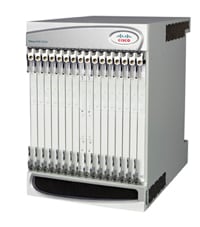
A nice presentation from Cisco is available online, covering many aspects of its ASR-5000 GGSN (the former Starent product).

See "Deploying the Cisco ASR 5000 in Mobile Networks" - here.

A section titled "Intelligence, In-line Services, Monetization" (slide 57) covers policy based services, including subscriber based policy enforcement, traffic classification and filtering.  Among other things, Cisco claims to support the detection of P2P, Skype, Sling and Vonage. More information on the product's DPI capabilities, including a complete list of supported protocols and limitations is available here.

No PCRF products are mentioned by name (see related posts-  "Cisco Needs a Policy Server" - here as well as here, here and here).  

Wednesday, September 8, 2010

Lightreading: Cisco's GGSN DPI Feature Under Test [Continued]

    
LightReading published the 2nd part of its Cisco mobile solution testing. See my post on the first part - here.

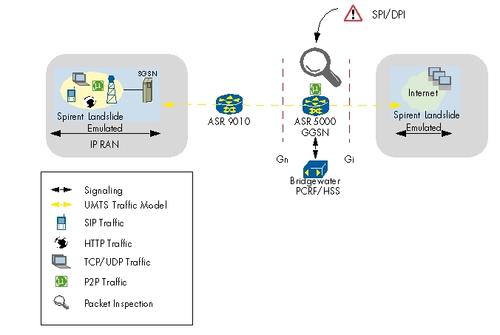
This time the Cisco GGSN, ASR 5000, (former Starent product) was tested, including its DPI capabilities.

See "Results: ASR 5000 GGSN Performance With DPI" - here.

LightReading summarizes: "In a GGSN role, the Cisco ASR 5000, configured with a Cisco-selected list of 900 HTTP, 99 TCP/UDP stateful filter rules plus one BitTorrent filter rule, achieved the exact same 20 Gbit/s throughput performance with 1 million active subscribers as in the previous GGSN test"

LightReading assumes that "The question in DPI tests is mainly how many rules are there, of what kind, and to what detail" - I must add to that that the rate of new connections (which means the rate of application identification processes) is also an important factor to the DPI performance.

The test itself had one rule for P2P traffic (detecting BitTorrent) and 900 rules for URL match (which Starent had for long time, for charging purposes). All the rest, including VoIP, was detected using layer 3-4 parameters (i.e. non-DPI detection).

If I am trying to correlate the test to common use-cases, my observations are:
  • Use case 1 Slowdown traffic - penalize subscribers that have exceeded their monthly usage limits, or reduce load on congested links - Usually means slowing-down all P2P file sharing traffic not just BitTorrent. Although all they had to do here was to define the relvant policies.
     
  • Use case 2 Block competitive VoIP services - Skype is the major detection challenge - but it was not tested.
     
  • Use case 3  charging - detecting access to a list of URL represents this well. It was tested here (although without the north-bound reporting).
Therefore, I believe that the test (which only tested the DPI process, without the QoS actions that are usually associated with DPI policies) does not really represent the common uses of DPI in mobile broadband environment.

I am also not sure that "Carriers favor integrated solutions, however, for ease of management and maintenance" - for the case of the GGSN, which is the most significant network element in the packet core where stability and performance are above all. It seems that the DPI solution from the pure players are much more advanced in their application identification capabilities.

LightReading comments on the above that "As a side note, the ASR 5000 product documentation (version 10.0) lists support for detection of over 64 peer-to-peer and streaming protocols, including the classics (BitTorrent, eDonkey, Gnutella), voice over IP protocols (Skype, Google Talk, Skinny), games (for example World of Warcraft, Xbox, SecondLife), video streaming (Slingbox etc.), and chat protocols (Fring, Yahoo, MSN...). The operator can not only block the traffic, but also police the bandwidth (limiting VoIP quality to be worse than operator voice service quality, for example – hard to pinpoint for subscribers). We tested only BitTorrent blocking in the available time."


Sunday, June 27, 2010

DPI Announcements - Cisco/Starent PGW - DPI, QoS, LI


Cisco updated on Friday its information on "Cisco PGW Packet Data Network Gateway" (PGW), a function that is supported on Cisco's ASR 5000 multimedia core platforms (the former Starent ST40 GGSN product).

See the introduction - here.

According to Cisco, the PGW function supports also the following functions, all in the ASR-5000 platform - and seems to be available now.
  • Acts as the Policy and Charging Enforcement Function (PCEF)
  • Manages quality of service (QoS)
  • Provides deep-packet inspection and lawful intercept