Showing posts with label Broadband Traffic Management. Show all posts

Thursday, August 13, 2015

Ofcom Report on Traffic Management Detection Methods


While  "Unlike some countries, All ISPs Voluntary Signed for the Net Neutrality Code"[here],  Ofcom, the UK regulator, had to find ways for detecting the use of traffic shaping practices used by ISPs and commissioned study that was published recently - "A Study of Traffic Management Detection Methods & Tools" (here).

Ofcom explains that "As consumers use more 'bandwidth hungry' Internet services such as video, existing access networks are likely to experience congestion problems. One way for Internet service providers (ISPs) to manage congestion is to increase the capacity of their networks. Yet, even in the longer term, congestion problems are still likely to persist as demand continues to rise; in particular on wireless networks. Alternatively, ISPs can adopt traffic management (TM) techniques to alleviate network congestion. 

[See also - "[UK] Ofcom Research on Transparency of Traffic Management" - here]

Potential TM points in the UK broadband infrastructure (wireline)
Source: "A Study of Traffic Management Detection Methods & Tools" (here). 

.. It is envisaged that a practical TM detection mechanism could be a useful part of the regulatory toolkit for helping the communications market deliver online content and services that meet consumer expectations. For example, such a mechanism could potentially help to increase transparency for consumers, visibility for the regulator, and benefits for online service providers.

The report provides a comparative analysis of the identified methods and tools, for example,
in terms of:

  • Their efficacy in detecting and quantifying the presence of TM in a given network;
  • The impact on the network and the consumer in terms generated traffic volume, quality of experience, etc; and
  • The need for a given tool or methodology to be integrated within, or executed outside a given ISP’s network infrastructure.
This literature review was commissioned by Ofcom to better understand the techniques that could be potentially used to detect traffic management"
See "Traffic Management Detection Methods & Tools" - here.

Wednesday, June 3, 2015

AT&T Will Manage Data Demand w/Software-centric Approach


Sean Buckley reports to FierceTelecom on Andre Fuetsch [pictured], senior VP of architecture and design for AT&T presentation at the TIA 2015 Network of the Future event, about how the carrier deals with the demand for data, and growth of video streaming traffic:
  • When we were predominantly a voice service provider, the capacity engineer only worried about one day out of the year, which was Mother's Day ,, it was pretty predictable ..now, traffic capacity planning for AT&T and other large telcos is all about planning for the unexpected traffic bursts caused by users viewing the latest celebrity videos online
     
  • The traffic capacity engineer has to worry about the latest Kardashian streaming video, who has been watching House of Cards [see "Procera: Netflix' House of Cards Stats; Need 27GB to See it All" - here].. the biggest event we worry about is when Apple releases their next big iOS upgrade [see "Apple IOS8 Update - DDoS Attack? Can Cache Help?" - here]
     
  • To stay on pace with these unpredictable demands, the current hardware-based network approach won't suffice. A software-centric approach will help AT&T deal with these network spikes
     
  • Unlike the telcos, web-based companies did not have the money or time to build a bottom-up network architecture. AT&T wants to adopt a similar strategy where it will build a network, applications and services in a software-centric approach
     
  • One of the first implementations that will be using this AT&T integrated cloud is our Network on Demand function, ,.. This is basically the first SDN-based service that we now recently opened up in more than 100 U.S. cities that gives enterprise customers the ability to dynamically control the bandwidth they need between their sites ..  AT&T has set possibly the most ambitious software-centric goals for its network: virtualize software control to 75 percent of network by the year 2020.

See "AT&T's Fuetsch: Apple's iOS software updates 'biggest event we worry about' on network" - here.

Friday, January 16, 2015

Ruckus Adds App-Aware Traffic Management Technology to Improve Performance


Ruckus Wireless announced  that "..several Ruckus ZoneFlex™ access points (APs) ..  have all been qualified under the Microsoft Lync Server Wi-Fi qualification program.

.. Unlike competitive alternatives, Ruckus Smart Wi-Fi access points integrate patented SmartCast™ technology. SmartCast combines sophisticated scheduling and queuing mechanisms with advanced heuristic algorithms that automatically identify and characterize traffic based on its unique behavior to help ensure peak performance.


With a Ruckus Smart Wi-Fi system, all traffic is queued/de-queued by specialized schedulers, optimized for the corresponding traffic type, the delay/jitter tolerance and bandwidth requirements of the traffic, and the changing characteristics of each station on the wireless LAN. This automatic Type Of Service (TOS) tagging also eliminates complex Quality of Service (QoS) configurations, with automatic management of lower-speed 802.11 devices to assure bandwidth availability for prioritized video and voice over Wi-Fi applications. When combined with Ruckus BeamFlex™ adaptive antenna array technology that directs each packet over the fastest signal path that yields the highest data rates, multimedia Wi-Fi performance is effectively perfected".

See "Ruckus Makes Multimedia Streaming and Wi-Fi Calling Crystal Clear, Flicker Free, Picture Perfect" - here.

Saturday, November 15, 2014

Winners of BBTM Awards 2014: NetCracker (x2), Huawei, Avvasi, Sandvine, Skyfire


The Broadband Traffic Congress 2014 awards, shown with relevant links to recent posts in my blog (see also 20112012 and 2013 awards):
  • Best Big Data Solution for Improving Customer Experience: NetCracker Big Data solution
     
  • Most Innovative Tool for Driving Real-Time Intelligence: Huawei Real Time Decision Center’ - see "Huawei: Over 3B Subscribers Served by Our SDM" - here
     .
  • Best Optimisation Tool for Managing Video Traffic: Avvasi Q-SRV’ Solution' - see "WIND Mobile [Canada] Uses Avvasi to Improve Video QoE" - here and "Virgin Mobile [France] Deploys Avvasi to Improve Video QoE" - here.
     
  • Best Real Time Charging Platforms for Customers: Sandvine – 'Sandvine Quota Manager' - see "Sandvine Enables CSPs to Interact Directly w/Subscribers; How does it Work?" - here
     
  • Best Cloud Solution for Traffic Management: Skyfire Rocket Optimizer’ Solution - see "Opera Adds Audio to Rocket Optimizer" - here
     
  • Best Analytics for Network Management: Netcracker  'Real Time Analytics Solution' - see "NetCracker Launches SDN/NFV Based Service Orchestrator" - here.

Monday, August 11, 2014

FCC Expands Traffic Management Policies Questioning to all MNOs


Alina Selyukh and Marina Lopes report to Reuters that "The top U.S. communications regulator on Friday said he is asking all large U.S. wireless carriers to explain how they decide when to slow download speeds for some customers, after questioning Verizon Wireless about such a plan"

This follows the letter sent earlier to Verizon (See "The FCC "Deeply Troubled" by Verizon's LTE Optimization" - here) following the MNO's decision to expand its "optimization" policy to LTE and limit unlimited users in congested locations (see "Verizon Expands "Optimization" to LTE Subs to Fight Cell Congestion" - here).

Verizon's response to FCC worries was (here, by TheRegister) that it is the right thing to do and everybody does that (try to claim that in a trial):  "The Commission Has Recognized the Reasonableness of this Form of Network Management .. Such Practices Are Widely Used Throughout the Industry and Have Been Widely Accepted [we are] Managing our 4G LTE to Ensure the Best Wireless Experience [and] With network optimization, our customers continue to be free to go where they want on the Internet and to use the applications, services and devices of their choice"

So ... if everybody does it, need to ask them as well.

Back to Reuters report - "AT&T Inc representatives did not immediately comment. A Sprint Corp spokeswoman said her company "goes to great lengths to be transparent about its network management practices," and will respond to Wheeler's letter as appropriate. "Our network practices are consistent with the Commission’s rules on the open Internet, are innovative and are good for consumers and competition," a T-Mobile US spokeswoman said.
 
See "After Verizon, U.S. FCC quizzing other carriers on data management" - here.

Saturday, March 1, 2014

[Israel] ISPs Respond to the CIR Regulation - What do they Promise?


Last month I reported about a new regulation in Israel (see "Carriers Must Disclose Broadband CIR" - here).

It turned out that this also applies to ISPs (the internet service in Israel is separated into the network access (DSL/Cable) and the ISP service), and yesterday I got an email from by ISP, Bezeq International, informing me about their "minimum commitment".

It was no surprise to learn that the CIR is 0.01 Mbps. Yes - 10 Kbps. A slow dial-up modem did better in the old days. It is symmetrical, though.


Thursday, February 27, 2014

TM Deployments [292]: MTN [Congo] Deployed Comviva PCEF/PCRF


Mahindra Comviva announced that its "Mobile Data Platform (MDP) [a package of PCEF, PCRF and Mobile Internet Gateway - see chart below] has gone live with MTN in Congo B. MTN will now be able to offer an unrivalled number of personalized data plans to its subscribers in Congo B. A holistic broadband management platform, MDP will also help MTN to manage, optimize and monetize its data infrastructure. It will provide enriched user experience by employing intelligent bandwidth management techniques, such as dynamic bandwidth throttling. It will provide real-time advice for charges, notifications and credit/usage limits to subscribers on home and roaming networks for bill shock management over all communication channels such as SMS, USSD, Web application".

MTN Congo has more than 1M subscribers.


See "Mahindra Comviva's Mobile Broadband Solution goes live at MTN CONGO B" - here.

Monday, November 18, 2013

Plusnet: Traffic Management/DPI is for your Own Viewing Pleasure!


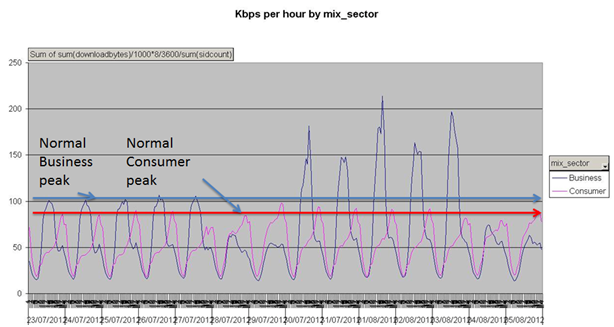
Martyn Hudson explains in Plusnet's blog how the UK ISP deals with major events generating spikes in bandwidth demand for several hours "Red Bull Stratos" (8M people watching live) or two weeks during the London 2012 Olympics games [see "Sandvine and Procera Analyze the Olympics Games" - here].

The games "saw Internet usage skyrocket – no more so than from business users. As we can see from the graph below, business use, depicted by the darker line, more than doubled across several days – no doubt as workers sneakily tuned into Olympics coverage whilst at their desks throughout the working week. Traffic from business use returned to a low level from the 3rd, which was incidentally the first weekend".


"So how does Plusnet cope with all this demand? - We know that people using our broadband, whether at work or at home, want to be able to watch big events particularly if it is once in a lifetime, such as the London Olympics was. In the case of events like the Olympics we have to consider not only the normal every day demand and the extra traffic from people watching the event but also increased usage from people working from home who didn’t want to travel. In order to ensure that everyday browsing, streaming and gaming continues to work as normal and everyone gets a good experience on the event traffic and their work VPNs Plusnet uses traffic prioritisation. 

This traffic prioritisation ensures that interactive and real time traffic will take priority over less time critical traffic, like file downloads, so that where one person in a household is watching the football game they don’t see any buffering because someone else is downloading the latest software updates for their phone at the same time". 

Nevertheless, Plusnet deploys a traffic management policy is done "at busy times" - probably not only just during global event, such as the Olympics or the Royal wedding. Their support web page (here) explains it:


See "Internet usage around big events" - here.

Thursday, November 14, 2013

Winners of BBTM Awards 2013: Oracle, Avvasi, ALU, Procera, Huawei, Skyfire and Flash Networks


The Broadband Traffic Congress 2013 awards, shown with relevant links to recent posts in my blog (see 2012 awards here):

Thursday, September 5, 2013

[UK]: Ofcom Consumer Guide for Traffic Management


I am following the UK traffic management regulation since the early days of this blog (see "DPI Deployments - Part4: UK - Everybody is Doing it !" - here), as the UK ISPs are more transparent in their disclosure (voluntarily or by regulation - see "[UK]: Self Regulation doesn't Satisfy Ofcom; Publishes Minimum Disclosure Level" - here) compared to ISPs in other countries.

On top of all that, Ofcom published a new consumer guide, explaining consumers what is traffic management and exposing ISPs policies. They used the common comparing Broadband Traffic Management to motorways, serving variety of cars and

"With 46 million people in the UK having access to broadband and many using it for data heavy activities such as streaming and downloading, the internet is becoming increasingly busy.To ensure that networks operate efficiently, ISPs can restrict or ration traffic on their networks, or give priority to some types of traffic over others. This is known as ‘traffic management’.

"Each ISP has its own traffic management policy and so when choosing a provider you should check their policy meets your needs. Below you will find links to policies of the largest providers. If your ISP is not on this list, visit your provider’s website or speak to their customer services department: BTKarooPlusnetSkyTalkTalk, Virgin Media (National and Cable), O2 (Home broadband and mobile broadband), EE (Handsets, broadband and mobile,broadband), ThreeVodafone."


See "New consumer guide on internet ‘traffic management’" - here.

Monday, August 19, 2013

Active Broadband Adds Standard SDN Controller for Broadband Service Control

 
Active Broadband Networks announced that its "Dynamic Broadband Service Manager (DBSM) now incorporates software-defined networking (SDN) technologies that transform the delivery of broadband services. This new SDN controller solution allows network operators to easily deploy an intelligent, software-defined service layer for the common control and active management of broadband services across different types of access networks, including cable, DSL, FTTH and WiFi  .. The DBSM can manage and control subscriber traffic flows through any SDN-enabled network element that supports OpenFlow and IPFIX". 

See also a guest post by Stephen Collins, VP of Product Marketing and Business Development - "Usage-Based Service Management for Fixed-Line Broadband" - here.


See "Active Broadband Networks Unveils Software-Defined Networking (SDN) Controller for Transforming Broadband Service Management" - here.

Thursday, July 4, 2013

[Survey]: Mobile SDN on the Fast Track - 50% to Implement in 2 Years


A new survey [130 completed responses received from mobile, converged and fixed operators] by Informa Telecoms & Media (sponsored by Juniper Networks)  finds that ".. momentum is building rapidly for mobile software-defined-network (SDN) technology among operators worldwide .. operators consider mobile SDN to be a critical technology for the future of networks: Ninety-three percent of operator respondents expect SDN to be implemented in mobile within five years, and half expect it to be implemented in the next one to two years.


The survey also found that LTE and LTE-Advanced deployments are expected to be the biggest drivers of mobile SDN adoption, and adoption is expected to be led by developed markets in North America (primarily the US) and Asia Pacific (South Korea and Japan). Sixty-five percent of the mobile operator respondents expect infrastructure vendors to have the greatest ability to influence take-up of mobile SDN".

See "Half of mobile operators globally expect mobile SDN implementation by 2015, and 93% expect it within five years" - here.

Monday, May 20, 2013

[Plusnet]: "We’re big fans of traffic management and truly unlimited broadband"

 
Kelly Dorset, Head of Products and Digital Care, Plusnet [UK] explains in a post to lovemoney that ".. traffic management is often seen in a negative light with many in the industry, technology media and broadband users viewing it as an unnecessary slow down on services to stop users downloading lots of bandwidth. Here at Plusnet [here], that couldn’t be further from the truth. We’re big fans of traffic management and truly unlimited broadband and we offer them both at the same time. Traffic management, otherwise known as traffic prioritisation, is applied to all Plusnet’s broadband products and ensures that real time applications like gaming and streaming don’t get interrupted when more than one person is downloading at the same time".

Plusnet traffic management policies are explained here and shown below ("the systems identify traffic and assign it to one of six priority queues; Titanium is the highest priority").

The ISP mentions that "Some applications not using the standard port may not be identified correctly by our system, as we use DPI to identify applications on the network. These applications may be classified as 'other' traffic in which case a lower priority may apply"
 
Plusnet Traffic management Policies

See also "[Ofcom] UK Traffic Management; P2P Might be Reduced by 99%" - here and "Plusnet: Troubles with Traffic Management System" - here.

"Plusnet prioritises certain types of traffic to ensure there is enough bandwidth, or data, available for each activity to be performed without interruption. Plusnet gives streaming games and video high priority to ensure they don't buffer or lag. For example, if you’re making a video call to relatives on the other side of the world, you don’t want the picture of your suntanned beloved to break up"

See "Why broadband traffic management is a good thing" - here.

Monday, May 6, 2013

Sandvine Wins $4M Fixed Network Project, w/PCRF Control

   
3GPP goes to fixed networks. Or at least in converged networks.

Sandvine announced that a it has ".. received over $4 million in initial orders from a nationwide South East Asian operator. The operator has fixed and mobile properties, with the initial orders relating to the fixed line network. After a thorough evaluation, the new customer has chosen Sandvine’s solutions to integrate with the operator’s existing PCRF (Policy Charging and Rules Function) and 3GPP policy framework to support the enforcement of new subscriber service tiers, and to manage network traffic for an optimal subscriber experience. Both of these initiatives and future business decisions will be informed by the real-time network information and forecasting capabilities of Sandvine’s Network Analytics business intelligence solution.

All solutions will leverage Sandvine’s PTS 24000 hardware platform. The PTS is powered by the Sandvine Policy Engine and a high-performance packet processing operating system executing on purpose-built, carrier-grade hardware".

See "Sandvine Receives Over $4 Million In Initial Orders From National South East Asian Operator" - here

Tuesday, April 30, 2013

[Analysys Mason]: "PCRF is becoming a core network element for CSPs"


A new report by Glen Ragoonanan (pictured), Senior Analyst, and Anil Rao, Analyst, Analysys Mason, covers the top-six network equipment manufacturers (NEMs): Alcatel-Lucent, Ericsson, Huawei, Nokia Siemens Networks, Cisco Systems and ZTE,

Among the findings, some relate to traffic management:  "Traffic management limited network infrastructure spend:
  • CSPs continued to implement policy management (PCRF/PCEF) solutions for fair usage and RAN congestion, limiting network overload from video and P2P traffic, primarily.
     
  • Data caps and Wi-Fi offloading reduced RAN congestion and limited spending on mobile backhaul capacity.
     
  • Diameter signalling traffic is increasing rapidly, but is mostly contained in the CSP’s high-capacity core network.
     
  • PCRF is becoming a core network element for CSPs. 
In additions, "Traffic management reduced investment in Business data services".

See "NEMS’ Network Management Systems: worldwide market shares 2012" - here.

Wednesday, April 17, 2013

Virgin Media Makes Traffic Management "more flexible and responsive"


Regulation helps consumers. After begin slammed by UK's ASA (see "UK: Traffic Management Makes "Unlimited Service" Limited" - here), Virgin Media is changing its traffic management policies.

"We’ve made it more flexible and responsive. If you’re on one of these tiers and enter traffic management, the speed reduction could apply for as little as an hour provided you reduce your downloads or uploads. Also, speed is only reduced for the direction a threshold is exceeded – if you exceed your threshold with downloads, your speed will only be reduced for downloading .. In addition to this we also apply a temporary speed limit to all peer-to-peer and Newsgroup traffic during peak times to ensure that they do not slow the network down for everyone".

See "Your guide to traffic management - 30Mb or Higher" - here.


Wednesday, April 10, 2013

EE: We Prioritize the Most Demanded Real-Time Traffic


Jamie Beach interviewed to IP&TV News Sylvain Thevenot (pictured), Marketing Director, EE, about their fixed broadband service - "EE has deployed a core broadband network in partnership with BT that gives broadband access to 86% or more of the population". "We have recently extended our broadband portfolio to include ‘up to 76 Mbps’ unlimited Broadband plans, and at the same time we launched 4G across the UK".

When asked about ".. preparations is EE making to establish more robust home networks that can support its service ambitions?". Mr. Thevenot said that ".. We believe that traffic management is a tool to help provide a better experience and does not deserve the bad press it has attracted. Indeed, we monitor the type of traffic used at peak time, and prioritise the most demanded traffic that requires real-time access – such as streaming from services such as IPlayer, and other traffic that are time-sensitive such as online gaming and Web browsing".

Nevertheless, EE's Broadband traffic management policies (here, below), show that unlimited plans limit the use of P2P and News Group and prioritize VoIP and Gaming, during peak hours. Video is not prioritized  according to the form (see below).


See "EE: 'Traffic management does not deserve the bad press it has attracted'" - here.

Thursday, April 4, 2013

Ofcom Checks Traffic Management Practices


Some highlights from UK's regulator, Ofcom, 2013/4 work plan (here, below):

"During 2013/14 Ofcom’s work on consumer information will address areas where we believe information provided by the market is insufficient. Examples of this will include:
  • Broadband speeds research: We will continue our work to ensure that consumers have adequate information on the actual fixed-line and mobile broadband speeds available, to help them make informed choices when selecting their broadband provider. We plan to publish research every six months, allowing consumers to see how broadband speeds vary across different providers, technologies, geographic areas and time periods.
     
  • Traffic management practices: we are doing further work to consider the transparency of information on traffic management, including a more detailed review of traffic management practices, to ensure consumers are getting the information they need to make informed choices. This work has started only  recently, but may result in modifications to the current industry codes, or the integration of new content with the existing Ofcom sponsored codes such as that on broadband speeds. Any outcomes will be based on analysis of how well the existing industry code fulfils the intended goal of providing sufficient transparency for consumers to make informed decisions."

Sunday, March 31, 2013

[IDC]:"Volumetric attacks will remain the predominant type of DDoS attacks"


With the recent "biggest DDoS attack ever" that "slowed down the Internet" (here) it comes with no surprise that a new report by Christian A, Christiansen (pictured), VP Security Products & Services research, IDC finds that "In 2012, there was a sharp increase in the frequency, bandwidth volume, and applications orientation of these attacks. As these attacks surged in prevalence and sophistication, organizations were often caught unaware. Embedded capabilities were quickly overwhelmed and outages were readily apparent on the Web. This is driving the need for proactive solutions to protect customer's infrastructure from current and future attacks"

".. the worldwide market for DDoS prevention solutions (including products and services) will grow by a compound annual growth rate (CAGR) of 18.2% from 2012 through 2017 and reach $870 million".

According to John Grady (pictured), Research Manager Security Products program, IDC: "Volumetric attacks will remain the predominant type of DDoS attacks throughout the forecast period .. A defense-in-depth posture with a combination of on-premise equipment and cloud-based mitigation provides the best protection against advanced application and SSL-based attacks as well as large-scale volumetric attacks".

See "Denial of Service Attacks Surge and Expose Enterprise Infrastructure Vulnerabilities and New Needs, IDC Says" - here.

Thursday, March 21, 2013

ZTE Announces Smart Pipe Solution


ZTE Corporation announced the "..debut of ezFlow, a national broadband network smart pipe solution.. ezFlow allows operators to operate and manage broadband networks efficiently, increase profits, reduce costs, and improve services for customers .. ezFlow, network capacity can decrease or split increasing traffic to reduce network pressure. The solution meets customer needs and provides differentiated services. In addition, it meets traffic operation requirements for different phases of national broadband development through smart pipe deployment and four-dimension traffic strategy. This aspect features expansion of traffic scale, activation of traffic value, decreases traffic costs and mines traffic content"

"ZTE’s national broadband network solution has been widely applied in global network construction including: Brazil, England, Ethiopia, Italy, Malaysia, South Africa and the Republic of Belarus".

Like in many similar announcements by Chinese and other large vendors, the web site does not have any additional information on the solution.

See "ZTE Debuts Broadband Smart Pipe Solution at Africa Digital Summit" - here.