Showing posts with label 3UK. Show all posts

Sunday, November 16, 2014

UK: 4G vs. 3G QoE Tested


Ofcom published its first research into "..consumers' experience of mobile broadband in the UK since the 4G auction in 2013. The research measured the performance of 4G and 3G services on smartphones from the four main mobile operators - EE, O2, Three and Vodafone - in Birmingham, Edinburgh, Glasgow, London and Manchester". 

Using smartphones, some 210,000 tests of 4G and 3G mobile broadband were carried out both indoors and outdoors across the five UK cities between March and June 2014 .. The research compared the performance of 4G and 3G services overall and highlighted variations between operators across four key measures: Download speed, Upload speed, Web browsing speed and Latency". 


See "4G and 3G mobile broadband speeds research" - here.

Thursday, September 5, 2013

[UK]: Ofcom Consumer Guide for Traffic Management


I am following the UK traffic management regulation since the early days of this blog (see "DPI Deployments - Part4: UK - Everybody is Doing it !" - here), as the UK ISPs are more transparent in their disclosure (voluntarily or by regulation - see "[UK]: Self Regulation doesn't Satisfy Ofcom; Publishes Minimum Disclosure Level" - here) compared to ISPs in other countries.

On top of all that, Ofcom published a new consumer guide, explaining consumers what is traffic management and exposing ISPs policies. They used the common comparing Broadband Traffic Management to motorways, serving variety of cars and

"With 46 million people in the UK having access to broadband and many using it for data heavy activities such as streaming and downloading, the internet is becoming increasingly busy.To ensure that networks operate efficiently, ISPs can restrict or ration traffic on their networks, or give priority to some types of traffic over others. This is known as ‘traffic management’.

"Each ISP has its own traffic management policy and so when choosing a provider you should check their policy meets your needs. Below you will find links to policies of the largest providers. If your ISP is not on this list, visit your provider’s website or speak to their customer services department: BTKarooPlusnetSkyTalkTalk, Virgin Media (National and Cable), O2 (Home broadband and mobile broadband), EE (Handsets, broadband and mobile,broadband), ThreeVodafone."


See "New consumer guide on internet ‘traffic management’" - here.

Tuesday, August 14, 2012

UK MNOs: We did Well During the Olympic Games; US Streamers Like Athletics

 
Chris Donkin reports to mobile news that "Network operators claim to have coped well after experiencing rises of up to 80 per cent in voice and data services at Olympic venues during the first week of the London 2012 Games. Everything Everywhere, Three, O2, and Vodafone all reported a good service during the events as a result of multimillion-pound upgrade investments to cope with demand".
 
"Everything Everywhere said it had experienced a 70 to 80 per cent rise at venues and tourist hotspots, as well as a 10 per cent increase across the rest of the UK as customers accessed 3G services .. Vodafone also reported a sharp increase in data use across the UK, with a 20 per cent rise in the number of its customers accessing Facebook during the opening ceremony and 300,000 following events live on Twitter"
See "Games prompt 80 per cent surge in mobile voice and data usage" - here.
 
Sandvine published "graphic we prepared that attempts to sum up the impact Olympic streaming had in the US. In it you can see the variance in Olympic streaming traffic throughout the games, and the accompanying event that drove traffic to its peak each day".

See "Olympic Update: What Events Owned the Podium?" - here.


Monday, June 4, 2012

Optimization Deployments [153]: 3UK Deployed Allot(Ortiva) for Video Optimization


Allot Communications announced a deployment of its recently acquired video optimization solution (see "Allot: Cost of Ortiva Acquisition - Less than $17M, in Cash" - here) to 3UK, probably the "European (part of a larger group) tier1 mobile customer" mentioned in the above link.

3UK faces a huge growth in data consumption (see "3UK: New Year's Mobile Traffic Growth: Voice +10%; SMS +28%; Data +471%" - here) and announced recently it will control some heavy data subscribers and usages (see "3UK Identifies and Controls File Sharing, Tethering and High Data Use" - here).

With video optimization it adds another level of data control. ".. Three UK has deployed Ortiva Wireless' unique iVOG (internet Video Optimization Gateway) platform to help optimize Three UKnetwork costs and provide the necessary level of quality for subscribers. By reducing the stalls, or buffering, that can be encountered by people watching video over mobile networks, Three UK's customers will receive a superior video experience".

Phil Sheppard (pictured), Director of Network Strategy at Three UK said: "Three selected the Ortiva iVOG platform after a detailed RFP, lab and field trial process Ortiva's scalability advantages allowed the deployment to be paid for entirely by the savings in network expansion costs, while at the same time improving the subscriber quality of experience even under challenging network conditions".

See "Allot Announces Three UK Customer Deployment of Ortiva Wireless IVOG Platform" - here.

Thursday, May 31, 2012

DPI Deployments [151]: 3UK Identifies and Controls File Sharing, Tethering and High Data Use

    
While 3 UK mobile data plans are "all you can eat" plans, the UK operator decided that some restrictions should apply. 3's network is "designed for data" but "it’s a fact that no mobile operator has an unlimited amount of network capacity, so while we’ll continue to invest, we also have a responsibility to make sure the network we already have is used wisely".

3 UK launched recently a new management tool, TrafficSense, which "..looks at types of data traffic and behaviour that stop other users from enjoying a fair allocation of our network. TrafficSense™ will only manage a very small percentage of users on our network – and the vast majority will actually benefit from higher speeds and a better internet experience".

TrafficSense identifies "File sharing, Tethering and High data use". See " About TrafficSense" - here.
File Sharing includes "peer-to-peer download services like BitTorrent or Napster [see "Napster, the Service that Started DPI, is Gone" -here] and downloading and sharing files using certain sites specifically set up to share files". See more below. 


Friday, January 20, 2012

3UK: New Year's Mobile Traffic Growth: Voice +10%; SMS +28%; Data +471%

     
While many mobile operators are concerned  that OTT data services will cannibalize their legacy services revenues (see "Study: Majority of MNOs Worried of Revenues Decline due to OTT Applications" - here), 3 UK shows a different view.

Data (unlimited for smartphones in their case) is rising, but traditional services are growing as well at least by the recent statistics, comparing New Year's Eve 2011 to 2010 traffic. 3 seems to be happy with the mix.

"The amount of data Three’s smartphone customers used on New Year’s Eve leapt from 14 terabytes (TBs) in 2010 to a massive 80TBs in 2011. The trend continued through New Year’s Day, with 74TBs used compared to 14TBs the year before .. Traditional mobile traffic grew too, but this growth was hugely outstripped by data. SMS levels grew from 36m on New Year’s Eve 2010, to 46m this year, while calls went from 19m last year to 21m
"Facebook was one of the most popular services as people rung in the New Year, with a 20% jump in traffic between midnight and 1am".

Thomas Malleschitz (pictured), Three’s Marketing Director, said: “.. It also shows just how important data bundles are becoming – and of course the value of plans which offer genuinely All-you-can-eat handset data allowances

See also - "Skype Grew by 48% in 2011 - Generating 25% of all International Minutes" - here.

See "Smartphones drive huge new year’s eve data surge" - here.

Thursday, November 3, 2011

3UK - Network Built and Used for Data; Revenues Come from Voice

   
Phil Sheppard (pictured), Director of Network Strategy at Three UK, updates in carrier's blog that "97% of all the traffic that now travels through our network is data .. since June last year and September this year (just 14 months) we’ve seen a 427% increase in data usage on Three for smartphone customers"

So, now it would be interesting to correlate these numbers with revenues or ARPU. The only information I could find is a bit old - but may be indicative. According to the Hutchinson's 2010 report, "The proportion of revenue from the higher margin non-voice services increased to 41% of ARPU compared to 36% in 2009" (here).

See "We’re built for data" - here.

Sunday, May 29, 2011

Ofcom Report Shows Significant Differences in MNOs Performance - O2 Leads

 
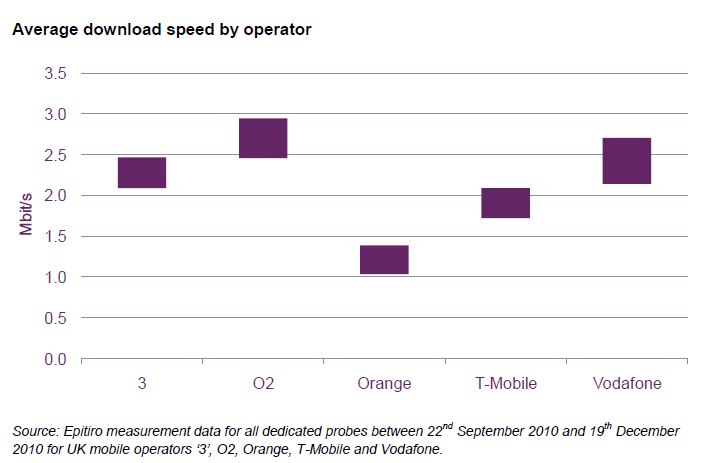
A recent report from the UK regulator, Ofcom, shows the differences in performance of UK's 3G mobile operators - "The research found some differences between the performance of operators’ 3G networks. O2, Vodafone and 3 offered faster average download speeds than T-Mobile and Orange .. The research, conducted between September and December 2010 in partnership with broadband monitoring specialists Epitiro .. involved over 4.2 million tests and measured average speeds as well as the performance of the five mobile operators in areas of good 3G network coverage" (see chart).

Ofcom also found that "17% of UK households are using mobile broadband to access online services, with 7% using it as their only means of internet access, compared to 3 per cent in 2009".

See "Mobile broadband speeds revealed" - here, full Report - here and coverage by channel 4 news (here and below).


Saturday, January 8, 2011

US and UK Regulators to add Mobile Spectrum for Data

 
The FCC and Ofcom both announced recently their intentions to add more spectrum to mobile carries, for data services.

FCC Chairman Julius Genachowski said in a press event at the 2011 CES show - "We need to free up more spectrum .. If we don’t tackle the spectrum crunch now, network congestion will grow, and consumer frustration will grow with it .. That’s why unleashing spectrum to support mobile innovation is at the top of the FCC’s 2011 agenda". See "Chairman Genachowski's Remarks at the 2011 International Consumer Electronics Show" - here.

Ofcom published a statement saying that "From today the airwaves used by mobile phone operators for 2G services, such as making phone calls and sending texts, will be available to provide 3G services .. Today’s move means that this spectrum could in future be used to meet the growing demand from smartphone devices and the like for 3G services". See "Ofcom opens up more frequencies for 3G services" - here.

Not everybody was happy with the move - for example 3UK, an operator that does not have 2G frequencies (as the name indicates ..). See "3UK head criticizes spectrum allocation ruling" - here
 
"Kevin Russell, chief executive of 3 UK (picture), has indicated that his business could be sold after accusing ministers and regulators of distorting competition in the telecoms industry. He criticized a decision by regulators to let the operator’s larger rivals reallocate some of their radio spectrum from basic phone services to data activities such as internet browsing. .. The company wants Ofcom, the telecoms regulator to draw up auction rules that cap the amount of spectrum that any operator can hold. Without this, 3 doubts that O2 and Vodafone could end up holding the bulk of the spectrum available at a bandwidth below one gigahertz. Everything Everywhere, the largest network operator, has similar concerns to 3".

Thursday, November 4, 2010

Skype: Cooperating with Operators is Good; [Some] Net Neutrality is also Good

  
MBB (Mobile Business Briefing) reports on a presentation made by Russ Shaw, VP of Mobile at Skype, during the Planet of the Apps 2010  in London - "Shaw.. used his keynote presentation this morning to position the company as a partner for mobile network operators, rather than a competitor intending to capture lucrative voice revenue .. However, in order for relationships to succeed, three key areas need to be addressed from the outset: who owns the customer data, how access to the network is governed, and who controls the user experience. “If you can't agree this up-front, it won't work,” he warned."
See "Skype trumpets co-operation, not competition, with operators" - here.

Shaw mentioned the cooperation with 3 UK (here), Verizon Wireless (here) and its new relationship with KDDI [Japan].

See also "Skype: Operators' Tiered Services will Replace Our 3G Surcharge Plans" - here and "Frost & Sullivan: Mobile Operators Should not Impose Bans or Surcharges to VoIP" - here.

Nevertheless, "Shaw also used his speech to highlight the need for net neutrality, in order to drive product and service innovation which will ultimately benefit customers – with Skype also standing to benefit if operators do not block competitive voice services ... Working together is key. Customers will end up with a better experience, and I think that networks will end up with more revenue and less churn"

It seems that the attitude is - we like Net Neutrality if it prevents non-partners to block us, but once we have a partner - it is no longer needed, and discrimination (or prioritization) is good.

Related post - "Skype's $100M IPO: "Our business depends on our users having continued and unimpeded access to the Internet" - here.

Monday, June 28, 2010

Skype Does Good for 3UK

   
Unlike the conventional wisdom, according to which allowing Skype over mobile data will cannibalize mobile operators' voice minutes revenues, 3 UK is seeing just the opposite - according to recent research by CCS Insight, reported by Rethink Wireless.

See "Skype boosts results for exclusive operators" - here.

"Nearly 80% of 3 UK's Skype users over the past year are new to the company, and on average, they deliver 20% higher ARPU and 14% lower churn than the rest of 3's base ... Though few operators actually block the service any more, only a handful has offered active support, including an optimized application and free calls over 3G - and so these tend to promote such a rare differentiator aggressively.

Concluding that this will be correct for every operators is maybe far fetching, but we did see Verizon going the same way earlier this year: "Verizon likes Skype" - here.

Let’s not forget Skype's intention to charge extra for currently free Skype to Skype calls over 3G: "Skype: We Will Charge 3G Calls to Ensure QoS Stays High" - here.

Monday, March 15, 2010

Net Neutrality Speculations and 3UK

 
While we wait for the FCC presentation of its new broadband plan (calendar here), including the Net Neutrality policy, we can speculate that the previously announced guidelines will be there.

I believe that all 3 main parties (customers, operators and OTT content providers) and the hidden party (vendors of traffic management/DPI solutions) can live in piece with most of the guidelines, leaving only two in controversy (non-discrimination and, to a lesser extent, handling of illegal traffic).

The following principles can make all of us happy:
  • Accurate disclosure of service terms to customers (and the public so one can compare different plans). Service terms may include the fair-use policies, subject to the other principles.
     
  • Allowing operators to manage traffic, during congestion, affecting only traffic and subscribers that are subject to congestion.
     
  • Allowing intelligent traffic management, so applications can get proper QoS according to their nature
Of course, the latter is the most sensitive item, as it tackles many problems - the difficulty of identifying applications (hence the need for DPI), discrimination and handling illegal traffic.

One way to ensure fairness to OTT services is to go back to the old “well-known ports” TCP standard (here). If an application uses its pre-registered port (operators will still need DPI to detect disguise) it will be classified to a certain, pre-defined and disclosed class-of-service (such as “real time”, “Interactive” or “off-line”) and will be treated the same way as all other applications defined with the same class. Applications disguised to others could be blocked or get the lowest priority.
The following article (from The Register, here) describes the approach taken by 3UK for broadband mobile traffic control:

".. But already 3UK has moved beyond that model to offer customers on the more expensive tariffs priority access when a cell gets congested. Originally that was going to include limiting YouTube streams to one per (non-premium) customer, but even that got rescinded as the bad publicity built and now it's just BitTorrent users who'll get hit when a cell is congested."

We can see here – disclosure (consistent with the UK policy described in my previous posts), managing traffic at congestion time and place (at the cell level!). Nevertheless, we can see discrimination of a certain applications (they tried YouTube – now they go for BitTorrent).