Showing posts with label streaming video. Show all posts

Sunday, December 13, 2015

[ABI]: VIdeo QoE (CDN, Monitoring and Analytics) Market to Reach $477M by 2020


A new study by Eric Abbruzzese, Research Analyst, and Sam Rosen [pictured], VP of Consumer, ABI Research finds that "Content Delivery Network (CDN) Balancing and OTT Monitoring, as well as Real User Monitoring (RUM) and Application Performance Monitoring (APM) technologies used to measure video services are growing, with associated revenues estimated to reach US$477 million in 2020.

While the video analytics market as a whole is rather mature, the desire for more granular, user-level data led to a shift in focus from QoS metrics to QoE services and data .. the increasing complexity of the IP video and OTT content markets will continue to drive both new and existing providers, operators and content owners to pursue deeper analytics capabilities to fully understand the experience of the end user.

Whether mobile or wireline, operators and service providers are focused on minimizing content start times and buffering delays while maximizing video quality and stream reliability .. Real-time, granular, user-level data streams allow the opportunity for a deeper understanding of not only how a network is performing but also how individual users are affected by network idiosyncrasies. Automated load balancing and network optimization platforms will help inform future business decisions, from content licensing to CDN usage
.”

See "Growing IP and OTT Video Delivery Demands and User Experience Focus Drives Network Optimization and Analytics Services" - here.

Saturday, December 12, 2015

Netflix: The Challenges of Preparing Video for Best QoE


Anne Aaron [pictured], Manager, Video Algorithms, and David Ronca, Director, Encoding Technology, explain in a post to Netflix Techblog how Netflix prepares its video content and "encode them to the best video streams possible for a given member’s viewing device and bandwidth capabilities" which turns out to be a bigger challenge than what most people think.

Related posts
  • How does Netflix Optimize Video? - here
  • Sandvine: Streaming Video is 70% (Netflix 37%) of NA Fixed Traffic" - here.
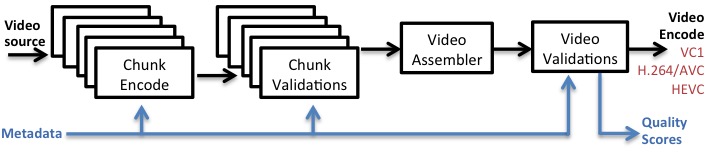
"The video encoding pipeline runs EC2 Linux cloud instances. The elasticity of the cloud enables us to seamlessly scale up when more titles need to be processed, and scale down to free up resources .. Long processing jobs are divided into smaller tasks and parallelized to reduce end-to-end delay and local storage requirements .. A modern 4K source file can be quite large. Larger, in fact, than a typical drive on an EC2 instance. In order to efficiently support these large source files, we must run the inspection on the file in smaller chunks .. Before we implemented parallel chunked encoding, a 1080p movie could take days to encode, and a failure occurring late in the process would delay the encode even further"

"..At Netflix we stream to a heterogeneous set of viewing devices. This requires a number of codec profiles: VC1, H.264/AVC Baseline, H.264/AVC Main and HEVC. We also support varying bandwidth scenarios for our members, all the way from sub-0.5 Mbps cellular to 100+ Mbps high-speed Internet. To deliver the best experience, we generate multiple quality representations at different bitrates (ranging from 100 kbps to 16 Mbps) and the Netflix client adaptively selects the optimal stream given the instantaneous bandwidth" 


See "High Quality Video Encoding at Scale" - here.

Monday, November 30, 2015

ITU Adopted Huawei's Video MOS Proposal


Huawei announced that "During the recent ITU-T SG12 Q13/12 and Q14/12 interim meetings held in Berlin Germany:
  • Huawei’s proposed video MOS Umbrella WID project (G.vidmos) was adopted. The project will provide video MOS evaluation guidelines to the industry with consideration of different classification of related factors. 
  • Concurrently, the modification of ITU-T Rec. P.800.1 "Mean Opinion Score (MOS) terminology" with the inclusion of video MOS standardized definitions, suggested by Huawei delegates, was agreed in the meeting.
  • During the meeting, Huawei made a proposal to differentiate the PC and Mobile scenarios based on extensive market analysis. It was also proposed to proceed with H. 265 and 4K resolution video MOS evaluation as soon as possible as one of the next phases of work priorities for video MOS.
Meanwhile, as one of the active participants among video MOS companies, Huawei submitted the audio, video, and audiovisual MOS evaluation models to ITU-T SG12 P.NATS project. This model can be used for the evaluation of real time encryption/non-encryption-based media stream OTT"

See "Huawei’s Proposed Video MOS Work Item Gains Approval by ITU-T" - here.

Monday, October 19, 2015

LG to Integrate Giraffic Video Optimization to Smart TV


Meir Orbach reported to Calcalist (here, Hebrew) that "LG will integrates Giraffic video optimization technology in its smart TV product line to enable 4K streaming". 

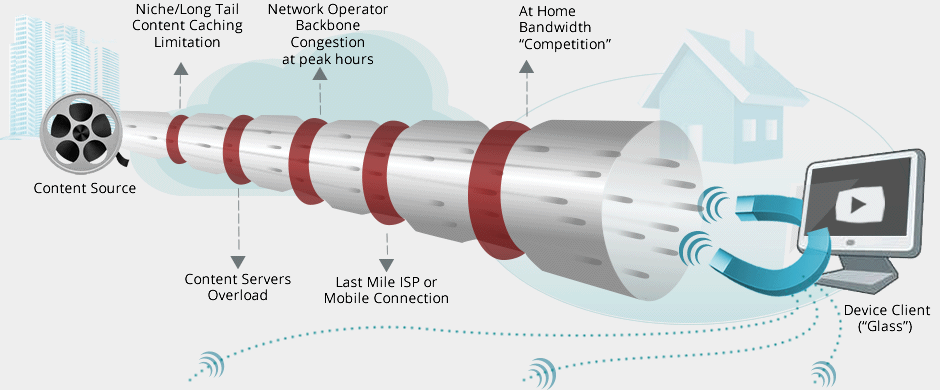
Giraffic’s multi-patented client-side AVA™ technology overcomes Internet bottlenecks from source to glass, enabling devices to actively control Internet streaming quality.Smart TVs, IP STBs, Tablets and smartphones with Giraffic AVA™ software provide a faster and smoother streaming experience from any internet content source on the end-user’s existing internet connection. Giraffic’s patents on multi-source streaming, congestion control, dynamic maximization of HTTP communication throughout, predictive buffering and network shaping overcomes internet bandwidth limits

Yoel Zanger [pictured], Giraffic CEO told Calcalist: "We understood that great technology (see "New Start-up Promises X2 Faster Video Streaming with 'Crowd CDN'", here) does not always trun into a revenue generating business model. We need to go after those who can and willing to pay. Therefore, 3 years ago, we made a change in our direction. The content and smart devices domain goes to 4K resolution, but the internet infrastructure cant provide the required quality to the home user".


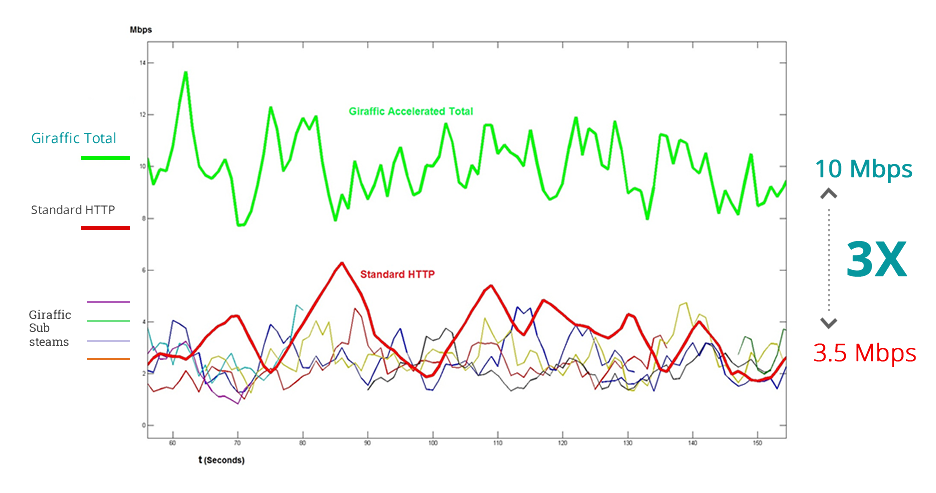
A real network monitor view of a typical Giraffic accelerated stream: averaging 3X higher throughput, and smoother QoS

Friday, September 25, 2015

Google's Introduces New Compression Algorithm

 
Zoltan Szabadka [pictured], Software Engineer, Compression Team, Google announced in a post to Google's Open Source Blog a new compression algorithm ".. Brotli [code here] is a whole new data format. This new format allows us to get 20–26% higher compression ratios over Zopfli. 

In our study ‘Comparison of Brotli, Deflate, Zopfli, LZMA, LZHAM and Bzip2 Compression Algorithms’ we show that Brotli is roughly as fast as zlib’s Deflate implementation. At the same time, it compresses slightly more densely than LZMA and bzip2 on the Canterbury corpus

The higher data density is achieved by a 2nd order context modeling, re-use of entropy codes, larger memory window of past data and joint distribution codes. Just like Zopfli, the new algorithm is named after Swiss bakery products. Brötli means ‘small bread’ in Swiss German.

​The decompression speed vs. compression ratio.
Source: Comparison of Brotli, Deflate, Zopfli, LZMA, LZHAMand Bzip2 Compression Algorithms

The smaller compressed size allows for better space utilization and faster page loads. We hope that this format will be supported by major browsers in the near future, as the smaller compressed size would give additional benefits to mobile users, such as lower data transfer fees and reduced battery use"

Can Google Beat this ? See more: Pied Piper Waiting for the next Season! 

See "Introducing Brotli: a new compression algorithm for the internet" - here.

Monday, September 7, 2015

How Long will you Wait for Video to Load? Will you Pay Extra for QoE?


An "independent research conducted by Censuswide commissioned by Openwave Mobility has found that poor mobile video streaming is an even bigger headache than a dropped call for iPhone users. Over 2,000 iPhone users in the UK and US were interviewed ahead of the new iPhone launch on 9th September to study people’s mobile video habits:
  • Over half (59%) of subscribers in both countries will abandon streaming a mobile video if they have to wait longer than 15 seconds
     
  • Nearly a fifth (19%) will abandon a video after only a 5 second wait
      
  • In both countries almost 1/3 of subscribers (31%) expressed a strong view that video buffering is simply unacceptable, and video delivery by mobile operators is lagging behind the latest handset technology that is driving the industry forward
      
  • 39%, said they would pay extra dollars if the operator could only provide some assurance on the quality of video delivery
      
  • 1 in 2 customers blame the carrier for poor mobile video service and 1 in 3 blame Apple. Notably almost nobody blames the content providers or the Over The Top (OTT) players". 


See "Mobile Video Buffering is the Biggest Annoyance for iPhone Users" - here.

Monday, April 27, 2015

Sandvine Rates North-American OTT Services


HBO Now and  colleagues  on Apple TV
A recent post by Dan Deeth Sandvine's blog shows how the recent HBO recent OTT service, HBO NOW, did compared to the other popular services. "HBO NOW .. is distinct from HBO’s other streaming platform HBO GO in the sense that you can purchase an HBO NOW subscription without the aforementioned television package"

But first we need some DPI: ".. Even though the service went live in the middle of last week, Sandvine was able to provide our customers with a software update on Friday that allowed them to not only measure the service, but more importantly be able to do so in time for the launch for the new season of HBO’s most popular show Game of Thrones.

So what impact did Game of Thrones and HBO NOW have? Below is a snapshot of traffic mix from one fixed network located in the eastern United States taken at 9:30PM .. This is one network, on one day, and Internet traffic does fluctuate, so it is important to not take these figures to be representative of North America:


See "Sunday Night Streams – How Did HBO NOW Fare?" - here.

Tuesday, January 27, 2015

Allot: 3 Traffic Optimization Orders


Allot Communications announced that it "received orders from three new mobile operator customers in the fourth quarter of 2014 for Allot VideoClass, an application-aware and network-aware video optimization system that fully integrates with Allot Service Gateway to dramatically improve the quality and efficiency of video delivery:
Allot's VideoClass 
  • One of EMEA’s leading Tier-1 mobile service providers is implementing the Allot VideoClass system to prevent video buffering delays, stalls and latency, and expedite web browsing to enhance the overall customer quality of experience (QoE). This implementation followed a competitive win against pure-play optimization vendors. The video QoE management solution also provides the operator with the network intelligence to achieve granular policy control to match the optimization policy to a customer profile and data plan.
     
  • A second order was received from a major multinational mobile operator based in LATAM that selected the Allot VideoClass system to eliminate network congestion and enhance video delivery. This order followed a competitive and extended trial process. The operator will be better able to identify and allocate bandwidth to each video application to ensure a high QoE while, at the same time, lowering operational expenses.
     
  • Allot received an additional Allot VideoClass system order from a mobile virtual network operator (MVNO) in Europe. This operator also utilizes Allot’s web optimization capabilities to accelerate web browsing responsiveness and further reduce delivery costs. The solution enables this operator to realize significant savings by dramatically reducing optimizable video bandwidth by up to 40% and overall bandwidth savings of up to 20%, while maintaining a high customer QoE. This operator is also taking advantage of network analytics capabilities to gain insights into mobile traffic, which enables the provider to develop application and subscriber-based charging models.  
See "Allot Communications Secures Video Optimization Orders from Three New Major Mobile Operators" - here.

Tuesday, January 13, 2015

M-GO Uses Beamr to Reduce 4K Video Bit Rate by up to 50%


Beamr announced that "M-GO is using Beamr Video [see "Beamr Launches Beamr Video 2.0 For Improved User Experience and Efficiency in Video Optimization" - hereto provide a best-in-class user experience for the company’s premium streaming service. Based on a patent-pending perceptual quality measure, Beamr Video automatically reduces the bitrate of any H.264 or HEVC HD and 4K video stream by up to 50 percent while retaining the full perceptual quality and format of the original file. 


"The table below summarizes the typical bitrate reduction ratios achieved by Beamr Video optimization for various types of content:

Content SourceBitrate reduction
BluRay Discs50 - 75%
Consumer video cameras (AVCHD, DSC, mobile)50 - 70%
Download services (iTunes, Amazon)40 - 50%
Streaming services (Hulu, NetFlix, YouTube)20 - 40%

See "M-GO Partners with Beamr Video to Provide Best-in-Class Streaming Quality" - here.

Tuesday, January 6, 2015

Secured Video Streaming is Bad for Your In-flight Internet


Gogo, the in-flight internet services provider, released a statement about its traffic shaping and blocking practice, made by Anand Chari [pictured], EVP and CTO:

Gogo takes our customer’s privacy very seriously and we are committed to bringing the best internet experience to the sky. Right now, Gogo is working on many ways to bring more bandwidth to an aircraft. Until then, we have stated that we don’t support various streaming video sites and utilize several techniques to limit/block video streaming. 

One of the recent off-the-shelf solutions that we use proxies secure video traffic to block it. Whatever technique we use to shape bandwidth, It impacts only some secure video streaming sites and does not affect general secure internet traffic. These techniques are used to assure that everyone who wants to access the Internet on a Gogo equipped plane will have a consistent browsing experience.

We can assure customers that no user information is being collected when any of these techniques are being used. They are simply ways of making sure all passengers who want to access the Internet in flight have a good experience.


This comes as a response to the following tweet:


See "STATEMENT FROM GOGO REGARDING OUR STREAMING VIDEO POLICY" - here.

Sunday, December 28, 2014

Sky [UK]: Streaming Viedo Drives Christmas 2014 Peak Traffic to Double


Sky Broadband announced that " Britain’s “connected Christmas” continued in 2014 after it analysed usage on its network, which reaches over 5 million homes across the country. The amount of data crossing Sky’s network peaked at 2Tbps – equivalent to about 1 million families streaming Disney’s Frozen in HD at the same time – and 100% up on last year. 

On Christmas Day over half of Internet traffic was from streamed video services including Sky’s On Demand service. 

Comparatively, on the famed Black Friday weekend Sky’s network saw a lower demand as customers took to shopping online instead of streaming videos.

Usage on Christmas Day surpassed the levels seen from Christmas 2013, with a steady increase in traffic on the day between 8am and 12noon as families switched on to spread some Christmas cheer. The Sky Broadband network then saw traffic drop between 1pm and 3pm as families across Britain tucked into their turkey side-lining any new devices. Post lunch data traffic then started to increase again, reaching an evening peak at 11pm, as the family settled to stream the latest Box Sets, browse the Christmas sales beating the crowds and share pictures of their present haul". 


See "Sky Broadband peaks from Christmas Day" - here.

Sunday, November 23, 2014

Ex-Sandvine Team NightShifts Netflix for Satellite Subscribers


A recent study from Sandvine (here) finds that "Netflix continues to dominate North American networks, accounting for 34.9% of downstream traffic in the peak evening hours" and even "On a fixed network in Australasia, where Netflix isn’t even available yet, approximately 2.5% of subscribers are accessing the service and it comprises as much as 4% of peak downstream traffic".

So everybody loves Netflix, but not all enjoy the internet connectivity allowing them to stream the movies and TV episodes with the expected QoE.

Aterlo Networks, a new start-up, led by ex-Sandvine employees ("Before starting Aterlo Networks Inc, our team worked together for years defining, building, architecting and managing mission-critical products which were deployed in some of the largest Internet Service Providers in the world" - here) changes that by adding a "local cache" to the home router. 

"NightShift runs on your compatible home router with a connected USB flash drive. It seamlessly works with existing Netflix players. It analyzes your viewing patterns and predicts content to automatically download at night. Once a TV show or movie is downloaded, you can watch it from any Netflix player in your home the same way you always do. NightShift creates a temporary local copy of video content. It does not break or bypass DRM, and an Internet connection is still required".

Of course, with the presence of the software at the subscriber's access point, a lot more can be achieved, including QoE measurements, and other features to the ISP (Aterlo positions itself as a service provider solution (here). A sure challenge would be the distribution of the software to the mass market.

An example is the satellite broadband service - "These subscribers have very limited day-time plans (15 – 25GB / month). They typically have either unlimited nights or additional usage that can only be used at night". Aterlo beta test (at Exede) showed that "In a typical night, and depending on Satellite Beam congestion, NightShift has been able to download up to 15GB of Netflix ready to watch the next day. Depending on playback quality settings, this equates to up to 5 hours of High Definition or over 20 hours of Standard Definition content". 


Thursday, November 20, 2014

Optimization Deployments [329]: LG U+[Korea] Tests Nokia's Base Station Cache and Video Optimization


Nokia announced that "LG Uplus has completed a three-month long trial of its Intelligent Network Platform (INP), realizing significant benefits: Up to 35% performance gain in content delivery with reduced latency for big objects of 10-30 MB. This means that mobile users save six seconds download time for a software package that usually takes 20 seconds to download. The trial also showed around 90% operating and capital cost saving in the mobile backhaul link, improved throughput, and a secure yet faster access to enterprise networks via LTE".

Related posts:
  • StarHub Trialed Nokia's Liquid Applications at WTA Finals - here
  • Rumors: NSN's Liquid Applications Uses Saguna's Technology - here
  • Zain [Saudi Arabia] Trials Nokia's Liquid Applications - here
"Nokia’s radio technology, Liquid Applications and professional services were used in the trial. CDNetworks, a global leader in the CDN space, also participated in the trial to evaluate the Liquid Applications’ impact on its commercial CDN service offerings. With these results, LG Uplus will be able to launch even better personalized services on its LTE network .. The LG Uplus INP is currently loaded with rich Liquid Applications features: Content Caching, Video Optimization, CDN Integration, and Enterprise Zone".


See "LG Uplus, Nokia Networks trial Intelligent Network Platform in live LTE network" - here.

Sunday, November 9, 2014

Procera Adds Video Analytics


Procera Networks adds another piece to its line of Network Intelligence solutions (following its RAN analytics solution - here).

The vendor announced the "..launch of Video Perspectives, a video analytics solution for network operators that delivers comprehensive video intelligence and actionable analytics .. With Video Perspectives, broadband operators have a complete view of the video being consumed by their subscribers and of their success in delivering a high QoE to subscribers. Now, broadband operators can create their own video quality scorecards to measure delivery of streaming video to their subscribers and use it to measure against the proliferation of content provider scorecards (for example, Netflix and Google) .. Video Perspectives is in trial with several Tier 1 operators, is available for beta testing immediately and will be generally available in Q1 2015.


.. It is a software solution that can run on PacketLogic™ hardware to collect detailed video analytics on a broadband network. The intelligence is visualized as an integrated part of the PacketLogic Insights product family, including Customer Care and Engineering Insights, and as a standalone Video Insights product. 

The solution that includes three new functions:

  • New method of analyzing streaming video and detecting more than twenty new metrics in real-time,
  • A new application specific score that enables comparing the video quality score to the entire delivery eco-system transport quality segmented by internet hop,
  • And a new web user interface enabling the CSP to created graphs to compare the new metrics supporting the presented score.

The integrated Insights solutions present detailed video reporting and analytics views that are combined with Procera’s other subscriber analytics to deliver a comprehensive view of the subscriber experience. Video Insights delivers highly detailed video intelligence, and is an interactive tool that allows operators to generate custom reports and analytics based on specific issues or opportunities they are seeing with video on their network.


See "Procera Networks Launches Groundbreaking Video Analytics Solution" - here.

Tuesday, November 4, 2014

[ABI]: New Video Delivery Technologies


A new report by Sam Rosen [pictured], Practice Director, ABI Research finds that video delivery technology has to be adapted to be able to meet demand and quality.

"A few trailblazers are working on disruptive innovations. Areas such as the inability of TCP delivery to keep up with high throughput demands, the lack of perceptual tools in modern codecs, as well as the inefficiency of storage within CDNs all pose significant additional challenges within the ecosystem. A number of innovative companies, from startups to more mature businesses, are addressing these issues: bitmovin [transcoding and players], beamr [Optimization], Akamai, Aspera [High-speed transfer] (part of IBM), Vantrix [here], and Conviva [Analytics]".

“Of the areas we examined, carrier equipment for video delivery, transit replacements for TCP, and real user monitoring (RUM)/application performance monitoring (APM) applied to video have the largest market potential and are expected to be the most pervasive in tomorrow’s video services .. Meanwhile, OTT monitoring is expected to remain a niche market. These disruptive innovations will lead to about US$1.5 billion in 2020 revenues across a variety of industries”.

See "Video Delivery Requires New Codecs, Improved Network Protocols and Analytics" - here.

Wednesday, October 8, 2014

Nokia will Include Flash Network Gateway in its Offering

    
Nokia Networks announced it ".. has signed a partnership agreement with Flash Networks to include Flash Networks’ Harmony™ Gateway [see chart below] as part of its mobile broadband core network offering. The market leading solution [see "Flash Networks (40%) and Citrix (30%) Lead the Mobile Optimization Market" - hereenables operators to optimize video and web traffic for an improved user experience, including faster web browsing and downloads, smoother video viewing, and content control services. 


Source: {Core Analysis}


Thorsten Robrecht [pictured], VP, Head of Product Management, Nokia Networks said: “With the addition of Flash Networks’ offerings into our mobile broadband portfolio, we create a significant value-add and enable mobile operators to maintain a competitive edge by providing the fastest network possible while handling the dynamic growth in mobile data”.

Flash Networks' Harmony™ Mobile Internet Services Gateway

See "Nokia Networks enters into partnership with Flash Networks" - here.

Thursday, September 25, 2014

Artesyn Announced High-density Video Acceleration PCI Cards

 
SharpStreamer™ PCIE-7207
Artesyn Embedded Technologies announced the "SharpStreamer™ add-on acceleration card that enables content owners, broadcasters and service provider networks to speed the deployment of high density video transcoding and multiscreen delivery.

..Artesyn is targeting the highest H.264/AVC and H.265/HEVC transcoding density in the smallest footprint. An Artesyn SharpStreamer card is capable of up to 48 streams of 1080p H.264 transcodes, or 4 streams of 1080p H.265/HEVC transcodes. It uses four Intel® Core™ i7-4650U Processors at 1.7 GHz with Intel® HD graphics 5000 Graphics supported by 8 GB memory per processor subsystem in a three-quarter length PCI Express card footprint.

..As with other add-on acceleration cards in the Artesyn portfolio, SharpStreamer is designed for compatibility with servers from Dell and HP.

The SharpStreamer is equipped with a software development kit comprised of the Intel® Media SDK with Intel® HD Graphics' hardware acceleration, monitoring and processor subsystem operating system and management tools for easy integration with server host processing environments"


See "New Artesyn Embedded Technologies Add-on Acceleration Card Enables High Density Video Processing in Standard Servers and Cloud Networks" - here.

Sunday, September 7, 2014

Study: What are the Barriers for Watching Video on Mobile?


Ericsson's reports that its ConsumerLab found (based on interviews with over 23,000 people in 23 different countries) that:
  • streaming video is now almost level with traditional TV watching, 75 percent of consumers watching streamed content several times a week, compared to 77 percent who watch scheduled broadcast TV programming several times a week

  • Almost one in five viewers (19 percent) are prepared to pay for the ability to access their favored content on any device, an increase of 25 percent in just two years. a rise in the amount of time spent watching content on smart phones and tablet devices
       
  • Barriers for watching video on mobile devices, outside home: 
  • Alongside this, many viewers have moved to subscription-based video on demand (S-VOD) services such as Netflix and Hulu, and 48 percent state that they would like to see all episodes of a series such as "Breaking Bad" and "House of Cards" released together, so they can choose when to watch them.

See "Ericsson ConsumerLab: streaming closing in on traditional TV as users want 'anywhere access'" - here.

Tuesday, July 15, 2014

Verizon vs. Netflix on Congestion - It is NOT Us!


So, who is responsible for a smooth video experience ? The ISP? the content provider? the transit network between the two?

According to Verizon, it is not them (at least in the case of Netflix streaming).

David Young report to the carrier's Public policy Blog:

Netflix ISP Ranking for Verizon FiOS, Feb-Jun 2014
"A few weeks ago, Verizon received an email from a customer in Los Angeles asking why he was not getting a good experience watching Netflix on his 75 Mbps FiOS connection.

He was understandably confused by some of the misleading public accounts that inaccurately suggest widespread congestion that could affect Netflix traffic on Verizon’s network [see "Netflix to Verizon: Nope, Your Congested Pipes Are Still Your Fault" - here]

.. our network operations team studied the network connection for this customer for the week preceding the date that he emailed us. They measured the utilization – or the percentage of total capacity used – at every link in the Verizon network – from the customer to the edge of our network, where we receive Netflix traffic .. there was no congestion anywhere within the Verizon network. There was, however, congestion at the interconnection link to the edge of our network (the border router) used by the transit providers chosen by Netflix to deliver video traffic to Verizon’s network .. For whatever reason (perhaps to cut costs and improve its profitability), Netflix did not make arrangements to deliver this massive amount of traffic through connections that can handle it"


See "Why is Netflix Buffering? Dispelling the Congestion Myth" - here.

Saturday, July 12, 2014

Yahoo Acquires RayV for "best-in-class quality and content video delivery"

    
Rumors spread two months (see "Yahoo to Buy RayV?" - here) ago are now a reality.
   
RayV (see "RayV Exposes Turn Key Video Streaming to MNOs and ISPs" -  here) site announces that "We are excited to announce we are joining Yahoo's Cloud Platforms and Services Team! Our team began the RayV journey with the goal of building a revolutionary video distribution platform that would provide a better video experience for viewers over the internet, while easing the distribution process for content creators. Over the last eight years, we have done just that".

Congratulations to some of my old VocelTech colleagues!
  
Yahoo's P.P.S. Narayan, VP of Cloud Platforms and Services says in the company's blog (here) - "I’m thrilled to announce that we have acquired RayV, a company with an exciting approach to online video streaming in the rapidly evolving mobile space .. at Yahoo, we are focused on building a video offering that delivers best-in-class quality and content, and can be streamed on-demand and live, on all platforms"

See "RayV is joining Yahoo platform and services team" - here.