Showing posts with label Copyright infringement. Show all posts

Monday, January 5, 2015

Netflix to Geo-block VPN Users

 
ERNESTO reports to TorrentFreak that "Netflix is starting to block subscribers who access its service using VPN services and other tools that bypass geolocation restrictions. The changes, which may also affect legitimate users, have been requested by the movie studios who want full control over what people can see in their respective countries 

.. Over the past weeks Netflix has started to take action against people who use certain circumvention tools. The Android application started to force Google DNS which now makes it harder to use DNS based location unblockers, and several VPN IP-ranges were targeted as well .. Thus far the actions are limited in scope, so not all VPN users may experience problems just yet. However, TorGuard is one of the VPN providers which noticed a surge in access problems by its users, starting mid-December.

..Netflix is not the only streaming service that’s targeting VPN and proxy users. A few months ago Hulu implemented similar restrictions. This made the site unusable for location “pirates,” but also U.S. based paying customers who used a VPN for privacy reasons".

See "Netflix cracks down on VPN and proxy pirates" - here.

Tuesday, July 22, 2014

UK: ISPs will Alert Subscribers on Copyright Infringement


The UK has a new plan for reducing copyright infringement, as probably the older plans did not work - UK Culture Minister Vaizey:'SPs have their role to play to help consumers find legitimate content'"here and "[UK]: Major ISPs Asked to Build 'Downloaders Database'" - here:
 "Representatives from the UK's creative industries and major Internet Service Providers (ISPs) have come together with the support of government to launch Creative Content UK, a ground-breaking new partnership that will boost consumer awareness of the wide array of legitimate online content services and help reduce online copyright infringement.
Creative Content UK will comprise two key components. 
  • The first, which will launch before Spring 2015, will be a major multi-media education awareness campaign, led by content creators and part-funded by government, that aims to create wider appreciation of the value and benefits of entertainment content and copyright. 
  • The second component is a subscriber alerts programme that will be co-managed and co-funded by ISPs and content creators and due to begin at a later date. Participating ISPs will alert and advise subscribers when their accounts are believed to have been used to infringe copyright. Account holders will receive an alert from their ISP, advising them unlawful filesharing may have taken place on their connection and offering advice on where to find legitimate sources of entertainment content.
.. Creative Content UK founding partners include the Motion Picture Association (MPA), the BPI (British Recorded Music Industry), and the four main internet service providers: BT, Sky Broadband, TalkTalk and Virgin Media, with the prospect of other ISPs joining at a later stage .. The campaign will aim to inform and encourage consumers - ranging from the next generation of digital users to 'silver-surfers' – about the huge range of entertainment content that is available from legal and licensed sources; giving them greater confidence when buying and using content online and providing additional guidance about internet safety.

John Petter [pictured], CEO, BT Consumer, said: “BT is very pleased to be able to support this important announcement today. The UK has a world-leading creative sector which plays a vital role in promoting the nation’s economic prosperity. BT is committed to supporting the creative industries by helping to tackle the problem of online piracy while ensuring the best possible experience for its customers. That’s why we’ve worked very hard with rights-holders and other leading ISPs to develop a voluntary programme based on consumer education and awareness which promotes the use of legal online content.

See "UK Creative Industries and ISPs Partner in Major New Initiative to Promote Legal Online Entertainment" - here.

Thursday, January 9, 2014

How will Pirate Bay Avoid Blocking?

 
As once said "All site blocking techniques can be circumvented" (here). Apparently we are going to see one more way to do that.

Ernesto reports to TorrentFreak that "The Pirate Bay’s PirateBrowser just hit 2.5 million downloads but the notorious torrent site has much bigger plans in store for the new year. The team behind the site is developing a new tool that doesn’t rely on domain names or server farms. Instead, users will serve as the P2P hosts of the sites, with the system running its own alternative DNS. Today, the Pirate Bay team shares some more details on the technology.

Over the past few years The Pirate Bay has had to deal with its fair share of censorship, mostly through court-ordered blockades
[see "UK ISPs Ordered to Block Pirate Bay" - here. In response to these efforts the site launched the PirateBrowser last summer.

“The goal is to create a browser-like client to circumvent censorship, including domain blocking, domain confiscation, IP-blocking. This will be accomplished by sharing all of a site’s indexed data as P2P downloadable packages, that are then browsed/rendered locally,” a Pirate Bay insider explains .. The new software will be released as a standalone application as well as Firefox and Chrome plugins.


See more "How The Pirate Bay Plans to Beat Censorship For Good" - here,

Friday, November 29, 2013

EU Courts can Order ISPs to Block Copyright Infringement Sites


The EU's Advocate General’s Opinion says that ".. Member States are to ensure that copyright holders or holders of related rights are able to apply for an injunction against intermediaries whose services are used by a third party to infringe their rights .. It is already established that internet providers can in principle be regarded as intermediaries and therefore as persons against which such injunctions, which are aimed at bringing to an end infringements already committed and at preventing further infringements, can be granted. In practice, the operators of illegal websites and the internet providers which make them available online are frequently based outside Europe or conceal their identity, making it difficult to pursue them before the courts".

"In his Opinion today, Advocate General Pedro Cruz Villalón [pictured] takes the view that the internet provider of the user of a website which infringes copyright is also to be regarded as an intermediary whose services are used by a third party – that is the operator of the website - to infringe copyright and therefore also as a person against whom an injunction can be granted. That is apparent from the wording, context, spirit and purpose of the provision of EU law".

See also "There is always another Way to Download" - here.

See "According to Advocate General Cruz Villalón an internet provider can be required to block access by its customers to a website which infringes copyright" - here.

Saturday, October 5, 2013

LSE: No Need to Punish Copyright Infringers


A report by Bart Cammaerts, Robin Mansell [picutred] and Bingchun Meng from the Department of Media and Communications, The London School of Economics and Political Science finds that "The experiences of other countries that have implemented punitive measures against individual online copyright infringers indicate that the approach does not have the impacts claimed by some in the creative industries".

See also "LSE: 'The use of peer-to-peer technology should be encouraged'" - here.

".. A 2013 report by the European Commission’s Joint Research Centre on online music consumption in France, Germany, Italy, Spain and the UK looked at clicks and visits to legal and illegal services. It showed that digital music ‘piracy’ did not displace legal music purchases in digital format and that the majority of music consumed illegally would not have been consumed if it was not freely available. It observed that, in France, HADOPI may have affected consumer choices and also that France had the highest content streaming rates compared with other countries, indicating the fast pace of changes in technology and online digital content services".

The lesson for the UK? - "We recommend a review of the DEA [UK's Digital Economy Act - see "UK: "3 Strikes" Regulation Expected in 2014"hereand related legislation that strikes a healthy balance among the interests of a range of stakeholders including those in the creative industries, Internet Service Providers and internet users. Fitting the digital sharing culture and new forms of cultural production into a copyright enforcement model that is out of touch with today’s online culture will only suppress innovation and dampen growth".

See "Copyright & Creation A Case for Promoting Inclusive Online Sharing" - here.

Tuesday, September 3, 2013

[UK]: Major ISPs Asked to Build "Downloaders Database"


I thought that fighting music sharing is no longer an issue, as reasonably priced legal services are very successful - but it turns out that the record industry is still thinking of a new ways to stop downloaders. The recent one is BPI that represents the UK’s recorded music industry.

Dave Neal report to The Inquirer that "Four UK internet service providers (ISPs) have been invited to help create a database of allegedly illegal downloaders for music record labels and film companies. Four firms - BT, Virgin Media, Bskyb and Talktalk - have been asked to provide information on a voluntary basis.

Virgin Media spokesperson Emma Hutchinson said that "what they're currently proposing is unworkable"; BT said that it was open to suggestions that would not harm its users' rights to privacy"
.

See "Media companies want a downloader database" - here.

Tuesday, June 4, 2013

France: Liberté, égalité, fraternité and Internet


Eric Pfanner reports to the New York Times that the French government is about to end its 3-strikes (see chart below; FAI=ISP) anti-piracy law, and shutdown Hadopi (see "French Copyright Law - 165 Cases Reached Court; File Sharing Declines" - here and "The French Internet Police: 100,000 Warring Emails have been Sent" - here), the agency that was responsible for its execution.

"Fleur Pellerin [pictured], the French minister in charge of Internet policy, said during a recent visit to a high-technology complex in Sweden that suspending Internet connections was incompatible with the French government’s hopes of spurring growth in the digital economy .. 'Today, it’s not possible to cut off Internet access,' she said. 'It’s something like cutting off water'".


See "French Appear Ready to Soften Law on Media Piracy" - here.

Monday, April 15, 2013

[Israel]: More Illegal Download Sites are Blocked (or not)

 
ZIRA's Notification on blocked sites
The Israeli press reports (Calcalist, here - Hebrew) reports that local ISPs are now blocking two more pirate video streaming downloading sites - nako.me and gozlan.me. 
 
The two are from few remaining illegal download sites, following the shutdown of other sites during the recent months. 

ISP are now blocking these sites based on DNS names, after an initial block by IP addresses failed. The court order issued to the request of ZIRA (Hebrew acronym for "Internet Copyrights"), a coalition of major local media and broadcasting organization.
 
Nevertheless, although my ISP is mentioned in the story as blocking the two sites, I can access both sites (which have new names now - Deniro and loka - the latter even ask the visitors to sign a petition against ZIRA).

Wednesday, February 27, 2013

US "6 Strikes" Anti-Piracy Enforcement Begins!


Pay, Don't share !
After some delays (originally planed for July 2012 - see "US Anti-Piracy Delayed; ISPs will not Terminate Accounts" - here) Jill Lesser, Executive Director, Center for Copyright Information announced that Feb 25 marked ".. the beginning of the implementation phase of the Copyright Alert System (CAS). Implementation marks the culmination of many months of work on this groundbreaking and collaborative effort to curb online piracy and promote the lawful use of digital music, movies and TV shows".

The CAS marks a new way to reach consumers who may be engaging in peer-to-peer (P2P) piracy and I am excited that our new website features information on the CAS, the Independent Review Processcopyright, P2P networks, and numerous consumer oriented legal sources for music, movies and television shows". 

According to the press Comcast is the first ISP implementing the system followed by AT&T, Cablevision, Time Warner, and Verizon later (here - see the 2011 MOU below).

See "Copyright Alert System Set to Begin" - here.


Sunday, February 10, 2013

Pirate Bay: The Movie


Enjoyed "The Social Network" ?

So here is The Pirate Bay movie: "The Pirate Bay Away From Keyboard  - documentary about the founders of the Pirate Bay".

See  also "There is always another Way to Download" - here.


Tuesday, December 4, 2012

Killed by DPI? - "It is with regret that we announce the closure of Newzbin2"


A year ago a "UK Court Orders BT to Block Newzbin2 in 14 Days, Using DPI" (here) and the end result is that Newzbin2 is closing its service. Is this because of effective [law and] network policy enforcement or simply people are not ready to pay for such service?

Newzbin2 site (here) now says: ".. combination of several factors has made this the only option. For a long time we have struggled with poor indexing of Usenet, poor numbers of reports caused by the majority of our editors dropping out & no-one replacing them. Our servers have been unstable and crashing on a regular basis meaning the NZBs & NFOs are unavailable for long periods and we don't have the money to replace them.

Newzbin2 was always hoped to be a viable underground commercial venture. The figures just don't stack up. Newzbin1 was said to have had 700,000 registered users. In fact that was the total number of people who ever signed up in the history of Newzbin from 2000 onwards & only a fraction were active, loads of people dropped out & went to other sites. We reckon they had about 100,000 users and of those only a few 10's of thousands paid premium topups.That still made good money for the Newzbin1 guys. We never quite got the trust and lots of people said "Newzbin2 is an MPA trap", that stung us bad and we never got the userbase back. We don't have much more than about 40000 active users and the number of premium users is in the small thousands. It costs much more to run than we bring in, It just doesn't stack up"


Sunday, November 18, 2012

[TorrentFreak]: How will AT&T, Verizon and TWC Handle Piracy?


Ernesto, Founder and Editor-in-Chief, TorrentFreak reports how US ISPs will handle copyright infringements, following the voluntary MOU to stop piracy (see "US Anti-Piracy Delayed; ISPs will not Terminate Accounts" - here):
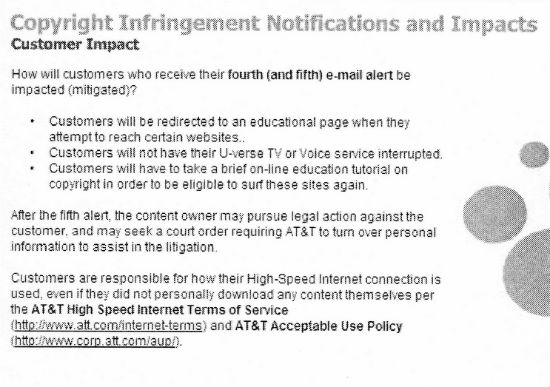
  • AT&T - "From leaked AT&T training documents we learned that the company will block users’ access to popular websites until they complete a copyright education course. However, none of the participating Internet providers have publicly commented on the measures they plan to take, until now
    Source - TorrentFreak- here


  • Verizon - Link Hoewing (pictured), VP Internet and Technology Issues, Verizon, said his company will employ a three stage process. The first two alerts will result in a simple notification email informing the users that their connection has been flagged for copyright infringements. After the second warning comes the acknowledgment phase in which a popup is delivered users. Once received subscribers are required to read and confirm, a process designed to ensure that they are aware of the unauthorized sharing that’s taking place via their account.If the infringements continue punishments become a reality on the fifth and the sixth alerts. Hoewing said that these repeated infringers will have their Internet connections throttled resulting in significantly slower download speeds. The throttling is temporary and will be lifted after two or three days.
     
  • TWC Fernando Laguarda (pictured), VP External Affairs, Time Warner Cable said "his company will take a slightly different approach. The notification and acknowledgment phases are fairly similar, but instead of reducing connection speeds they will restrict users’ Internet browsing by directing them to a landing page".


See "Verizon Will Reduce Speeds of Repeated BitTorrent Pirates" - here.

Saturday, September 1, 2012

[TorrentFreak]: Site Suspected of Copyright Infringement Disappeared

 
TorrentFreak reports that ".. Filesonic, previously listed among the top 10 largest file-sharing sites in the world, was badly affected by the Megaupload shutdown and lost huge amounts of traffic in 2012. During the last 48 hours it simply ceased to function .. Despite the efforts of Filesonic to stay out of the copyright infringement spotlight (in December 2011 the company had partnered with anti-piracy company Vobile), in February 2012 the International Intellectual Property Alliance reported Filesonic to the USTR. IIPA, who count the MPAA and RIAA as members, described Filesonic as an 'infringing distribution hub'".


"But today, six months on, it appears something is seriously amiss with this former giant of the file-sharing world. For two days Filesonic has been completely unreachable via its .com domain after changes were made to its DNS settings"

See "Major Cyberlocker Filesonic Goes Offline After Traffic Plummets" - here.

Tuesday, July 17, 2012

There is always another Way to Download

     
Peter Sunde, co-founder,
Pirate Bay
Mark Jackson report to ISPreview that "One of the country’s largest broadband ISPs has revealed that the recent censorship of The Pirate Bay website has had only a short-lived impact upon overall P2P file sharing traffic, with data volumes dipping 11% immediately after the ban before returning “pretty much back to where they were before“.

See "UK ISPs Ordered to Block Pirate Bay" (here) for background on the censorship, as well as what the UK regulator, Ofcom thinks of web blocking ("Ofcom: "All site blocking techniques can be circumvented" - [The Leaked Document]"- here).

It is not clear if users accessed Pirate Bay or other site/s to reach copyrighted material, or used P2P for other file transfers.

Mark explain that "In fairness it should be said that ISPs generally only keep a very vague record of overall network activity, which cannot identify precisely what type of files are being transferred over P2P networks (legal, unlawful or illegal content etc.). As a result it’s difficult to know what the real impact has been, although users of such content tend to switch over to a different site or simply work their way around the block itself. In any case overall P2P traffic, which was the primary focus of The Pirate Bay, appears not to have suffered".

See "Big UK ISP Claims the The Pirate Bay Block Had Little Impact on P2P Traffic" - here.

Tuesday, July 3, 2012

UK: "3 Strikes" Regulation Expected in 2014; Scam Emails Already Received


Ofcom warned UK consumers over email scams related to the non-existent copyright infringement regulation "Ofcom is aware of a current email scam which attempts to persuade the recipient to pay a fine, supposedly relating to copyright infringement under the Digital Economy Act" (here).
Last week Ofcom published a proposal for a plan similar to the one used in France (see "Large UK ISPs will Fight Copyright Infringements" - here) that will become effective, if accepted, in 2014. 
Mark Tyson reported to Hexus on the scam, showing the fake message "While fresh in the average Brit’s mind some ‘enterprising’ phishing email writers have been crafting a ‘legit’ looking letter, despite being partially written in pidgin or ‘Google Translate’ English (below). 
See "Fake Digital Economy Act fines being sent out via email" - here


Wednesday, June 27, 2012

Large UK ISPs will Fight Copyright Infringements


Being fashionably late (for a party that is almost over now - see "French Copyright Law - 165 Cases Reached Court; File Sharing Declines" - here), the UK regulator, Ofcom published a "draft code for consultation that would require large internet service providers (ISPs) to inform customers of allegations that their internet connection has been used to infringe copyright".

See also "UK Culture Minister Vaizey:"ISPs have their role to play to help consumers find legitimate content" - here and

"The code will initially cover ISPs with more than 400,000 broadband-enabled fixed lines – currently BT, Everything Everywhere, O2, Sky, TalkTalk Group and Virgin Media. Together these providers account for more than 93% of the retail broadband market in the UK. The draft code requires ISPs to send letters to customers, at least a month apart, informing them when their account is connected to reports of suspected online copyright infringement.

If a customer receives three letters or more within a 12-month period, anonymous information may be provided on request to copyright owners showing them which infringement reports are linked to that customer’s account. The copyright owner may then seek a court order requiring the ISP to reveal the identity of the customer, with a view to taking legal action for infringement under the Copyright Designs and Patent Act 1988".

What seems to be a long process will start now and "Ofcom currently expects the first customer notification letters to be sent in early 2014"

See "New measures to protect online copyright and inform consumers" - here.

Monday, May 21, 2012

US Anti-Piracy Delayed; ISPs will not Terminate Accounts;


Source: CCI
Just two months ago it was stated that the agreement ("voluntary MOU", July 2011) between US major ISPs and the MPAA and RIAA will start on July 2012 "Most of the participating ISPs (Comcast, Cablevision, Verizon, Time Warner Cable and other bandwidth providers) are on track to begin implementing the program by July 12" (here).
     
So volunteering work is not what it used to be.
  
TorrentFreak reports that "..it now appears that the much-discussed July start date will have to wait until later in the year as the parties involved may fail to meet the provisional deadline .. TorrentFreak asked the CCI (Center for Copyright Information) about the upcoming target date, and their response suggests that things may take longer than expected .. " We do not intend to launch until we are confident that the program is consumer friendly and able to be implemented in a manner consistent with all of the goals of the MOU. We expect our implementation to begin later this year", CCI told TorrentFreak. 
    
"The CCI, however, ensured TorrentFreak that none of the ISPs has plans to terminate the accounts of subscribers. Temporary disconnections remain as one of the possible punishments".
 
See "US “Six Strikes” Anti-Piracy Scheme Delayed" - here.

Wednesday, May 16, 2012

Pirate Pay Stops Illegal File Transfers - How?

 
Elena Shipilova reports to Russia Beyond the Headlines that "The creators of Pirate Pay, a Perm-based start-up, say they can stop files from being illegally downloaded from torrent networks .. the technology prevents file sharing in torrent networks".
   
Andrei Klimenko, founder and CEO of Pirate Pay describes the method they use: "In December 2011 the film “Vysotsky. Thanks to God I’m Alive” came out in movie theaters, and for a month after its opening, Pirate Pay protected the film on torrent networks .. We used a number of servers to make a connection to each and every p2p client that distributed this film. Then Pirate Pay sent specific traffic to confuse these clients about the real I.P. addresses of other clients and to make them disconnect from each other .. Not all the goals were reached. But nearly 50,000 users did not complete their downloads" (see more- here).
 
"This company’s successful defense of the film brought in its first big payday. Company officials will not discuss exact earnings, but said that projects will cost clients between approximately $12,000 and $50,000 depending on the resources needed to mount a defense".
 
A year ago Microsoft invested $100,000 in the compnay (see "Microsoft вручил грант первому стартапу, ставшему победителем конкурса Фонда посевного финансирования компании" - here).
 
See "Russian innovators pursue prototype to prevent piracy" - here.

Wednesday, May 2, 2012

UK ISPs Ordered to Block Pirate Bay


The BBC reports that "File-sharing site The Pirate Bay must be blocked by UK internet service providers, the High Court has ruled. The Swedish website hosts links to download mostly pirated free music and video. Sky, Everything Everywhere, TalkTalk, O2 and Virgin Media must all prevent their users from accessing the site".

Few months ago a similar order was issued in the matter of Newzbin2 (see "UK Court Orders BT to Block Newzbin2 in 14 Days, Using DPI" - here).

Like always, I should mention that the UK regulator, Ofcom, believes that "All site blocking techniques can be circumvented" (here).

See "The Pirate Bay must be blocked by UK ISPs, court rules" - here.

Tuesday, March 20, 2012

Indian ISPs need to Block Sites - Will they Use DPI?

 
Courts in several counties issued recently orders to ISPs to block access to certain sites to prevent copyright infringement (UKBelgiumFinland as well as the SOPA legislation in the US).

Jayesh Limaye (pictured) reports to techtree that ".. the Calcutta High Court has issued a diktat to all the ISPs in India to block 104 domains who have been found to distribute music illegally. In a verdict that will cause the Indian Music Industry (IMI) to rejoice, the court has ordered a ban on websites such as BollywoodMP4.com andFreeIndiSongs.com. The ISPs have been given 36 hours to comply, by either blocking domain \ IP addresses or by using Deep Packet Inspection to ban the offending URLs".

A list of ISPs in India is available here.

See "Indian ISPs Told To Block Music Sharing Sites" - here.