Showing posts with label Verizon. Show all posts

Thursday, December 10, 2015

Verizon to Test Sponsored Data (w/Allot?);"The capabilities we've built allow us to break down any byte"


Ina Fried, Senior Editor Mobile, reports to Re/code that "Verizon plans in the next few days to start testing so-called sponsored data, the equivalent of toll-free calling for the Internet age .. Verizon is working with just a few partners in the testing phase, but said next year this feature will be available to all comers at an affordable rate" 

Marni Walden [pictured], Executive VP and president of Product Innovation and New Businesses, Verizon said: "The capabilities we've built allow us to break down any byte that is carried across our network and have all or a portion of that sponsored .. We’ll be out in a larger commercial way in the first quarter of 2016".

A year ago I published an unconfirmed rumor that "Allot's DPI product SigmaE-14 was installed in 26 Verizon Wireless (VzW) sites for Passive Network Subscriber Analytics" (here). See also "Allot's US Tier1 MNO $9M Order: "not a classical DPI"" - here.

See also a guest post "1-800 Apps Concept: Superficially Appealing but Unworkable" - by Dean Bubley*, Founder, Disruptive Analysis - here.

See "Verizon to Start Testing ‘Toll-Free’ Data in Coming Days" - here.

Saturday, September 26, 2015

Here Comes the "Fast Lane" from Verizon (Over LTE & Fixed)


Here is how to offer "Fast Lanes" in the Net Neutrality era: call it a private network.

Matt Hamblen reports to Computerworld that "Verizon today introduced an LTE wireless traffic management service to give business and government customers the ability to prioritize critical network-based applications.

..Verizon said it is the first U.S.-based carrier to offer such a service, which it calls Private Network Traffic Management .. The service will work over both LTE wireless and wired communications and will segregate the priority communications from Verizon's public network 

Verizon will offer different service levels, including a "mission critical" class, that a customer could use for video or voice over IP traffic. In that scenario, a customer could decide to prioritize video communications above emails or even lower-priority communications in a machine-to-machine network.

.. Carlos Benavides, associate director of product management, Verizon predicted the biggest use of the private network will be to support Internet of Things buildouts .. there would be three levels of service: Enhanced, Premium and Public Safety" 


See "Some IoT functions would get higher priority than others in a crowded network" - here.

Wednesday, September 9, 2015

Verizon Uses Cisco to Offer SDN-Based, Application-Aware, Network Services


Verizon unveiled its "new software-defined WAN service using Cisco's Intelligent WAN (IWAN) technology that harnesses the power of the Internet with the performance and reliability of a private IP network, to help enterprises keep up with the continued growth of network traffic.

Through Cisco's software-defined WAN solution, Verizon is enabling a:
  • Better User Experience: Integrated application optimization for improved and faster application performance
     
  • Highly Secure Infrastructure and Applications: Robust, highly secure and certified routing platforms (ISRs and ASRs)
     
  • Low Operational Cost: Intelligent Path Control to fully utilize both MPLS and the Internet
     
  • IT Agility: Provision new sites and services faster with a hybrid WAN to support key business initiatives
Verizon and Cisco will both market and sell the managed solution to their respective enterprise customer bases in the U.S. beginning in September. The companies plan to roll out the solution in EMEA by the end of the year. The new solution will be supported by Verizon's IT consulting group which help enterprises manage their transition to SD-based networking". 


See "Verizon Becomes First Service Provider to Offer New Cisco Software-Defined Networking Technology" - here.

Tuesday, May 26, 2015

HP Acquires ConteXtream for [Estimated] Tens of Millions $


A post by Saar Gillai [pictured], SVP and General Manager, Communications Solutions Business, HP announces that "HP has signed a definitive agreement to acquire ConteXtream, a provider of OpenDaylight-based, carrier-grade SDN fabrics for NFV, and a current HP OpenNFV partner.

Headquartered in Mountain View, CA, ConteXtream offers solutions that allow service providers to create a more flexible and programmable network through an SDN/NFV model. ConteXtream’s open SDN controller platform complements HP’s NFV expertise and telecommunications and IT experience.


After the transaction closes, ConteXtream will become part of HP’s Communications Solutions Business. ConteXtream’s current CEO, Chairman, and co-founder Nachman Shelef will continue to lead the ConteXtream business within HP and will report to me".

  
ConteXtream was founded and is based in Israel. The local press estimates the acquisition price in the Tens of Millions of USD. Comcast and Verizon are among the investors, along a number of VCs. 

Related posts:
  • Orange Teams w/ConteXtream to Introduce NFV-Based Subscriber-Aware Services - here
  • ConteXtream Adds OpenDaylight-based, Carrier-Grade SDN Fabric for NFV - here 
  • Largest SDN Network Deployed by US Tier1 MNO w/ConteXtream (T-Mobile?) - here
  • Telenor Manages OTT Video Traffic With: ALU, Opera/SkyFire, ConteXtream and Velocix  - here
  • ConteXtream Secured $14M - Investors Include Comcast and Verizon - here

See "HP to acquire ConteXtream to accelerate NFV adoption" - here.

Friday, May 15, 2015

Verizon: Should a "Standard SDN" be Also Open?


A recent article by Carol Wilson, Editor-at-Large, Light Reading, quotes Chris Emmons [pictured]. Director, Network Planning, Corporate Network & Technology, Verizon from a presentation made at Light Reading Carrier SDN Networks - about "Having a standard version of SDN is "a prerequisite" to deployment because Verizon needs to be sure that whatever it deploys can interoperate not only with other pieces of its network but also future networks".

Verizon, with "its key technology partners" - Alcatel-Lucent, Cisco, Ericsson, Juniper Networks and Nokia Networks" announced recently its plan to transform its netwrok to SDN control (here).

Mr. Emmons agreed with Heavy Reading's analyst Sterling Perrin [pictured] that "there are almost too many different deployment options and evolving standards today for Carrier SDN. So while Verizon wants to move forward as quickly as possible with the strategy announced in April, there are still key issues to resolve .. Even if we can't get to commodity hardware, however, standards are important for interoperability and so we can present APIs so the network can be programmable". 

Indeed, Verizon announcement mentioned that "to enable its network vision, Verizon and its technology vendors have co-authored a comprehensive SDN network architecture document". However, the document is nowhere to be found on Verizon's site. When I contacted Verizon's media relations, The answer I got was "At this time the SDN network architecture document is not available to the public. It’s only available to those technology vendors we are working with on SDN".
    
See "Verizon: Telecom Needs to Solve SDN Problem" -here.

Friday, May 1, 2015

Verizon Transfers its Network to SDN Control


While we saw mixed feelings on SDN so far (see "[LightReading]: SDN/NFV Still Doesn’t Show Capex Savings for US MNOs" - here and ["Strategy Analytics]: "Operators are beginning to see the huge potential for SDN""- here), Verizon made a very strong statement with its "key technology partners" - Alcatel-Lucent, Cisco, Ericsson, Juniper Networks and Nokia Networks.

Verizon announced it is "transforming its network by implementing a software defined network architecture, laying the groundwork for new innovative services and applications. This SDN-based architecture is designed to introduce new operational efficiencies and allow for the enablement of rapid and flexible service delivery to Verizon’s customers.

.. To enable its network vision, Verizon and its technology vendors have co-authored a comprehensive SDN network architecture document, which includes all interface specifications and reference architectures plus requirements for both the control layer and forwarding box functions. This network architecture document will enable Verizon’s key technology partners to develop solutions to achieve the business and technical benefits of an SDN-enabled network.

Much of the foundational work required to deliver on Verizon’s next-generation network has been underway for several years. Verizon has created live lab environments in San Jose, California; Tampa, Florida; and Waltham, Massachusetts, and has commercial data center environments on both the East and West Coasts".


See "Verizon Announces Software Defined Networking Strategy" - here.

Tuesday, March 24, 2015

ISPs Sue FCC Against New Net Neutrality


Brendan Sasso [pictured] reports to the NationalJournal that "Telecom companies filed a pair of lawsuits Monday in an attempt to reverse the Federal Communications Commission's new net neutrality rules. The suits are expected to be the opening shots in a long legal war against the controversial regulations .. The suits claim the rules are outside the FCC's authority, violate administrative law, and infringe on the companies' constitutional rights:
  • USTelecom, which represents AT&T, Verizon, and other companies, filed its lawsuit [see below] in the U.S. Court of Appeals for the D.C. Circuit
    See also: "USTelecom Files Protective Petition for Review" - here - "USTelecom strongly supports open Internet rules, but disagrees with the Federal Communications Commission’s decision to reclassify broadband Internet providers as common carriers in the order adopted March 12".
     
  • Alamo Broadband, a small Texas-based wireless Internet provider, filed its suit in the U.S. appeals court based in New Orleans.


See "Internet Providers Sue to Kill Net Neutrality" - here.

Monday, February 2, 2015

Verizon: Customers May Opt-out from Header Insertion


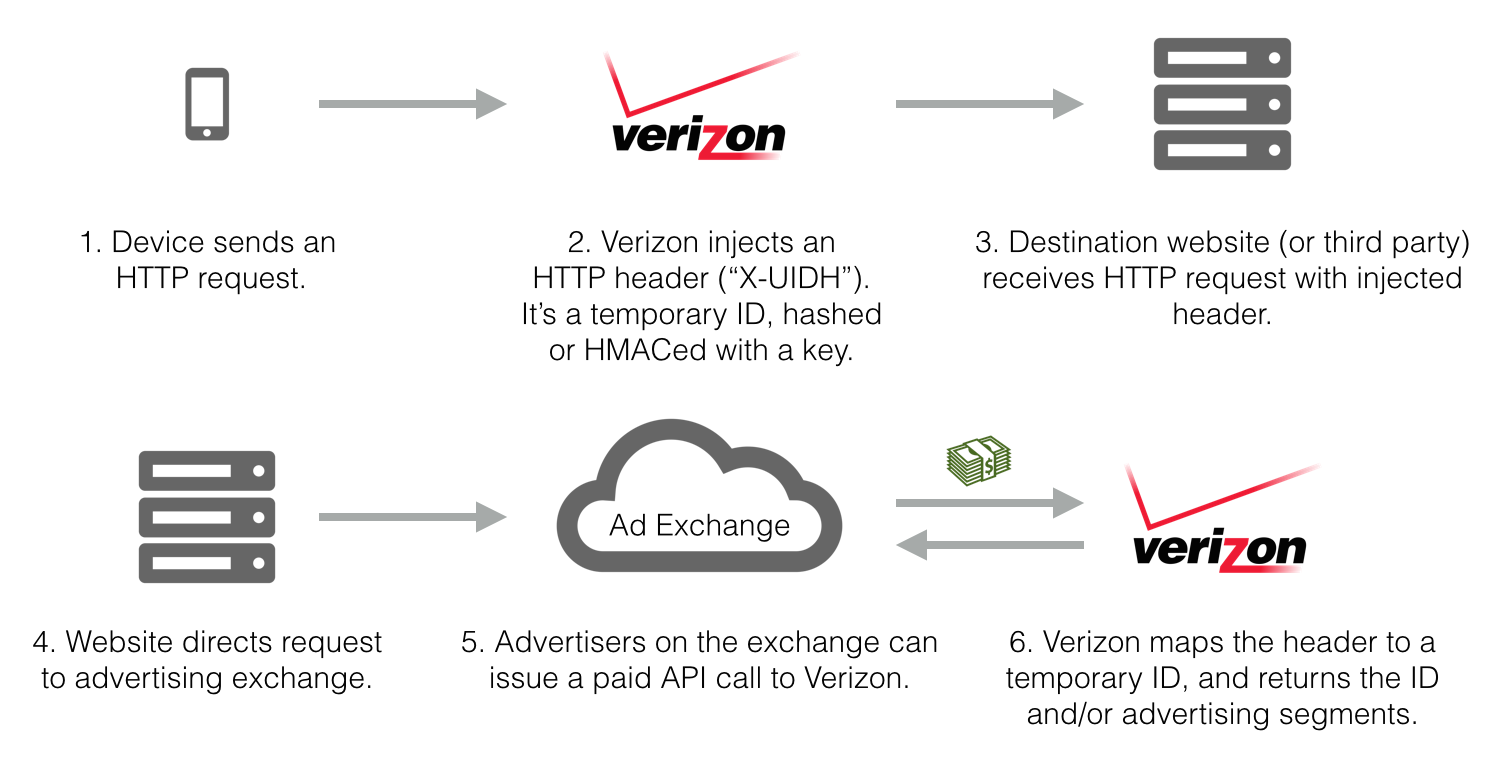
Back in October,  Jonathan Mayer,  a computer scientist and lawyer at Stanford, found how Verizon Wireless'  HTTP header insertion works (here, chart below), which naturally raised concerns about customers'  privacy.

In conjunction (?) with the Data Privacy Day (here), Brian X. Chen and Natasha Singer post to the New York Times blog states that "Verizon Wireless, which has been under fire by privacy advocates since late last year, has decided to make a major revision to its mobile ad-targeting program .. In a recent interview, Praveen Atreya, a Verizon director who helped develop the technology behind the mobile marketing program, said the company was considering allowing its subscribers to opt out of being tagged with its undeletable customer codes. On Friday, Verizon confirmed this decision.

Debi Lewis [pictured], a Verizon spokeswoman, issued this statement: 'Verizon takes customer privacy seriously and it is a central consideration as we develop new products and services. As the mobile advertising ecosystem evolves, and our advertising business grows, delivering solutions with best-in-class privacy protections remains our focus.

We listen to our customers and provide them the ability to opt out of our advertising programs. We have begun working to expand the opt-out to include the identifier referred to as the UIDH, and expect that to be available soon. As a reminder, Verizon never shares customer information with third parties as part of our advertising programs'".

See "Verizon Wireless to Allow Complete Opt Out of Mobile ‘Supercookies’" - here.

Friday, January 30, 2015

Verizon Adds Parental Controls to the Home Gateway


Verizon announced recently that "Our customers who have the FiOS Quantum Gateway router will now have access to a number of new parental controls and guest Wi-Fi capabilities. With this latest router update, parents can easily grant or restrict Internet access to any device on their home FiOS network. Additionally, parents are now able to set daily time limits on network-connected devices for management of screen-time.

And it’s free .. Manage children’s Internet usage on a per device basis so you can minimize binge TV watching! Establish parental control rules conveniently from the MyFiOS App, whether you’re home on the go Grant or limit Internet access for any connected device in your home which is perfect during final exam and PSAT preparation. Set daily or weekly time limits on any connected device in your home.


See "The Fastest Router Now Offers Easy Parental Controls and Guest Wi-Fi" - here.

Sunday, December 7, 2014

Allot @Verizon: 26 Locations


Recently I quoted an Infonetics Research survey, which states that "Respondents reported either buying or being likely to buy subscriber intelligence solutions from traditional analytics vendors, though nearly half indicated they were likely to buy from DPI (deep packet inspection) vendors". 

It seems that the survey's results are not just forward looking, but is already a reality, with one of the world's leading MNO.

A random review of one of Allot Communications former employee's profile in LinkedIn, shows that the engineer claims to be a member of the team servicing a Verizon Wireless subscriber analytics project:

 "Allot’s DPI product SigmaE-14 was installed in 26 Verizon Wireless (VzW) sites for Passive Network Subscriber Analytics. Performed software upgrades and solved issues reported by VzW. Involved in sizing of Allot products to VzW requirements in Southern CA sites. Team member to manage Allot’s Big Data Analytics (see "Allot Enhances Analytics w/Visibility, Granularity and Self-Service Approach" - herePOC to VzW".

Needless to say, this information should be treated as a rumor, as this former employee does not necessarily have accurate information about the project and its size. Allot itself has never identified Verizon as a customer, although rumors about the deal exist since early 2013 following former Allot's CEO, Rami Hadar, statement at 2013 Q1 earning call:

"The thing we will say is that U.S. Tier 1 mobile operator, the order is mainly around certain Value-Added Services, which, obviously, we will not go into detail. But it is around -- it's not a classical DPI at the moment"  (see "Allot's US Tier1 MNO $9M Order: 'not a classical DPI'"- here and the press release - here).

Verizon Customer's Agreement for its wireless service states, in the "My Privacy" section:

"We collect personal information about you. We gather some information through our relationship with you, such as information about the quantity, technical configuration, type, destination and amount of your use of our telecommunications services. You can find out how we use, share and protect the information we collect about you in the Verizon Privacy Policy, available at verizon.com/privacy"

The "Privacy Policy Summary" page states that "Verizon collects and uses information about our customers and website visitors when you interact with us, when you use our products and services, and when you visit our websites. This information is used to deliver, provide, and repair products or services; establish and maintain customer accounts and billing records; contact you about our products and services and direct offers or promotions to you; monitor website statistics; and manage and protect our networks. Information may also be aggregated or anonymized for business and marketing uses by us or by third parties. 

We may also obtain consumer information (such as demographic and interest data) from outside companies who provide such data. We use this data and combine it with other information we have to help us predict customer preferences and direct marketing offers".

Allot's Subscriber Analytics Reports

Sunday, October 26, 2014

Verizon Injects HTTP Header for Advertising


A post by Jonathan Mayer [pictured], a computer scientist and lawyer at Stanford analyzes the recent HTTP header insertion by Verizon (apparently used for behavioral advertising):

"After poring over Verizon’s related patents and marketing materials, here’s my rough understanding of how the header works [see chart below] .. In short, Verizon is packaging and selling subscriber information, acting as a data broker on real-time advertising exchanges. Questionable. By default, the information appears to consist of demographic and geographic segments.2 If a user has opted into “Verizon Selects,” then Verizon also shares behavioral profiles built by deep packet inspection". 

See more at "How Verizon’s Advertising Header Works" - here.

Tuesday, October 7, 2014

Verizon Wont Optimize LTE Congestion by Temporary Throttling


Back in July Verizon announced that it will ".. expand its existing Network Optimization to include unlimited data customers who use 4G LTE devices .. when an unlimited data customer meets specific criteria and hops onto a cell site that is experiencing high demand. This is only a temporary reduction, not a billing cycle throttle. Once that customer leaves the cell site under stress, their connection should return to normal" (see "Verizon Expands "Optimization" to LTE Subs to Fight Cell Congestion" - here).

Something has changed, and Verizon announced recently that "We’ve greatly valued the ongoing dialogue over the past several months concerning network optimization and have decided not to move forward with the planned implementation of network optimization for 4G LTE customers on unlimited plans. Exceptional network service will always be our priority and we remain committed to working closely with industry stakeholders to manage broadband issues so that American consumers get the world-class mobile service they expect and value"

Verizon "Network Optimization Practices for Customers with Unlimited Data Plans" (here) is yet to be updated. It explains the optimization practice ("To optimize our network, we manage data connection speeds for a small subset of customers – the top 5% of data users on unlimited data plans – and only in places and at times when the network is experiencing high demand") but excludes only some LTE customers ("Only a small percent of customers will be affected. To be affected, you must be a data customer on an unlimited data plan who is among the top 5% of data users. Network Optimization of 4G LTE devices does not apply to government customers or business customers who have signed a major account agreement").
 
See "Ensuring the Optimal Wireless Experience" - here.

Saturday, August 23, 2014

[ABI]: Mobile Internet Services to Generate 45% of MNOs Service Revenues by '19


A new report by Marina Lu [pictured], research analyst, ABI Research finds that "In 1Q 2014, the worldwide mobile service revenue increased 0.58% year-on-year (YoY) to US$264 billion .. the aggregate service revenue for 2014 will grow 2.9% YoY to US$1.01 trillion, mainly driven by the robust growth of the mobile Internet market. 

Proliferating mobile data subscriptions and enhanced network capacity will drive global mobile Internet service revenue to US$456.7 billion by 2019—44.7% of total mobile service revenue. Despite global service revenue growth, the Western European market is declining: 1Q 2014 service revenue declined 5.2% YoY".

"In ABI Research’s profitability analysis, Verizon Wireless beat China Mobile for the first time, carrying the top position for most profitable mobile carrier in aggregate for 1Q 2014, followed by China Mobile and AT&T respectively. Strong growth in retail postpaid subscribers, increased smartphone customer base, enhanced 4G LTE smartphone line-up, and attractive pricing plans have contributed to Verizon’s profitability. In addition, Verizon also moved up one position to second in the ranking for quarterly gross profit per subscriber, at US$77.1".

See "Mobile Internet Will Continue to Drive Mobile Revenues, Contributing to 31% of Global Service Revenue in 1Q 2014" - here.

Monday, August 11, 2014

FCC Expands Traffic Management Policies Questioning to all MNOs


Alina Selyukh and Marina Lopes report to Reuters that "The top U.S. communications regulator on Friday said he is asking all large U.S. wireless carriers to explain how they decide when to slow download speeds for some customers, after questioning Verizon Wireless about such a plan"

This follows the letter sent earlier to Verizon (See "The FCC "Deeply Troubled" by Verizon's LTE Optimization" - here) following the MNO's decision to expand its "optimization" policy to LTE and limit unlimited users in congested locations (see "Verizon Expands "Optimization" to LTE Subs to Fight Cell Congestion" - here).

Verizon's response to FCC worries was (here, by TheRegister) that it is the right thing to do and everybody does that (try to claim that in a trial):  "The Commission Has Recognized the Reasonableness of this Form of Network Management .. Such Practices Are Widely Used Throughout the Industry and Have Been Widely Accepted [we are] Managing our 4G LTE to Ensure the Best Wireless Experience [and] With network optimization, our customers continue to be free to go where they want on the Internet and to use the applications, services and devices of their choice"

So ... if everybody does it, need to ask them as well.

Back to Reuters report - "AT&T Inc representatives did not immediately comment. A Sprint Corp spokeswoman said her company "goes to great lengths to be transparent about its network management practices," and will respond to Wheeler's letter as appropriate. "Our network practices are consistent with the Commission’s rules on the open Internet, are innovative and are good for consumers and competition," a T-Mobile US spokeswoman said.
 
See "After Verizon, U.S. FCC quizzing other carriers on data management" - here.

Thursday, July 31, 2014

The FCC "Deeply Troubled" by Verizon's LTE Optimization


Few days after Verizon published its plan to optimize traffic at congested cells [see "Verizon Expands "Optimization" to LTE Subs to Fight Cell Congestion" - here], the FCC Chairman, Tom Wheeler, sent them a number of questions, expressing he is  "deeply troubled" by the move, and questioning if this should the right policy for "reasonable netwrok management*" or it is actually done to  "enhance revenue streams".

See also "Net Neutrality Approval Reopens US Market for DPI and Policy Management" - here

*Reasonable network management.  A network management practice is reasonable if it is appropriate and tailored to achieving a legitimate network management purpose, taking into account the particular network architecture and technology of the broadband Internet access service. Legitimate network management purposes include: ensuring network security and integrity, including by addressing traffic that is harmful to the network; addressing traffic that is unwanted by users (including by premise operators), such as by providing services or capabilities consistent with a user’s choices regarding parental controls or security capabilities; and by reducing or mitigating the effects of congestion on the network.

The letter uploaded by jbrodkin2000


Saturday, July 26, 2014

Verizon Expands "Optimization" to LTE Subs to Fight Cell Congestion


3 years after Verizon established its optimization policy to reduce cell congestion, [see "Verizon Explains its "Network Optimization" Policy" - here] it is now expanded to LTE.

Kellex reports to DroidLife that "On October 1, Verizon will expand its existing Network Optimization policy to include unlimited data customers who use 4G LTE devices and “have fulfilled their minimum contract term.” That “optimization” occurs when an unlimited data customer meets specific criteria and hops onto a cell site that is experiencing high demand. This is only a temporary reduction, not a billing cycle throttle. Once that customer leaves the cell site under stress, their connection should return to normal.

Update: The policy is changing somewhat on how long you could be throttled. From information we have received from sources (and now reflected on Verizon’s own policy), the throttling could last through a current billing cycle and on to the end of the next, should a user be on a cell site experiencing high demand. This is the exact wording for the potential throttling – “The customer may continue to be impacted for the rest of the current billing cycle and through the next billing cycle, but only while on a cell site that is experiencing high demand.


Verizon's Optimization Policy page (here) says that "95% of our data customers are not impacted. The top 5% with devices on unlimited data plans may experience managed data speeds when connected to a cell site experiencing high demand after reaching certain data-usage levels in a bill cycle. These high data users will feel the smallest possible impact and only experience reduced data speeds when necessary for us to optimize data network traffic in that area"

See "Starting October 1, Verizon Will Include Unlimited 4G LTE Customers in “Network Optimization”" - here.

Tuesday, July 15, 2014

Verizon vs. Netflix on Congestion - It is NOT Us!


So, who is responsible for a smooth video experience ? The ISP? the content provider? the transit network between the two?

According to Verizon, it is not them (at least in the case of Netflix streaming).

David Young report to the carrier's Public policy Blog:

Netflix ISP Ranking for Verizon FiOS, Feb-Jun 2014
"A few weeks ago, Verizon received an email from a customer in Los Angeles asking why he was not getting a good experience watching Netflix on his 75 Mbps FiOS connection.

He was understandably confused by some of the misleading public accounts that inaccurately suggest widespread congestion that could affect Netflix traffic on Verizon’s network [see "Netflix to Verizon: Nope, Your Congested Pipes Are Still Your Fault" - here]

.. our network operations team studied the network connection for this customer for the week preceding the date that he emailed us. They measured the utilization – or the percentage of total capacity used – at every link in the Verizon network – from the customer to the edge of our network, where we receive Netflix traffic .. there was no congestion anywhere within the Verizon network. There was, however, congestion at the interconnection link to the edge of our network (the border router) used by the transit providers chosen by Netflix to deliver video traffic to Verizon’s network .. For whatever reason (perhaps to cut costs and improve its profitability), Netflix did not make arrangements to deliver this massive amount of traffic through connections that can handle it"


See "Why is Netflix Buffering? Dispelling the Congestion Myth" - here.

Friday, June 27, 2014

Verizon Digital Media CDN (EdgeCast) Expands Globally


Verizon Digital Media Services announced that "Since its acquisition of EdgeCast Networks [see "Verizon Acquires EdgeCast; Will it Serve DT and TeliaSonera?" - here.. Verizon Digital Media Services has rapidly expanded the capacity of the Verizon EdgeCast CDN, adding more than 20 new points of presence, or POPs, in major cities around the world since January. These cities include Warsaw, Stockholm, Milan, Vienna, Melbourne, Helsinki, Kaohsiung, Batam, Jakarta and Sao Paulo. The company also expanded its presence with additional POPs in many cities already served, including London, Madrid, Paris and Amsterdam. These additions offer customers even greater connectivity and performance within these markets.


.. Each new POP is built securely on Verizon Digital Media Services’ latest generation of delivery servers, with pre-built dedicated space for rapid expansion. The POPs have multiple diverse connections into last-mile networks and are provisioned to support the full suite of Verizon EdgeCast services".

See "Verizon Digital Media Services Expands Global Content Delivery Network" - here.

Wednesday, May 14, 2014

Netflix - Speed to Comcast Customers Continue to Surge


Netflix published its ISP index for April (here) showing a significant improvement in Comcast speed. Since the two reached the peering agreement (end of February, here), the service to Comcast subscriber has improved by 83%! (blue line at the chart below).

The service to Verizon subscribers (DSL, Orange line and FIOS, Brown line) has also improved in April (see "In line with the New Net Neutrality: Netflix Adds Verizon to its Peers" - here). Let's wait for May results to see the effect of the peering agreement.


Wednesday, April 30, 2014

In line with the New Net Neutrality: Netflix Adds Verizon to its Peers


After Netflix signed its first agreement with Comcast (see "Comcast and Netflix - BFF ("no preferential network treatment")" - here) ad reported "Netflix Reports Slower Speeds for Verizon" (here) it was reported that they are also in talks with AT&T and Verizon (See "Netflix: First we take Comcast, then we take AT&T and Verizon; How Much it Costs?" - here).

Sam Gustin reports to the TIME that "Netflix has reached a paid-peering-interconnection agreement with Verizon, both companies confirmed to TIME on Monday"

As can be seen from Netflix ISP Index charts (for Verizon FIOS and Verizon DSL), service has been deteriorated in recent months, although some improvements is seen in March. As the "New Net Neutrality" allows to prioritize traffic (see "FCC: New Net Neutrality? Just be "Commercially Reasonable"" - here), there should not be any regulation problem with such arrangement.  


Joris Evers, Netflix spokesperson, told TIME: “We have reached an interconnect arrangement with Verizon that we hope will improve performance for our joint customers over the coming months".