Showing posts with label SK Telecom. Show all posts

Thursday, July 16, 2015

NI Deployments [360]: SK Telecom [Korea] Uses Accedian to Realize QoS Visibility


Accedian Networks announced the ".. deployment of its market leading performance monitoring solution across the SK Telecom mobile network — encompassing 12,000 locations across the six largest cities in South Korea, with plans to extend coverage to all sites serving over 28 million subscribers nationwide. 


SK Telecom operates a sophisticated multi-vendor network, ensuring each supports the RFC-5357 two way active measurement protocol (TWAMP), a vendor-independent, global performance monitoring standard. Accedian’s centralized monitoring solution acts as a uniform instrumentation layer, centralizing a real-time view of network performance throughout the network. Where access equipment lacks TWAMP standards support, SK Telecom installs Accedian’s Nano smart SFP modules to ensure ubiquitous network coverage from end-to-end.
 
With the Accedian solution, SK Telecom improves network performance by:
  • Ensuring service performance standards using key KPIs that can proactively mitigate risks to customer experience proactively
  • Detecting traffic bursts and optimizing their LTE network to reduce Quality of Service (QoS) impact
  • Locating bottlenecks for improved overall capacity
  • Identifying and correcting any network mis-configurations immediately
  • Optimizing fault failover to eliminate service downtime and improve network quality
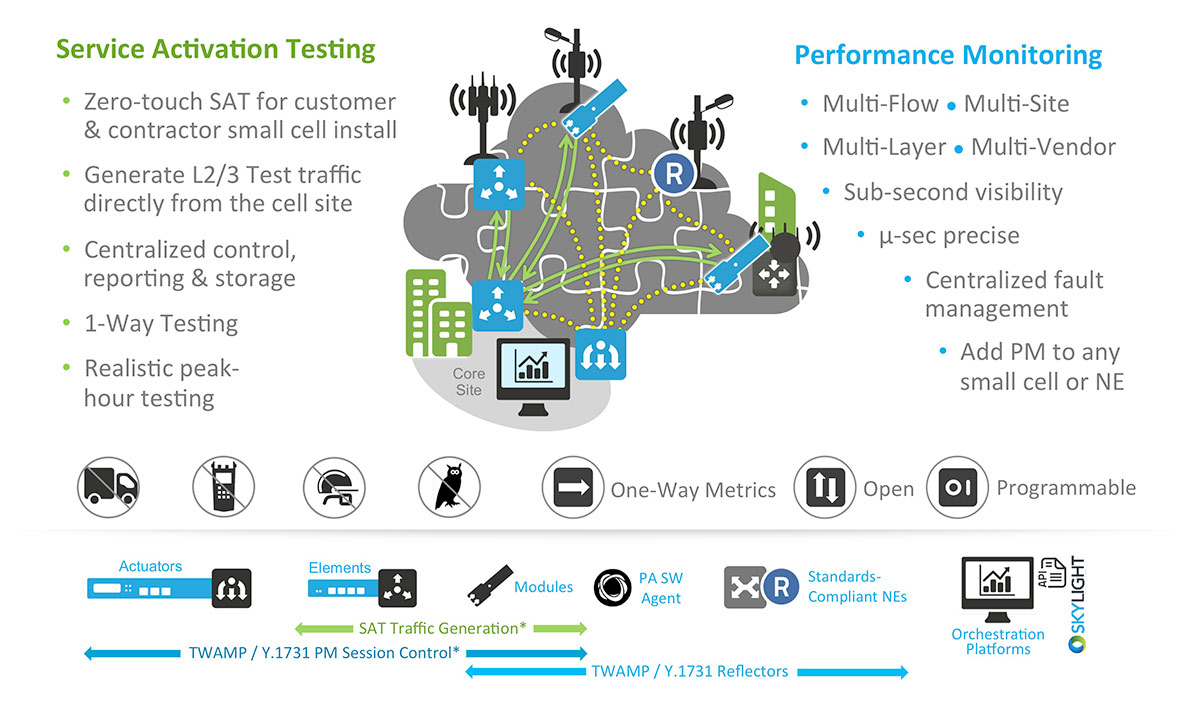


Having this real-time stream of Quality of Experience (QoE) metrics integrated with SK Telecom’s own performance assurance network management system (NMS) and SDN controllers allows them to optimize end-to-end user experience with performance trending and proactive fault management. Direct reporting to operational and business support systems (OSS/BSS) allows all regions in the SK Telecom network to monitor performance, 24/7". 


See "Accedian Monitoring Solution Applied to SK Telecom’s Network to Assure End-to-End Performance" - here.

Saturday, March 1, 2014

[ABI]: 2B LTE (750M on LTE-Advanced) Subscribers by 2019; Boosts ARPU

 
A new report by Marina Lu [pictured], research associate, ABI Research finds that "Worldwide LTE-related subscriptions reached 229.7 million in 2013, and will continually grow at a CAGR of 43.6% between 2013 and 2019, to exceed 2 billion. .. Among the LTE subscription growth, Asia-Pacific contributes the most with a 49% market share. The second greatest contributor is North America with an 18% share .. The large population base in Asia combined with rapid LTE network deployment and cost-competitive smartphones has accelerated the remarkable subscriber adoption.”

.. LTE-Advanced subscribers will grow to 750 million in 2019 accounting for 37.3% of overall LTE subscribers. North America will be the most aggressive LTE-Advanced market, followed by Asia-Pacific and Western Europe. Remarkably, the South Korean Operators, SK Telecom and LG U+, commercially launched LTE-Advanced networks in June 2013 and by the end of 2013, SK Telecom gained more than 1 million LTE-Advanced subscribers, which equates to 10% of all its LTE subscribers,” adds Jake Saunders, VP and practice director.

The growth of LTE subscribers has also boosted ARPU, because they are bigger spenders than their 3G and 2G counterparts by 35%". 


See "Global LTE Subscriptions to Exceed 2 Billion in 2019, Driven by LTE-Advanced" - here.

Monday, February 25, 2013

Rumors: NSN's Liquid Applications Uses Saguna's Technology

 
Nokia Siemens Networks announced the "Biggest transformation in the role of the base station since launch of GSM 22 years ago .. Rather than being just part of a commoditized data bit-pipe, Nokia Siemens Networks is turning the base station into a place where any type of content and data can not only be stored but also take advantage of knowing where and why people are using their smartphones and tablets. By placing useful information right at the edge of their networks, at the point where people connect, operators can deliver a far better service and increase the efficiency of their network .. The new innovation from Nokia Siemens Networks is called Liquid Applications.

Rumors are that NSN embedded Saguna's caching and optimization technology in the new product. This seems to be the 4th OEM Saguna's CEO mentioned earlier this month (see "Saguna CEO: "We have 4 New OEM licensees for our Mobile Caching Technology"; Going Live on Q2" - here) after the 3 partners I've covered so far: ADVAFibroLANand Ubiquisys.

Rumors are also that the integrated solution is already in trials by Vodafone and T-Mobile USA (NSN also announced that "SK Telecom, Nokia Siemens Networks collaborate on Liquid Applications" - here).

".. Liquid Broadband provides capabilities to intelligently deliver personalized services to subscribers. End-to-end QoS Differentiation enables operators to prioritize mobile broadband traffic and fine-tune services according to user profiles and applications. With the operator CDN, operators can allocate network resources whenever and wherever required to control the delivery of content right down to the user device. This ensures that the content is delivered with the right priority, in the right format and at the right time.

See "Nokia Siemens Networks revolutionizes the mobile base station" - here.

Friday, September 21, 2012

Security Deployments [180]: SK Telecom [S. Korea] Selected Arbor to Protect Service


Arbor Networks announced that "SK Telecom .. the largest mobile service provider in Korea, has selected Arbor’s Peakflow SP platform in order to maintain the performance and availability of their mobile network and services ..  Managing the rise in mobile data and signaling traffic due to the ever increasing usage of 3G and 4G devices such as smartphones and tablets and protecting their network from DDoS attacks and mobile application anomalies are just some of the many challenges SK Telecom faces on a daily basis".

See also "SK Telecom [Korea] Selected Fortinet for Security Services" - here.

".. SK Telecom has invested heavily into the access, backhaul and core of their mobile network. By leveraging IP flow data (i.e Netflow, sFlow etc.) embedded in network backbone and peering/transit edge routers, Peakflow SP enables SK Telecom to gain cost effective visibility into where their mobile network traffic is going to and coming from"

SK Telecom has more than 26 million subscribers.

SK Telecom: Subscribers and Market Share, Q2 2012


See "South Korea’s Largest Mobile Operator, SK Telecom,Selects Arbor Networks’ Peakflow® SP Platform for Mobile Infrastructure & Service Protection" - here.

Tuesday, September 11, 2012

[ABI]:VoLTE will Help MNOs Fight OTT Voice and Messaging


A new report by Marina Lu, research associate and Jake Saunders (pictured), vice-president for forecasting, ABI Research concludes that "​Mobile operators are increasingly coming under pressure to improve mobile telecom service profit margins as well as bring in new services to counter the competition from Over the Top (OTT) services such as Skype, Viber, Whatsapp, and FaceTime [see "AT&T will Block Facetime/3G to non Shared Data Plan Customers" - here]".

"In 2Q 2012, minutes of use showed the greatest declines compared to 2011 in Asia-Pacific (-7.36%), Africa (-6.3%), Western Europe (-2.32%), and North America (-2.12%) .. “Messages Sent” is keeping stable in Q2 2012 compared to last quarter .. mobile data traffic continues its rapid increase with 13.4 Exabytes to be consumed through 2012".
"Mobile operators have had limited options with 3G but 4G LTE should give the mobile operators some new tools .. LTE does not just transform the delivery of broadband data, it also can enrich voice services. SK Telecom, Korea’s largest operator, launched out the world’s first VoLTE services on 8 August, 2012. More recently, LG U+ in South Korea and MetroPCS Communications in the US [see "MetroPCS will Use Amdocs for VoLTE QoS" - here] have also introduced Voice over LTE".
For voice communications, VoLTE enables rich media content to be overlaid over voice, while the packetized delivery of the voice data allows for greater cost of service savings”.
See "Carriers Relying on Voice over LTE Services to Improve Margins as Traditional Minutes of Use Decline" - here.

Thursday, July 5, 2012

Korea's Net No-Neutrality: MNOs may Surcharge for OTT VoIP and Messaging


KaKao Talks
When KPN tried to do it, Netherlands become the first European county with Net Neutrality legislation (here). However, it is a different play for the South Korean mobile operators - SK Telecom, KT and LG U+.

First there were some complaints against SK Telecom and KT about blocking VoIP over mobile (here);  Then KT CEO said that "OTT Providers should Pay or will see a big data blackout" (here). Last month SK Telecom's Head of SKT’s Technology Strategy Office said that "Korean mobile carriers are experiencing difficulties, including decreased SMS revenues and increased network investment cost to accommodate surging traffic, caused by the popularity of various free messaging services ..KaKao Talk, a mobile messaging service used by 37 million Koreans (46 million subscribers globally as of May 2012), is fast becoming a threat to mobile operators as it has recently launched a mVOIP service".

And the result of the campaign?

Yewon Kang reports to IT World that ".. the Korea Communications Commission said last week that it will let three local mobile operators, SK Telecom, KT and LG U+, charge users extra fees for VOIP applications or block their use entirely .. SK Telecom and KT currently offer unlimited data plans, which allow users to freely download apps on their networks, whereas LG U+ used to block over-the-top programs entirely .. The companies have not yet released specific information on their new rates .. Unofficially, the KCC has already permitted telecoms to enact policies of their choice regarding third-party apps, experts say".

See "South Korean telcos get OK to charge extra for mobile VOIP apps" - here.

Thursday, June 21, 2012

SK Telecom Fights OTT Services and Signaling Load


SK Telecom continues its fight against OTT. After trying to protect their voice and messaging revenues by blocking access to competitive internet based services (see "Complaint against SK Telecom & KT for Blocking VoIP over 3G (Using DPI)" - here), the MNO is now launching its own services.

Mobile World l!ve reprots from GSMA MOBILE ASIA EXPO 2012 that "South Korea’s largest mobile operator SK Telecom (SKT) is fighting back against a number of Over-The-Top (OTT) players that have become hugely popular in the country in recent years, promising the imminent launch of an RCS-based service and further deployment of its Smart Push technology"

Dr. Choi Jin-Sung (pictured), SVP and Head of SKT’s Technology Strategy Office, told Mobile Asia Daily: “Korean mobile carriers are experiencing difficulties, including decreased SMS revenues and increased network investment cost to accommodate surging traffic, caused by the popularity of various free messaging services .. KaKao Talk, a mobile messaging service used by 37 million Koreans (46 million subscribers globally as of May 2012), is fast becoming a threat to mobile operators as it has recently launched a mVOIP service. And these OTT service providers are expected to evolve into a UC (Unified Communication) platform after securing subscribers based on their messaging services

About the notorious signaling/keep-alive problem:

"At the same time, the company is applying Smart Push, its home-grown technology that enables integrated management of keep-alive signals, to prevent network overload .. Here, the opening up of the Smart Push technology is an exemplary case where all stakeholders including mobile carriers, OTT service providers and customers gain benefits .. SK Telecom has also entered into MOUs with Samsung Electronics and NSN to promote overseas exports of Smart Push-embedded network equipment


See "SK Telecom fights OTT rivals" - here.

Sunday, February 12, 2012

Ovum: "Experience is showing that the move to LTE without flat rates can be achieved with positive results"

 
Nicole McCormick (pictured), senior analyst, Telco strategy, Ovum says that ".. There is now solid evidence that leading operators in Asia-Pacific, the US, and Sweden now accept this. These operators are devising new ways to transition to LTE without continuing to offer burdensome unlimited tariffs". 

"Experience is showing that the move to LTE without flat rates can be achieved with positive results .. this has been the approach taken by SK Telecom [hereand LG U+ in South Korea, Singapore Telecom [herein Singapore, and AT&T Wireless [here, here, herehere, here, here, ],  in the US .. In Asia-Pacific, Hong Kong mobile operator CSL [here] recently adopted a new LTE tariff strategy centered on volume-based pricing, which has proven popular with customers. US mobile operator Verizon Wireless [here, here, here] also phased out unlimited data tariffs for LTE in July 2011, and this has not adversely affected its LTE uptake"

(follow the embedded links to previous relevant posts, such as the PCRF vendor these MNOs are using).

See "Mobile operators begin to abandon unlimited data" - here.

Thursday, December 29, 2011

PCRF Deployments [112]: SK Telecom [Korea] Signs a $1.7M Deal with ntels for LTE

   
My daily search came up today with a message in Korean, for which I could not find any English source, and had to trust the Google translator.

According to the translation, ntels, closed a PCRF (probably this product) contract with SK Telecom, for 1.95B Won ($1.69M).

The report to the Korean stock market (here) explains (to my best understanding)" This Agreement is for the 4G mobile networks (LTE) wireless policy traffic management, to provide a system for efficient QoS control function"  

See (and correct me if I am wrong) "엔텔스, SKT와 19.5억 규모 공급계약" - here.

See also "Complaint against SK Telecom & KT for Blocking VoIP over 3G (Using DPI)" - here.

Friday, November 25, 2011

Complaint against SK Telecom & KT for Blocking VoIP over 3G (Using DPI)

      
We have seen this before (China, KPN, MetroPCS, TeliaSonera) - and here is another example of how mobile operators are trying either to protect their voice revenues or increase ARPU from what they consider as a "premium service" (see also yesterday’s post on Application based Charging - here).

My People
Yoon Ja-young reports to The Korea Times that "Telecommunications companies here have been preventing mobile Voice over Internet Protocol (mVoIP) .. which eat into their profits and weigh on the network ..The Citizens’ Coalition for Economic Justice (CCEJ) and Jinbo Network, the country’s leading NGOs, filed a complaint against SK Telecom and KT, the two biggest industry players, with the Fair Trade Commission and Korea Communications Commiss .. They also submitted a petition to the National Human Rights Commission seeking restrictions on deep packet inspection (DPI), technology which enables monitoring the communication of users" (see "Is it Possible to Block Skype with DPI ?" - here and "The Challenges of Maintaining a Current DPI "Signatures File" - here)
"Mobile Internet phone services, such as “My People” operated by Daum and “Skype,” send voice through the data networks of mobile carriers. Smartphone users welcomed these services as they can make free phone calls. Instead of levying charges on consumers, mVoIP firms consider advertisements as their income source. SK Telecom and KT however, have banned such services in their customer contracts, except for those who subscribe to the premium data packages costing 54,000 won ($46) or more a month"

An SK Telecom representative said that ".. few countries which fully allowed mVoIP, such as the United States and the Netherlands [here], saw a raise in mobile rates ..  it is impossible to intercept communications with DPI technology. “It only analyzes the type of packets that pass the network. There is no way to analyze the content included in the packet. It is unrelated with private information or privacy
   
See "Carriers under fire for banning free Internet telephone services" - here.

Friday, August 19, 2011

VAS Deployments (87): SK Telecom [Korea] Selected Fortinet for Security Services

    
Fortinet announced that "SK Telecom, the leading telecommunications provider in Korea, has chosen Fortinet's FortiGate®-3950B high-end network security appliance to help protect its 24-million subscribers using its 3G and 4G LTE services against increasing malicious attacks .. SK Telecom has purchased FortiGate-3950B appliances for carrier-grade NAT service and for 10G firewall protection of its content server farm. With this implementation, the telco provider will be able to apply up to 10 million concurrent session firewall performance, SSL & IPSEC VPN, NAT/PAT, ALG-SIP, DPI (Deep Packet Inspection), and QoS features over its service at no additional cost. Moreover, SK Telecom will be able to offer greater stability in its services by preventing service delays caused by traffic overload and ensure high availability".  

See "SK Telecom Chooses Fortinet to Enable Broad, High Performance Security Protection to its Subscribers" - here.