Showing posts with label behavioral advertising. Show all posts

Thursday, August 27, 2015

AT&T Uses RaGaPa for Wi-Fi Ad Insertion


Last October I shared a post by Jonathan Mayer [pictured], a computer scientist and lawyer at Stanford, who discovered that " Verizon Injects HTTP Header for Advertising" (here). His discovery made Verizon  to announce that "Customers May Opt-out from Header Insertion" (here).

Now it is AT&T turn.

Jonathan reports that "While traveling through Dulles Airport last week, I noticed an Internet oddity. The nearby AT&T hotspot was fairly fast—that was a pleasant surprise. But the web had sprouted ads. Lots of them, in places they didn’t belong .. I started poking through web source. It took little time to spot the culprit: AT&T’s wifi hotspot was tampering with HTTP traffic.

The ad injection platform appears to be a service from RaGaPa 
[HotSpot Monetization], a small startup. Their video pitch [see below] features “MONETIZE YOUR NETWORK” over cascading dollar signs. (Seriously.)


Ad Inserted into a federal government site. Source: Web Policy

When an HTML page loads over HTTP, the hotspot makes three edits ... " 


See "AT&T Hotspots: Now with Advertising Injection" - here.

Monday, February 2, 2015

Verizon: Customers May Opt-out from Header Insertion


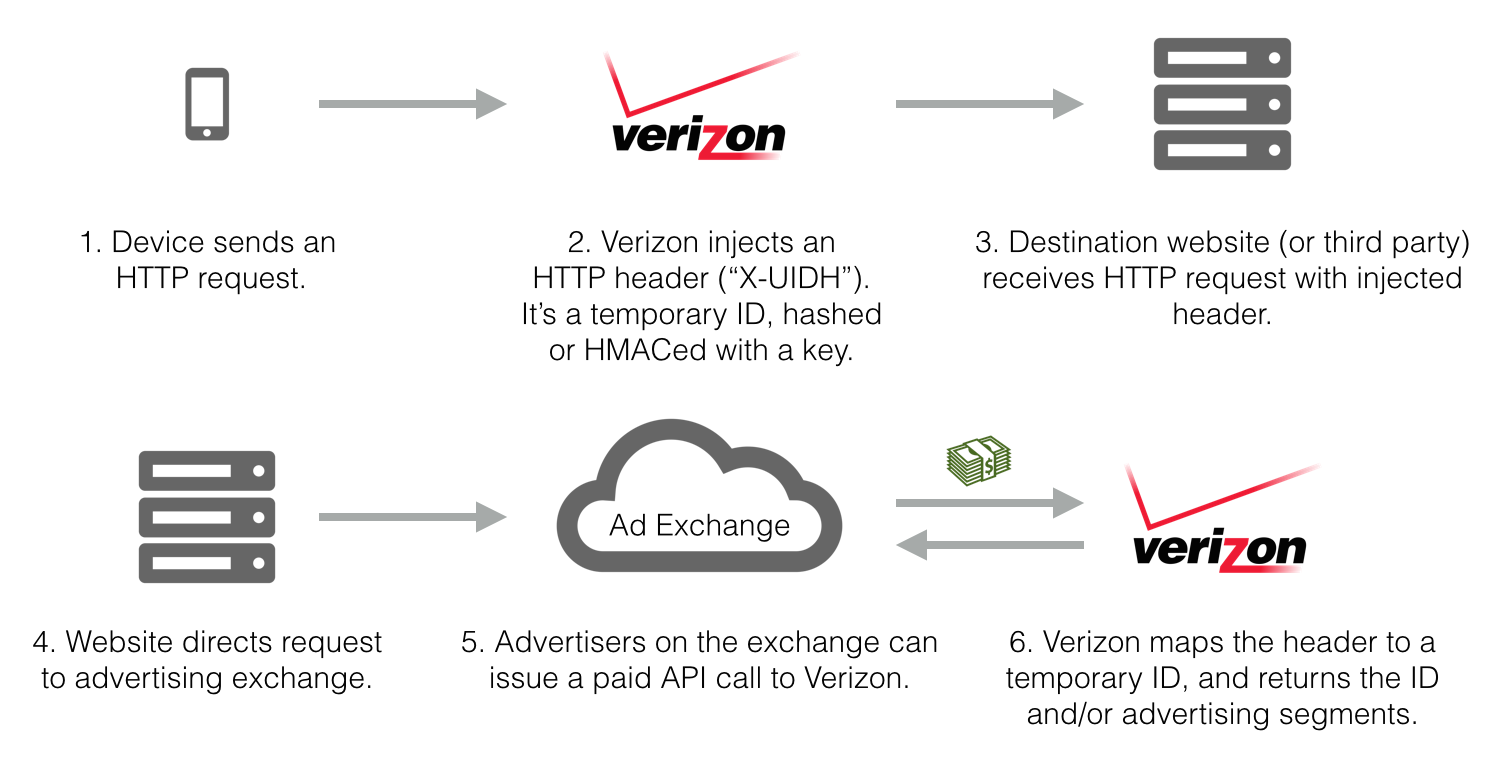
Back in October,  Jonathan Mayer,  a computer scientist and lawyer at Stanford, found how Verizon Wireless'  HTTP header insertion works (here, chart below), which naturally raised concerns about customers'  privacy.

In conjunction (?) with the Data Privacy Day (here), Brian X. Chen and Natasha Singer post to the New York Times blog states that "Verizon Wireless, which has been under fire by privacy advocates since late last year, has decided to make a major revision to its mobile ad-targeting program .. In a recent interview, Praveen Atreya, a Verizon director who helped develop the technology behind the mobile marketing program, said the company was considering allowing its subscribers to opt out of being tagged with its undeletable customer codes. On Friday, Verizon confirmed this decision.

Debi Lewis [pictured], a Verizon spokeswoman, issued this statement: 'Verizon takes customer privacy seriously and it is a central consideration as we develop new products and services. As the mobile advertising ecosystem evolves, and our advertising business grows, delivering solutions with best-in-class privacy protections remains our focus.

We listen to our customers and provide them the ability to opt out of our advertising programs. We have begun working to expand the opt-out to include the identifier referred to as the UIDH, and expect that to be available soon. As a reminder, Verizon never shares customer information with third parties as part of our advertising programs'".

See "Verizon Wireless to Allow Complete Opt Out of Mobile ‘Supercookies’" - here.

Sunday, October 26, 2014

Verizon Injects HTTP Header for Advertising


A post by Jonathan Mayer [pictured], a computer scientist and lawyer at Stanford analyzes the recent HTTP header insertion by Verizon (apparently used for behavioral advertising):

"After poring over Verizon’s related patents and marketing materials, here’s my rough understanding of how the header works [see chart below] .. In short, Verizon is packaging and selling subscriber information, acting as a data broker on real-time advertising exchanges. Questionable. By default, the information appears to consist of demographic and geographic segments.2 If a user has opted into “Verizon Selects,” then Verizon also shares behavioral profiles built by deep packet inspection". 

See more at "How Verizon’s Advertising Header Works" - here.

Monday, January 27, 2014

AT&T: 30% Discount on Gig, for Being DPI'ed


AT&T announced that ".. Austinites have a need for speed and data consumption, and that is helping drive stronger than expected demand for the fastest consumer broadband service delivered over the new AT&T network – AT&T U-verse® with GigaPower. AT&T plans to expand the all-fiber network to reach twice as many Austin area households in 2014" (here).

The GigaPower service in Austin was announced in December with the following plans:
  • Premier**: Internet speeds up to 300 Mbps – download an HD movie in less than two minutes² – for $70 per month, includes waiver of equipment, installation and activation fees. Customers who also select U-verse TV will receive free HBO, HBO GO for 36 months, and HD service for $120 per month with qualifying TV services.

    **U-verse with GigaPower Premier offer is available with your agreement to participate in AT&T Internet Preferences. AT&T may use your Web browsing information, like the search terms you enter and the Web pages you visit, to provide you relevant offers and ads tailored to your interests.

    "We've established electronic and administrative safeguards designed to help make the information we collect secure"
     
  • Standard: Internet speeds up to 300 mbps – download your favorite TV show in less than nine seconds² – for $99 per month.

Sunday, October 27, 2013

Bell Canada will Use Network Usage Information for "select purposes"


Bell Canada is going to use its customers (starting with mobile subscribers) data usage information for a number of purposes, including the controversial behavioral advertising. The way it is done (with opt-out option only, see below) brings back past incidents in the UK (Phorm) and US (Nebuad) - all  ended up with lawsuits (see "Paper: The Use of DPI for Behavioral Advertising (Case Study: Nebuad and Phorm)" - here).

In addition, Bell say it may share information that identifies customers personally with its affiliates (a very wide defenition, usually). 

Bell's web page "How does Bell respect my privacy?" (here) explains that "Your privacy is an important priority at Bell, and so is providing an experience that best meets your needs .. Today we want to tell you about some important updates relating to new uses of information".

"Starting on November 16, 2013, Bell will begin using certain information about your account and network usage for select purposes, such as continuing to improve network performance and product offers through new business and marketing reports, making some of the ads and marketing partner offers you see more relevant to you, and providing increased levels of fraud detection and prevention. We will not share any information that identifies you personally outside of Bell Canada and its affiliates.

Initially, this applies only to Bell Mobility customers but we look forward to expanding it to tv and internet customers in the future. Remember, no customer is required to participate. If you don't want your data used for relevant advertising, we won't use it.

Network usage information, such as:
  • Web pages visited from your mobile device or your Internet access at home. This may include search terms that have been used.
  • Location
  • App and device feature usage
  • TV viewing
  • Calling patterns
If you do not want us to use your information for any of the purposes described above, you can opt out.

Monday, June 24, 2013

[Guest post]:Video adverts – glass half empty or half full for mobile operators?

By Chris Koopmans*, VP and GM, Service Provider Platforms, Citrix

As radio access technologies have evolved and downlink speeds have increased, we’ve seen video content taking up a larger proportion of the total data traffic on mobile networks. Specifically, as RANs have moved through 2G to EDGE, UMTS and into HSPA, the combination of faster networks, cheaper data, smarter devices and better QoS for video means that video as a percentage of traffic has risen from 30 percent to over 50 percent.
 
In the five years since the iPhone first launched and kick-started a smartphone revolution, video has become a much bigger portion of traffic on mobile networks. Unfortunately for mobile operators, the proportion of revenue that video brings in has not grown at the same rate as the traffic. As we move into LTE and towards LTE-Advanced we’re going to see the share of video continue to grow.
 
We may not need to wait long for video traffic to accelerate its growth. Facebook looks set to begin moving forward with video adverts, a step that may be setting off alarm bells at networks operators around the world – or at least wherever Facebook has a presence. In the Citrix Bytemobile Q2 2013 Mobile Analytics Report we found mobile Facebook usage has grown five-fold in a year, with the level of traffic Facebook generates growing from one to five percent of overall data traffic. That includes very little video. So, what happens when we add video adverts to Facebook? 
 
In the same Mobile Analytics Report, we indicate that a single mobile YouTube session contributes the equivalent of ten mobile Facebook sessions -- that’s the power of video. When Facebook rolls out video adverts, there will be an unavoidable bump in data traffic associated with Facebook. When video adverts are added to all of the other online services, that new traffic could start to have a seriously detrimental impact on the quality of service subscribers enjoy.


Of course, even in the absence of video adverts, operators have had to manage the growth of data on their networks – or risk financial implosion. The tools used range from relatively blunt instruments such as throttling and lossy compression to more nuanced approaches such as adaptive traffic management, the latter employed in the service of ensuring the best possible subscriber QoE within the constraints of the network. More recently, operators have begun to consider QoE as part and parcel of a differentiated services plan in which the subscriber experience – including access to particular content – is tied directly to willingness to pay. The question at hand is: which of the above approaches – or other approaches -- are most relevant in the context of video adverts?
 
There are a few things to consider. First, these adverts will be pushed over the network over and over again, making the excess traffic challenge that much worse. Second, at approximately 2MB each, these adverts, if seen many times per day and month, can serve to consume a significant portion of the subscriber’s quota. Finally, the effectiveness of the advert and the likelihood of having a subscriber click through will be related to the video experience, for example the amount of time it takes for the advert to load.
 
Given these considerations, it’s clear that some degree of data optimization is required in order to reduce the overall transport costs and, perhaps more importantly, to minimize the hit to subscriber quotas. Adverts can be easily cached and highly compressed, so the blunt instrument approach could certainly be justified. After all, the operator isn’t making any extra money from these adverts. But they could be.
 
If ever there were an opportunity to pursue a two-sided business model – one in which the operator collects revenue not just from subscribers but from content providers as well – this is it. Both Facebook and its advertisers have a financial incentive to generate as many click-throughs as possible. Meanwhile, the operator -- in partnership with an optimization vendor -- has the tools at its disposal to affect this click-through rate while better serving the interests of its subscribers. 
 
At the most basic level, an improved user experience enabled by optimization would better ensure the timely delivery of the advertisement. Taken a step further, the operator could use its understanding of real-time user experience to only send adverts when the subscriber is likely to have a good experience. Who’s benefitting here? Facebook (or equivalent). The basis for an agreement between the operator and the social networking site is thus established.
 
And it doesn’t need to end there for either party. The operator has the option of zero-rating the traffic associated with these video adverts, so as not to unfairly consume the subscriber’s data quota. The presence of a business arrangement between the two makes doing so even more palatable. Perhaps of most interest (and most controversy) is the idea of sharing certain elements of the subscriber profile – elements inaccessible to Facebook or the advertiser – thus enabling the more effective targeting of adverts. This, of course, is exactly what all parties want.
 
What looks at first like a network burden that must be ignominiously accommodated like so many others is in fact an opportunity for operators to establish partnerships with the content providers, for whom an enhanced subscriber experience translates to revenue.


________

*Chris Koopmans joined Citrix as vice president, Service Provider Platforms, with the acquisition of Bytemobile in 2012. He is responsible for product development, management and marketing for the Service Provider Platforms group, as well as the Citrix business strategy for telecommunications service providers. Koopmans was a founding engineer at Bytemobile in 2000 and rose to the position of chief operating officer, responsible for all aspects of product development, management, marketing, delivery, and support, as well as information technology (IT). He has over 14 years of industry experience in hardware and software engineering and architecture.

Friday, June 21, 2013

Monday's Guest Post: Video Ads Monetization


A new guest post will be published on Monday. In his article, "Video adverts – glass half empty or half full for mobile operators?" my 27th guest, Chris Koopmans, will discuss video ads - The impact that streamed video ads will have on the mobile networks and on users’ quality of experience, how operators can understand subscriber behavior and act on it to lessen the deleterious impact of high levels of video traffic and use this understanding to monetize customer experience.

"We may not need to wait long for video traffic to accelerate its growth. Facebook looks set to begin moving forward with video adverts, a step that may be setting off alarm bells at networks operators" says Chris.

Stay tuned!

    Thursday, April 18, 2013

    Sandvine and Openwave Offer Joint VAS Steering Solution


    Openwave Mobility announced a joint solution with Sandvine to
    "enable mobile operators, to deliver advanced monetization capabilities by empowering them to rapidly introduce new Layer 7 services including targeted video optimization, innovative pricing models, and subscriber self-care"

    This follows a previous announcement by Sandvine of similar solutions with other partners: "Sandvine: 40 Joint Deployments with PeerApp, Mobixell and Netsweeper" - here.

    "Sandvine’s Policy Traffic Switch .. combined with Openwave Mobility’s Integra4 .. offers operators a solution whereby data traffic can be classified at line-rate and appropriate Layer 7 application traffic can be steered to Integra4 to apply services. These services can include video optimization, parental controls or even dynamic content insertion for engaging users with inline promotions. These promotions typically include new Application-based Price Plans which are easy for subscribers to adopt and are known to lead to significant incremental ARPU increase .. the Sandvine-Openwave Mobility solution has been successfully trialed with live traffic by a North American operator".

    See "Openwave Mobility and Sandvine Collaborate to Empower Operators to Pursue Large-Scale Monetization Opportunities" - here.

    Tuesday, January 8, 2013

    Embarq Cleared by US court in Relations to NebuAd Ad Insertion


    A recent decision by the United States Court of Appeals in a case against Embarq (now CenturyLink), in relations to the use of NebuAd for behavioral advertising clears Embarq, the ISP (background - here, here).

    Judge Harris L Hartz concludes: "The alleged interceptions occurred when Embarq authorized NebuAd, Inc., an online advertising company, to conduct a technology test for directing online advertising to the users most likely to be interested in the ads.  Exercising jurisdiction under 28 U.S.C. § 1291, we affirm the district court’s judgment.  Although NebuAd acquired various information about Embarq users during the course of the technology test, Embarq cannot be liable as an aider and abettor.  And it was undisputed that Embarq’s access to that information was no different from its access to any other data flowing over its network.  Because this access was only in the ordinary course of providing Internet services as an ISP, this access did not constitute an interception within the meaning of the statute".

    See here, and below.

    Wednesday, December 19, 2012

    Kindsight Adds VAS Opportunities for MNOs; Switches from Advertising to Freemium Business Model


    Kindsight released ".. new features for Kindsight Mobile Security to expand the protection mobile operators can offer their subscribers. Mobile operators can now alert users of suspicious apps that would be missed by device-only security apps, block infected devices from communicating with attackers’ command-and-control (C&C) servers, and help the subscriber locate missing phones and remotely lock or wipe data from stolen phones".

    Kindsight used to present the business opportunity for operators as a paid Value-added Service or free service with advertising (here). This seems to have changed, and the current model is the freemium concept:

    "..Mobile operators can deploy the white-labeled Kindsight Mobile Security solution to launch new value-added services to their subscribers under their own brand. These services can be offered for a monthly fee to generate new revenue or by using a freemium model where some functionality is offered for free and the subscriber can upgrade to the premium features for a fee. Since mobile operators are the only providers who can combine network-based and device-based security, by working with Kindsight they can offer a strongly differentiated offering to their subscribers as compared to off-the-shelf, device-only mobile security solutions".


    See "Kindsight Expands Mobile Security Protection" - here.

    Tuesday, October 9, 2012

    Telefonica to Monetize on its Mobile Analytics Data


    Telefonica Digital announced  ".. the establishment of Telefónica Dynamic Insights, a new global business unit, dedicated to identifying and unlocking the potential opportunities for creating value from ‘big data' .. The first product, ‘Smart Steps’, will use fully anonymised and aggregated mobile network data to enable companies and public sector organisations to measure, compare, and understand what factors influence the number of people visiting a location at any time" 

    "To expand its capability and extend its market reach, Telefónica has also entered into a global strategic partnership with GfK .. in addition to retail footfall measurement, Telefónica Dynamic Insights is also developing analytics products to help companies in a wide range of different industries. Initial product focus areas include fraud protection, and ‘Smart City’ technology, including traffic management"

    Telefonica uses Sandvine's DPI solutions (here).

    See "Telefónica launches Telefónica Dynamic Insights - a new global big data business unit
    " - here.

    Saturday, September 22, 2012

    Paper: The Use of DPI for Behavioral Advertising (Case Study: Nebuad and Phorm)

      
    From time to time we see the return of Behavioral Advertising as a business opportunity for ISPs, despite the loud crash of these services few years ago. 

    Recently I reported on several deployments - in NigeriaTurkey, SaskTel, Marriott Hotels, Orange France, Romania and more. Today's deployments are usually based on an opt-in service, a very different model from the "we dont tell you what we do" model that failed the earlier players - Nebuad and Phorm (which is still there - see "Phorm's New Chinese Operation Valued at $155M" - here and behind some of the above deployments). 

    A new research by Andreas Kuehn and Milton Mueller (pictured), Syracuse University, School of Information Studies, examines the political issues behind this service.

    Abstract: 
     
    This paper examines the use of deep packet inspection (DPI) in online advertising, and analyzes the effects public pressure, regulatory actions and judicial and policy-making proceedings had on those deployments. The research is part of a larger project on the effects of DPI on Internet governance which is funded by the U.S. National Science Foundation [see "NSF Funds Research on DPI" - here]. DPI, which allows Internet service providers (ISPs) to monitor the content of data packets in real-time, can be considered a disruptive technology because of the way its use conflicts with pre-established principles and norms of Internet governance. 

    In this comparative study, we examine the rise and fall of NebuAd in the U.S. and of Phorm in Europe. We also include some less visible companies and spill-overs to Brazil and South Korea. We conduct a comprehensive analysis of these cases – from the early development and secret trials of the technology to the regulatory actions, business failures and litigation in the aftermath. Looking at a timeline of several years that covers the dynamic technical, economic and institutional interactions at play, the framework contrasts distinct actors, actor constellations and modes of interaction across institutional settings to illustrate similar and divergent policy outcomes. This research is based upon comprehensive analysis of political and legal documents and a series of interviews with DPI vendors, Internet advocates, engineers, and advertisers.

    The narrative follows four stages that we have found in similar case studies of DPI deployments: 1) unilateral, secret deployment, 2) uncontrolled public disclosure of the deployment, 3) civil activism around net neutrality and privacy norms, 4) political, legal and regulatory proceedings to resolve the conflicts. This framework highlights the interaction of technical, economic and institutional factors that are at work when politically contested technologies with a disruptive potential are deployed on the Internet. In this case, as in many others, the analysis shows how the deployments ran afoul of established principles and expectations and how the “notification” and “consent” practices so crucial to privacy law failed to bridge the gap between the expectations of Internet users and the formal legal definition applied by the courts. We show how this gap led to intense political pressure and market exit of DPI-based advertising platforms in both countries.


    See and download from "Profiling the Profilers: Deep Packet Inspection and Behavioral Advertising in Europe and the United States" - here

    Thursday, August 16, 2012

    Ad Insertion Deployments [170]: Etisalat Deploys ALU's Optism


    Etisalat Nigeria announced the launch of a "..permission- and preference-based mobile advertising service, in collaboration with Alcatel-Lucent. Etisalat Nigeria is to deploy Alcatel-Lucent’s Optism, the software-based mobile marketing solution which allows subscribers to share their interests and preferences with their mobile operator and ‘opt-in’ to receive personalized, relevant advertising and special offers on their mobile phones from their favorite brands"


    Etisalat Nigeria has 13M subscribers and is one of the 17 operations of the Etisalat Group, serving a total of 172M subscriebrs (end of Q2, 2012).

    Wael Ammar, Chief Commercial Officer, Etisalat Nigeria, said: “Optism is enabling us to achieve a number of exciting and important objectives. First, we are bringing the power of permission-based mobile advertising to the Nigerian market with our EasyAdz service. This simply means that we will provide customers with advertising content relevant to their specific locations and choices. We are also providing a large and highly profiled audience base for brands and advertisers as well as creating an avenue to connect with our most important asset – our growing base of over thirteen million subscribers”

    See "Etisalat Nigeria introduces permission-based mobile advertising to over thirteen million customers using Alcatel-Lucent’s Optism™" - here.

    Wednesday, July 11, 2012

    Ad Insertion Deployments [160]: TTNET [Turkey] Deploys Phorm


    Phorm announced that "..we have now installed our system within the network of leading Turkish ISP TTNET [a subsidiary of Türk Telekom], which has around 6m Turkish broadband lines. We are in the process of sending ‘opt-in’ invitations to TTNET’s subscribers and, as with Phorm’s operations in both Brazil [Oi and Telefonica - hereand Romania [see "Romtelecom Launching Personalized Ad Insertion Service, Using Phorm" - here], we have been delighted with the results which are in excess of our expectations". 


    Number of Broadband Subscribers, TTNET;
    Source: Turk Telekom Group

    Kent Ertugrul, CEO, said: "TTNET is the fourth ISP with whom  we have deployed and this reflects a growing realization by ISPs around the world that Phorm’s solution provides significant benefits for consumers, ISPs, advertisers and publishers alike .. The scale of our operations in Turkey represents a significant revenue opportunity for Phorm and the initial advertiser and publisher reaction to our 
    proposition has been very encouraging". 

    See "Commencement of Commercial Activities in Turkey with TTNET" - here.

    Wednesday, July 4, 2012

    VAS/Security Deployments [158]: SaskTel Deploys Kindsight Security Service

     
    Kindsight announced the ".. rollout of the Kindsight Security Service with SaskTel .. By deploying the network-based security service from Kindsight, SaskTel Internet Threat Detector can detect malware in subscribers’ Internet traffic, send alerts and provide step-by-step instructions on how to remove threats".

    ".. The Kindsight service is offered as a subscription fee or, like other Internet applications, subscribers have the option to enable the service at no cost through relevant advertising on the ISP’s or partner web sites". In the case of SaskTel, the service is offered "Free - Ad supported (mysask.com and selected partner websites)" or for "$3.95 per month - Security service only - No relevant ads".

    At the end of 2011, SaskTel had 594,405 wireless accesses, 514,351 wireline network accesses, 234,676 and Internet accesses.
      
    "The Kindsight Security Service is built on a Network-based Intrusion Detection System (NIDS) deployed within the Internet service providers’ network to analyze Internet traffic from subscribers’ home networks for the presence of malware. The system provides accurate detection of malware using exploit and spyware signatures from Kindsight Security Labs and best of breed partners. These signatures are selected to detect botnet command and control communications, Trojan backdoor connections, attempts to infect others, hijacked browsers and spyware infections, hacking and distributed denial of service (DDoS) activity, and excessive email". 


    See "Kindsight Security Service Protects Home Networks in Saskatchewan" - here.

    Friday, June 8, 2012

    Phorm's New Chinese Operation Valued at $155M


    Phorm, one of the pioneers of behavioral advertising (background - here), restarts - this time in China.

    The company announced it has "..entered into agreements to raise £20m via a subscription for a 20% equity stake in an operating subsidiary for Hong Kong and the People’s Republic of China (“Phorm China”). The equity subscription gives Phorm China a post-money valuation of £100m".

    "At the end of 2011 it is estimated that China had in excess of 500m internet users, making it the world’s largest internet market. The total online advertising market in China was estimated to be $5.97bn in 2011, being the world’s third largest market".

    See also "Romtelecom Launching Personalized Ad Insertion Service, Using Phorm" - here.

    The company also announced its "intention to re-domicile the holding company of the group from Delaware to Singapore" (here).

    See "£20m equity fundraising into Phorm China" - here.


    Tuesday, May 29, 2012

    Allot Presents New Monetization Use Cases


    Allot Communications updated its "Optimizing, Monetizing & Personalizing Broadband Services - Use Cases" handbook (see previous edition here) with new use cases.
    The new cases are focused on revenue opportunities, and are related to the Allot's recent product announcement ("Allot Enables Better Monetization with Granular Usage Analytics and Subscriber Profiling" - here):
    • Subscriber Behavior Analysis
    • Targeted Promotions and Advertising
    • Collaboration and Revenue Generation 
    According to Allot "This handbook presents a selection of real network use cases that leverage the power and innovation of Allot’s technology and products". This should include the "politically sensitive" cases, which may raise concern over privacy issues (targeted advertising) or net neutrality (paid prioritization of content by its  providers - see also "Tekelec Adds Secured "2 Sided Business Model" to DSR" - here).


    Tuesday, May 22, 2012

    CEM Announcements: Comptel Adds Contextual Intelligence


    The CEM trend continues ... this time suggesting a revenue opportunity.

    Comptel introduced a new concept of "..Contextual Intelligence for Telco (CIQ4T), which was created to help communications service providers (CSPs) take customer experience management to the next level .. CIQ4T builds on Comptel’s proven expertise in collecting and processing large volumes of data and automatically executing actions involved in the deployment and launch of rich communications services. Key characteristics of CIQ4T include contextual, real-time data, advanced predictive analytics and automated actions".

    ".. IQ4T uses predictive analytics to allow communications service providers (CSPs) to better understand individual subscribers and convert that knowledge into business opportunities. For instance, CSPs can combine historical and real-time data with predictive modeling to gain unique insight into current and future customer behaviors. In turn, this enables CSPs to better segment customers for more targeted mobile advertising and offer personalized service bundles, and open up the possibilities for many other revenue opportunities".

    "Comptel implements this approach with its Customer Engagement solutions that includes event data processing and real-time action-taking tools. Already, trials of Comptel’s predictive analytics product have demonstrated a 21% reduction in churn and 25% increase in revenue among CSPs".

    See "Comptel Raises the Bar for Telco Customer Experience Management with Advanced Analytics-Based Approach" - here.

    Wednesday, April 25, 2012

    Flash Networks: "Content recommendations" will be Launched in June


    David Murphy, MobileMarketing, interviewed Merav Bahat (pictured), head of marketing at Flash Networks, about the optimization vendor's future product "content recommendations" (or behavioral advertising) which is based on DPI analysis of  subscriber's traffic going through Flash' gateway.

    "So we have these user sessions and traffic going through the gateway, so we know the context. We know, for example, that Jane is a sports fan, so we can recommend stuff to her that she might be interested in .. [we may push] messaging or interstitials, but we have something else - a toolbar we overlay on a web page. We can put this on any web page, and this toolbar contains the offers".

    The history of behavioral advertising shows that operators should be careful with the way they present it to their subscribers, to avoid privacy concerns, and offer that through an opt-in process. For example, it is not the best idea to show that the information could be associated with the subscriber identity (Jane, above). See the recent example from Marriott - here.

    Nevertheless, some operators already launched similar services(?) - Smart (here), Romtelecom (here) and Orange France (here).
      
    "The toolbar solution with the content recommendations is not live yet, but we have had one live deployment for a year in Russia [MTS?? - hereof another service, which has been very successful, and there are more in the pipeline. This is a Quota Management service where mobile users can check their account status on the phone .. It tells you the status of your account, warns you when you are about to use up your allocated data plan, so you can upgrade to a more relevant plan that better meets your needs. It puts the user in control .. [content recommendations] will launch this June. We are in the process of negotiating the revenue share with a number of operators. The feedback we have had so far has been very encouraging".

    See "Recommended Reading" - here.

    Tuesday, April 10, 2012

    Marriott (on DPI Ad Insertion): ".. we didn't know .. everybody does it.. it is disabled now"

       
    Follow up on Marriott's Ad insertion (here). 
     
    No more ad insertion here - 
    Residence Inn New York Manhattan
    Brian X. Chen reports to the NYT that Marriott "..said in an e-mailed statement" that:

    "As soon as we learned of the situation, we launched an investigation into the matter. Preliminary findings revealed that, unbeknownst to the hotel, the Internet service provider (ISP) was utilizing functionality that allowed advertising to be pushed to the end user. The ISP has assured the hotel that this functionality has now been disabled.

    While this is a common marketing practice with many Internet service providers [common ??? where ?? ], Marriott does not condone this practice. At no time was data security ever at risk. We will continue to look into this matter and find opportunities to remind our hotels of Marriott’s high-speed Internet policies"

    See "Marriott Says It Stopped Ad Service Hidden in Wi-Fi" - here.