Showing posts with label netflix. Show all posts

Saturday, December 12, 2015

Netflix: The Challenges of Preparing Video for Best QoE


Anne Aaron [pictured], Manager, Video Algorithms, and David Ronca, Director, Encoding Technology, explain in a post to Netflix Techblog how Netflix prepares its video content and "encode them to the best video streams possible for a given member’s viewing device and bandwidth capabilities" which turns out to be a bigger challenge than what most people think.

Related posts
  • How does Netflix Optimize Video? - here
  • Sandvine: Streaming Video is 70% (Netflix 37%) of NA Fixed Traffic" - here.
"The video encoding pipeline runs EC2 Linux cloud instances. The elasticity of the cloud enables us to seamlessly scale up when more titles need to be processed, and scale down to free up resources .. Long processing jobs are divided into smaller tasks and parallelized to reduce end-to-end delay and local storage requirements .. A modern 4K source file can be quite large. Larger, in fact, than a typical drive on an EC2 instance. In order to efficiently support these large source files, we must run the inspection on the file in smaller chunks .. Before we implemented parallel chunked encoding, a 1080p movie could take days to encode, and a failure occurring late in the process would delay the encode even further"

"..At Netflix we stream to a heterogeneous set of viewing devices. This requires a number of codec profiles: VC1, H.264/AVC Baseline, H.264/AVC Main and HEVC. We also support varying bandwidth scenarios for our members, all the way from sub-0.5 Mbps cellular to 100+ Mbps high-speed Internet. To deliver the best experience, we generate multiple quality representations at different bitrates (ranging from 100 kbps to 16 Mbps) and the Netflix client adaptively selects the optimal stream given the instantaneous bandwidth" 



See "High Quality Video Encoding at Scale" - here.

Tuesday, December 8, 2015

Sandvine: Streaming Video is 70% (Netflix 37%) of NA Fixed Traffic; BitTorrent is 4.4%


A new study by Sandvine focusing on Africa, the Middle East, and North America (based on data from a selection of Sandvine’s customers), finds that:


  • "Real-Time Entertainment (streaming video and audio) traffic now accounts for over 70% of North American downstream traffic in the peak evening hours on fixed access networks. Five years ago it accounted for less than 35%
     
  • Netflix (37.1%), YouTube (17.9%), and Amazon Video (3.1%), the top three sources of video traffic on fixed access networks in North America, all saw an increase in traffic share over the levels observed earlier in the year
     
  • With the growth of video, BitTorrent share continues to see a decline in fixed access bandwidth share, and now accounts for only 5% of total traffic in North America. Last year during the same period it accounted for over 7%". 


See "Sandvine: Over 70% Of North American Traffic Is Now Streaming Video And Audio" - here.

Friday, September 18, 2015

Sandvine: Netflix Reaches Almost 10% of Peak Downstream traffic in Austria and France


Sandvine released its ".. latest Global Internet Phenomena Report focusing on Asia-Pacific and Europe. The report is based on data from a selection of Sandvine’s 250-plus communications service provider (CSP) customers .. and contains findings from both fixed and mobile networks: 


  • Netflix is making gains in the new European markets they entered late last year, with the service now accounting for almost 10% of peak downstream traffic in Austria and France
     
  • Apple Music, bolstered by a three month free trial, has surpassed Spotify as the leading music streaming service on mobile networks in Australia and New Zealand
     
  • YouTube is the top mobile application in both Europe and Asia-Pacific, making it the global leader in mobile traffic
     
  • Online gaming continues to drive traffic on fixed networks with Twitch and Steam now top-10 applications for the first time in Europe and Asia-Pacific respectively
     
  • A prediction that Filesharing traffic share has peaked in Asia-Pacific and will begin to see significant declines as more over-the-top (OTT) video services expand to the region
     
  • On a European airline, the three most popular applications by bandwidth are Facebook, general Web Browsing, and Apple’s iMessage
See "Sandvine Report: Netflix And Apple Music Making International Gains" - here.

Saturday, August 22, 2015

Aterlo Networks Deployed by Wireless Nation (ANZ); Offers Subscriptions


Last December I presented Aterlo Networks (see "Ex-Sandvine Team NightShifts Netflix for Satellite Subscribers" - here) and interviewed the CEO, Gerrit Nagelhout (here).

Aterlo NightShift Solution 


Since then, Aterlo made a nice progress, partnering with an ISP to deploy its technology in Oceania and offering its service directly to consumers:
  • Wireless Nation, an ISP from New Zealand, is using Aterlo's Nightshift technology

    "New Zealand and Australian Netflix users can now save time, money and their data allowances .. Wireless Nation’s technical director, Tom Linn says he’s pleased to be able to offer this easy solution to customers frustrated with slow internet speeds due to congestion at peak times .. For Wireless Nation’s rural customers, this is a great saver because they can pre-load Netflix shows and movies at night, using their free off peak data .. NightShift comes in the form of a dual-band router that plugs into the back of your current router. The NightShift technology is installed into the router so it’s ready to use from the moment you get it"

    See "Streaming Netflix in NZ Just got Much Easier" - here
  • The company is moving forward with its plan to offer paid subscriptions to consumers ('The idea is to charge a monthly subscription fee" - here) and launched a new site for direct sale to consumers. The service is priced at $9.99/month, and ooffered now, for a limited time, at $6.99. 


Monday, August 3, 2015

TIM [Italy] Promises "Best Streaming Quality Experience" for Netflix


Yet another Net Neutrality problem coming up? it depends on what Telecom Italia will be doing to keep-up its promise for "best streaming quality experience" to the upcoming Netflix service in Italy (here).

Related post: "The EU 'Enshrines Net Neutrality’s no Blocking or Throttling Rules'" - here.

Telecom Italia group and Netflix announced an "..agreement to deliver easy access to Netflix to TIM's customers directly on the TIMvision set-top box ..  TIM customers will have easy, on demand access to Netflix, the world’s leading Internet TV network .. Netflix programming will be available in HD quality, directly on the TV via the TIMvision set-top box, on TIM’s fixed ADSL and UBB networks, the most broadly available networks in Italy. 

TIM and Netflix will work together to provide TIM’s customers an easy way to access the Netflix app and enable best streaming quality experience"

See "Telecom Italia to bring Netflix to TIMvision" - here.

Friday, July 24, 2015

Netflix - The New Way of Sharing Media


Years after P2P file sharing built the DPI industry (first for music, later for video), it appears that even paid OTT services are shared, and potentially a large portion of the popular Netflix traffic (see "Sandvine: NA Internet is Concentrated Around 3 Content Providers" - here) is not paid for.

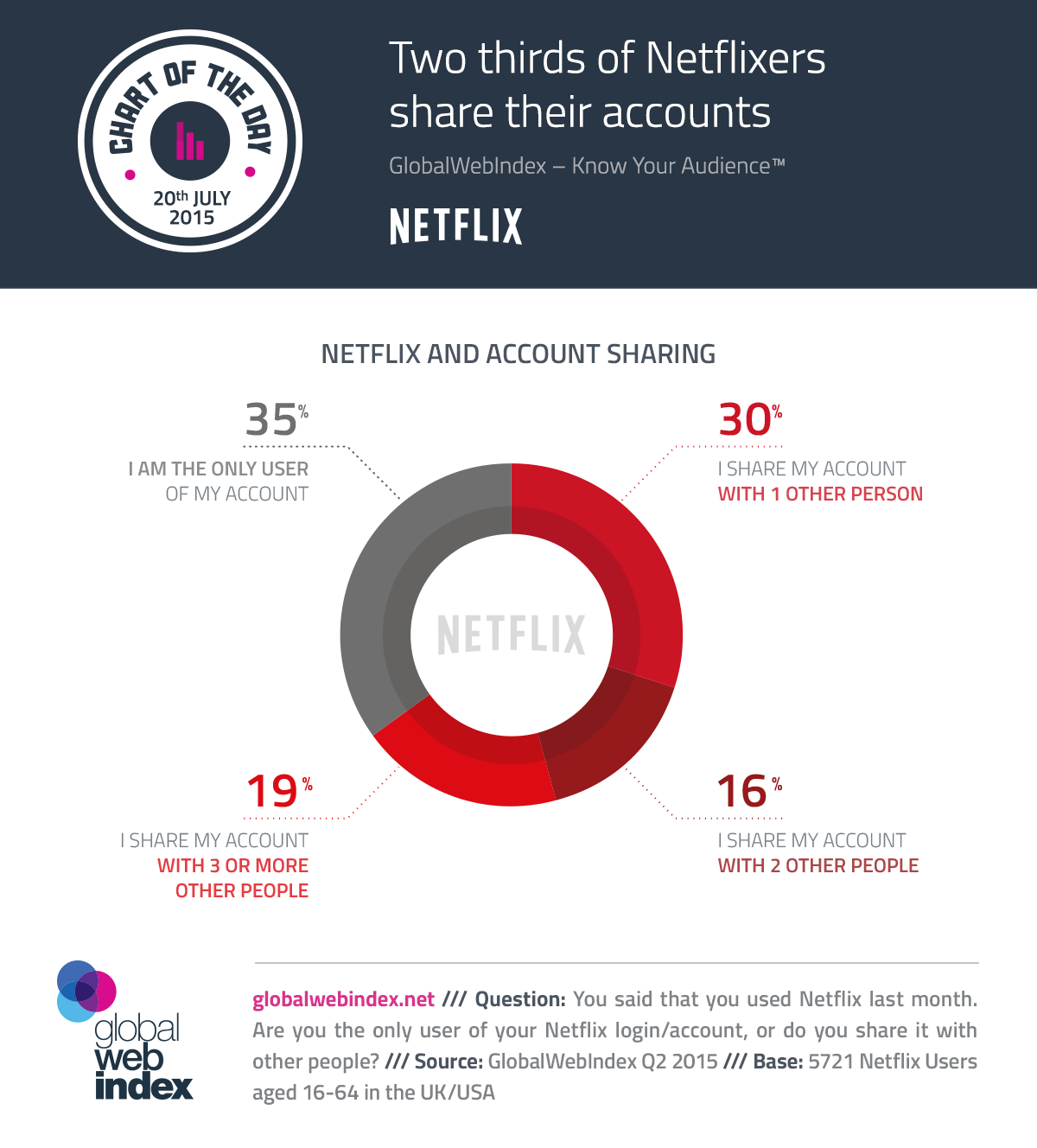
Jason Mander [pictured] reports to globalwebindex that ".. Reed Hastings also announced that Netflix was considering ways of making it harder for people to share passwords – which GWI’s data shows to be a widespread trend. In fact, our new Q2 2015 figures reveal that almost two thirds of users in the USA and UK are currently sharing their account.


What’s perhaps most significant here is that almost a fifth of Netflixers say that 3 or more other individuals use the same account as them. When we’re talking about total audience sizes, that means we need to abandon the notion that 1 paid-for subscription = just 1 user. In reality, there are tens of millions of additional users and the likelihood of people taking this approach will only get more common as Netflix gets more expensive". 


See "Two thirds of Netflixers share their accounts" - here.

Wednesday, July 22, 2015

AT&T Agreed to Prevent Discrimination Against Online Video Competition


More than a year after Netflix said it will discuss an agreement with AT&T, this seems to be no longer necessary (see "Netflix: First we take Comcast, then we take AT&T and Verizon; How Much it Costs?" - here).

Marguerite Reardon (pictured) reports to CNet that "To win regulatory approval for its $49 billion bid to buy satellite TV provider DirecTV, AT&T has agreed to stricter Net neutrality rules and a promise to expand its fiber-optic-based broadband network to more customers.

..Details of the conditions have not been released. But in a statement, Wheeler said that "the conditions will build on the Open Internet Order already in effect." Specifically, AT&T has agreed to prevent discrimination against online video competition by agreeing not to "exclude affiliated video services and content from data caps on its fixed broadband connections." In other words, if AT&T imposes a data cap, it's not allowed to exclude its own content from these caps while other services are counted in the cap.

To ensure that AT&T is not discriminating against other services like Netflix, which offer similar streaming video service over broadband networks, the company has agreed to submit to the FCC all "completed interconnection agreements." These agreements are commercial arrangements between companies that exchange Internet traffic. Netflix has complained publicly that other broadband providers, such as Comcast and Verizon, have forced it to pay fees to deliver its streaming video service to consumers. In the current Net neutrality order, the FCC for the first time said it would examine these deals on a case-by-case basis if complaints are filed"

See "AT&T agrees to stricter Net neutrality rules to get its DirecTV deal approved" - here.

Monday, July 6, 2015

iiNet [Australia]: Popularity Of Zero-rated Netflix Costs us too Much


Few months ago the title was "iiNet [Australia] Offers Zero Rated Netflix" [here]. Was that a good idea?

David Ramli reports to The Sydney Morning Herald that "iiNet chief executive David Buckingham [pictured] says the massive popularity of internet services like Netflix means current broadband plans will not be sustainable under the national broadband network unless the company building it drastically slashes prices .. Internet service providers like Singtel-Optus and iiNet are not charging customers for the data used by Netflix as both a marketing tool and a way to prevent bill shock for users.

But the service consumes a huge amount of data because it offers constant streaming of high-definition videos to several devices simultaneously – an issue some claim would make it unaffordable under the NBN's current pricing arrangements.


..The main complaint for telcos is a fee charged by NBN called the connectivity virtual circuit charge (CVC), which costs $17.50 per 1 megabit per second. iiNet chief technology officer Mark Dioguardi in April warned that users could be forced to pay a "Netflix tax" of $26 a month extra for moderate HD streaming, and $60 a month for the ability to watch occasional 4K streams". 
 
See "Netflix popularity requires NBN price rethink, says iiNet boss David Buckingham" - here.

Wednesday, June 17, 2015

AT&T CEO: It is Hard to Explain the SDN Concept; 10X Traffic Growth to 2020


Earlier this month I covered the intention of AT&T to use SDN ("AT&T Will Manage Data Demand w/Software-centric Approach" - here) - and it turns out it is the "most exciting thing happening now" for AT&T's CEO,  Randall Stephenson [pictured].

And it is all about Streaming Video, And Apple, And Netflix.

In an interview by Jonathan Vanian, to Fortune, Mr. Randel says:
  • "You’re going to find this horribly boring, but it’s this concept called software-defined networking. You’re managing a massive global network the way you’d manage a cloud-based data center. It’s a little geekish, and only the white-socks guys and knuckle-draggers in the industry appreciate it, but it’s actually going to change how businesses operate. It’s hard to help the general businessman understand this concept.
     
  • I’ll give you an example. This year’s Masters Golf Tournament came at an interesting moment in time. Over that weekend Apple released an iOS update to all of its users, the Masters was streaming over the Internet, and there was the debut of Game of Thrones. All of this was coming across the same peering point [where Internet networks connect] in our various networks, and the end customer had a miserable experience. In a software-defined network, we could have redistributed and managed that capacity in real time
     
  • If you look at our core network, since 2007 the volume that we’re hauling by virtue of smartphones and video is up 100,000%. And we’re looking out to 2020, and engineering and designing to accommodate another 10X growth in volume across the network. You’re seeing this kind of mismatch playing out that has tormented us. Capacity and performance are scaling according to Moore’s law, but networks around the globe are not
     
  • Without software-defined networking I don’t think the industry keeps up with these kinds of volumes. Without software-defined networking Netflix CEO Reed Hastings is going to continue to scream about how slow peering points are. You have to have this technology to accommodate video traversing these kinds of networks"
See "AT&T CEO: 'Half of our mobile network traffic is video'"- here.

Sunday, May 31, 2015

Sandvine: NA Internet is Concentrated Around 3 Content Providers

Mobile Vs. Fixed: While Ericsson that sees "Facebook and 4 Other Apps" (here) in mobile networks, Sandvine sees (in North America's Fixed networks) much higher usage stats for Netflix, and claims that the internet is used to serve Netflix, Google and Facebook.

In its "latest Global Internet Phenomena Report focusing on North America and Latin America. The report is based on data from a selection of Sandvine’s 250-plus communications service provider (CSP) customers" Sandvine finds that:

  • Netflix continues to slowly increase its domination of North American fixed networks, accounting for 36.5% of downstream traffic in the peak evening hours
     
  • In Latin American, two companies, Facebook and Google, now control over 60% of total mobile traffic in the region
  • BitTorrent continues to see a decline in fixed access bandwidth share, and now accounts for only 6.3% of total traffic in North America, and 8.5% in Latin America
     
  • Netflix’s recent decision to encrypt their service will result in the majority of Internet traffic in Latin America and North America being encrypted in 2016 (see "Sandvine: Netflix Brings us to the Encrypted Age" - here)
See "Sandvine: In The Americas, Netflix + Google + Facebook = The Internet?" - here.

Sunday, May 3, 2015

Sandvine: Netflix Brings us to the Encrypted Age


Sandvine released a new paper on encrypted Internet traffic. Based on data collected for a live, representative network in North America, the research findings and projections are:
  • Netflix’s recent decision to encrypt their traffic will result in over two-thirds of North American Internet traffic being encrypted in 2016
     
  • YouTube is the largest source of encrypted traffic in North America, and still a significant contributor of unencrypted traffic
     
  • Google Play traffic is encrypted, preventing the ability for third-parties to identify the apps, movies, and music being consumed by subscribers. Apple’s iTunes traffic remains unencrypted.
     
  • The simplicity of the Electronic Frontier Foundation’s “Let’s Encrypt” program, due to launch in mid-2015, will help drive encryption adoption among smaller sites


See "Sandvine: Two-Thirds Of North American Internet Traffic Will Be Encrypted In 2016" - here.

Wednesday, March 4, 2015

iiNet [Australia] Offers Zero Rated Netflix


While Net Neutrality is reborn in the US, and Zero-rated service plans gain traction in developing countries, iiNet has news to his customers in Australia: "Get Netflix quota-free on an iiNet Fixed Line Broadband or NBN Fibre plan" (here).

"Following confirmation from Netflix that it will launch locally on 24 March, iiNet’s broadband, Naked DSL, NBN and iiNet TV with Fetch customers (excludes all Satellite, NBN Wireless, Mobile Voice, Mobile Broadband and all Business customers) will have access to as much Netflix content as they like, without it counting against their monthly quota".
iiNet offers 100 GB to 1 TB DSL service plans for their "own netwrok" customers; "Both uploads and downloads count towards your monthly included data. There are no automatic excess usage charges on ADSL2+. Instead, traffic beyond the included data will be slowed to 256kbps/256kbps. You may purchase a Data Pack at an additional cost for a data top-up, if required". 

See "iiNet to flick on quota-free Netflix" - here.

Thursday, February 26, 2015

Ericsson: It's Always Facebook and 4 Other Apps


A new report from Ericsson finds:
  • Two-thirds of app data traffic over mobile networks comes from top five apps in each country studied, with video streaming and social networking dominating .. each nation displays its own unique preferences - for example, in December 2014, the US top three included Netflix and YouTube, while South Korea was notable for peer-to-peer TV app AfreecaTV and home-grown search portal NAVER.

    Facebook
    was the number one app in each country studied.

  • Total mobile video traffic of next six years will be around 17 times that of last six years
     
  • Q4 2014: LTE subscriptions achieved higher net additions, with 110 million, than WCDMA/HSPA for the first time.
      
  • FY 2014: 800 million smartphone subscriptions added worldwide taking the total number to 2.7 billion, up 40% from a total of 1.9 billion subscriptions in 2013


See "Mobile data traffic dominated by top five apps: Ericsson Mobility Report" - here.

Wednesday, February 4, 2015

Qwilt Goes to School: Saves 65% of Video Bandwidth and 96% of iOS Updates


Qwilt announced several deployments in college campuses that - ".. provides behind-the-scenes technology which fuels the new college lifestyle that now includes consuming copious amounts of online video such as educational streaming content, binge-able shows on Netflix and streaming Twitch tournaments. 

.. Jason Sebastiani, Principal Network Engineer at Grand Canyon University said: “.. After just one week of automatically learning what it could cache, we turned the Qwilt cache on and got immediate savings. Qwilt’s Open Cache solution currently serves close to 1GB per second of our streaming video peak traffic per day, which is about 65 percent of our total video bandwidth.”


Grand Canyon University (GCU) also benefitted from Qwilt’s solution when the bandwidth-heavy iOS 8.0 update came out. The Apple software update, which slowed traffic on networks nationwide, was considered a non-event for GCU because Qwilt cached it immediately and then delivered over 96 percent of the iOS updates from cache, allowing the average user to upgrade their Apple devices in minutes.

In addition to GCU, other schools that have deployed Qwilt’s Open Cache solution to date include: Lynn University, Western Kentucky University, University of Alaska and University of Hartford.


See "Qwilt Makes Online Video ‘Binge-able’ on College Campuses" - here.

Monday, January 5, 2015

Netflix to Geo-block VPN Users

 
ERNESTO reports to TorrentFreak that "Netflix is starting to block subscribers who access its service using VPN services and other tools that bypass geolocation restrictions. The changes, which may also affect legitimate users, have been requested by the movie studios who want full control over what people can see in their respective countries 

.. Over the past weeks Netflix has started to take action against people who use certain circumvention tools. The Android application started to force Google DNS which now makes it harder to use DNS based location unblockers, and several VPN IP-ranges were targeted as well .. Thus far the actions are limited in scope, so not all VPN users may experience problems just yet. However, TorGuard is one of the VPN providers which noticed a surge in access problems by its users, starting mid-December.

..Netflix is not the only streaming service that’s targeting VPN and proxy users. A few months ago Hulu implemented similar restrictions. This made the site unusable for location “pirates,” but also U.S. based paying customers who used a VPN for privacy reasons".

See "Netflix cracks down on VPN and proxy pirates" - here.

Sunday, December 14, 2014

Netflix to the FCC: "Open Connect is not a fast lane"


Earlier this month, FCC Commissioner, Ajit Pai [pictured], sent a letter (here) to Netflix CEO, Reed Hastings, saying that Netflix "..has been working to effectively secure "fast Lames" for its own content on ISPs' networks at the expense of its competitors".

The claim refers to Netflix' CDN service, Open Connect (see "How does Netflix Manage Video Delivery?" - here) and may have to do with the statistics Netflix itself published on ISPs' performance (See "Netflix CDN Customers have More Fun" - here).

A similar claim has been raised in the past against BT and its Wholesale caching features (see "BT's Wholesale Content Connect Service and Net Neutrality" - here).

ChristopherLibertelli, VP Global Public Policy, responded in a letter to the Mr. Pai: "Netflix designed the Open Connect content delivery network (CDN) to provide consumers with a high quality video experience that enables ISPs to manage their networks in an efficient and cost effective way. Through Open Connect, Netflix brings data to the location(s) of an ISP’s choice, usually at common Internet exchange points or through localized caches. This is how most CDNs interconnect. Under the Open Connect program, Netflix bears all of the costs of providing Open Connect equipment to any ISP that chooses to participate in Open Connect.

Neflix Open Connect
hardware (here)
Open Connect is not a fast lane.  Since the beginning of this proceeding, Netflix has consistently opposed the Commission permitting ‘fast lanes” in consumer Internet connections.  Open Connect does not prioritize Netflix data. Open Connect uses “best efforts” Internet services into and out of its content  caches. When an ISP asks Netflix to localize an Open Connect cache within its network, it does not  disadvantage other Internet content. To the contrary, Open Connect helps ISPs reduce costs and better manage congestion, which results in a better Internet experience for all end users"

Only ISPs can speed up or slow down data that flow over their last mile. When Netflix directly
interconnects with an ISP, Netflix data does not travel faster than other Internet content VV unless an ISP is artificially constraining capacity to other data sources".


Monday, December 1, 2014

Aterlo's CEO: "The idea is to charge a monthly subscription fee"


Following my post on Aterlo Networks  ("Ex-Sandvine Team NightShifts Netflix for Satellite Subscribers" - here) earlier this week, I had a short Q&A session with Gerrit Nagelhout, Atelo's CEO [pictured]. The first thing I learned is that Gerrit spent several years at Sandvine's R&D center in Israel (here), but more-importantly - much more on Aterlo's plans.

Gerrit started with the observations led to the starting Aterlo: 

When we left Sandvine, we set out to solve the problem of peak congestion caused by streaming media in the access network. We felt this was a space that didn't have enough focus yet. This is an issue for any network, but in particular the rural ISPs (satellite , fixed wireless and some DSL) are struggling to deliver a good Streaming Video experience. Being a startup we had to focus and choose one area so we started out with Netflix

Q: I understand that Aterlo targets service providers (here) as a market, rather than the consumers.

A: With our Sandvine background, we originally fully intended to sell directly to service providers. Although we are in talks with a number of them now, we actually started with the end consumers. As you probably know, selling to service providers can take time. We were looking for a way to bring our first version of the product to market as fast as possible in order to gauge interest and get valuable product feedback. We figured that from there we would see what would happen. Either continue to sell to end consumers and/or attract the attention of service providers and start working directly with them. In some cases it would even make sense to integrate our technology with their existing home gateways.

On the consumer front, many satellite internet providers structure their plans to have either unlimited/free or additional bytes available at night. These people typically can't use Netflix at all (or if they do only at very low quality levels and in great moderation). This was a perfect starting point for NightShift. We posted on a couple of ISP forums and got our first batch of beta customers this way. Somebody with free nights can now basically watch an unlimited amount of Netflix, while not causing the ISP any congestion issues as its all downloaded off peak. Actually it makes it better for the ISP even in this case for those that did use some Netflix during the peak already.

Q: What is the business model?
   
A; In terms of the end consumer business model, the idea is to charge a monthly subscription fee (something less than Netflix itself). NightShift currently supports various ASUS routers (pretty much anything running asuswrt with a USB port). We expect to expand upon this in the future. Part of our software runs on the router, and part of it in our cloud service (hence the monthly subscription). For now, consumers buy an ASUS router and a USB Flash Drive (typically 64GB), download our software onto the Flash drive, put it into the router and it automatically installs from there.

Q: What are the other benefits to the carrier?

A: At this point, NightShift is in beta and deployed at end consumers of a number of different service providers. We are now also in talks directly with a number of carriers. The benefits to the carriers are
  • Reduction in peak bandwidth leading the less congestion and/or ability to add more subscribers to typically constrained capacity networks such as satellite
     
  • Reduced churn in subscribers (or even additional subscribers)
     
  • Potential value add packages they can sell to their subscribers while using off-peak bandwidth that is already available. 

Q: How do you select the content to cache? 

A: There are a couple of different models for selecting the content. NightShift automatically downloads subsequent episodes in TV shows when one episode is watched. This doesn't require any consumer interaction and is a great to way to automatically offload peak bandwidth. About 70% of Netflix is in the form of TV shows. 

For those consumers that want to download all Netflix at night (we are getting this a lot right now), we have provided a mechanism to schedule movies. That is currently done by watching the first few seconds of the movie from their Netflix player in order to provide a hint to NightShift. We are looking at other options for this in the future.


We do not break the Netflix DRM, you need an active Netflix subscription and internet connection to be able to use NightShift. NightShift stores the content in the same encrypted way that a network level cache would.  Because of this we think this is a good thing for content providers such as Netfix also as it will result in additional subscribers and improved QoS for them.

Sunday, November 23, 2014

Ex-Sandvine Team NightShifts Netflix for Satellite Subscribers


A recent study from Sandvine (here) finds that "Netflix continues to dominate North American networks, accounting for 34.9% of downstream traffic in the peak evening hours" and even "On a fixed network in Australasia, where Netflix isn’t even available yet, approximately 2.5% of subscribers are accessing the service and it comprises as much as 4% of peak downstream traffic".

So everybody loves Netflix, but not all enjoy the internet connectivity allowing them to stream the movies and TV episodes with the expected QoE.

Aterlo Networks, a new start-up, led by ex-Sandvine employees ("Before starting Aterlo Networks Inc, our team worked together for years defining, building, architecting and managing mission-critical products which were deployed in some of the largest Internet Service Providers in the world" - here) changes that by adding a "local cache" to the home router. 

"NightShift runs on your compatible home router with a connected USB flash drive. It seamlessly works with existing Netflix players. It analyzes your viewing patterns and predicts content to automatically download at night. Once a TV show or movie is downloaded, you can watch it from any Netflix player in your home the same way you always do. NightShift creates a temporary local copy of video content. It does not break or bypass DRM, and an Internet connection is still required".

Of course, with the presence of the software at the subscriber's access point, a lot more can be achieved, including QoE measurements, and other features to the ISP (Aterlo positions itself as a service provider solution (here). A sure challenge would be the distribution of the software to the mass market.

An example is the satellite broadband service - "These subscribers have very limited day-time plans (15 – 25GB / month). They typically have either unlimited nights or additional usage that can only be used at night". Aterlo beta test (at Exede) showed that "In a typical night, and depending on Satellite Beam congestion, NightShift has been able to download up to 15GB of Netflix ready to watch the next day. Depending on playback quality settings, this equates to up to 5 hours of High Definition or over 20 hours of Standard Definition content". 


Friday, October 17, 2014

Cache Deployments [323]: ViewQwest [Singapore] Use Qwilt to Improve QoE on Fiber


Qwilt announced that "ViewQwest, Singapore’s premium fiber broadband operator, has deployed the Qwilt Video Fabric Solution to deliver improved quality of experience (QoE) to ViewQwest’s customers ..  

When fiber broadband was introduced to consumers and businesses in Singapore, ViewQwest took full advantage by launching Fibernet, a superior service for popular online game streaming applications like Twitch, and online video streaming sites such as Netflix and YouTube".

Vignesa Moorthy [pictured], CEO, ViewQwest said: “Our Fibernet service was designed to eliminate antiquated practices such as severe caps on international bandwidth, traffic shaping, port blocking and throttling of downloads and torrents. We needed an innovative approach to caching that doesn’t sacrifice quality of experience or performance of our service offerings,.. We also saw an immediate improvement in network optimization and are very impressed with the QoE we are now able to offer our customers”.

Alon Maor, CEO, Qwilt said: "We are honored to provide a solution that can reduce the amount of OTT video traffic by up to 80 percent and offer a higher QoE across all major content provider sites.”

See "Qwilt’s Plug-and-Play QB-Series Video Fabric Controller Deployed by ViewQwest" - here.

Saturday, August 9, 2014

Netflix Prevents DPI-based Rating Measurements


Peter Kafka [pictured] reports to re/code that "Netflix doesn't want anyone to know how many people watch its original shows, like “House of Cards” and “Orange Is the New Black .. But until a few months ago, at least one company had a pretty good idea — and shared it publicly. Now Netflix has plugged that leak.

Procera Networks .. says it was able [see "Procera: Netflix' House of Cards Stats; Need 27GB to See it All" - here and chart below] to track individual shows Netflix users streamed on multiple Internet networks for several days at a time .. [Procera] couldn’t provide overall viewership numbers for Netflix’s shows, but could at least provide directional information, by showing how they performed on several of its client’s networks. 

Procera anlytics for a US MSO network, on "House of Cards" Season 2
Release day, Feb 14, 2014,  

..[Netflix] appears to have tacitly acknowledged that Procera’s data was accurate, because it has taken steps to cut Procera off .. That happened in late spring, when Netflix began anonymizing its files. You can see evidence of Netflix’s plans via release notes the company sent to broadband providers that work with the company’s Open Connect data network [see "Netflix CDN Customers have More Fun" - here]; Netflix told partners that new software would “further protect content and utilization information,” and “may minimize the accuracy of devices that perform DPI or traffic reporting ..Netflix declined to comment".

See "How One Company Figured Out How Many People Watch Netflix’s New Shows — And How Netflix Stopped Them" - here.